Format: Short Film / Anthology Episode | Est. Length: 10-12 minutes
Imagine a series set in a world gripped by an eternal winter, where humanity clings to survival in vast, frozen cities. Each episode of this anthology series delves into the personal struggles of individuals navigating this harsh reality, exploring themes of resilience, desperation, and the enduring human spirit against a backdrop of societal decay and authoritarian control. This particular episode introduces the audience to the brutal everyday existence within the Frost, hinting at the larger forces at play and the profound cost of hope in a world designed to crush it.
A young, starving boy named Lonnie struggles to open a frozen drawer, his hunger a sharp counterpoint to the absence of his missing older brother, Jay. His desperate search for food leads him to discover a tiny, intricately carved ice bird, a potential message from his vanished sibling.
In a perpetually frozen, dystopian city, a desperate boy follows a trail of cryptic ice carvings left by his missing brother, clinging to the hope of reunion. He must navigate the city's treacherous underbelly, only to discover a devastating betrayal orchestrated by those he trusted.
The central themes revolve around false hope, the brutal cost of survival, and the profound impact of betrayal. Lonnie's journey is a poignant exploration of how desperation can blind individuals to obvious dangers, making them vulnerable to manipulation in the pursuit of a cherished belief. It also delves into the nature of sibling bonds, portraying how love and longing can become both a driving force and a fatal weakness in a merciless world.
The narrative also touches upon the loss of innocence and the harsh realities of a dystopian society where trust is a luxury few can afford. The beauty and fragility of the ice carvings symbolize the fleeting nature of hope itself, melting away to reveal a stark and painful truth. This story serves as a stark reminder that in a world stripped bare, even the most profound human connections can be exploited.
For Lonnie, the stakes are existential: finding his brother Jay represents not just reunion, but survival, warmth, and the restoration of his fractured world. Without Jay, Lonnie faces starvation and the crushing loneliness of a brutal city. The ultimate stake is Lonnie's very life and freedom, as his quest to find Jay is revealed to be a trap set by the Warden's Enforcers, leading directly to his capture and an uncertain, grim future.
The primary external conflicts are Lonnie's struggle against the relentless cold and hunger, and the pervasive danger of the Glimmer Trenches, a lawless area of the city. The most direct antagonistic forces are Jesse, the manipulative scavenger who betrays Lonnie, and the Warden's Enforcers, who represent the oppressive authority of the city. Internally, Lonnie battles despair and loneliness, clinging to the fragile hope of Jay's survival, which ultimately makes him vulnerable to Jesse's deception.
Lonnie, a young boy struggling with hunger and the absence of his older brother Jay, discovers a small, intricately carved ice bird in their shared bunk. Believing it to be a coded message from Jay, a skilled carver, Lonnie ventures out into the frozen, dystopian city, following a trail of similar ice carvings—a fish, a star—which he interprets as a map to Jay's whereabouts. His journey takes him into the dangerous Glimmer Trenches, a lawless district where scavengers and outcasts reside.
In the Trenches, Lonnie encounters Jesse, a cunning and starved man who claims to know Jay and understand the "code." Jesse manipulates Lonnie into trading his last two ration bars for guidance, fueling Lonnie's desperate hope. Jesse leads Lonnie to a derelict factory, where a large ice key hangs as the supposed final clue. However, the factory is a trap; the door slams shut, and Enforcers emerge from the shadows. Jesse reveals his betrayal, admitting he created the final ice carving and sold Jay, and now Lonnie, to the Warden, shattering Lonnie's hope as he is captured.
Lonnie: (Psychological Arc: Desperate and naive, clinging to the memory and hope of his brother, Lonnie transforms into a shattered, betrayed, and captured victim, his innocence irrevocably lost.) He is a skinny, resilient boy whose love for his brother is his greatest strength and ultimate vulnerability.
Jesse: (Psychological Arc: Appearing as a cunning but helpful scavenger driven by hunger, Jesse is revealed as a cold, calculating, and opportunistic betrayer, devoid of empathy.) He is a gaunt, rat-eyed man whose survival instincts override any moral compass.
Jay (Off-screen): Lonnie's older brother, a skilled fixer and carver. He represents hope, ingenuity, and a lost sense of security for Lonnie, though his fate is sealed by Jesse's betrayal.
Enforcers: Tall, uniformed agents of the Warden, representing the oppressive and violent authority of the city.
Lonnie, starving and alone, struggles with a frozen drawer in his bunk, longing for his missing brother, Jay, until he discovers a small, perfectly carved ice bird, igniting a fragile spark of hope. He ventures into the desolate, frozen city, following a trail of increasingly complex ice carvings—a fish, a star—each discovery deepening his conviction that Jay is alive and leaving him clues. Lonnie’s journey leads him into the dangerous Glimmer Trenches, where he encounters Jesse, a manipulative scavenger who claims to know Jay and the "code," extracting Lonnie's last rations in exchange for guidance.
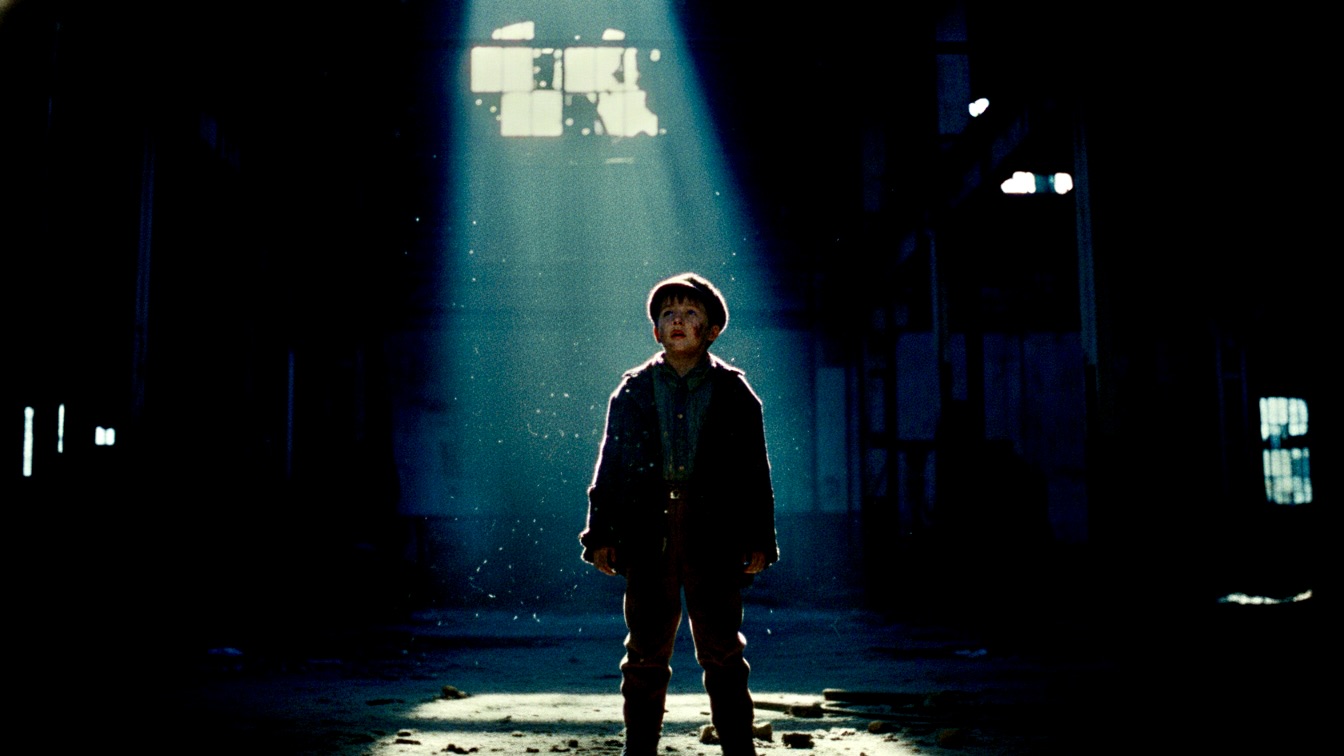
Jesse leads Lonnie to a massive, derelict factory, pointing to a large ice key hanging high above as the final clue to Jay's safehouse. As Lonnie stares up, filled with overwhelming hope, the factory door slams shut, and Enforcers emerge from the shadows. Jesse reveals his betrayal, admitting he manufactured the clues and sold both Jay and Lonnie to the Warden, shattering Lonnie's world as the Enforcers advance. Lonnie is left utterly devastated, his hope extinguished, as the Enforcers close in, the once-precious ice bird now a cold, wet spot in his pocket.
The episode begins with a pervasive sense of bleakness and desperation, quickly shifting to a fragile, almost desperate hope upon the discovery of the ice bird. This hope builds steadily as Lonnie follows the clues, reaching a peak of eager anticipation and relief when Jesse offers guidance. The mood then abruptly plummets into crushing despair, shock, and profound betrayal during the climax, leaving the audience with a stark, chilling sense of hopelessness and the brutal reality of the world.
This episode serves as a powerful introduction to the series' core themes of survival, resistance, and the search for truth in a broken world. Lonnie's capture could kickstart a season-long arc where he must navigate the Warden's oppressive system, perhaps in a labor camp or prison, forcing him to adapt and find new forms of resilience. His journey could evolve into one of awakening, where he sheds his naivete and becomes a reluctant participant in a larger resistance movement against the Warden, driven by the memory of Jay and the injustice of his betrayal.
Future episodes could explore the wider network of individuals like Jay who are targeted by the Warden, revealing the true nature of their "crimes" and the Warden's motives. Lonnie might encounter other survivors or prisoners who were similarly betrayed, forming alliances and uncovering deeper layers of corruption and control within the Frost. The overarching story could build towards Lonnie's eventual escape and his quest to expose the Warden, embodying the enduring fight for freedom and humanity in a frozen world.
The visual style should be stark, desaturated, and grimy, emphasizing the oppressive cold and decay of the dystopian setting. A palette dominated by grays, whites, and muted blues would evoke the perpetual winter, with minimal pops of color reserved for moments of fleeting hope or stark danger. Cinematography would utilize wide shots to convey Lonnie's isolation in the vast, crumbling city, contrasting with tight close-ups on his face to capture his internal emotional turmoil and the intricate details of the ice carvings.
The tone is one of grim realism, suspense, and ultimately, tragedy. Influences could include the desolate beauty of The Road, the claustrophobic survivalism of Snowpiercer, and the stark, character-driven drama of Children of Men. The visual language should oscillate between the mundane struggle for survival and the brief, almost magical glimmer of the ice sculptures, making their eventual symbolic melting all the more poignant.
The target audience is young adults and adults who appreciate dystopian science fiction, survival thrillers, and character-driven dramas. Viewers who enjoy stories exploring themes of hope, betrayal, and resilience in harsh environments will be drawn to this narrative. It is suitable for streaming platforms or anthology series that cater to a audience interested in thought-provoking, emotionally resonant speculative fiction.
The pacing begins slowly, establishing Lonnie's desperate circumstances and building tension as he embarks on his search. The middle section, involving the discovery of clues and the encounter with Jesse, maintains a steady, suspenseful rhythm, punctuated by moments of rising hope. The final act accelerates rapidly, culminating in a swift, brutal climax and a devastating resolution, maximizing the emotional impact of the betrayal and capture within the compact runtime.
Practical effects for the ice carvings are crucial to convey their intricate beauty and fragility, perhaps using real ice or realistic resin props that can be subtly "melted" on screen. Sound design will be paramount in creating the immersive atmosphere of the Frost: the crunch of boots on ice, the howl of wind, the creaking of frozen structures, and the hollow echo of Lonnie's voice in the factory. These elements will enhance the sense of isolation and danger without relying heavily on dialogue.
The factory setting offers opportunities for striking visual compositions, utilizing the vast, derelict space and the interplay of dim light and deep shadows to heighten suspense. Minimal CGI might be used for subtle environmental enhancements, such as breath in the cold or distant cityscapes, but the focus should remain on grounded, tangible realism. The performances, particularly Lonnie's emotional arc, will be central, requiring a young actor capable of conveying profound vulnerability and despair.