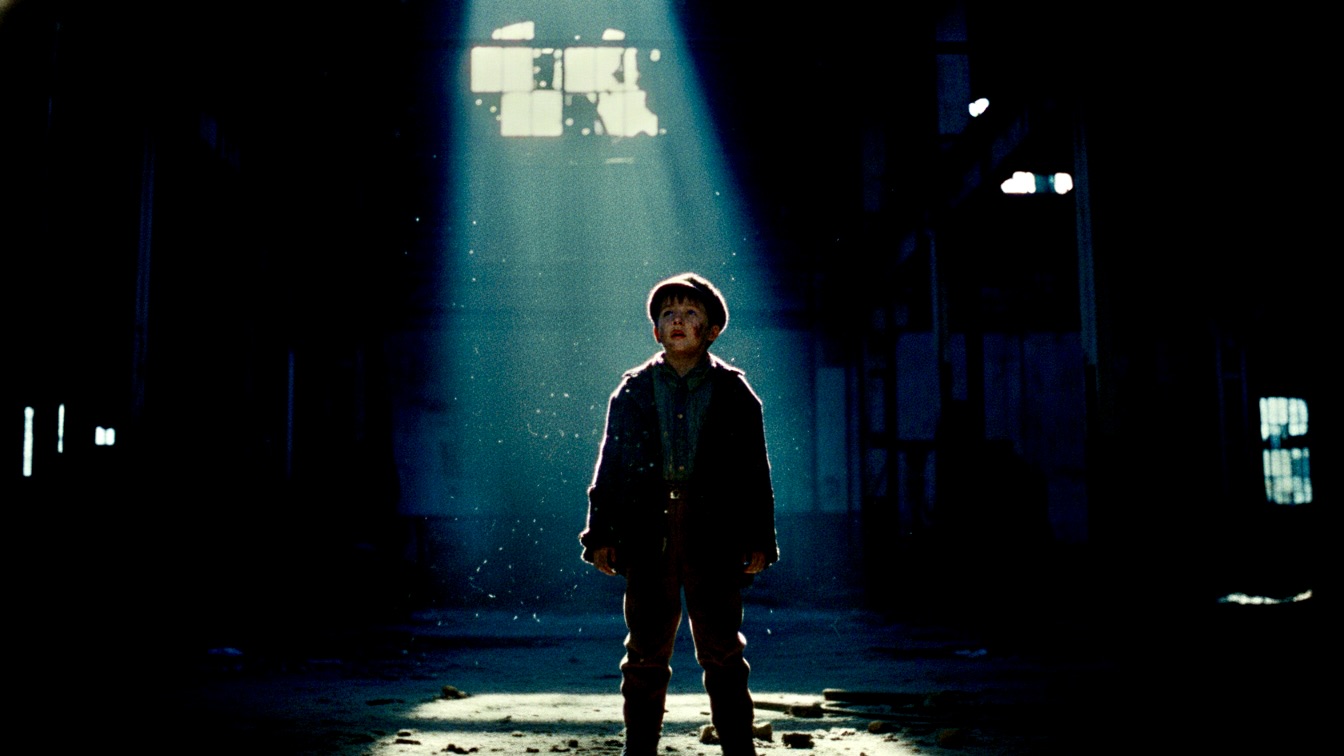
The chapter introduces Lonnie, a young male enduring a harsh, frozen world and the recent disappearance of his beloved older brother, Jay. Driven by gnawing hunger and a desperate need for connection, Lonnie discovers a series of intricate ice carvings – a bird, a fish, a star, and a moon – which he believes are a coded message from Jay, leading him to a safe haven. Venturing into the dangerous Glimmer Trenches to follow these clues, Lonnie encounters Jesse, a seemingly knowledgeable scavenger who offers to guide him for a steep price. Lonnie sacrifices his precious rations, clinging to the hope of reuniting with Jay and escaping his bleak existence. However, Jesse leads Lonnie into a brutal trap within a derelict factory, revealing himself as a betrayer who sold Jay to the Enforcers and orchestrated the entire "code" to lure Lonnie for a further reward, leaving Lonnie to face the menacing Enforcers alone.
The narrative deeply explores the theme of hope and despair in a dystopian setting. Lonnie's entire journey is fueled by a desperate, almost childlike hope that his brother is alive and has left him a path to safety. The ice carvings symbolize this fragile hope, a tangible connection to a lost loved one amidst overwhelming desolation. The ultimate shattering of this hope, revealed as a cruel manipulation, plunges Lonnie into an absolute despair that underscores the brutal reality of his world.
Another prominent theme is survival and morality, highlighting the extreme measures individuals resort to in a struggle for existence. Lonnie's willingness to sacrifice his last two ration bars for the hope of finding Jay demonstrates a profound prioritization of familial connection over immediate physical sustenance. In stark contrast, Jesse embodies a brutal, amoral pragmatism, where loyalty and compassion are utterly sacrificed for personal gain, even if it means betraying a former acquaintance and ensnaring a vulnerable child. This dichotomy showcases the different ways characters navigate a world devoid of resources and safety.
The story masterfully employs deception and betrayal as its central conflict. Jesse's elaborate construction of the "ice code" is a calculated act of manipulation, preying on Lonnie's deepest desires and vulnerabilities. The betrayal is not merely an act of physical harm but a profound psychological wound, shattering Lonnie's belief in his brother's protective presence and the very idea of a safe haven. This insidious treachery underscores the pervasive danger of human malevolence in a world where trust is a fatal weakness.
Furthermore, the chapter delves into loss and grief, particularly Lonnie's unresolved sorrow over Jay's disappearance. Lonnie's constant memory of Jay, his "smoky, metallic scent," and his skills as a "fixer" illustrate the profound impact of this absence. The search for the ice carvings is Lonnie's way of coping with grief, transforming it into a quest for meaning and reunion. The final revelation about Jay's fate and Jesse's role intensifies Lonnie's grief, transforming it into a crushing realization of absolute loss and the cruel finality of his brother's demise.
Finally, the narrative contrasts childhood innocence with harsh reality. Lonnie, despite his struggles, retains a profound capacity for hope and belief in his brother's goodness, making him susceptible to Jesse's lies. His "puffing out his chest" when claiming intelligence reveals a youthful desire for validation and connection. The story brutally portrays how a dystopian environment can crush such innocence, forcing a devastating awakening to the world's inherent cruelty and the ease with which one's vulnerabilities can be exploited.
Lonnie is portrayed as a vulnerable yet remarkably resilient young male, navigating a world defined by extreme cold, pervasive hunger, and profound loss. His core motivation stems from an intense, almost primal, love for his older brother, Jay, and a desperate hope for his return. This deep emotional attachment drives him to overlook immediate physical needs, such as his last rations, in favor of pursuing the perceived clues to Jay's whereabouts. Lonnie exhibits a youthful naivete, clinging to the idealized image of Jay as a clever protector who would never abandon him without a sign.
Psychologically, Lonnie is in a state of prolonged grief and denial, unable to fully accept Jay's absence and thus projecting his longing onto the "coded" ice carvings. His emotional state fluctuates wildly, moving from the persistent ache of hunger and fear to a burgeoning, almost euphoric hope, which then shatters into absolute despair. This journey highlights his internal conflict between the instinct for self-preservation and the profound need for connection. His vulnerability to Jesse's manipulation underscores the deep psychological impact of loss and the human desire for a perceived safe haven, even at great personal cost.
Though physically absent from the narrative, Jay is a powerful, idealized figure in Lonnie's memory, representing warmth, competence, and protection. Lonnie consistently recalls him as a "fixer," a "builder," and the "cleverest person" he knew, someone capable of crafting beauty from scraps. This cherished image of Jay provides Lonnie with both comfort and motivation, symbolizing a lost sense of security and a better, more stable past. Jay's perceived cleverness and his past acts of kindness, such as carving wooden animals, are precisely the traits Jesse exploits to construct his elaborate deception.
Psychologically, Jay functions as Lonnie's primary attachment figure, whose unexplained disappearance destabilizes Lonnie's entire world. The belief that Jay would "leave a sign" speaks to Lonnie's deep understanding of his brother's character and the strength of their bond. The tragic irony lies in the fact that Jay's actual cleverness in "disappearing" from the Enforcers ultimately made him a target, and his memory was then weaponized to ensnare his innocent brother. Jay's role in the story is primarily as a catalyst for Lonnie's perilous journey and a poignant symbol of what has been irrevocably lost.
Jesse emerges as a cunning and utterly ruthless antagonist, embodying the moral decay and desperate pragmatism prevalent in the dystopian setting. Initially presenting himself as a cynical but knowledgeable scavenger, he quickly reveals a predatory nature, exploiting Lonnie's emotional vulnerability and physical hunger without any discernible remorse. His casual admission of betraying Jay and orchestrating Lonnie's capture highlights a profound lack of empathy and a chilling willingness to commit heinous acts for personal gain. His shift in voice from "raspy" to "clear and cold" perfectly mirrors his transformation from perceived guide to calculating betrayer.
Psychologically, Jesse operates on a purely transactional basis, viewing human connection, trust, and even life itself as commodities to be bartered for survival or profit. His "rat-like" quickness and "thin smile" that fails to reach his eyes suggest a calculating, reptilian coldness and an absence of genuine human emotion. He is a survivor hardened by his environment, but one who has chosen a path of active malevolence rather than passive endurance. Jesse's actions serve as a stark warning about the dangers of false hope and the depths of human depravity that can emerge in extreme circumstances.
The narrative is presented through a first-person perspective, immersing the reader directly into Lonnie's immediate and visceral experience of the harsh, frozen world. This intimate viewpoint intensely amplifies the emotional impact of the story, particularly the crushing betrayal Lonnie endures at the climax. The language employed is stark and evocative, perfectly mirroring the desolate environment with phrases such as "hollow ache that the cold made sharp as a knife" and "wind that scraped like steel wool," which paint a vivid picture of pervasive desolation and discomfort.
The pacing in the chapter is masterfully controlled, beginning with a slow, desperate struggle against a stuck drawer that sets a tone of struggle and longing. It then builds tension steadily as Lonnie follows the increasingly mysterious clues, accelerating into a frantic search driven by burgeoning hope. The dialogue is sparse but highly effective, especially Jesse's manipulative lines, which gradually peel back his deceptive facade. Sensory details are crucial throughout, ranging from the remembered "smoky, metallic scent" of Jay to the "creak and groan of ice-heavy buildings" and the ubiquitous "flat gray light," all contributing to a pervasive atmosphere of cold, decay, and imminent danger.
The tone shifts dramatically over the course of the chapter, reflecting Lonnie's psychological journey. It commences with a sense of melancholic longing and quiet desperation, subtly transitions into cautious hope and growing determination as Lonnie follows the "code," and culminates in a shocking, brutal despair. The narrative skillfully employs subtle foreshadowing, such as Jesse's "rat-like" eyes and his "thin smile" that never quite reaches them, hinting at his true, sinister nature. The narrative voice, Lonnie's own, conveys a profound youthful innocence and vulnerability that makes the final betrayal particularly devastating, emphasizing the loss of both a brother and a fragile sense of security.