Melgund Township Winter Story Library
A Preliminary Report on Restorative Justice - Treatment
by Jamie F. Bell | Treatment
by Jamie F. Bell | Treatment
Format: Short Film / Anthology Episode | Est. Length: 10-12 minutes
Imagine a series, The Sidebar, where each episode follows a journalist on the fringes—disgraced, suspended, or just plain hungry—who stumbles upon a seemingly minor local story that spirals into a high-stakes world of crime, conspiracy, and moral compromise. "A Preliminary Report on Restorative Justice" serves as a quintessential episode, establishing the series' core theme: the perilous space between reporting the truth and becoming a part of it. The overarching narrative arc of the series would see protagonists forced to confront their own ethics when the story they're chasing turns on them, blurring the line between observer and participant.
Exiled to a remote Quebec town during a paralyzing blizzard, a disgraced journalism student discovers a police report detailing a seemingly absurd accusation: an old man claims the mayor stole his family's secret maple syrup recipe. This trivial, quirky lead is the only thing standing between her and complete professional ruin.
A disgraced journalism student, desperate for redemption, agrees to help a charismatic old man commit a heist to reclaim his stolen family legacy. But when they break into the target's house, they discover they've stumbled into the middle of a murder scene and are now trapped by a blizzard with no way out.
This episode is a rural noir thriller that explores the chasm between legal justice and restorative justice. It questions the objectivity of journalism, suggesting that true understanding sometimes requires crossing ethical lines. The central theme is the slippery slope of ambition; Carrie's desire to redeem her career leads her down a path of escalating criminality, where a "human interest story" becomes a felony, and then a potential murder charge. The story blends the dark, folksy humor of a small-town feud with the sudden, brutal gravity of a homicide, creating a tense atmosphere where morality is a luxury no one can afford.
Beneath the crime narrative lies an exploration of legacy and identity. For André Dubois, the recipe is not just a recipe; it is his family's soul, his history, and his life's work. His fight is a primal one against erasure by a corrupt, powerful figure. This personal, deeply felt motivation provides the emotional core of the story, making the characters' illegal actions feel, at times, like a righteous crusade against a world run by bullies and thieves.
The initial stakes for protagonist Carrie are professional: redeem herself in the eyes of her professor and salvage her journalism career after a major ethical breach. For her cameraman Ben, the stakes are freedom from being tethered to Carrie's disgrace. These stakes escalate dramatically when they agree to the heist, risking their freedom and facing felony charges. The ultimate stakes are life and death; upon discovering the mayor's body, they are no longer just burglars but the prime suspects in a homicide investigation, trapped in a locked-down town with no alibi and incriminating evidence in their hands.
The primary external conflict is initially with Mayor Tremblay, a corrupt and arrogant figure who represents the systemic injustice that has pushed André Dubois to his breaking point. This conflict is amplified by the physical environment—a relentless, isolating blizzard that acts as both a cover for their crime and a cage that traps them. The ultimate antagonistic force becomes the law itself, embodied by the unseen police force that is closing in on them. Internally, Carrie battles her own reckless ambition against the remnants of her journalistic ethics, while Ben struggles between his loyalty to Carrie and his own instinct for self-preservation.
Disgraced journalism student Carrie and her reluctant cameraman Ben are exiled to the remote Quebec town of Sainte-Céleste during a fierce blizzard, assigned a meaningless puff piece on an ice festival. Desperate for a real story, Carrie uncovers a police report about an old man, André Dubois, who accuses the town's mayor, Réjean Tremblay, of stealing his family's priceless maple syrup recipe. Intrigued, they visit Dubois, expecting a delusional eccentric but instead finding a sharp, meticulous man who has spent four years plotting his revenge.
Dubois reveals a detailed plan to break into the mayor's mansion during the festival's grand parade, steal back his recipe journal, and take a "consulting fee" from the mayor's hidden safe. Seeing this as the story of a lifetime—and a chance at a huge payday—Carrie and Ben agree to help, becoming active participants in the crime. Under the cover of the storm, they successfully bypass the security system, break into the house, and open the safe, only to hear a stray police radio transmission that shatters their triumph: Mayor Tremblay has been found murdered inside the house, and the blizzard has closed every road, trapping them at the center of a homicide investigation.
Carrie: A sharp, ambitious, and recently disgraced journalism student. She begins the story cynical and desperate, viewing the world through the lens of potential headlines. Her psychological arc is a rapid descent from detached observer to committed criminal, driven by the seductive thrill of a "real story" and a warped sense of justice; she ends the story in a state of pure, claustrophobic terror, stripped of her journalistic identity and facing a life sentence.
Ben: Carrie's cameraman and the collateral damage of her previous scandal. He starts as the weary, grounded conscience of the duo, deeply resentful but pragmatically loyal. His arc sees him reluctantly drawn into the heist, where his technical mind and hidden resourcefulness make him an unexpectedly competent accomplice, but he ends trapped and horrified, his worst fears about Carrie's recklessness realized in the most catastrophic way possible.
André 'Andy' Dubois: A 78-year-old maple syrup artisan. Initially presented as a potentially senile victim, he is quickly revealed to be the story's brilliant, morally gray mastermind. He is driven by a cold, four-year-old rage and a profound belief in "restorative justice," operating with the chilling logic of a man who has nothing left to lose. He is the catalyst for the entire plot, a charismatic and dangerous mentor figure whose true role in the night's events remains menacingly ambiguous.
The Report (Setup): In a dreary motel room battered by a blizzard, disgraced journalist Carrie discovers a dismissed police report about a stolen maple syrup recipe, a thread of genuine intrigue in her exile.
The Proposition (Inciting Incident): Carrie and Ben meet the complainant, André Dubois, who is not a rambling old man but a sharp, calculating strategist who unveils a detailed blueprint to burgle the corrupt mayor's house and recruits them for the job.
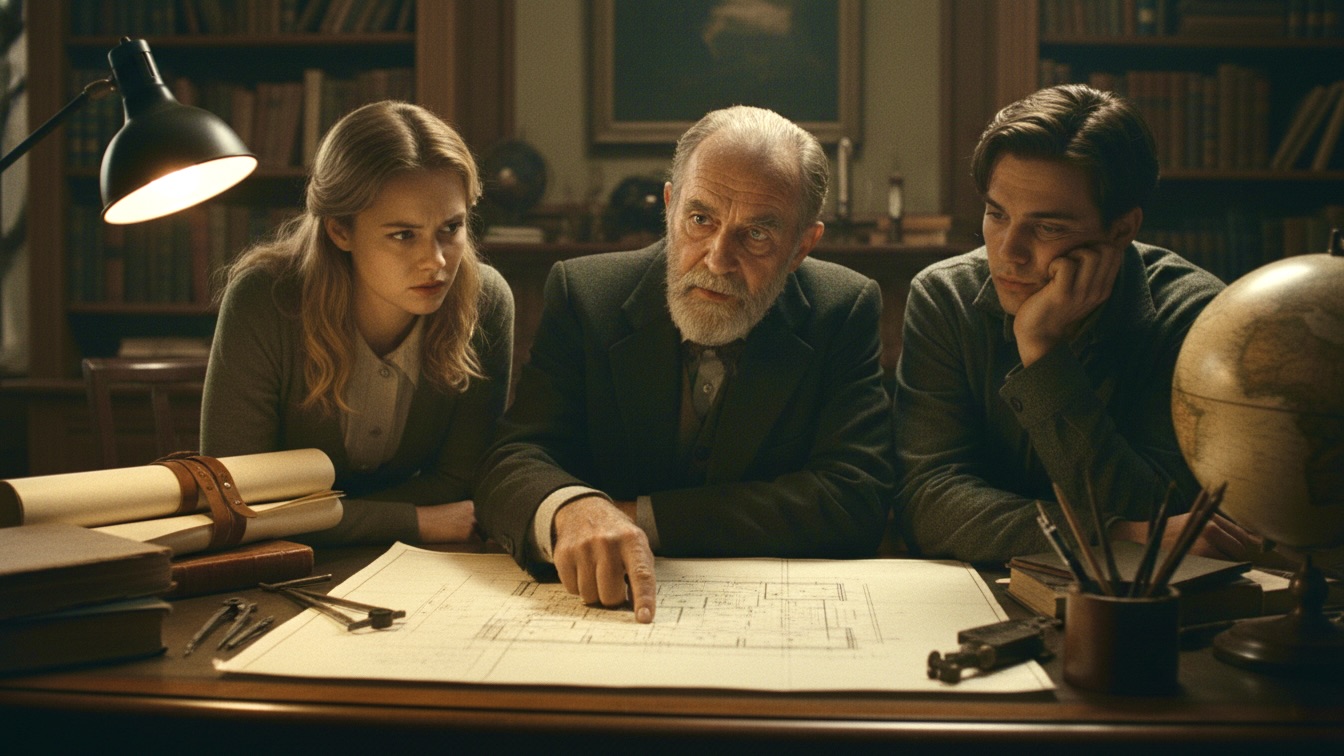
The Workshop (Rising Action): The trio finalizes the heist in Andy's workshop, detailing every step from disabling sensors with salt slush to creating a diversion with a self-destructing ice sculpture of the mayor, cementing their alliance.
The Heist (Midpoint): Under the cover of the storm, Carrie and Ben successfully infiltrate the mayor's mansion, bypass security, and crack the safe, sharing a brief, euphoric moment of victory as they retrieve the recipe book and a bag full of cash.
The Radio (Climax): A stray police radio transmission reveals the mayor has been found murdered in the house, turning their burglary into a homicide, and a second transmission confirms the blizzard has shut down all roads, trapping them at the scene of the crime.
The episode begins with a tone of dreary, cynical resignation, mirroring Carrie's professional exile in the oppressive white landscape. This mood shifts to one of intrigued suspicion upon meeting Andy, which quickly builds into a tense, conspiratorial excitement during the planning phase. The heist sequence is pure, high-stakes suspense, culminating in a brief, exhilarating moment of triumph. The emotional arc then plummets violently into sheer panic and claustrophobic dread with the final reveal, leaving the audience in a state of shock and breathlessness.
If expanded, the immediate next episodes would follow Carrie and Ben's desperate attempt to escape the locked-down town and the murder investigation, forcing them to use their wits to outmaneuver Constable Pelletier and the Sûreté du Québec. The season-long arc would delve deeper into the town's corruption, revealing that Mayor Tremblay's death was part of a larger conspiracy. Carrie would be forced to investigate the murder to clear her own name, discovering that Andy may be far more dangerous than he appeared and that the "stolen recipe" was a cover for a much darker secret.
This arc would explore Carrie's transformation from a disgraced journalist into a hardened survivor, forced to use unethical methods for the ultimate righteous cause: her own freedom. Her relationship with Ben would be the season's emotional core, tested to its breaking point as they navigate their roles as partners in crime, fugitives, and reluctant detectives. The central question would shift from "Who stole the recipe?" to "Who killed the mayor, and can Carrie expose them before she takes the fall?"
The visual style is rural noir, defined by a stark contrast between the warm, cluttered, wood-toned interiors of Andy's cabin and the cold, monochromatic, and oppressive whiteout of the blizzard outside. Cinematography will utilize tight, often handheld shots to create a sense of immediacy and claustrophobia, especially inside the motel and the mayor's study. The color palette will be desaturated and cool, dominated by blues, grays, and whites, with pockets of warm, golden light (the stove, headlamps) creating a feeling of fleeting safety in a hostile world.
The tone is heavily influenced by the Coen Brothers' Fargo and Debra Granik's Winter's Bone, blending moments of dark, folksy humor with a pervasive sense of dread and sudden, shocking violence. The pacing is deliberate at first, building atmosphere, but becomes ruthlessly efficient and tense during the heist and its aftermath. The sound design will be critical, with the constant, howling wind of the blizzard serving as an oppressive, omnipresent character.
The target audience is adults aged 25-55 who are fans of character-driven crime thrillers, neo-noir, and anthology series. This includes viewers of shows like Fargo, True Detective, and Ozark, who appreciate complex moral ambiguity, atmospheric tension, and sharp, surprising plot twists. The episode's blend of dark humor and high-stakes suspense will also appeal to fans of contained, "pressure cooker" thrillers.
For its 10-12 minute runtime, the episode will have a rapid, compressed three-act structure. Act One (The Setup and The Proposition) will be swift, establishing the characters' predicament and introducing the central conflict within the first 3-4 minutes. Act Two (The Plan and The Heist) will comprise the bulk of the runtime, focusing on the tense, meticulous execution of the crime to build maximum suspense. Act Three is brutally short, consisting solely of the shocking radio reveal and the final realization of their entrapment, functioning as a powerful cliffhanger that leaves the audience breathless.
The most significant production consideration is creating a convincing and oppressive blizzard. This will require a combination of on-set practical effects (high-powered fans, snow machines using biodegradable material) and subtle VFX enhancement for wide shots to establish the scale of the storm. The limited number of key locations (motel, cabin, one room in a mansion) makes this a contained and budget-conscious shoot.
A key prop is the "self-destructing" ice sculpture of the mayor. This would likely be achieved practically, with a pre-scored sculpture and a small, hidden heating element or a simple mechanical rig to ensure the head detaches on cue. Careful sound design will be crucial to making the wind a constant, menacing presence and to ensure the crackle and clarity of the police radio transmissions provide the maximum dramatic impact for the final twist.