Melgund Township Winter Story Library
A Preliminary Report on Restorative Justice - Analysis
by Jamie F. Bell | Analysis
by Jamie F. Bell | Analysis
The document, a flimsy photocopy blurring at its edges, serves as a potent, unsettling metaphor for the chapter's unraveling reality and ethical decay. Initially dismissed as a bureaucratic trifle, its physical instability reflects the precariousness of Carrie’s journalistic integrity and the fading clarity between truth and fabrication. This initial blurring foreshadows the narrative’s swift descent into moral ambiguity, where the lines of justice, law, and personal ambition become indistinguishably smudged, much like the "hazy gray ghost" of the Sûreté du Québec letterhead. It is a material manifestation of the unreliable ground upon which the protagonist builds her desperate quest for redemption, a foundation destined to crumble under the weight of escalating deceit.
This chapter skillfully navigates a complex thematic landscape, initially presenting itself as a cynical take on redemption before veering sharply into the perilous territory of a crime thriller infused with psychological drama. The core tension arises from Carrie’s struggle between professional integrity and the irresistible lure of a "big story," a conflict exacerbated by her recent suspension. Her initial assignment, a "wholesome" human-interest piece, is quickly discarded for the promise of a more sensational narrative, highlighting themes of ambition, moral compromise, and the slippery slope of ethical relativism. The narrative's mood shifts from one of weary resignation and cynical humor to escalating intrigue, culminating in a chilling sense of dread and panic as the heist devolves into a murder investigation.
The narrative voice, delivered through Carrie's first-person perspective, immediately establishes her as an unreliable narrator, her past "unfortunate incident" casting a shadow over her present judgments. Her perception is heavily colored by her ambition and desperation for professional validation, causing her to interpret events and characters through the lens of a potential scoop. The pervasive winter environment, initially a symbol of her exile and a source of inconvenience, gradually transforms into a powerful metaphor for her perceptual limits and moral blind spots. The blizzard’s isolation, rather than offering clarity, seems to amplify her tunnel vision, allowing her to rationalize increasingly dangerous choices under the guise of pursuing a "truth" that ultimately becomes obscured by her own actions. She misunderstands the true extent of Andy Dubois's intentions, viewing him primarily as a source for a story, rather than a dangerous manipulator.
The chapter delves into profound moral and existential dimensions, particularly questioning the nature of "restorative justice" when it necessitates illegal acts. Andy Dubois's philosophy, that breaking the law can rectify a greater crime, forces Carrie to confront her own ethical boundaries, revealing their surprising pliability. The story explores the corrupting influence of ambition, the existential weight of being trapped by one's choices, and the psychological impact of isolation. The harsh, unforgiving Quebec winter acts as a constant, external pressure, mirroring the internal coldness and starkness of the characters' moral compromises. It amplifies the fear of consequence, the desperation for escape, and the feeling of being utterly alone in a world that is indifferent to human struggles.
Psychological State: Carrie enters the narrative in a state of professional disgrace and personal cynicism, driven by a deep-seated need for redemption and validation from her supervising professor. She carries a palpable guilt for Ben's suspension, which contributes to her willingness to push boundaries. Her inherent journalistic "itch" for a compelling story quickly overrides her initial, safe assignment, revealing a core recklessness and a potent ambition that prioritizes narrative over ethics. The frigid, isolating environment of Sainte-Céleste-du-Fjord seems to sharpen her focus and determination, paradoxically pushing her further into morally ambiguous territory rather than towards cautious self-preservation.
Mental Health Assessment: Carrie exhibits traits of impulsivity and a clear tendency to disregard established rules and legal boundaries when pursuing a perceived "truth" or a "big story." Her coping mechanism for professional disgrace is to actively seek out an even more dramatic and dangerous scoop, suggesting a pattern of escalating risk-taking. While her determination indicates a degree of resilience, her judgment is significantly impaired by her ambition and the trauma of her past failure. The isolation imposed by the blizzard seems to strip away her conventional defenses, making her particularly susceptible to Andy's manipulative influence and the allure of an illicit opportunity.
Motivations & Drivers: Her primary motivations are professional redemption, validation from Dr. Albright, and the urgent need to prove her capabilities as a journalist. Ultimately, she is driven by the thrill of the hunt for a truly significant and impactful story, one that can resurrect her career. The financial incentive presented by Andy also plays a crucial, pragmatic role in her decision-making. The oppressive, stark winter environment might subtly fuel her desire for a dramatic escape from her current predicament, or a breakthrough that transcends her frozen exile.
Hopes & Fears: Carrie profoundly hopes to regain her professional reputation, to demonstrate her journalistic prowess, and to break a story that is genuinely impactful. Her deepest fears revolve around further disgrace, irreversible professional failure, and the perpetual judgment of her peers and mentors. The escalating blizzard heightens her underlying fear of being physically and professionally trapped, a feeling that becomes terrifyingly real by the chapter's end. Her ambition, once a source of drive, now becomes a source of dread.
Psychological State: Ben presents as weary, resigned, and initially cynical, a direct consequence of being collateral damage in Carrie’s previous "unfortunate incident." This has fostered a low-grade resentment and an ingrained caution, making him reluctant to engage in further risky endeavors. Despite his initial disinterest in Andy’s tale, he becomes increasingly fascinated and involved, revealing a hidden pragmatism, a technical aptitude for problem-solving, and perhaps a suppressed adventurous streak. The harsh winter environment seems to accentuate his vulnerability and his reluctant participation in Carrie's escalating schemes.
Mental Health Assessment: Ben appears to be experiencing a degree of burnout and disillusionment, likely stemming from his professional setback. He initially exhibits a cautious and pragmatic nature, serving as Carrie’s moral counterweight. However, his eventual agreement to participate in the heist suggests a complex interplay of loyalty to Carrie, a sense of obligation, and perhaps a latent desire for excitement or a substantial financial reward. His mental health appears stable, but he is clearly burdened by his circumstances and the lingering effects of his past association with Carrie's scandal.
Motivations & Drivers: His primary drivers are a sense of loyalty to Carrie, a desire to fulfill his professional obligations without further incident, and to simply get through the current assignment. The promise of a substantial sum of money quickly becomes a significant motivator, offering a path out of their shared predicament. Once committed, Ben's technical mind is engaged by the practical challenges of the heist, finding purpose in deconstructing alarm systems and planning entry points.
Hopes & Fears: Ben's core hopes are to complete the current assignment safely, to avoid any further professional or legal entanglements, and to move past the shadow of the 'unfortunate incident.' He fears additional professional setbacks, severe legal repercussions, and being dragged deeper into Carrie's impulsive and reckless pursuits. The prospect of prison is a particularly potent fear, and the blizzard's eventual entrapment makes these fears acutely tangible.
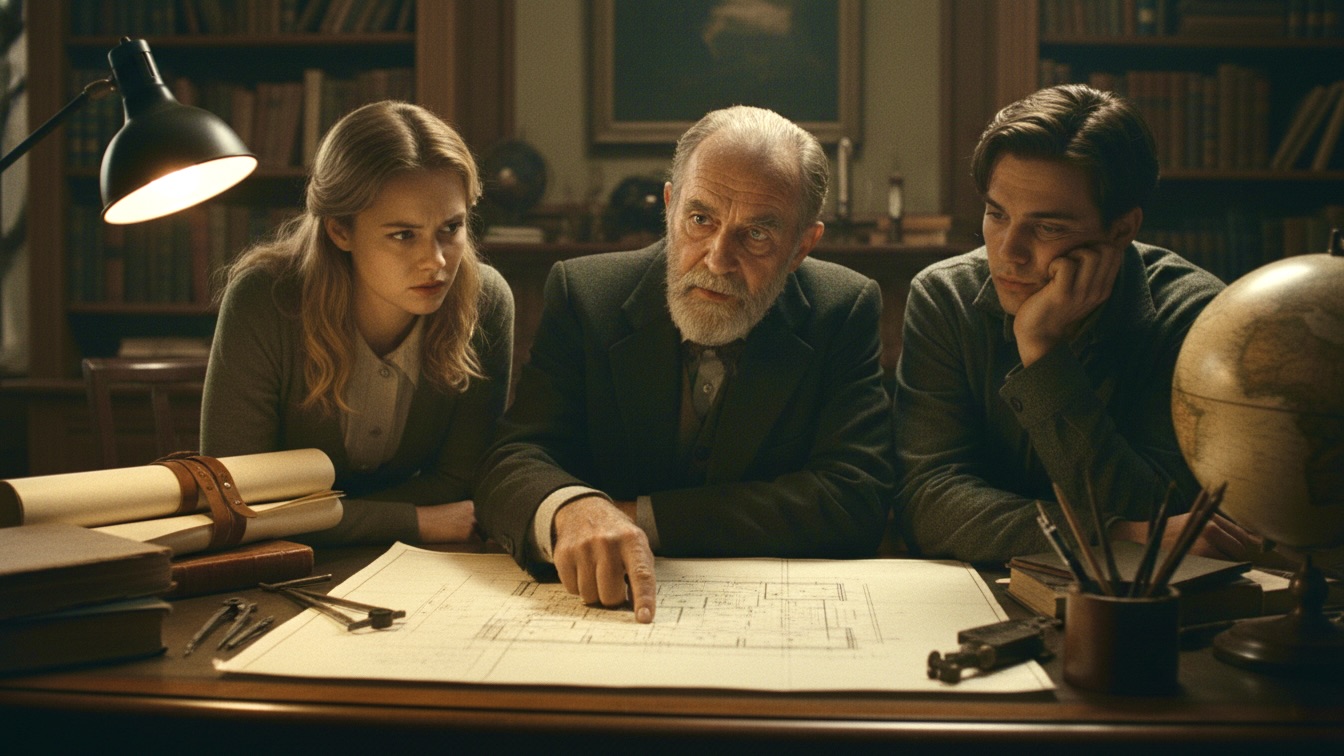
Psychological State: Andy Dubois projects an outward calm and composed demeanor, yet his meticulous planning and intense focus betray a deep, simmering obsession and an unyielding sense of injustice. He is portrayed as sharp, highly intelligent, and subtly manipulative, effectively deploying a "folksy old man" persona to disarm and recruit Carrie and Ben. Having spent four years meticulously planning his "restorative justice," he demonstrates a profound psychological commitment to his goal. The isolating winter environment of his remote home likely provided the perfect, uninterrupted conditions for his focused, solitary strategic development.
Mental Health Assessment: While the narrative refrains from labeling him "crazy," Andy's singular, four-year focus on revenge and his elaborate, criminal plan suggest an obsessive personality. His ability to accurately assess and manipulate Carrie and Ben’s vulnerabilities indicates a sophisticated understanding of human psychology. His mental state is one of calculated resolve, bordering on a highly functional fanaticism, yet grounded in a clear, albeit skewed, logic concerning justice and retribution. He is perceptive and utterly committed to his mission.
Motivations & Drivers: Andy is primarily driven by a profound sense of injustice, stemming from the theft of his family's secret maple syrup recipe—a symbol of his heritage and identity. His goal is to reclaim this stolen legacy and exact retribution against Mayor Tremblay. The significant sum of cash in the safe, while a powerful lure for Carrie and Ben, appears secondary to the recovery of his great-grandfather’s journal, indicating his deeper, intrinsic motivations.
Hopes & Fears: Andy's core hope is to restore his family's honor and legacy by retrieving the stolen recipe book. He fears that his family's invaluable tradition will be permanently appropriated and that Mayor Tremblay will continue to profit from his crime with impunity. His age and physical limitations are also a practical concern, which compels him to seek the assistance of younger, more capable individuals to execute his meticulously crafted plan.
The chapter masterfully constructs its emotional landscape, beginning with a pervasive sense of weary resignation and low-grade guilt that defines Carrie's initial state. The mundane task of researching ice sculptures, juxtaposed with the "unfortunate incident," immediately establishes a cynical and somewhat disillusioned mood. This quickly gives way to intrigue as the bizarre police report about stolen maple syrup sparks Carrie's dormant journalistic "itch," injecting a surge of professional curiosity and a nascent thrill. The emotional temperature rises steadily with the introduction of Andy Dubois and his chillingly logical plan, transforming curiosity into a tense anticipation and a growing sense of the forbidden.
As the heist plan unfolds in Andy's workshop, the mood becomes one of heightened, almost manic, excitement mixed with palpable fear. The characters' internal conflicts—Carrie's ethical struggle, Ben's reluctant loyalty—build a complex emotional layering. The detailed planning, juxtaposed with the absurdity of the "syrup king" premise, creates a dark, almost comedic tension that slowly gives way to genuine apprehension. The blizzard, initially a dramatic backdrop, becomes an active participant in shaping the emotional experience, its relentless howl amplifying the characters' isolation and the increasing claustrophobia of their predicament.
The emotional climax is a sudden, brutal plunge into terror and dread with the revelation of Mayor Tremblay's murder and their subsequent entrapment by the whiteout. The initial rush of triumphant euphoria from cracking the safe and retrieving the book is instantly replaced by a cold, metallic taste of panic. The shift is abrupt and disorienting, leaving the characters, and the reader, in a state of profound shock and helplessness. The winter environment, which had served as a strategic ally, now transforms into an insurmountable barrier, its relentless cold mirroring the chilling reality of their grim new situation and sealing their fate in a suffocating embrace of fear.
The setting of Sainte-Céleste-du-Fjord, a remote town buried in a relentless blizzard, serves as a powerful psychological mirror and amplifier of the characters' internal states. The initial isolation of the motel room, "Le Gîte du Voyageur," reflects Carrie's own professional exile and her suspended state, a liminal space of forced inaction that breeds cynicism. The "cheap, slightly damp texture" of the police report, felt against her thumb, grounds her in a tangible, almost squalid reality that contrasts sharply with the "wholesome" story she is supposed to be pursuing. This initial environment sets the stage for a narrative where comfort is fleeting and external conditions are oppressive.
Andy Dubois’s saltbox house and workshop, initially a refuge from the storm, quickly transform into a psychological command center where the domestic warmth of woodsmoke and coffee clashes with the sinister plotting. This juxtaposition creates a profound sense of unease, as a seemingly benign environment becomes the incubator for criminality. The "sprawling, ancient sugar maple" in his yard, a symbol of rooted tradition and natural resilience, subtly underscores Andy’s own deeply entrenched connection to his heritage and his unwavering resolve. The blizzard, which begins as a mere narrative inconvenience, progressively becomes a central psychological force. It initially provides strategic cover for the heist, an accomplice in their plans, but ultimately evolves into an inescapable, suffocating prison. Its "frantic swirl of white" and "maëlstrom" of snow visually represent the chaotic internal state of panic and the overwhelming external threat that seals their fate. The cold, once a sensation, becomes an active barrier, mirroring the emotional and moral numbness that overtakes the characters as they cross irreversible lines.
The chapter's prose demonstrates a nuanced aesthetic, employing a varied sentence rhythm that adapts to the narrative's shifting emotional currents. Carrie's initial internal monologue is reflective and cynical, characterized by longer, more complex sentences that convey her disillusionment and intellectual processing. As the tension escalates, particularly during the planning and execution of the heist, the sentence structure becomes shorter, sharper, and more direct, mirroring the characters' increasing focus and anxiety. The dialogue, too, shifts from Ben's gravelly, resigned interjections to Andy's precise, conspiratorial whispers, and finally to Carrie's breathless, panicked exclamations, enhancing the sense of unfolding drama.
Diction is carefully chosen to highlight contrasts and underscore thematic elements. Journalistic jargon like "human-interest story" and "B-roll montage" clashes with the formal, almost comically bureaucratic language of the police report ("felonious intent," "vexatious reporting"). This juxtaposition emphasizes Carrie's professional background and the absurd context of the crime. Andy's heavily accented but clear English, peppered with folksy observations, provides a grounding authenticity while subtly masking his manipulative intelligence. The imagery is consistently vivid and sensory, ranging from the tactile "cheap, slightly damp texture" of the paper to the auditory "wheezing groan of the wall-unit heater" and the olfactory "smell of stale coffee and wet wool," immersing the reader in the immediate environment.
Symbolism is deeply integrated throughout the narrative, with winter and its associated motifs serving as central thematic anchors. The "flimsy" photocopy of the police report symbolizes the fragility of truth and ethics, blurring the lines between right and wrong. The ice sculptures, initially representing the superficiality of Carrie's original assignment, become a literal diversion, with the grotesque image of Mayor Tremblay's head falling off serving as a darkly comedic metaphor for his imminent downfall. Maple syrup, "L'Or du Fjord," transcends its culinary function to become a powerful symbol of stolen heritage, family legacy, and cultural identity for Andy. Most significantly, the blizzard evolves from a mere weather condition into an omnipresent character, symbolizing isolation, entrapment, the chaos of human ambition, and an indifferent, overwhelming force of nature that ultimately dictates the characters' inescapable fate. The red filters on the headlamps symbolize their clandestine activity, their altered perception, and their descent into the moral darkness of their chosen path.
The chapter cleverly situates itself within several broader cultural and literary frameworks, drawing on established genres and archetypes while subverting expectations. At its core, it leans heavily into classic heist narratives, reminiscent of films like Ocean's Eleven or Rififi, where meticulous planning, an unlikely crew, and a daring infiltration are central. However, the unexpected twist of the murder at the scene of the crime dramatically subverts the typical caper, shifting the genre towards a darker, more morally ambiguous territory that echoes neo-noir. The cynical narrator, the blurring of good and evil, the sense of entrapment, and the harsh, isolating environment all contribute to this noir sensibility, where personal ambition leads to a spiraling descent into criminality.
The story also engages with the rich tradition of winter narratives, particularly those common in Canadian literature, where the harsh environment often becomes a character in itself. The relentless blizzard and the remote setting evoke themes of isolation, survival against the elements, and the starkness of human existence when confronted by nature's indifference. This tradition often uses winter as a crucible that reveals the true nature of characters, stripping away pretenses and forcing confrontation with fundamental fears and desires. The "small town secrets" trope is another clear intertextual link, where the seemingly quaint and idyllic Sainte-Céleste-du-Fjord conceals layers of corruption and hidden agendas, a common device used to expose the underbelly of seemingly peaceful communities.
Furthermore, the chapter directly confronts the ethical dilemmas inherent in journalism, echoing works like All the President's Men or Shattered Glass. However, it radically departs from these by having the journalist actively participate in, rather than merely report on, the illegal activities. This active complicity pushes the narrative into a more transgressive space, questioning the very foundations of journalistic integrity and the pursuit of "truth" at any cost. Andy Dubois’s concept of "restorative justice" also carries mythological undertones, suggesting an ancient, almost primordial form of retribution that transcends modern legal frameworks, positioning him as a kind of vengeful trickster figure who manipulates others to achieve his deeply personal quest for balance.
The chapter leaves a profound and unsettling emotional and intellectual impact, primarily shaped by the escalating sense of dread and the pervasive, suffocating winter motifs. What lingers most acutely is the chilling realization of unintended consequences, the terrifying ripple effect of a single, seemingly calculated decision. The initial thrill of the audacious heist, fueled by Carrie's desperate ambition, curdles into a cold, hard terror as the narrative abruptly pivots from a quirky crime caper to a murder investigation. The reader is left with a visceral sense of being trapped alongside Carrie and Ben, the freedom of action suddenly replaced by the crushing weight of their predicament.
Intellectually, the story compels a re-evaluation of justice, truth, and the permeable lines between reporting and participating. Andy Dubois's definition of "restorative justice" challenges conventional morality, forcing the reader to grapple with whether an illegal act can ever be justified by a perceived greater wrong. The story questions the very nature of journalistic ethics, pushing the boundaries of what a reporter might do for "the story." The cold, indifferent blizzard, initially a strategic ally, transforms into an inescapable prison, leaving a lasting impression of nature's formidable power and its capacity to seal human fate.
The enduring image is that of the "maëlstrom of white," the inescapable whiteout that closes all roads, symbolizing the characters' complete and utter entrapment. It evokes a potent sense of claustrophobia and helplessness, a feeling that no matter how far or fast they run, the consequences of their actions, like the snow, will relentlessly pursue and bury them. The question of who killed Mayor Tremblay and how Carrie and Ben will possibly escape remains a stark, unanswered void, intensified by the silent, frozen landscape that now holds them captive. The lingering chill is not just from the blizzard, but from the moral abyss they have plummeted into, a cold, hard knot of fear and complicity that resonates long after the final words.
The howl of the blizzard, once a calculated accomplice, now echoes as an indifferent, final judgment, sealing the characters within an icy, inescapable fate. The initial frost of professional disgrace has deepened into a bone-chilling terror, transforming a desperate gambit for redemption into an irreversible descent into a criminal abyss. The pursuit of a "big story," meant to thaw Carrie's frozen career, has instead solidified into a narrative of terror, a testament to how ambition, unchecked by ethics, can lead to a landscape of profound and irreversible isolation.
Caught between the dead mayor's study and the impassable, snow-choked roads, Carrie and Ben are left in a chilling tableau of complicity and dread. The promise of "restorative justice" has fractured into a murder investigation, leaving behind not clarity, but a suffocating whiteout of uncertainty and fear. The cold, once a strategic element, now stands as a stark, unyielding barrier, a physical manifestation of the crushing consequences that have finally caught up, freezing all pathways to escape and leaving only the stark, unyielding silence of a crime scene.