Format: Short Film / Anthology Episode | Est. Length: 10-12 minutes
Imagine a psychological horror anthology series, Urban Phantoms, where the ghosts of a city are not spirits tied to a place, but to a person's unresolved trauma. Each episode plunges a new protagonist into a familiar urban landscape—a subway, a high-rise, a forgotten warehouse—that transforms into a personalized hell, forcing them to confront the literal ghost of their greatest failure, guilt, or rival. The Encore Below serves as a signature episode, establishing the series' core concept: you can't outrun your own ghosts, especially when they know you better than you know yourself.
A well-dressed man, JAMES, sprints desperately through a flickering, deserted subway station late at night. He is pursued not by a person, but by an impossible, metallic screeching sound that seems to tear at the very air around him.
A guilt-ridden actor is stalked through the New York subway system by the vengeful ghost of his former rival. To survive the night, he must abandon the performance of his life and deliver a final, honest confession on a stage made of concrete and decay.
At its core, The Encore Below is a chilling exploration of toxic ambition and professional jealousy. It examines how the relentless pursuit of success can curdle into a corrosive force that destroys relationships and hollows out the victor. The story uses the supernatural framework to literalize the concept of being "haunted by your past," where unresolved guilt manifests as a physical, malevolent entity demanding a reckoning.
The narrative delves into the dichotomy between art and artifice, truth and performance. James, an actor who has built a career on calculated technique, is forced to confront a ghost who demands raw, unvarnished truth. The episode is a claustrophobic psychological horror, but its emotional undercurrent is one of tragic drama, exploring the deep-seated insecurities that fuel our most destructive impulses and the potential for catharsis in absolute, terrifying honesty.
The stakes for James are threefold: physical, psychological, and spiritual. Physically, his life is in immediate danger; the ghost of Stef can manipulate the environment, causing pipes to burst and threatening to bring the tunnel down on him. Psychologically, his sanity is on the line, as Stef's torment is designed to break him by forcing him to relive his most painful memories and insecurities. Spiritually, what's at risk is his soul—if he fails to confront his guilt, he will be trapped forever in this subterranean purgatory, eternally directed by the ghost of the man he wronged.
The primary external conflict is James versus the ghost of Stef. Stef is not just a phantom but an active, intelligent antagonist who acts as a malevolent director, turning James's prison into a stage and using his knowledge of James's psyche as a weapon. The secondary external conflict is Man vs. Environment, as James must navigate the treacherous, labyrinthine tunnels of the subway's underbelly. The central internal conflict, however, is James versus his own guilt and fraudulent identity. He has spent his career performing, and now he must fight the actor's instinct to "play the part" and instead find the courage to be brutally honest for the first time in his life.
James, a successful but emotionally hollow actor, is hunted through the late-night New York subway by a terrifying, disembodied sound. The sound is the herald of Stef, the ghost of his intensely talented and bitter rival who died years ago after a career-defining argument. Taking refuge in a dark maintenance tunnel, James finds there is no escape as the haunting becomes intensely personal, trapping him in a series of spectral reenactments of his most painful memories, with Stef playing the role of a cruel director.
Realizing that playing along with Stef's twisted scenes will only lead to his death, James makes a desperate choice. He finds an abandoned "ghost station" and turns the tables, claiming the space as his own stage for one final performance. In a raw and harrowing monologue, James confesses the truth of his envy, his guilt over Stef's death, and the hollowness of his own success. This ultimate act of vulnerability is the one performance Stef cannot critique, and having finally heard the truth, the ghost grants a final, weary approval before dissolving, leaving James broken but free in the subterranean darkness.
JAMES (40s): A technically proficient and successful stage and screen actor who has built a career on discipline and control. Psychological Arc: James begins the story as a terrified victim, a man whose carefully constructed life is being torn apart by a literal demon from his past. He is defined by his denial and his instinct to perform, even when running for his life. Through his ordeal, he is stripped of all artifice and forced to confront the fraudulent foundation of his success, moving from a state of panicked fear to one of courageous, painful honesty. He ends the story exhausted and emotionally raw, but finally unburdened and authentic.
STEF (The Ghost) (40s): A specter of raw talent and consuming bitterness. In life, Stef was a brilliant, chaotic, and emotionally driven actor who was James's fiercest rival. Psychological Arc: As a ghost, Stef is a manifestation of James's guilt and his own unresolved artistic rage. He starts as a terrifying, unseen force, then evolves into a condescending, cruel "director" who torments James with their shared past. His ultimate goal is not just to kill James, but to force a confession—an admission of James's perceived mediocrity and theft. His arc concludes with a moment of release, where James's honest confession finally satisfies his spectral grievance, allowing him to let go.
THE CHASE: James flees a terrifying, unseen presence through the flickering lights of the Bleecker Street station, the sound of scraping metal clawing at his heels. His panic is visceral as his shadow leaps and dances like a monstrous puppet in the inconsistent light. He escapes the main platform by plunging into the absolute darkness of a service corridor, trading one terror for another.
THE MEMORY STAGE: In the suffocating dark, the scent of decay triggers a vivid flashback to a dressing room confrontation where his rival, Stef, surgically dismantled his confidence before a premiere. The memory is a full sensory immersion, establishing the deep-seated psychological nature of their rivalry and Stef's cruel genius. This beat reveals that the true horror isn't just the ghost, but the history that created it.
THE DIRECTOR'S CUT: Stef's ghost manifests, a swirling form of dust and cold light, and turns the tunnel into a spectral stage. He forces a terrified James to re-enact key moments of their past, including the audition for the role James "stole" from him. When James falters, the ghost punishes him by bursting a pipe overhead, drenching him in freezing water and demonstrating his control over this nightmarish theater.
FINDING THE STAGE (MIDPOINT): After being tortured by a re-enactment of their final, fatal argument, James realizes he cannot win by playing Stef's scenes. In a moment of desperate clarity, he rejects the ghost's direction, turns his back on the apparition, and walks deeper into the darkness. He stumbles into a vast, abandoned "ghost station," a cavernous, derelict space that he claims as the stage for his own final act.
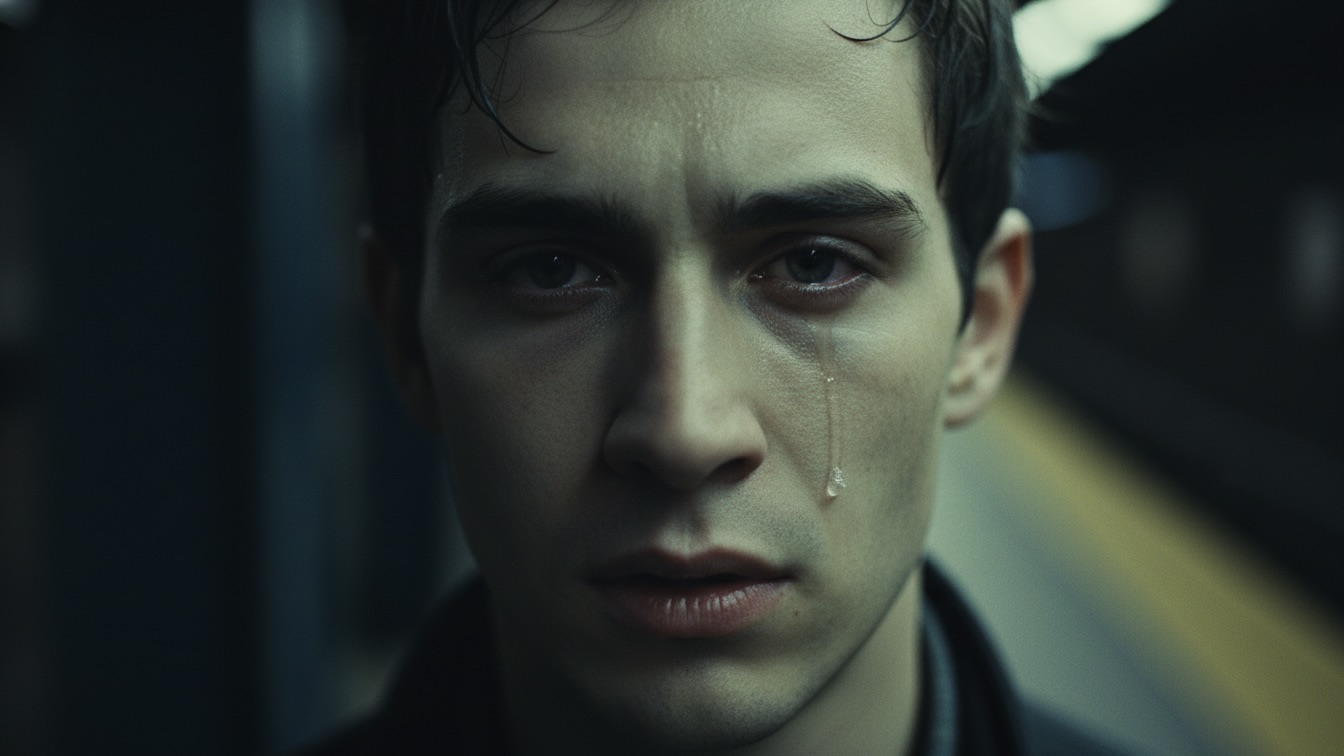
THE FINAL MONOLOGUE (CLIMAX): On the crumbling platform, James turns to face the approaching ghost and delivers the performance of his life. It is not a scene from a play, but a raw, unscripted confession of his envy, his admiration for Stef's talent, his guilt, and the profound hollowness of his own career. He weeps real tears, stripping himself emotionally bare and offering the ghost the one thing he always denied him: the unvarnished truth.
THE CURTAIN FALLS: Having heard the confession, the ghost's judgmental form softens, its rage replaced by a profound weariness. Stef offers a final, quiet critique—"The performance... was... acceptable"—and, with a faint smile of release, dissolves into nothingness. The unnatural cold recedes, leaving James shivering, alone, and finally free in the silent, empty station.
The audience is immediately thrown into a state of high-anxiety and propulsive fear during the opening chase. This transitions into a claustrophobic, psychological dread as the nature of the haunting is revealed through flashbacks and spectral confrontations. The emotional centerpiece is the climax, which is designed to be deeply cathartic; the audience witnesses James's painful vulnerability and confession, transforming their fear for him into empathy. The episode concludes on a somber, quiet, and melancholic note of exhaustion and hard-won peace, leaving the viewer with a lingering sense of tragedy and relief.
In a full season of Urban Phantoms, James's story could serve as a powerful standalone premiere or a pivotal mid-season episode that defines the "rules" of these hauntings. A season-long arc could follow a recurring character—perhaps a skeptical transit worker or a paranormal investigator—who begins to notice a pattern in these strange events across the city, collecting stories like James's. This investigator could uncover that a recent event, like a massive power grid failure or a strange celestial phenomenon, has weakened the veil between the city's physical reality and the psychological torment of its inhabitants.
James himself could potentially reappear in a later episode. Having survived his encounter, he might now be "attuned" to these phenomena, able to perceive other urban phantoms. The investigator might seek him out as the only known survivor of a full-blown manifestation, making James a reluctant expert or "guest star" who can offer insight into how to confront and appease these intensely personal ghosts, tying the anthology's disparate stories together with a thread of shared experience.
The visual style is one of gritty, high-contrast urban decay, heavily reliant on chiaroscuro lighting. The subway tunnels are a labyrinth of deep shadows and harsh, flickering, unreliable light sources (dying fluorescents, James's lighter), creating a sense of disorientation and claustrophobia. The color palette is dominated by cold blues, sickly greens of the ghostly apparitions, and the grimy yellows of the station lights, punctuated by absolute, oppressive blacks.
The tone is one of sustained psychological dread rather than jump-scare horror, prioritizing atmosphere and performance. The flashbacks should be visually distinct, shot with a theatrical, almost dreamlike quality that contrasts with the raw grit of the present-day tunnels, highlighting the theme of stagecraft versus reality. Tonal comparables include the grounded, character-focused horror of The Haunting of Hill House, the high-concept psychological tension of Black Mirror, and the oppressive urban atmosphere of David Fincher's Se7en.
The target audience is mature viewers (18-49) who are fans of sophisticated psychological horror, supernatural thrillers, and character-driven drama. This episode will appeal to admirers of anthology series like Guillermo del Toro's Cabinet of Curiosities and films like Jacob's Ladder or Personal Shopper. It is intended for an audience that appreciates thematic depth, atmospheric tension, and strong performances over gore, and enjoys stories that explore the darker corners of the human psyche.
For its 10-12 minute runtime, the pacing is aggressive and structured to maximize tension. Act One (The Chase) is breathless and frantic, establishing the stakes in under two minutes. Act Two (The Confrontation) slows deliberately, creating a claustrophobic, tense rhythm as it intercuts spectral torture with revealing flashbacks. Act Three (The Confession and Resolution) is a single, sustained emotional climax, allowing the final monologue to breathe before a quiet, abrupt, and contemplative ending.
The primary production challenge will be the visual effects for the ghost of Stef. The effect should feel visceral and almost practical, avoiding a clean, overly digital look. Techniques using particle systems to create a form from swirling dust, cold vapor, and ambient light will be more effective than a simple transparent figure. This "unstable" physical presence will enhance the horror and the ghost's emotional state.
Sound design is paramount and should be treated as a character in itself. The signature "metallic screech" must be unique and unnerving, while the whispered, echoing quality of Stef's voice needs to feel both intimate and vast. The contrast between the cacophony of the chase and the suffocating, dripping silence of the tunnels is crucial to the film's tension. Securing access to a subway location or building a highly detailed, contained set for the tunnels and ghost station will be essential for creating the authentic, claustrophobic atmosphere the story demands.