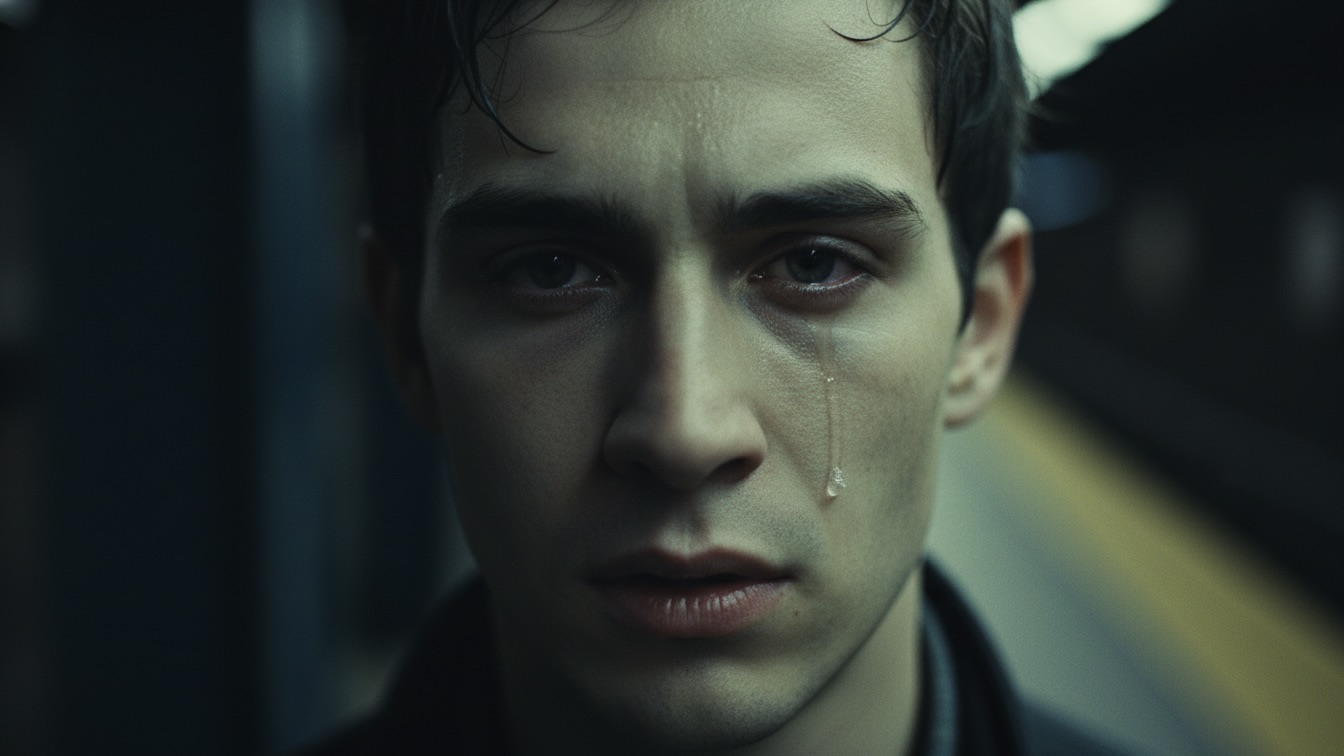
The cracked mirror is a treacherous geography, a frozen lake where identity splinters into jagged shards. It does not merely reflect; it dissects, separating the frantic, beating heart from the painted mask worn for the world’s applause. In this fractured glass, the boundary between the performer and the ghost dissolves, leaving only a cold, sharp edge where envy and survival bleed together. To look into it is to risk cutting oneself on the jagged truth that lies beneath the surface of a polished, frozen lie.
The narrative operates within the pressurized confines of psychological horror and the gothic tradition, transposed into the gritty, subterranean arteries of modern New York. The story utilizes the classic trope of the doppelgänger but refracts it through the specific lens of theatrical rivalry. Here, the antagonist is not merely a monster but an externalization of the protagonist’s deepest professional and personal insecurities. The genre elements—the chase, the supernatural manifestation, the haunting—serve as a scaffold for a profound exploration of Imposter Syndrome. The "monster" is the fear of mediocrity given teeth and a voice. The setting of the winter tunnel is not incidental; it establishes a pervasive atmosphere of hostility. The cold is an active participant, biting at the narrator’s lungs and freezing his tears, symbolizing the harsh, unforgiving nature of the artistic critique he fears.
The narrative voice is strictly first-person, filtered through James's terrified and deteriorating psyche. While technically unreliable due to his panic and hallucinations, James possesses a lacerating emotional honesty. He may not be seeing physical reality clearly, but his perception of the emotional stakes is crystal clear. His narration is steeped in the vocabulary of the theatre—he speaks of "objectives," "tactics," and "scenes." This linguistic framework reveals his fundamental flaw: he views his own life as a performance to be managed rather than an existence to be lived. The winter imagery reinforces this detachment; just as the cold numbs the skin, James’s technical approach to life has numbed his soul. He perceives the world as a stage set, often describing lighting and blocking even while running for his life, suggesting a man who cannot stop acting long enough to simply be.
Ethically, the story navigates the murky waters of ambition and passive malice. The central moral crisis is not a murder, but a failure to act—a "sin of omission." James did not push Stef; he simply let the winter take him. This explores the corrosive nature of envy, where the destruction of a rival is secretly desired, even if not actively executed. The story asks whether technical perfection without emotional truth has value, and whether a life built on the relief of a rival's death can ever be anything but hollow. The resolution suggests that redemption is not found in forgiveness from the ghost, but in the brutal, unadorned confession of one's own ugliness. The "cold" truth is the only thing that can dispel the spectral frost.
Psychological State:
James is in a state of acute psychological decomposition, oscillating between primal panic and dissociative observation. The physical stress of the chase strips away his defenses, leaving him vulnerable to the intrusion of his subconscious trauma. He is trapped in a feedback loop of anxiety, where the external cold of the tunnel mirrors the internal freeze of his emotional repression. His mind is a theatre where the curtain never falls, and he is perpetually underprepared for the role.
Mental Health Assessment:
James exhibits clear signs of Post-Traumatic Stress Disorder compounded by severe Imposter Syndrome. His hallucination of Stef is a manifestation of unresolved guilt and a fractured self-image. He relies on "acting" as a coping mechanism, attempting to script his survival just as he scripts his plays. However, this defense is brittle; under the pressure of the "winter" of his distress, his persona cracks. He lacks resilience because his self-worth is entirely extrinsic, dependent on awards and applause that he secretly believes belong to a dead man.
Motivations & Drivers:
Initially, James is driven by the biological imperative to survive the physical threat. However, as the supernatural elements take hold, his motivation shifts. He seeks to escape the judgment of the "critic." By the climax, his driver evolves into a desperate need for catharsis. He is no longer running to save his life, but to save his sanity. He is driven to prove—if only to the ghost—that he is capable of a "real" performance, motivated by the freezing clarity of the tunnel to finally drop the mask.
Hopes & Fears:
His greatest fear is exposure—not just of his cowardice regarding Stef’s death, but of his fundamental mediocrity. He fears that he is a "thief" of talent, a technician with no soul. Conversely, his deepest hope is validation. He craves the respect of the one person who saw through him. He hopes that by confessing the ugly truth, he can finally earn the role he has been playing for years. The winter setting amplifies his fear of becoming frozen in a state of permanent fraudulence.
Psychological State:
As a projection of James's psyche (or a vengeful spirit), Stef represents the Id and the Super-Ego simultaneously. He is the chaotic, creative force James lacks, but also the harsh, critical judge. He is arrogant, theatrical, and cruel, embodying the "tortured genius" archetype. His demeanor is cold and predatory, utilizing the freezing environment as an extension of his will. He is the "fire" that burns cold, a paradox of passion and death.
Mental Health Assessment:
In life, Stef appears to have been narcissistic and possibly unstable, prone to drinking and dramatic outbursts. In death, he functions as a relentless psychological tormentor. He displays a perverse form of mentorship, pushing James through trauma. His "health" is irrelevant as a ghost, but as a memory, he represents the destructive, consuming nature of unchecked artistic ego.
Motivations & Drivers:
Stef’s apparent motivation is to torture James, to force him to relive his failures. However, the ending reveals a more complex driver: he wants the truth. He acts as a harsh director pushing an actor to break through their inhibitions. He is driven by a desire for a "final scene" that is authentic. He utilizes the winter cold to strip James of his comforts, forcing a raw, uninsulated reaction.
Hopes & Fears:
Stef seems to fear a legacy of mediocrity—not his own, but the mediocrity of the man who replaced him. He cannot rest while his "rival" plays the part poorly. His hope is realized when James finally delivers a performance of raw honesty. He seeks a worthy adversary, even in death. He fears that his "fire" was extinguished in vain, replaced by James's safe, technical "ice."
The story constructs its emotional arc through a sensory assault that mirrors the protagonist's internal disintegration. It begins with high-velocity panic, grounded in the physical pain of running—the "burning lungs" and "pumping pistons." This establishes a baseline of frantic desperation. As James enters the service corridor, the emotional tenor shifts from adrenaline to oppressive dread. The darkness becomes "viscous," and the silence is heavy, creating a claustrophobic tension that weighs on the reader. The introduction of the flashback serves as an emotional pivot, transporting the anxiety from the physical danger of the tunnel to the psychological humiliation of the dressing room.
The tension escalates through the interplay of temperature and memory. The cold is not merely atmospheric; it is the medium through which the ghost manifests. The freezing water that drenches James acts as a shock to the system, shattering his ability to "act" and forcing him into a raw, vulnerable state. The emotional climax is reached not through a physical fight, but through a verbal confession. The transition from fear to sorrow is mediated by the realization that James is his own harshest critic. The "green light" of the ghost shifts from a source of terror to a spotlight of judgment, raising the emotional stakes to an existential level.
Finally, the release of tension is achieved through the acceptance of the "cold." When James stops fighting the ghost and delivers his monologue, the emotional architecture stabilizes. The panic evaporates, replaced by a profound, melancholy emptiness. The "warmth" of the resolution comes paradoxically from the acceptance of the freezing truth. The transfer of emotion goes from the ghost (anger/judgment) to James (fear/guilt) and finally resolves in a shared, quiet resignation. The lingering feeling is one of exhaustion and clarity, like the air after a snowstorm.
The subway system functions as a powerful psychological descent, a literal and metaphorical underworld. Bleecker Street, a known, labeled location, dissolves into the "guts" of the city, representing James's journey from his constructed public persona into his messy, repressed subconscious. The tunnels are labyrinthine, mirroring the convoluted rationalizations James has built to protect himself from his guilt. The "NO ADMITTANCE" sign he passes is a threshold crossing, marking the point of no return into the deepest recesses of his own mind. The darkness here is "thick," suggesting that the environment is clogged with the unspoken and the buried.
Winter acts as the primary environmental antagonist and metaphor. The season is not a backdrop; it is a weapon. The "spike of ice" in the throat and the "damp cold" of the floor serve to strip away the artifices of civilization and comfort. In the theatre of James's mind, the dressing room is humid and hot, a place of sweating ambition, while the tunnel is freezing, representing the cold reality of death and the numbness of his impostor existence. The abandoned station acts as a liminal space—a "ghost station" for a ghost performance. It is a place out of time, stripped of the commercial aspects of the modern subway (ads, commuters), leaving only the raw structure. This mirrors James's final state: stripped of awards and applause, standing on the raw structure of his own humanity.
The prose rhythm mimics the physiological state of the narrator. In the opening, sentences are choppy and breathless, driven by hard consonants and kinetic verbs ("pumping," "slap," "shriek"). As the story moves into the flashback and the confrontation, the rhythm slows and expands, adopting the more measured, resonant cadence of a theatrical monologue. The diction is heavily curated from the lexicon of the stage—"marks," "cues," "audience," "props"—which reinforces the central theme of life as performance. This specific vocabulary highlights James's inability to engage with reality directly; everything must be filtered through the lens of his craft.
Symbolism is woven tightly into the narrative fabric. The "greasepaint" represents the mask of the actor, but also the "decay" of the artifice. The "green light" evokes the sickness of envy and the supernatural, creating a visual link to the idea of a "ghost light" in a theatre. The "broken pipe" and the subsequent deluge of freezing water symbolize a baptism of sorts—not a cleansing one, but a shock that washes away the "makeup" of James's pretenses. The "rat" serves as a reminder of the base, scurrying reality beneath the lofty ambitions of the artists.
The "Cold" is the most pervasive motif. It is used to describe Stef's eyes ("chips of blue ice"), the air ("tasted of rust and cold stone"), and the internal state of James ("blood turned to ice water"). This consistent thermal imagery unifies the physical setting with the emotional landscape. The cold represents the absence of the "fire" that Stef possessed and James coveted. It is only when James accepts the cold—standing freezing and wet on the platform—that he finds a way to coexist with it, turning the numbness into a form of solid, undeniable truth.
The story is deeply rooted in the tradition of the "theater story," specifically echoing the dynamics found in Chekhov’s The Seagull. The explicit mention of the play anchors the rivalry: James as Treplev (the insecure, suicidal son desperate for validation) and Stef as Trigorin (the successful, somewhat callous genius). This intertextual reference provides a shorthand for the characters' psychological profiles and foreshadows the tragic nature of their relationship. The story also draws heavily from the Dantean concept of the Inferno, presenting the subway as a descent into a personal hell where the sinner is forced to confront their specific vice (envy/pride) through contrapasso—a punishment that mirrors the sin.
Furthermore, the narrative engages with the archetype of the "Shadow" in Jungian psychology. Stef is the Shadow Self—the repository of everything James denies in himself (chaos, raw talent, cruelty). The confrontation in the tunnel is a classic process of integration, where the protagonist must face and acknowledge the Shadow to become whole. The setting evokes the urban gothic of works like Neil Gaiman’s Neverwhere or the subway horror of the film Jacob’s Ladder, where the underground transit system becomes a purgatorial space between life and death.
The winter imagery connects the story to a long lineage of literature where the cold represents moral paralysis or clarity, such as in Ethan Frome or the final circle of Dante’s Hell (Cocytus), which is frozen. The "cold" is the ultimate truth-teller, preserving things as they are, stripping away the rot of summer/life to reveal the bone beneath. In this context, the story suggests that winter is the season of judgment, where only what is solid and true can survive.
The story leaves a residual chill, a lingering sense of the high cost of authenticity. It forces the reader to confront the uncomfortable reality of professional envy—the dark relief felt when a rival stumbles or falls. The emotional impact stems from the subversion of the typical ghost story resolution; the ghost is not exorcised by a ritual or a battle, but by a confession of personal inadequacy. This resonates because it suggests that the monsters we fear most are often just the truths we are too cowardly to speak.
The imagery of the freezing, abandoned station persists in the mind as a powerful metaphor for the internal state of the imposter. It evokes a sense of profound loneliness—the feeling of performing to an empty room, waiting for an applause that, even if it comes, feels undeserved. The story asks us to consider whether our own successes are "warm" with genuine achievement or "cold" with the knowledge of compromise.
Ultimately, the narrative suggests that the "encore" we fear is the repetition of our own lies. The "cold" remains not as a threat, but as a state of being—a reminder that once the heat of the spotlight fades, we are left alone with who we really are. The silence at the end of the story is heavier than the screeching metal at the beginning, for it is the silence of a man who has run out of lines and must finally, terrifyingly, just be.
The tunnel does not warm up simply because the ghost has departed. The frost on the rails remains, indifferent to the catharsis that has just occurred, suggesting that the revelation of truth offers clarity but not necessarily comfort. James is left standing in the wreckage of his own confession, shivering not from fear, but from the sheer, biting reality of his existence stripped of its costume. The winter underground is a permanent season, a geological fact that cares nothing for the dramas of men, serving only to preserve the silence that follows the final line.
There is no applause in the dark, only the rhythmic dripping of water, counting down the seconds of a life no longer scripted. The darkness is no longer a canvas for monsters, but a vast, open mouth that has swallowed the artifice whole. In this hollow space, the breath of the living rises in visible plumes, fragile and fleeting against the eternal stone, a testament to the only performance that truly matters: the simple, terrifying act of drawing the next breath in the cold.