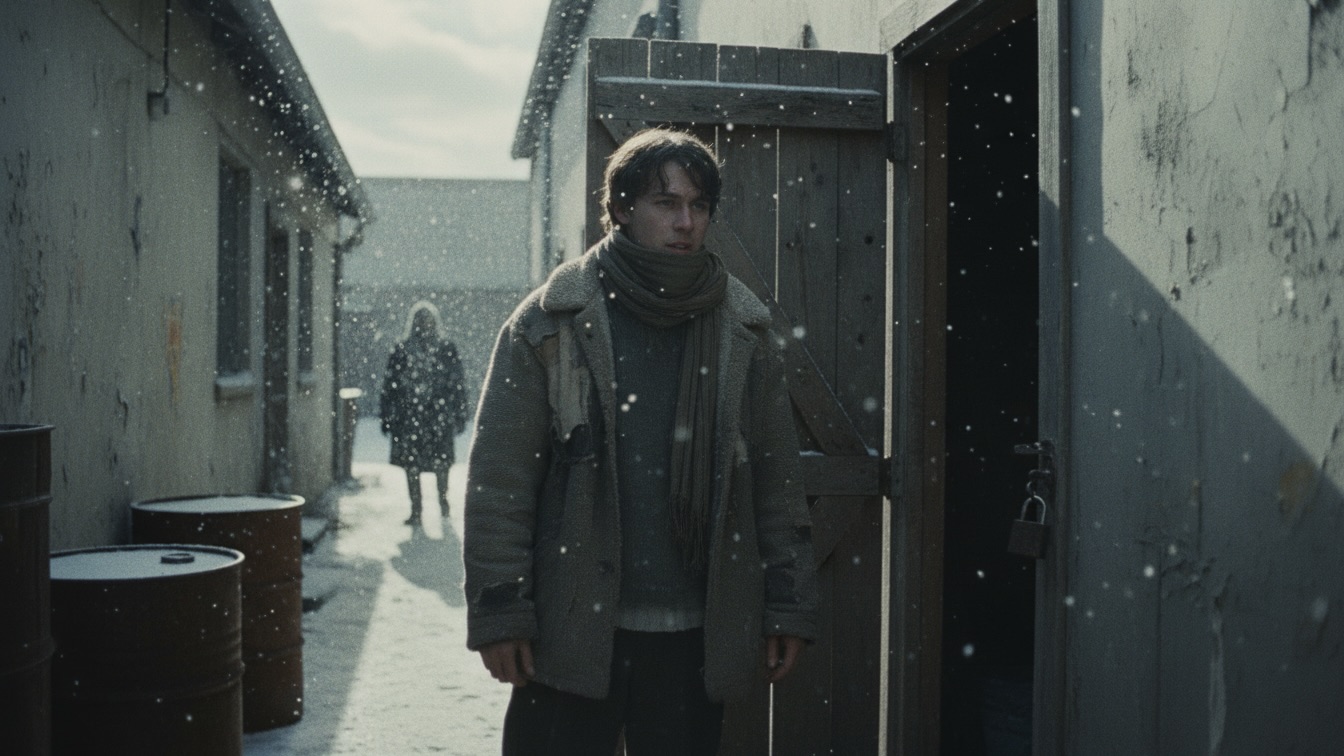
Format: Short Film / Anthology Episode | Est. Length: 10-12 minutes
Imagine "The Frozen Jam" as a standalone episode within a larger anthology series titled THE THAW or FROSTBITE CHRONICLES. The series explores disparate lives in the aftermath of "The Collapse," a global event that triggered a new ice age. Each episode is a contained, character-driven story focusing on the small, desperate battles for survival, warmth, and humanity in a world frozen solid, with overarching narrative threads connecting key locations, recurring characters, and the growing conflict between fortified settlements and nomadic factions.
In a frozen alley, with the roar of a desperate city protest swelling in the background, a lone survivor’s entire world hinges on a single, frozen padlock he cannot open. His fingers are numb, his hope is fading, and the cold is winning.
In a frozen, post-apocalyptic city, a desperate man must open a jammed lock to retrieve vital supplies for his community before it collapses. His struggle attracts the attention of a dangerous stranger who offers a solution, but at a price that will drag him into a much deadlier conflict.
The episode is a microcosm of survival in a collapsed world, exploring the theme of cascading failure where the smallest obstacle—a frozen lock—can trigger a catastrophic breakdown of an entire system. It delves into the psychological toll of constant struggle, where frustration and exhaustion erode one's humanity. The narrative pivots on the theme of desperate choices, questioning whether it's better to fail alone or to accept help from a potential predator, blurring the line between salvation and damnation.
Beneath the surface story of survival, the episode examines the nature of power and leverage in a lawless society. The lock represents a simple, physical obstacle, while the Stranger represents a complex, human one. The story contrasts the impersonal cruelty of the natural world (the cold) with the calculated, opportunistic cruelty of humanity, ultimately suggesting that the greatest threat in this new world isn't the environment, but the other people trying to survive it.
The immediate stakes are Jude's access to the shed, which contains generator fuel and a critical wrench needed to repair the settlement's water filtration unit. If he fails, the generator goes cold, and soon after, the settlement's only source of clean water will fail, leading to widespread sickness and death. The arrival of the Stranger raises the personal stakes exponentially: Jude's life is now forfeit if he fails to meet the Stranger's demand, and he has unwillingly entangled his entire community in a pact with a dangerous, unknown entity.
The primary external conflict is Man vs. Environment, embodied by the oppressive, life-threatening cold that has frozen the lock and numbs Jude's body and spirit. This is compounded by Man vs. Society, represented by the chaotic, violent protest just beyond the alley, a constant threat that limits his options. The central conflict shifts to Man vs. Man with the arrival of the Stranger, an antagonistic force who is both a solution and a new, more terrifying problem. Internally, Jude battles his own frustration, dwindling hope, and the gnawing fear of failure, a struggle that defines his every action.
Jude, a weary survivor in a frozen, post-collapse city, desperately tries to open a jammed padlock on a vital supply shed. His fingers are numb, his tools are inadequate, and the roar of a nearby protest is growing more violent, adding a terrifying deadline to his task. Every failed attempt deepens his frustration and sense of hopelessness, as he knows the survival of his small settlement—specifically its water filtration system—depends on the generator fuel locked inside.
His noisy, desperate efforts attract a mysterious, hooded Stranger. The figure, moving with a predator's calm, offers to help. Wary but out of options, Jude watches as the Stranger effortlessly picks the lock in seconds. But the help comes with a price: Jude must meet the Stranger alone at the old radio tower at sunrise, with the unspoken threat of violent consequences for him and his community if he refuses. Jude is left with an open door but is now trapped in a dangerous pact, having traded a simple mechanical problem for a complex human one.
JUDE: A pragmatic but exhausted survivor, worn down by the daily grind of staying alive. He is resourceful but not a natural leader, defined by a sense of duty to his community that outweighs his own despair.
* Psychological Arc: Jude begins the story consumed by a tangible, frustrating problem, viewing the world as a series of physical obstacles to overcome (the lock, the cold). By the end, he is forced to confront a far more dangerous and unpredictable threat: the complex motivations and menace of another human. His focus shifts from immediate, practical survival to long-term, strategic fear, as he realizes he has been unwillingly recruited as a pawn in a larger game.
THE STRANGER: An enigmatic and opportunistic figure who thrives in the chaos of the collapsed world. They are a pragmatist to the extreme, viewing others not as people but as tools or obstacles, and possessing skills (like lock-picking) that are invaluable in this new reality. Their motives are shrouded, but their actions reveal a cold, calculating intelligence and an air of predatory confidence. They are the human embodiment of the world's new, ruthless rules.
BEAT 1: THE IMPASSABLE DOOR: The story opens on Jude's desperate, fumbling attempts to open the frozen padlock, establishing the oppressive cold, his inadequate gear, and his mounting frustration. The muffled but persistent roar of a nearby protest serves as an auditory backdrop of societal decay, a constant, low-level threat. His failure to make any progress with the bent key solidifies his feeling of helplessness against an indifferent world.
BEAT 2: THE APPROACHING STORM: The sound of the protest intensifies, with sirens and shattering glass signaling an escalation from protest to riot, raising the immediate stakes and shortening Jude's timeline. He resorts to brute force, hammering the lock with his hand, but only succeeds in hurting himself, deepening his despair and sense of futility. This moment highlights that his methods are failing and he is running out of time and options.
BEAT 3: THE SHADOW'S OFFER (MIDPOINT): The Stranger appears silently, a stark, menacing silhouette that immediately shifts the nature of the conflict from environmental to interpersonal. Their calm, gravelly voice and offer of "persuasion" present Jude with a critical choice between continued failure and accepting help from a clear threat. This is the turning point where Jude relinquishes control of his situation to an unknown, dangerous variable.
BEAT 4: THE PRICE OF ENTRY (CLIMAX): The Stranger picks the lock with unnerving speed and precision, a display of superior skill that establishes their power and competence in this world. Just as a wave of relief hits Jude, the Stranger reveals their price—a clandestine meeting at the radio tower—turning the act of assistance into a transaction of coercion. The roar of the riot peaks just outside the alley, trapping Jude emotionally and physically as the Stranger delivers their ultimatum.
BEAT 5: THE OPEN VOID: The Stranger melts back into the shadows, leaving Jude with the now-open padlock, which feels less like a victory and more like a trap. He stares from the open lock to the dark, gaping maw of the shed, understanding that while he has solved one problem, he has just stepped into a much larger and more terrifying one. The final shot frames him alone in the alley, caught between the riot behind him and the dark unknown of the shed and his future, the weight of his new pact settling upon him.
The episode's emotional journey begins with a tone of cold, grinding frustration and isolation, immersing the audience in Jude's physical and psychological struggle. This slowly builds into a state of anxious desperation as the external threat of the riot grows louder and closer. The arrival of the Stranger injects a sharp, sudden spike of suspense and fear, which is sustained through their tense interaction. The brief moment of relief when the lock opens is immediately subverted by dread, leaving the audience on a cliffhanger of profound unease and foreboding.
This episode serves as an inciting incident for a season-long arc. Jude's forced meeting at the radio tower would introduce him to the Stranger's faction—a highly organized, ruthless group of survivalists operating in the city's shadows, perhaps led by the Stranger themselves. This group could be in direct opposition to Jude's more communitarian settlement, forcing Jude to act as an unwilling informant or double agent, caught between his loyalty to his people and the threat the Stranger holds over him.
The season would explore the escalating conflict between these two ideologies of survival: the settlement's attempt to rebuild a semblance of cooperative society versus the faction's belief in survival of the fittest. Jude's journey would be central, as he navigates this treacherous landscape, trying to protect his people while feeding the Stranger just enough information to stay alive. The ultimate mystery would revolve around the Stranger's true goal: are they trying to destroy the settlement, absorb it, or use it as a pawn in a larger power struggle for control of the city's last remaining resources?
The visual style will be gritty, tactile, and claustrophobic. The color palette is heavily desaturated, dominated by cold blues, muted greys, and the brown of rust and decay, with any vibrant color appearing unnatural and jarring. Cinematography will utilize a handheld, observational style to create a sense of immediacy and instability, with a shallow depth of field to isolate Jude in his environment. The focus will be on textures: the crystalline structure of ice, the rough grain of rusted metal, the frayed wool of a worn glove, making the cold a tangible presence.
The tone is one of slow-burn, atmospheric tension, prioritizing psychological realism over action. It is bleak but not nihilistic, focusing on the resilience of the human spirit even in the face of overwhelming despair. Tonal comparables include the stark, character-focused survivalism of The Road, the oppressive and grounded world-building of Children of Men, and the contained, escalating suspense of a thriller like Green Room.
The target audience is mature viewers (18-49) who are fans of character-driven speculative fiction, post-apocalyptic dramas, and psychological thrillers. This episode and the potential series would appeal to audiences who appreciate the nuanced world-building and moral complexity of shows like The Last of Us and Station Eleven, and the atmospheric tension of films by directors like Denis Villeneuve or Jeremy Saulnier. It is for a viewer who prefers suspense and thematic depth over high-octane action.
Within its tight 10-12 minute runtime, the episode follows a distinct three-act structure with deliberate pacing. Act One is slow and methodical, focusing entirely on Jude's repetitive, frustrating struggle with the lock to fully immerse the audience in his headspace. The pacing accelerates sharply in Act Two with the arrival of the Stranger, shifting from a meditative struggle to a tense dialogue scene. Act Three is rapid and sharp, consisting of the lock being opened, the demand being made, and the Stranger's departure, leaving no time for resolution and maximizing the impact of the cliffhanger ending.
The production is designed to be contained and budget-conscious, primarily taking place in a single exterior location—a constructed or well-dressed alleyway. Sound design is paramount to the storytelling; the contrast between the sharp, intimate, metallic sounds of the lock and key and the muffled, ever-present, and increasingly loud roar of the off-screen riot is the primary driver of tension. The sound mix should make the audience feel as trapped and overwhelmed as Jude.
Costuming and practical effects are key to world-building. All clothing must be layered, worn, and visibly inadequate for the extreme cold, telling a story of scarcity. Practical frost and ice effects on the set, props, and actors (breath fog, frost on hair and clothes) are essential for selling the harshness of the environment. The Stranger's costume should be a collection of scavenged, utilitarian layers that effectively obscure their features, creating a menacing silhouette that is more terrifying for what it hides than what it shows.