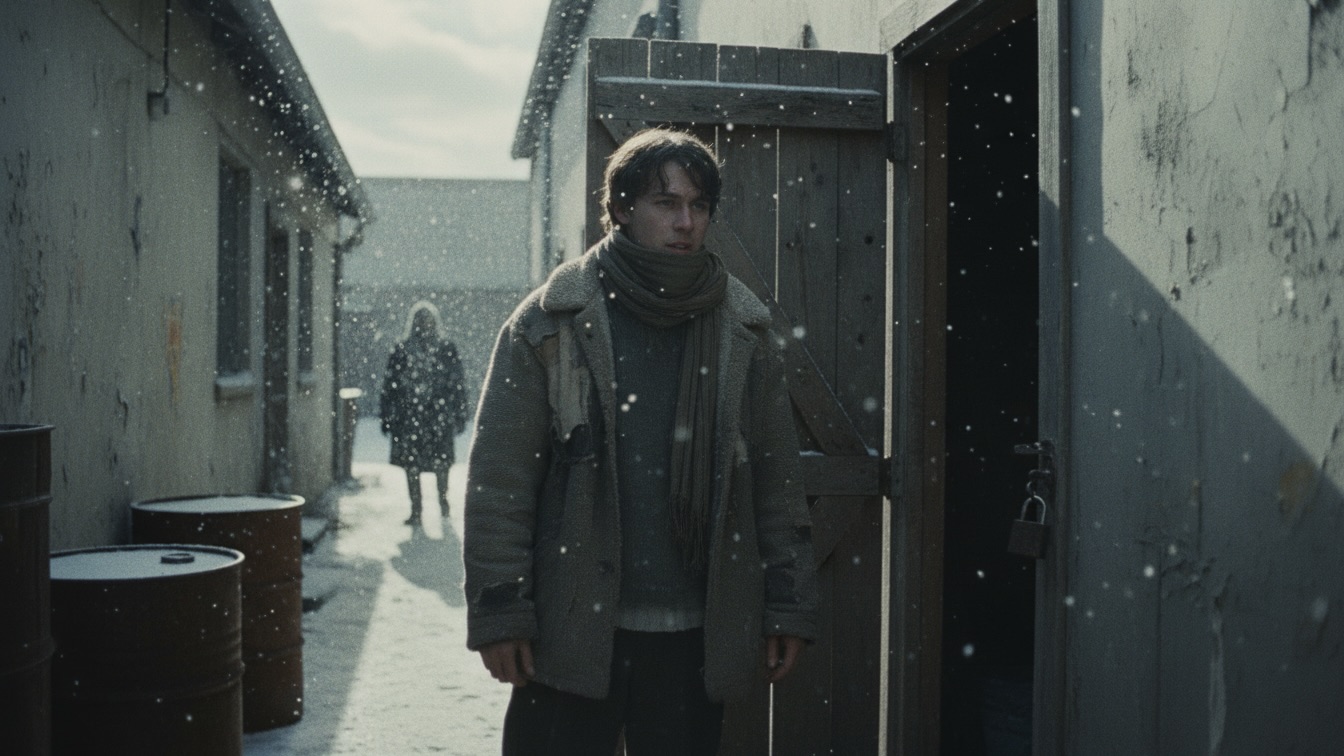
The narrative centers on Jude, a desperate survivor in a freezing, post-apocalyptic cityscape, struggling to open a jammed padlock on a shed. His objective is to retrieve essential supplies—specifically generator fuel and a wrench for a filtration unit—to keep his settlement’s life support systems running. As he battles the physical pain of the extreme cold and the mechanical stubbornness of the lock, he is surrounded by the threatening auditory backdrop of a violent civil protest occurring nearby. His futile efforts are interrupted by the arrival of a mysterious, ragged figure who emerges from the shadows.
This stranger, possessing a cynical demeanor and a specialized lock-picking tool, confronts Jude about his desperation. After a tense exchange regarding the nature of survival and the futility of altruism, the stranger effortlessly picks the lock. However, this assistance comes with a menacing condition: Jude must meet the stranger alone at the old radio tower at sunrise. The chapter concludes with the shed door finally open, but Jude is left paralyzed by the weight of the ominous pact he has just struck, caught between the immediate danger of the riot and the future threat posed by his savior.
The primary theme permeating the text is the antagonistic nature of the environment, where the physical world is not merely a setting but an active oppressor. The cold is personified as a malicious entity that bites, stings, and actively works against human survival. This anthropomorphism extends to inanimate objects; the lock is described as having a "pathology" and offering "deliberate malice." This reflects a psychological state where the protagonist feels the universe is conspiring against him, transforming a mechanical failure into a personal persecution. The cold serves as a metaphor for the emotional and societal entropy of this dystopian world, slowing down progress and numbing the human spirit.
Parallel to the environmental hostility is the theme of societal collapse and the erosion of community. The background noise of the protest acts as a Greek chorus of chaos, signaling that the macrocosm of society is breaking down just as the microcosm of Jude’s specific task is failing. The text juxtaposes the "clean, urgent shriek" of old sirens with the "ragged, broken sound" of the current ones, illustrating a degradation of order. The crowd’s demands for food and relief are framed as futile cries into an indifferent void, reinforcing the idea that the systems meant to protect humanity have disintegrated into noise and violence.
Furthermore, the story explores the concept of transactional survival. In this harsh reality, altruism is portrayed as a relic of the past. Jude acts out of a sense of communal duty to his settlement, driven by the need to keep the filtration unit running for the collective good. In stark contrast, the stranger operates on a philosophy of self-interest and leverage. The assistance provided is not an act of kindness but a calculation. The interaction highlights a shift in moral paradigms where "attention is a currency" and every action requires a payment, suggesting that in extreme survival scenarios, moral debts are more dangerous than physical ones.
Jude serves as the archetype of the burdened survivor, a man crushed by the weight of responsibility and the relentless nature of his environment. His internal monologue reveals a deep-seated sense of inadequacy and guilt. He repeatedly internalizes external failures, blaming himself for forgetting thick gloves or for the lock not turning. This refrain of "Always his fault" indicates a depressive cognitive pattern where he assumes total liability for circumstances largely beyond his control. He is driven not by hope, but by a fear of the consequences of failure—specifically, the death of his settlement.
Psychologically, Jude exhibits signs of chronic stress and hyper-vigilance, yet he is paradoxically numbed by the cold. He projects his anxieties onto the objects around him, imagining the key giggling or the lock mocking him. This projection is a defense mechanism, allowing him to externalize the overwhelming despair he feels. Despite his fragility and the "dull throb" of his freezing limbs, he possesses a stubborn resilience. He refuses to leave the alley without the supplies, demonstrating a fierce commitment to his community that overrides his instinct for self-preservation. However, his passivity in the face of the stranger reveals his vulnerability; he is physically and emotionally exhausted, making him susceptible to manipulation.
The stranger functions as a foil to Jude, representing adaptation to the new, harsh world. Where Jude is frantic and clumsy, the stranger is fluid and precise. He moves with "deliberate grace" and speaks with a "dry, humorless" cynicism that suggests he has long abandoned the societal norms Jude still clings to. He is a predator in this ecosystem, stalking silently and observing Jude’s struggle before revealing himself. His ability to open the lock with a specialized tool—described with surgical precision—marks him as someone who has mastered the mechanics of this broken world.
His motivation is distinct from Jude's communal altruism; he is driven by curiosity and the acquisition of leverage. He views Jude’s struggle with amusement and condescension, referring to him as "little spark." This nickname implies he sees Jude’s hope and effort as fragile and fleeting. By forcing Jude into a future meeting, he exerts dominance, transforming a chance encounter into a binding contract. He embodies the chaotic neutral element of the wasteland—helpful only when it serves his own obscure and threatening agenda.
The narrative voice is strictly third-person limited, closely adhering to Jude’s sensory experience and psychological state. This intimacy creates a claustrophobic atmosphere, trapping the reader within Jude’s freezing body and anxious mind. The pacing mirrors the action of the lock; it begins slowly and repetitively, emphasizing the grinding frustration of the jammed mechanism. As the stranger arrives and the riot intensifies, the pacing accelerates, shifting from introspection to tense dialogue, culminating in the swift, decisive action of the lock picking and the sudden, open-ended conclusion.
Sensory imagery is utilized aggressively to establish the tone. The author relies heavily on tactile and auditory details to convey the misery of the setting. The cold is not just described but felt through words like "biting," "stinging," "sandpaper," and "crystalline." The auditory landscape is equally vivid, with the "metallic snarl" of the lock contrasting with the "guttural roar" of the crowd. These sounds are layered to create a symphony of decay, where mechanical clicks are drowned out by the organic chaos of the riot.
The tone is relentlessly grim, characterized by a sense of decay and futility. The prose frequently employs similes and metaphors related to death and breaking: the breath is a "ghost," the sirens sound like a "dying animal," and the wires are "frozen veins." This consistent use of morbid imagery reinforces the existential threat facing the protagonist. Even the moment of success—the opening of the lock—is framed not as a victory, but as a defeat for the lock and the beginning of a new danger for Jude, maintaining the tension and denying the reader any true catharsis.