Format: Short Film / Anthology Episode | Est. Length: 10-12 minutes
Imagine an anthology series, The Divide, where each episode explores a pivotal moment when individuals from starkly different worlds collide. From a concert pianist falling for a demolition expert to a politician finding solace with an off-grid survivalist, the series examines whether love can bridge the fundamental gaps in class, culture, and worldview. "Terminal Velocity" serves as a poignant episode within this framework, focusing on the volatile intersection of sterile academia and the rugged, unpredictable wilderness, asking if two people who require different "environments" can create a sustainable ecosystem together.
A disheveled academic, his suit ruined and his composure shattered, sprints through a sterile airport terminal. He is a system in total collapse, desperately trying to stop the one variable he can't control from boarding a plane and leaving his life forever.
A rigidly controlled professor must abandon logic and embrace chaos to stop his rugged, wilderness-guide partner from leaving him for good. His last chance is a desperate, life-altering confrontation at the departure gate, where he must prove that their two opposing worlds are not just compatible, but essential to one another.
The primary theme is the conflict between Order and Chaos, embodied by the two protagonists. Yuki represents a life of sterile, predictable control—a "monoculture" of data and routine—while Kaito represents the messy, unpredictable, and vital variables of the natural world. The episode uses scientific and ecological metaphors to explore the idea that true strength and resilience in a system, whether ecological or emotional, comes not from uniformity but from symbiotic diversity.
A secondary theme is the courage required to abandon a "safe" but unfulfilling life. Yuki has achieved the success he was programmed to want—tenure, respect, stability—but realizes it is a gilded cage. The story is about the terrifying but necessary act of shattering that cage for a chance at a life that is authentic, messy, and truly alive.
The stakes are profoundly personal and absolute for both men. For Yuki, failure means losing Kaito and being condemned to the "flat line" he envisions: a sterile, emotionally hollow existence of academic success that he now recognizes as meaningless. For Kaito, the stakes are the final, devastating heartbreak of accepting that the man he loves cannot or will not bridge the gap between their worlds, forcing him back into a solitary life he no longer wants. At risk is not just their relationship, but their last chance at a shared, authentic future.
The central conflict is Yuki's internal war between his ingrained need for control and his desperate love for Kaito. His own fear, his reversion to "protocol" under pressure, and his history of prioritizing his career are the primary antagonistic forces he must overcome. Externally, he faces the literal ticking clock of the flight's final boarding call and the physical barrier of the gate. Kaito’s hardened skepticism and emotional self-protection also serve as a significant obstacle; he is no longer willing to accept empty promises and forces Yuki to make a concrete, undeniable commitment.
Yuki, a brilliant but emotionally repressed professor, arrives at an airport terminal in a state of total disarray, having abandoned a prestigious tenure review to stop his partner, Kaito, from leaving for a remote job in Alaska. The initial confrontation at the gate is fraught with tension and misunderstanding, as Kaito, hurt and resigned, sees Yuki's appearance as just another chaotic scene from a man who hates them. He urges Yuki to return to his orderly, academic life, believing their worlds are fundamentally incompatible.
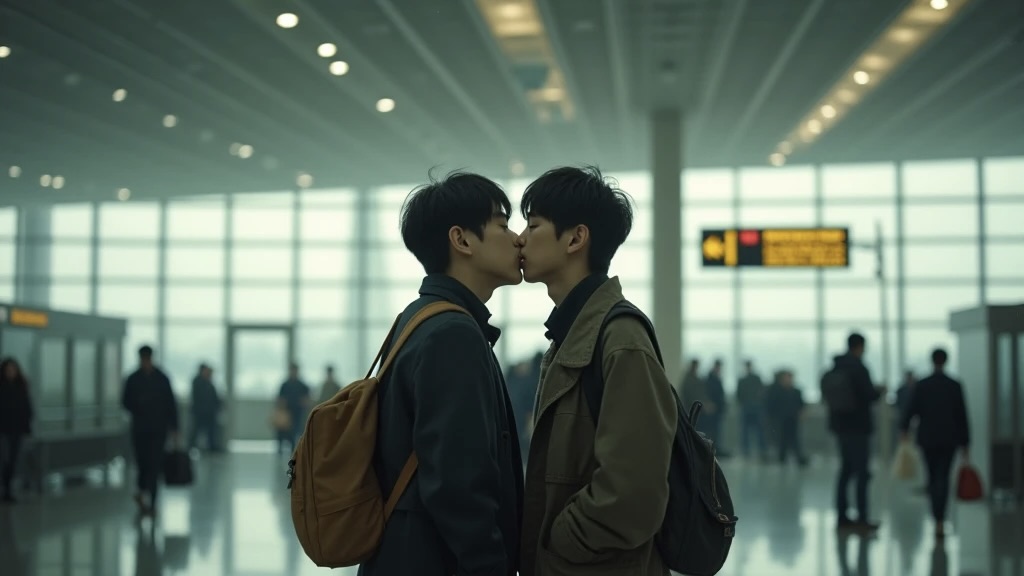
Pushed to his breaking point, Yuki finally sheds his logical facade and confesses the terror of a future without Kaito, framing his love in the only language he truly understands: scientific theory. He argues they are a symbiotic ecosystem, each necessary for the other's survival and growth, and backs his plea with a life-altering promise to abandon his tenure track and join Kaito in the field. The sincerity of this sacrifice shatters Kaito's defenses, leading to a desperate, passionate kiss just as the gate to the jetway closes, sealing their decision and stranding them together to figure out what comes next.
YUKI: A brilliant academic whose life is a fortress of order, routine, and intellectual control. At the start of the story, his fortress has been breached by overwhelming emotion, leaving him a disheveled, panicked mess. His Psychological Arc is a journey from intellectual abstraction to visceral, emotional truth, forcing him to realize that the control he craves is a prison and that a meaningful life requires embracing the messy, unpredictable "variables" that Kaito represents. He ends the story stripped of his professional dignity but more rational and alive than ever, ready to trade his sterile lab for a life of "mud."
KAITO: A rugged, pragmatic field specialist who is deeply in love with Yuki but has been worn down by their seemingly incompatible lifestyles. He begins the story in a state of defensive resignation, having accepted what he believes is the painful truth that Yuki will never truly choose him over the safety and prestige of his career. His Psychological Arc is about allowing himself to hope one last time, moving from a guarded, self-protective stance to cautiously accepting Yuki's radical, desperate plea. He ends the story with his hope renewed, ready to lead them both into the uncharted territory of their new shared life.
THE CHASE: Yuki, a wreck in a ruined suit, bursts into the sterile airport concourse, his panic a stark contrast to the indifferent flow of travelers. He spots Kaito standing stoically at Gate B7, the physical distance between them a potent symbol of their emotional chasm. The world rushes on around them, oblivious to the singularity forming as Yuki prepares to cross the divide.
THE CONFRONTATION: The initial exchange is clipped and painful, with Kaito using Yuki’s disheveled appearance as proof of their incompatibility. Yuki’s attempts to explain are dismissed as rambling, highlighting his inability to communicate outside of data points. Kaito’s tired plea for Yuki to "go home" establishes him as the gatekeeper to their future, a barrier Yuki must overcome with more than just panicked words.
THE BREAKDOWN (MIDPOINT): When Kaito accuses him of lying, Yuki finally shatters, confessing his terror of a life without him, describing it as a "flat line" of meaningless data. This is the turning point where Yuki abandons intellectual defense for raw emotional vulnerability. He is no longer arguing a point; he is pleading for his life.
THE HYPOTHESIS: Kaito counters with the practical, seemingly insurmountable differences in their lives, calling them "different species." This allows Yuki to pivot onto familiar ground, refuting Kaito's claim with a passionate lecture on ecology. He reframes their differences not as a flaw but as a strength, arguing they are a "symbiotic ecosystem" that requires both of their unique elements to thrive.
THE CLIMAX: Yuki makes his argument concrete by vowing to apply for a field grant to join Kaito in the Yukon, a tangible sacrifice of the career he has built. As the gate agent announces the flight is officially closed, the finality of the moment hangs in the air. Seeing absolute conviction in Yuki's eyes, Kaito closes the distance and pulls him into a desperate, passionate kiss that serves as a public declaration and the final, shattering acceptance of Yuki's plea.
THE AFTERMATH: The plane retracts, leaving them behind in the quiet aftermath of their emotional storm. The tension breaks, replaced by gentle humor and profound relief as they find a place to sit and process their new reality. They end the episode hand-in-hand, walking against the flow of traffic toward the food court, leaving the gate and their old lives behind for good.
The episode begins with a tone of high-strung anxiety and desperation, mirroring Yuki's frantic state of mind. This transitions into a tense, painful standoff at the gate, heavy with the weight of unspoken history and imminent loss. The emotional peak is a cathartic explosion of vulnerability and passion during Yuki's confession and their subsequent kiss, providing a powerful release for both the characters and the audience. The story then resolves into a warm, intimate, and hopeful quietude, leaving the viewer with a feeling of deep satisfaction and the gentle humor of two people starting a new, uncertain adventure together.
If expanded into a series, Season 1 would follow Yuki and Kaito's attempt to build their "symbiotic ecosystem" in the harsh reality of the Yukon. The central conflict would test Yuki's romantic declaration against the grueling, muddy truth of fieldwork, forcing him to develop practical skills and emotional resilience he's never needed. Kaito, in turn, would be challenged to be a patient teacher and to trust Yuki's commitment, while also navigating the intrusion of Yuki's academic world (grant proposals, video calls with the department) into his wilderness sanctuary.
The season-long arc would explore whether their love is strong enough to survive the actual merger of their worlds, not just the idea of it. Subplots could involve a rival research team competing for the same grant, a dangerous environmental event that tests their combined skills, and a visit from one of Yuki's skeptical academic colleagues. The season would culminate in them either successfully publishing their first joint study—a literal testament to their symbiosis—or facing a crisis that proves their hypothesis was tragically wrong.
The visual style will be one of stark contrasts. The airport terminal is shot with a cold, desaturated color palette—all blues, grays, and sterile whites—using clean, static frames and wide shots to emphasize Yuki's isolation within the impersonal environment. The camera on Yuki will initially be handheld and frantic, reflecting his internal chaos. As the emotional core of the scene unfolds, the cinematography will shift to intimate, warm-toned close-ups, focusing on micro-expressions, the texture of Kaito’s jacket, and the raw emotion in their eyes.
The tone is a blend of intense romantic drama and character-driven realism, reminiscent of the contained, dialogue-heavy intimacy of Andrew Haigh's Weekend (2011) or the emotional vulnerability of Portrait of a Lady on Fire (2019). The goal is to create a naturalistic, grounded world where the high-stakes emotional drama feels both epic and deeply personal. The airport's ambient sound design—the robotic announcements, the rolling luggage, the distant chatter—will be used to create a soundscape that heightens the feeling of our characters being in a private bubble against the world.
The target audience is adults aged 25-55 who gravitate towards character-driven, emotionally intelligent dramas and independent cinema. It will appeal strongly to fans of LGBTQ+ romance and relationship-focused stories like HBO's Looking or anthology series such as Modern Love. The episode is for viewers who appreciate nuanced performances and sophisticated, dialogue-rich storytelling over action or high-concept spectacle.
For a 10-12 minute runtime, the pacing is urgent and compressed, mirroring the "final call" deadline of the flight. The story follows a clear three-act structure contained almost entirely within a single location. Act One is Yuki's frantic arrival (1-2 mins). Act Two is the long, escalating confrontation at the gate, which forms the emotional and narrative core of the piece (6-8 mins). Act Three is the short, quiet resolution after the plane has departed, serving as a gentle denouement and a hopeful look toward the future (2 mins).
This is a contained, performance-driven piece, making it relatively budget-friendly. The primary production consideration is securing an airport terminal location or a convincing set. The key to success lies in casting two actors with exceptional chemistry who can carry a long, emotionally demanding dialogue scene and convey a deep, shared history through subtle looks and gestures.
Costuming and production design are crucial for visual storytelling. The contrast between Yuki's expensive but disheveled suit (Brooks Brothers meets train wreck) and Kaito's worn, practical field gear (Carhartt, flannel, scuffed boots) immediately communicates their conflicting worlds. Smudging on Yuki's glasses, the lack of a belt, and the frayed strap on Kaito's duffel are small but vital details that ground the characters in reality.