The absence of a leather strap around a waist becomes the fulcrum upon which an entire existence pivots, transforming a mundane wardrobe malfunction into a somatic signal of total systemic failure. This missing bind acts as the physical manifestation of a psychological unraveling, where the friction that holds a carefully curated persona together suddenly vanishes, leaving the subject exposed to the relentless pull of gravity. It is an unmooring that feels less like freedom and more like a terrifying structural collapse, where the tightness of control is replaced by the loose, terrifying slide of vulnerability. In this state of disarray, the man is no longer a cohesive unit of social propriety but a collection of sliding variables, forcing him to clutch at the fabric of his own life lest it pool hopelessly around his ankles.
The narrative operates within the framework of a high-stakes romantic drama, yet it subverts the typical tropes of the genre by filtering emotional confession through the lens of scientific rationalism. The central conflict is not merely interpersonal but philosophical, pitting the safety of a controlled environment against the chaotic vitality of the natural world. Yuki represents the "monoculture"—a system of high control and low resilience—while Kaito embodies the "mud," the messy, complex ecology that requires adaptation. The chapter functions as a critique of the sterile life, suggesting that the pursuit of perfection and tenure is a form of stasis, whereas true survival requires the introduction of volatile variables.
The narrative voice is closely aligned with Yuki, trapping the reader inside his neurotic, hyper-analytical mind. This perspective highlights the limitations of his worldview; he perceives his environment through data points, temperature readings, and probabilities, initially failing to grasp the emotional undercurrents driving the scene. The "winter" and "cold" serve not just as setting details but as the narrative threat that Yuki must choose to embrace. His fear of the cold—of the Yukon, of the dark—is synonymous with his fear of the uncontrollable aspects of intimacy. By the chapter's end, the narrative arc bends toward the acceptance of this chill, reframing the harshness of the elements as a necessary condition for growth rather than a hazard to be avoided.
Morally and aesthetically, the text explores the concept of "terminal velocity" as a necessary collision with reality. The airport setting is crucial here; it is a "non-place," a transient zone of indifferent air-conditioning that stands in stark contrast to the visceral reality of the proposed destination in the Yukon. The story suggests that moral courage is found not in the maintenance of order, but in the willingness to disrupt it. The "singularity" forming at Gate B7 challenges the existential dread of a "flat line" life. The characters must decide whether to exist as observers behind glass or to step into the "mud," accepting that the messiness of the world is the only place where genuine connection can take root.
Psychological State:
Yuki begins the chapter in a state of acute cognitive dissonance and physiological distress. His panic is palpable, manifested in the physical "heaving" of his chest and the "entropic collapse" of his attire. He is a man who relies on external structures—belts, ties, schedules—to regulate his internal chaos. The loss of these signifiers strips him of his defense mechanisms, forcing a raw, unfiltered confrontation with his desires. The cold of the winter outside initially represents a threat to his homeostasis, mirroring his fear of emotional exposure.
Mental Health Assessment:
Yuki exhibits traits consistent with obsessive-compulsive tendencies or a high-functioning anxiety disorder, where control is paramount to functioning. He intellectualizes emotions as a coping mechanism, translating feelings into "data points," "simulations," and "probabilities" to render them manageable. However, his resilience is surprisingly high; when his primary protocol (order) fails, he successfully pivots to a secondary, albeit chaotic, survival strategy (pursuit). His willingness to abandon the "tenure track"—his primary source of validation—suggests a breakthrough moment where he recognizes that his current coping mechanisms are maladaptive and leading to emotional stagnation.
Motivations & Drivers:
His primary motivation is the aversion to a "sterile" future. The terror of a life without Kaito outweighs the terror of social embarrassment or professional suicide. He is driven by a sudden clarity that his "control group" lifestyle is a slow death. The winter environment of the Yukon becomes the new variable he seeks; he is motivated to trade the safety of the lab for the "longitudinal study" of a life shared with Kaito.
Hopes & Fears:
Yuki fears the "flat line," a life of meaningless data devoid of connection. He fears becoming theoretical. Conversely, he harbors a latent hope for "mud"—for the messiness of real life that he has rigorously excluded. He hopes that his capacity for adaptation is greater than his need for control, trusting that he can "buy lamps" to survive the metaphorical and literal darkness of a winter in the north.
Psychological State:
Kaito presents as exhausted and guarded, occupying a state of depressive realism. He has accepted the end of the relationship as a painful but necessary fact, evidenced by his "defensive" posture and the "bruised confusion" in his eyes. He is less reactive than Yuki, grounded by a heavy sadness that contrasts with Yuki’s frantic energy. The winter light washing over him emphasizes his exposure; he is already out in the cold, psychologically speaking, having accepted the harshness of separation.
Mental Health Assessment:
Kaito appears psychologically robust but weary. He demonstrates a healthy intolerance for inauthenticity, rejecting the "polite lie" in favor of painful truth. His mental health seems contingent on congruence between his environment and his internal self; he cannot thrive in Yuki's "air-conditioned" world. He is a survivor, accustomed to "cedar smoke" and "frayed straps," indicating a resilience built on enduring discomfort rather than avoiding it.
Motivations & Drivers:
Kaito is driven by a need for genuine connection or, failing that, a clean break. He attempts to leave because he refuses to be a "house pet" or a hidden aspect of Yuki's life. He challenges Yuki not out of malice, but out of a desire to force a decision. He wants to be integrated into an ecosystem, not kept as a separate specimen.
Hopes & Fears:
His greatest fear is being a secret, an embarrassment hidden away from "faculty dinners." He fears the incompatibility of their "species." However, his hope is revealed in the fracturing of his hard expression; he desperately wants Yuki to prove the hypothesis of incompatibility wrong. He hopes that Yuki will finally choose the "mud" over the marble, validating their relationship as something that can survive the harsh winter of reality.
The emotional trajectory of the chapter follows a curve of escalating tension that resolves into a grounded, quiet intimacy. It begins with high-kinetic anxiety, characterized by Yuki’s physical exertion and the sensory overload of the terminal. The "recycled ozone" and "copper tang" establish a physiological baseline of panic. This tension is not merely internal but spatial, measured in the "oceanic trench" of distance between the two men. The cold, indifferent atmosphere of the airport acts as a pressurizer, containing the emotional explosion until it becomes unavoidable.
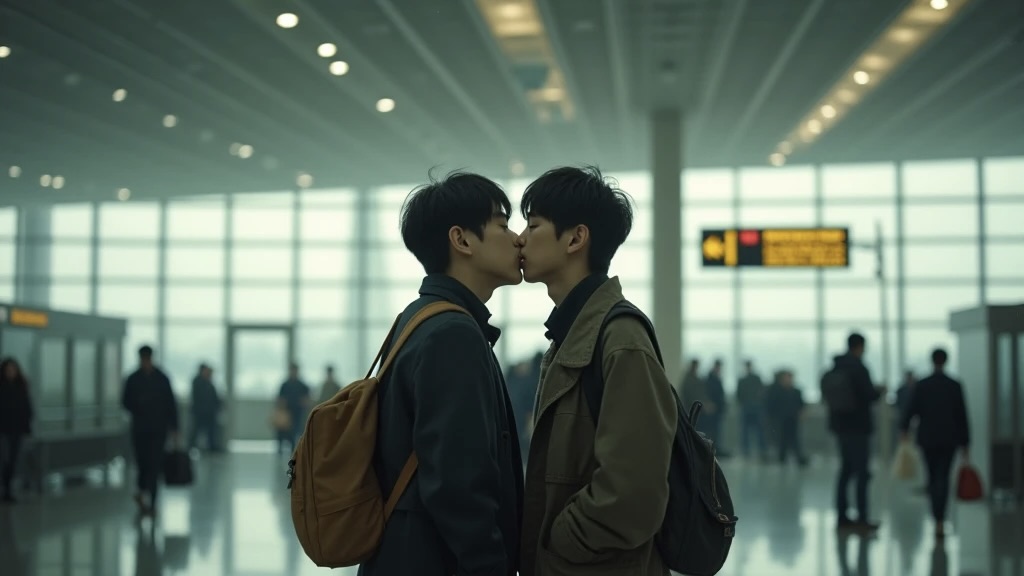
As the dialogue commences, the emotion shifts from panic to intellectual desperation. Yuki attempts to bridge the emotional gap using the only language he trusts: science. This creates a unique friction—a "symbiotic ecosystem" of logic and passion. The tension here is derived from the risk of translation; Yuki is trying to convey love through the terminology of biology. The turning point occurs when the intellectual barrier collapses, and Yuki admits to wanting the "mud." This admission acts as an emotional release valve, transforming the sterile tension of the argument into the raw, tactile reality of the kiss.
The aftermath of the climax brings a profound deceleration. The "terminal velocity" is reached, and the impact is not fatal but grounding. The emotional architecture shifts from the vertical (the looming plane, the high stakes) to the horizontal (sitting in chairs, the flat line of the horizon). The shared humor about the belt and the "inefficiency" replaces the high drama with domestic comfort. The winter outside is no longer a threat but a backdrop for their new shared reality, changing the tone from frantic desperation to a warm, "buoyant" exhaustion.
The setting of the airport terminal is instrumental in mirroring Yuki’s internal state while simultaneously acting as the antagonist he must defeat. Airports are liminal spaces—transitions between where one was and where one is going. For Yuki, the terminal represents the "soulless sixty-eight degrees" of his current life: regulated, predictable, and ultimately indifferent to his suffering. The "glass partitions" and "security scanners" reflect the barriers he has erected around his own psyche, transparent but impenetrable walls that keep him observing life rather than living it.
Conversely, the looming winter outside—the "white whale" of the plane and the destination of the Yukon—represents the chaotic unconscious. The cold is the domain of Kaito, a place of "cedar smoke" and "holes in the ground." By crossing the terminal to Gate B7, Yuki is physically traversing the landscape of his own repression. The "gray, industrial carpet" represents the safe, known path, while the "linoleum" marks the transition point. When they finally sit together, turning their backs on the departing flights, they create a micro-environment of intimacy within the sterile vastness, effectively reclaiming the space from its impersonal function.
The prose utilizes a distinct lexicon of scientific and industrial terminology to articulate profound emotional truths. Words like "entropic," "singularity," "monocultures," and "variables" are weaponized by Yuki to deconstruct his own defenses. This diction creates a rhythmic counterpoint to the romantic action; the more desperate Yuki becomes, the more clinical his language gets, until the emotional weight shatters the jargon. The rhythm of the dialogue is sharp and percussive, mimicking the "click" of dress shoes and the "robotic voice" of the announcements, before softening into the "murmur" of the conclusion.
Symbolism is heavily anchored in clothing and physical constraints. The missing belt is the primary symbol of Yuki’s loss of control; without it, he literally cannot hold his public image together. The "perfect Windsor knot" hanging like a "noose" suggests that his previous perfection was suffocating him. The "mud" serves as a recurring motif for the messiness of intimacy and life itself, contrasted against the "sterile" lab. The "white whale" metaphor for the plane elevates the scene to a mythic quest, implying that Kaito is the elusive truth Yuki has been hunting.
The imagery of the "glass wall" shattering is central to the chapter’s resolution. Yuki has spent ten years behind a barrier of intellect and propriety. The public kiss is the physical act of breaking that glass. The "cedar smoke" scent acts as an olfactory anchor, a sensory detail that cuts through the "recycled ozone" of the artificial world, grounding Yuki in the organic reality of Kaito.
The narrative draws upon the archetype of the "Ivory Tower" intellectual descending into the underworld or the wilderness to retrieve a lost soul—a variation of the Orpheus myth, though here, the protagonist chooses to stay in the underworld rather than lead the beloved out. It also engages with the "Odd Couple" dynamic, elevating it through the lens of ecological philosophy. The tension between the "Raw" and the "Cooked" (Levi-Strauss) is evident, with Kaito representing the raw, natural world and Yuki representing the cooked, cultured society.
The story situates itself within the tradition of winter narratives where the cold serves as a crucible for truth. In literature, winter often strips away the superfluous, leaving only the essential structure of things visible. Here, the prospect of the Yukon winter acts as a clarifying agent. It forces Yuki to evaluate what is essential for his survival. The "dark for six months" is not a void, but a canvas upon which they must paint their own light ("we'll buy lamps").
Furthermore, the text echoes the modern anxiety of the "non-place" (Marc Augé), exploring how human connection struggles to survive in the transient, commercialized spaces of late capitalism. The airport is designed for efficiency, not intimacy. By missing the flight—an act of supreme inefficiency—the characters rebel against the capitalist imperative of movement and productivity, choosing instead the unscripted stillness of the present moment.
What remains with the reader is the visceral sense of relief that comes from the abandonment of dignity. The story validates the terrifying notion that one must sometimes dismantle one's life to save it. The image of a distinguished professor holding up his trousers while running through an airport lingers not as comedy, but as a poignant portrait of desperation. It forces the reader to question their own "belts"—the small, invisible constraints they accept daily to maintain a facade of control.
The "cold" of the Yukon remains a haunting but hopeful prospect. The story does not promise a "happily ever after" in the traditional sense; it promises a struggle. The reader is left contemplating the reality of the "mud" Yuki has asked for. There is a lingering intellectual satisfaction in the argument that love is an ecosystem, requiring diversity and friction to thrive. The metaphor of the "monoculture" dying resonates beyond the relationship, serving as a broader commentary on the dangers of a homogenized, risk-averse life.
Ultimately, the chapter leaves behind the taste of "salt and coffee"—a blend of tears, sweat, and stimulation. It evokes the feeling of a threshold crossed. The silence of the breakfast scene, contrasted with the earlier noise, creates a resonant space where the reader can feel the weight of the decision made. The departure of the plane without them is a powerful image of missed opportunity transformed into seized destiny, leaving the reader with the quiet thrill of the unknown.
The sensation that persists is not the warmth of the reconciliation, but the bracing chill of the open door. The air conditioning of the terminal, once a symbol of sterile indifference, now feels like a thin membrane separating the characters from the vast, unmapped territory of the Yukon winter. The narrative leaves us suspended in the quiet hum of the food court, a temporary shelter before the inevitable exposure to the elements. It is a stillness that vibrates with the promise of frost, suggesting that the true test of their "symbiotic ecosystem" will not be found in the grand gesture at the gate, but in the long, dark months where the only heat source is the friction between their differing natures.
We are left with the image of the "mud" not as a dirty inconvenience, but as the primordial soup of a new existence. Yuki’s acceptance of the dirt, the cold, and the inefficiency of a life without a belt marks a fundamental shift from observer to participant. The story closes not on a period, but on an ellipsis—a breath of white vapor rising in the cold air, signaling that the simulation has ended and the chaotic, unquantifiable experiment of living has finally begun.