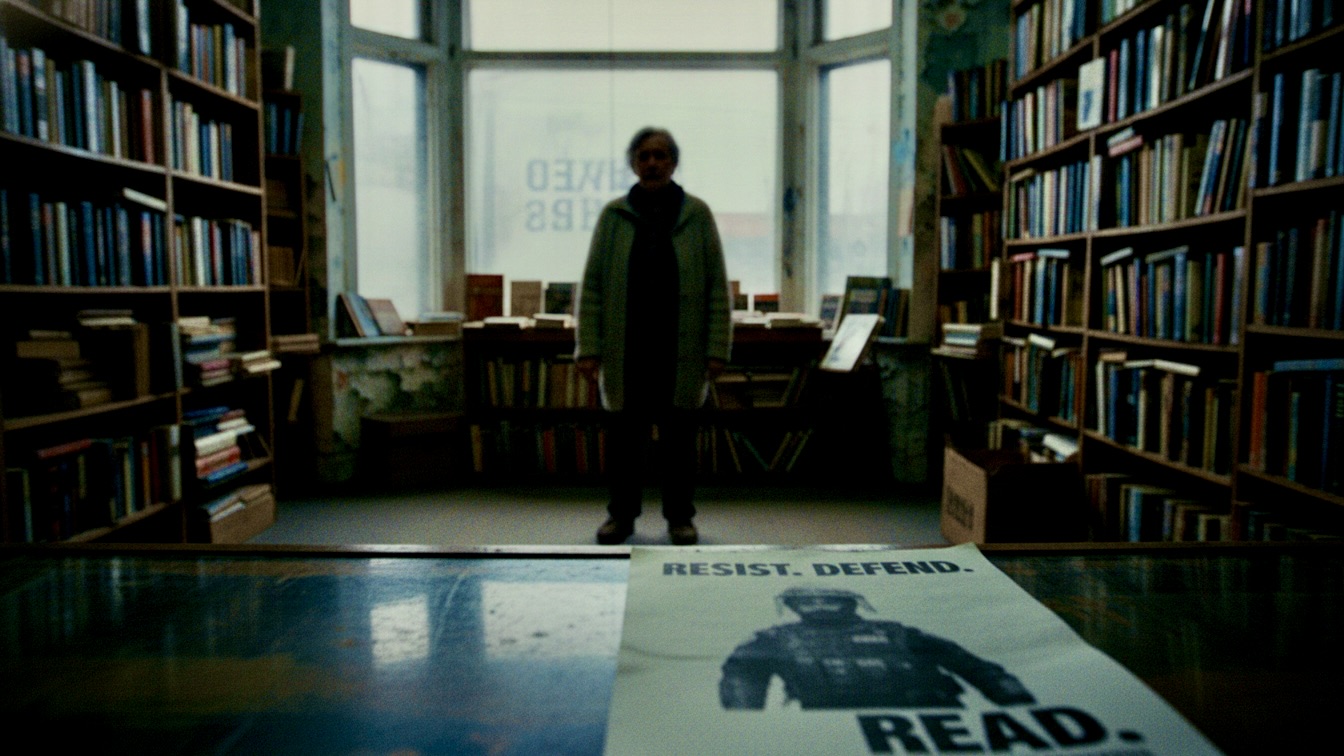
Format: Short Film / Anthology Episode | Est. Length: 10-12 minutes
Imagine "Dust on the Shelves" as a standalone episode within a grounded, near-future anthology series titled The Quiet War. Set in a politically fractured Western nation, the series explores the lives of ordinary citizens caught in the crossfire of escalating civil unrest and encroaching authoritarianism. Each episode is a taut, character-driven vignette, revealing how individuals navigate the collapse of civil norms, with overarching narrative threads connecting the federal government's crackdown, the motivations of protest movements, and the moral compromises made by those just trying to survive.
An elderly woman’s quiet, orderly world is violated not by the city-wide strike notice plastered on her bookstore’s door, but by the ugly strip of packing tape used to affix it. This small act of disrespect triggers a deep-seated anger, setting the stage for a confrontation with the very chaos she has spent a lifetime avoiding.
An elderly refugee who survived a totalitarian regime by building a life of quiet invisibility must confront her traumatic past when she gives shelter to a young protestor. The encounter forces her to decide between the safety of her silence and the moral imperative to finally make a stand.
The central theme is the conflict between Silence and Noise as modes of survival and resistance. Elena embodies a philosophy of quiet endurance, believing that invisibility is safety, a lesson learned from the brutal efficiency of a past regime. In contrast, the protestors and the federal patrols represent the loud, chaotic nature of open conflict, a world of slogans and force she finds naive and terrifying. The story explores whether true resistance is a quiet, internal act of preservation or a loud, external act of defiance, ultimately arguing that the silence cultivated for survival can become its own form of prison.
A secondary theme is the cyclical nature of history and the haunting power of unresolved trauma. Elena's past is not a distant memory but a living ghost that informs every decision she makes in the present. The episode posits that personal and political histories are doomed to repeat themselves, and that confronting the ghosts of the past is the only way to break the cycle, both for an individual and for a society teetering on the brink of tyranny.
The immediate stakes for Elena are her physical safety and the sanctity of her bookstore, the last bastion of the life she painstakingly built. By opening her door to the protestor, Lara, she risks being targeted by the federal patrols and losing the anonymity that has protected her for decades. For Lara, the stakes are her freedom and potentially her life, as she is being actively hunted by government forces. On a deeper level, what is at stake for Elena is her soul and the very meaning of her life's philosophy; she must risk everything she has built to reclaim the part of herself she was forced to bury as a child.
The primary external conflict is between the citizens and an increasingly authoritarian state, embodied by the faceless, black-clad federal patrols. This conflict manifests as the city-wide strike, the chaotic protests, and the violent crackdown that drives Lara to Elena's door. The antagonistic forces are not just the government agents, but the entire atmosphere of civil unrest that threatens to shatter Elena's carefully constructed peace. Internally, Elena is at war with her own deeply ingrained trauma; her survival instinct, which screams at her to remain silent and uninvolved, is pitted against a reawakening conscience and the repressed rage of a childhood tragedy, forcing a battle over the very definition of survival.
Elena, an elderly bookstore owner and survivor of a past totalitarian regime, finds her quiet life disrupted by a city-wide general strike. Enraged by the violation of her sanctuary, she isolates herself inside, clinging to the silence that has been her lifelong shield. Her solitude is shattered when a terrified young protestor, Lara, begs for refuge from the federal patrols cracking down on the demonstration outside.
Elena reluctantly grants Lara shelter but unleashes a lifetime of bitter wisdom upon her, scorning the futility of loud protest and championing the quiet endurance of a survivor. After the danger passes and Lara leaves, Elena discovers a protest flyer left behind. The grainy image of a federal agent triggers a vivid, traumatic memory of soldiers in black uniforms dragging her father away decades ago, forcing her to realize that her cultivated silence was not a strategy for peace, but an act of surrender. In a stunning reversal, she locks her beloved store from the outside and walks with quiet determination toward the chaos, ready to confront the ghosts of her past.
Elena (80s): A Polish immigrant and bookstore owner, Elena is a fortress of quiet dignity and deep-seated trauma. Psychological Arc: She begins the story as a firm believer in silence and invisibility as the only rational means of survival, viewing the noisy protests outside as childish and dangerous. The encounter with Lara and the subsequent triggering of her childhood memory forces her to re-evaluate her entire life, leading to the profound realization that her silence has been a form of complicity. She ends the story by shedding her fear, not by shouting, but by taking the resolute, terrifying step of walking into the conflict, transforming from a passive survivor into an active, albeit silent, witness.
Lara (20s): A young, idealistic protestor who serves as the catalyst for Elena's transformation. She is passionate and committed to the cause but is also naive about the true brutality of the forces she is opposing. Psychological Arc: Lara begins with a certainty in her righteous cause, believing in the power of signs and slogans. Her terrifying chase and subsequent confrontation with Elena's harsh, lived experience momentarily shatters her idealism, forcing her to confront the real-world consequences of her actions. She leaves Elena’s shop humbled and shaken, but having unknowingly ignited the spark of true resistance in the old woman.
The Violation: Elena, a ghost in her own window, confronts the ugly strip of tape on her bookstore door, a symbol of the world's chaos encroaching on her sanctuary. Her internal monologue reveals a life built on the principle of being left alone, a principle that has just been violated. The distant sound of chanting underscores her isolation.
The Intrusion: A sudden, violent banging on the door shatters the store's dead silence, sending a shock of pure adrenaline through Elena. A terrified young woman, Lara, pleads for entry through the glass, her eyes wide with a familiar terror that pierces Elena's decades-old defenses. Against every instinct, Elena’s hand moves to the deadbolt.
The Lecture (Midpoint): Inside, Elena unleashes a cold, bitter lecture on the naive girl, equating her protest with a childish tantrum and extolling the virtues of silence and hiding. She points to the strike notice on the door, accusing Lara of running to the very sanctuary she helped deface. The generational and philosophical gulf between them is a vast, unbridgeable chasm.
The Catalyst: After Lara flees back into the street, Elena discovers a crumpled protest flyer on the floor, an unwanted piece of the chaos left in her quiet space. Her first instinct is to destroy it, to purge the intrusion and restore order to her world. She stoops to pick it up, her body protesting the movement.
The Climax: The flyer's grainy photo of a faceless federal agent dissolves into a visceral flashback of two black-uniformed soldiers storming her childhood apartment and dragging her father away. The smell of old paper is replaced by the phantom scent of boiled cabbage and fear as her mother's silent, terrified face burns into her memory. In this moment, Elena understands that her lifelong silence was not strength, but the very thing her father's captors demanded of her.
The March: Galvanized by a cold, ancient rage, Elena moves with a new, jerky purpose, grabbing her coat and keys. She stands on her stoop, the sounds of the protest now a siren's call rather than a threat. She locks the door to her life's work behind her and begins a steady, determined walk directly toward the line of federal agents, a single, quiet figure marching into the heart of the noise.
The episode begins with a mood of quiet, melancholic frustration, establishing Elena's orderly world and her resentment at its disruption. This shifts abruptly into high tension and fear with Lara's desperate arrival, creating a claustrophobic, suspenseful atmosphere inside the bookstore. The emotional peak of the second act is one of bitter, intellectual anger during Elena's confrontation with Lara, before plunging into the raw, traumatic horror of the flashback sequence. The final emotional state is one of chilling, quiet resolve; the audience is left with a sense of awe and terror as Elena walks toward an uncertain fate, her final act feeling both inevitable and profoundly shocking.
If expanded, Elena’s story could serve as a powerful inciting incident for a season-long narrative. Her solitary walk into the protest line could end ambiguously, with her becoming a martyr, a prisoner, or an unlikely symbol for the movement—the "Woman of the Bookstore." A subsequent season could follow other characters whose lives are touched by her act: the federal agent who confronted her, a journalist who captured the image, or Lara, who is radicalized by the memory of the old woman she dismissed.
The bookstore itself could become a contested space, a symbol of the "quiet war." The season could explore the escalating conflict through this single location, showing it transform from a sanctuary to a makeshift clinic, a resistance hideout, and finally, a casualty of the conflict. The overarching story would track the city's descent into open warfare, using Elena's legacy as a thematic touchstone to question the price of silence and the true cost of resistance.
The visual style will be built on a stark contrast between Elena's interior and exterior worlds. Inside the bookstore, the cinematography will be warm, intimate, and stable, using soft, dusty light, deep shadows, and slow, deliberate camera movements that reflect Elena's controlled existence. The color palette will be dominated by the warm tones of wood, aging paper, and cream-colored walls, creating a womb-like sense of safety.
Conversely, the world outside will be shot with a colder, desaturated palette of grays, blues, and blacks. The camerawork will be more dynamic and unsettling, employing subtle handheld movements and stark, high-contrast lighting to convey a sense of instability and danger. The tone is one of grounded, psychological realism, eschewing overt sci-fi elements for a palpable, near-future tension. Tonal comparables include the atmospheric dread and character focus of Children of Men and the intimate examination of surveillance and quiet defiance found in The Lives of Others.
The target audience is mature viewers (25-55+) who appreciate character-driven, psychological dramas and grounded speculative fiction. This includes fans of prestige television series like The Handmaid's Tale or Years and Years, as well as audiences for independent films that explore complex social and political themes. The episode is designed for a viewer who values nuanced storytelling and thematic depth over fast-paced action, and is comfortable with morally ambiguous and emotionally challenging narratives.
For a 10-12 minute runtime, the pacing will be deliberate and immersive. Act One will be a slow burn, establishing Elena's character and her sanctuary through quiet, observational moments. The pace will accelerate sharply in Act Two with the arrival of Lara, creating a tense, contained thriller sequence that comprises the bulk of the runtime. The final act, triggered by the discovery of the flyer, will be swift and decisive, with the flashback serving as a rapid, disorienting climax that propels Elena into her final, resolute action, which plays out in a slow, inexorable long take.
The bookstore is the most critical set piece and must feel authentic and lived-in, not like a curated set. It should be filled with thousands of real, worn books, with dusty corners and specific details that speak to a lifetime of curation. The sound design is paramount to the storytelling, requiring a clear distinction between the muffled, distant chaos heard from inside the store and the raw, overwhelming audio of the streets.
The flashback sequence should be visually distinct to signify a memory state. This could be achieved through a change in aspect ratio, a shift to high-contrast black and white, or the use of a grainy 16mm film texture. The federal agents' uniforms should be designed to be sleek, modern, and anonymous, with face-obscuring helmets that directly echo the soldiers from Elena's past, visually linking the two time periods and solidifying the story's central theme.