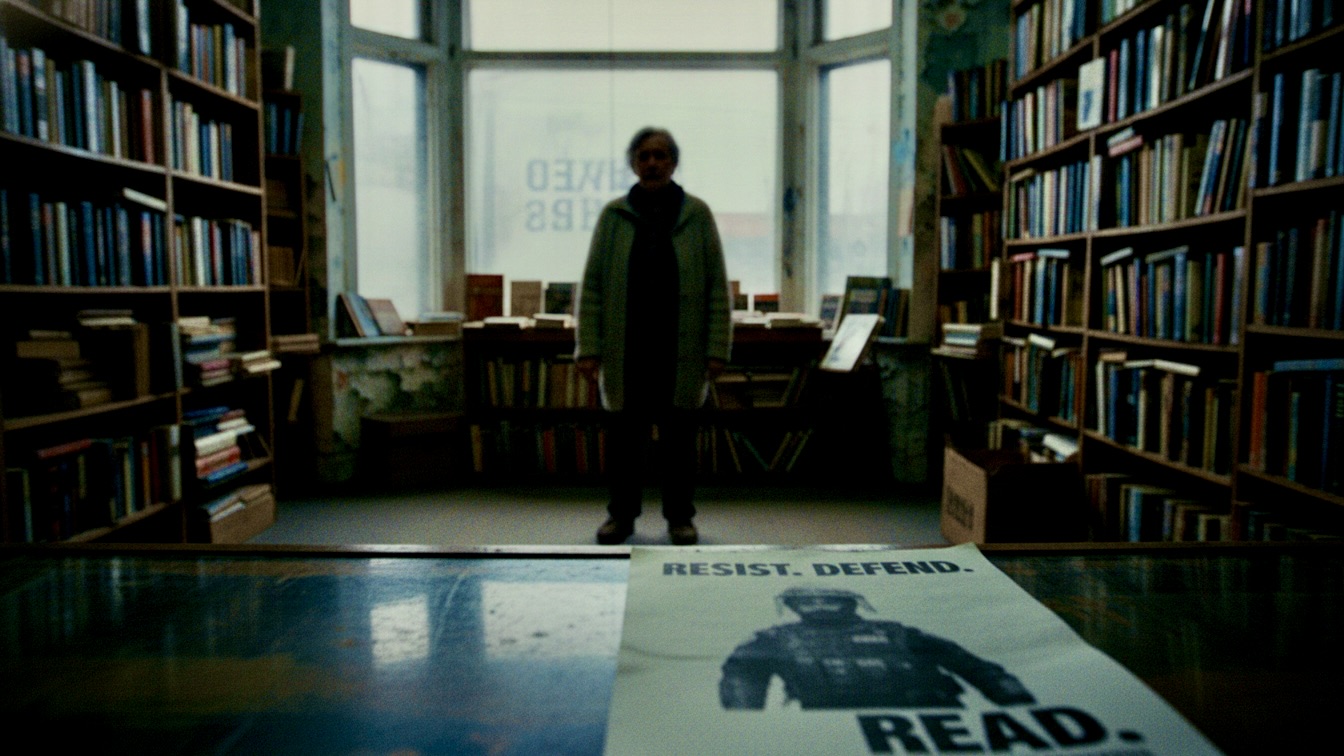
The narrative centers on an elderly bookstore owner who views her shop as a sanctuary of silence and order amidst a city erupting in civil unrest. She initially directs her frustration toward the protestors, symbolized by a flyer taped to her door, viewing their noise as a naive disruption to the safety she has meticulously cultivated over decades. Her isolation is breached when a terrified young female protester begs for entry to escape federal agents. The protagonist reluctantly shelters the girl but berates her for provoking a government she believes cannot be fought, projecting her own cynical survivalism onto the youth. However, after the girl departs, the protagonist discovers a dropped flyer depicting a militarized police officer. This image triggers a visceral flashback to her childhood under a totalitarian regime, specifically the traumatic memory of her father’s abduction by secret police. Realizing that her lifetime of quiet compliance was not peace but submission, she abandons her fortress of books and walks deliberately toward the violent clash, choosing confrontation over the suffocating safety of silence.
The central theme of the text is the complex relationship between silence and survival, and how the meaning of "quiet" shifts as the protagonist’s psychological defenses crumble. Initially, silence is presented as a virtue and a refuge. The bookstore represents a controlled environment where the protagonist has constructed a "country" of her own, insulated from the chaos of the outside world. In this early stage, noise—represented by the chanting crowd and the frantic girl—is the enemy. It signifies a disruption of the order she established to keep trauma at bay. She equates being "unobtrusive" with safety, believing that invisibility is the only shield against state power.
However, the narrative deconstructs this belief by exposing the traumatic root of her silence. Through the flashback, the story reveals that silence was not a choice made in freedom, but a command enforced by terror. The memory of the soldier’s finger and the implied threat—"Be quiet. Or you’re next"—recontextualizes her entire life. The silence she treasured is unmasked as a scar left by authoritarianism, a mechanism of control rather than a sanctuary. The theme suggests that while silence may ensure physical survival, it comes at the cost of spiritual death and complicity with the oppressor.
Furthermore, the story explores the generational divide regarding political resistance. The protagonist initially views the protestors as "foolish, loud, ignorant children" playing at war. She contrasts their performative rebellion with her lived experience of actual totalitarianism. Yet, the story ultimately validates the protestors' noise. The "young" generation’s refusal to be silent serves as a catalyst for the "old" generation’s awakening. The protagonist realizes that the girl’s "pointless shouting" is actually the courage she herself was denied. The narrative suggests that trauma can blind survivors to the necessity of resistance, trapping them in a cycle of fear until a mirror—in this case, the flyer and the girl—forces them to confront the past.
The protagonist is a deeply psychological portrait of a trauma survivor who has utilized avoidance and sublimation to cope with a devastating past. She has constructed her identity around the bookstore, transforming a "derelict laundromat" into a "fortress of books." This physical renovation mirrors her psychological attempt to scrub away the "grime" of her childhood trauma and replace it with the clean, orderly scent of pine and paper. She is defined by her need for control; the tape on the door is an insult not because it is vandalism, but because it represents an external force imposing its will on her curated reality.
Her interaction with the young protester reveals a defense mechanism known as displacement. She projects her deep-seated fear of the "black uniforms" onto the girl, scolding the victim rather than the aggressor. Her anger is defensive; she attacks the girl’s naivety to validate her own cowardice, which she has reframed as "wisdom" and "survival." By convincing herself that the girl is foolish, she protects herself from the painful realization that her own life of "quiet desperation" might have been a mistake. She is rigid, cynical, and emotionally armored, viewing empathy as a weakness that invites "trouble."
However, the climax of the chapter reveals the fragility of this armor. The visual trigger of the flyer causes a dissociation, collapsing the timeline between the present and her childhood. The "deep, cold rage" that emerges is the repressed emotion of the seven-year-old girl she once was. Her final action—walking toward the police line—is a profound psychological shift. She moves from a passive "freeze" response, which has dictated her behavior for seventy years, into an active "fight" response. She is no longer walking to save the world or join the movement; she is walking to reclaim her agency and to confront the "faceless monolith" that stole her father, finally breaking the command to be quiet.
The narrative employs a sensory-rich, introspective style that mirrors the protagonist’s internal state. The author uses tactile and olfactory details to ground the reader in the protagonist's immediate reality before shattering it. The description of the tape "flaking away in tiny, unsatisfying pieces" parallels the protagonist's brittle emotional state. The "smell of old paper" and "pine" serves as an olfactory anchor for her safety, which is violently displaced by the phantom scents of "boiled cabbage," "wet wool," and "metallic" blood during the flashback. This sensory shift viscerally demonstrates the intrusion of traumatic memory into the present.
Pacing is utilized effectively to build tension and reflect the protagonist's psychological unravelling. The opening paragraphs are slow and methodical, mimicking the quiet, dusty atmosphere of the bookstore. The sentences are often long and flowing as she describes the history of the shop. This rhythm is disrupted by the "sudden bang" of the girl arriving, where the syntax becomes choppier and the dialogue urgent. The pacing creates a sense of claustrophobia that matches the protagonist's feeling of being trapped between the noise outside and the ghosts inside.
The author also relies heavily on metaphor to convey the protagonist's worldview. The bookstore is described as her "country," implying that she is an exile from the rest of society. The "ghost in a gray cardigan" description establishes her feeling of irrelevance and semi-existence. Most poignantly, the transition of the federal agent's image in the flyer—blurring from a modern tactical figure into the "older shape" of her childhood trauma—serves as a powerful visual device. It illustrates how PTSD superimposes the past onto the present, rendering the specific political context irrelevant in the face of the universal archetype of tyranny.