Format: Short Film / Anthology Episode | Est. Length: 10-12 minutes
Imagine a series where the mundane landscapes of suburbia become the backdrop for high-stakes espionage, all through the eyes of two best friends. "Operation Slush Fund" serves as a perfect entry point into the world of Sam and Leo's self-styled counter-intelligence unit, where every wandering stranger is a potential operative and every public park is enemy territory. Each episode follows a new "mission," blending the earnestness of childhood imagination with the subtle, encroaching realities of the adult world, exploring themes of friendship, creativity, and the bittersweet transition out of boyhood.
In a dreary, unseasonably warm January park, a young boy named Sam lies flat in a patch of brown slush, his gaze fixed on a mysterious man in a trench coat. This is not a game; this is a mission, and the Target is getting away.
Two best friends on a self-assigned spy mission track a suspicious man with a briefcase through a muddy park, only to find their elaborate fantasy colliding with the boring reality of adult life. Their determination to maintain the game forces them to escalate their own mission, turning a mundane afternoon into an adventure of their own making.
At its core, "Operation Slush Fund" is a story about the power of imagination as a shield against the mundane. Sam and Leo transform a bleak, slushy park into a landscape of tactical challenges and imminent dangers, using the language of espionage to give meaning and excitement to an otherwise boring Tuesday. Their friendship is the engine of this fantasy; they operate on a shared wavelength where a man eating lunch can be a sleeper agent and a playground slide can be a communications tower. The episode celebrates the profound, world-building magic that exists between two kids with nothing to do.
Beneath the surface, the story touches on themes of change and disillusionment. The unseasonably warm, "wrong" weather serves as a metaphor for the encroaching complexities of a world that doesn't fit childhood expectations. Sam's desperate refusal to accept that the Target is just a normal guy highlights the fragility of his imaginative world and the fear of the boring reality that awaits him as he grows older. It’s a quiet, comedic exploration of the moment a child first senses the curtain of make-believe beginning to thin.
The primary stake for Sam is the integrity of the mission, which is a proxy for the integrity of his imaginative world. If the Target is just a man with a sandwich, then Sam is not a spy—he's just a kid getting wet and muddy for no reason, a realization he fights at every turn. For Leo, the stakes are more immediate and physical: avoiding "trench foot," staying dry, and securing the promise of Pizza Pockets. The overarching stake for their friendship is the preservation of their shared game; if the belief fails, the adventure ends and they are left with nothing but the cold, wet reality of the park.
The external conflict is twofold: the "Target," the mysterious man whose actions they must interpret and counter, and the environment itself. The park is a character and an obstacle course—a minefield of deep puddles, slippery mud, thorny brambles, and treacherous playground equipment. The internal conflict resides entirely within Sam, who wages a constant battle against the encroaching, boring truth. Leo acts as a gentle antagonistic force, his pragmatic complaints and observations ("Maybe it's a sandwich") serving as constant reminders of the reality Sam is trying so desperately to rewrite.
In a strangely warm and slushy winter park, self-styled spies Sam and Leo are on a mission, tracking a suspicious "Target" in a trench coat carrying a briefcase. Led by the fiercely committed Sam and reluctantly followed by the pragmatic, complaining Leo, they crawl through mud, sprint across treacherous fields, and navigate obstacles like a dog-walker's tangled leashes. Their pursuit is filled with whispered spy jargon and tactical debates, culminating in them getting a clear view of the Target at a gazebo.
The mission's narrative collapses when the Target opens the briefcase to reveal not plutonium or secret codes, but a simple ham sandwich. Devastated by the anticlimax, Sam refuses to accept defeat and immediately invents a new objective: they must secure the high ground of the playground's spiral slide to prevent the Target from "transmitting a signal." After a final, climactic struggle across a "moat" of meltwater and up the slide tower, they achieve their goal, only to see the man is still just eating. They declare victory anyway, finding satisfaction in the adventure itself, and head home, their partnership immediately renewed by a text from Sam's mom assigning them a new, real-world "supply run" mission.
Sam: The mission commander and chief believer. Sam begins the story fully immersed in his spy fantasy, interpreting every mundane detail through a lens of high-stakes espionage. His psychological arc is not one of disillusionment, but of resilience; when reality threatens to shatter his narrative (the sandwich reveal), he doesn't give up but doubles down, actively creating a new objective to keep the game alive. He ends the episode not necessarily still believing the man was a spy, but having successfully protected the feeling of the mission, proving that the adventure is a choice he can consciously make.
Leo: The loyal but skeptical sidekick. Leo starts as the voice of reason and physical reality, complaining about the cold, the wet, and his deviated septum. He is the grounding force, constantly questioning the mission's premise with humorous pragmatism. His arc is one of unwavering friendship; despite his skepticism and discomfort, he never abandons the mission. He follows Sam into the brambles and across the flooded playground, proving his commitment is not to the fantasy itself, but to his friend who needs it.
The Stakeout: Sam and Leo observe their Target from behind a bush, establishing their spy dynamic through whispered, jargon-filled dialogue. The dreary, unseasonably warm park is introduced as a hostile environment, with Leo’s practical complaints clashing with Sam’s intense focus. The pursuit begins as the Target moves with suspicious speed toward the "Bridge of Doom."
The Chase: The boys break cover and pursue the Target across the Great Lawn, a treacherous open field of slush and hidden puddles. This sequence highlights the physical struggle of their mission, as they run, slip, and vault over obstacles, with Sam’s grim determination contrasting with Leo’s flailing, reluctant sprint. They are forced to detour through a thicket of brambles, showcasing Sam's willingness to sacrifice comfort for the mission.
The Reveal (Midpoint): Having finally cornered the Target at a gazebo, they watch from a hiding spot as he opens the mysterious briefcase. The tension builds to a comedic anticlimax as he pulls out nothing more than a ham sandwich wrapped in wax paper. The entire premise of their mission evaporates, leaving Sam visibly frustrated and Leo comically vindicated.
The Pivot: Refusing to accept the boring reality, Sam's mind races to salvage the narrative, declaring the sandwich a decoy and the man's nervous glances as proof of a deeper conspiracy. When Leo directly engages the Target and confirms it's just "paperwork and ham," Sam makes a crucial decision. He invents a new, more urgent objective: they must seize the playground's spiral slide, reframing it as a "transmission tower" to prevent the Target's escape.
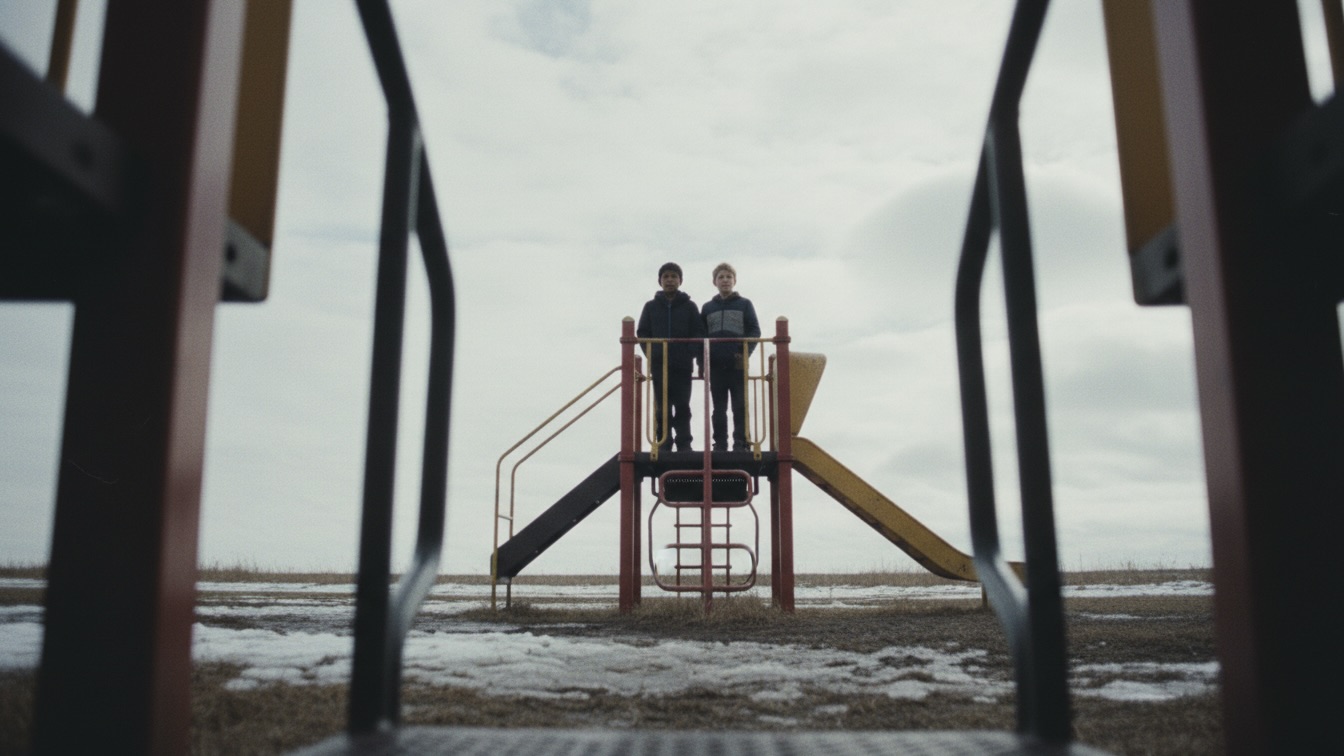
The Assault (Climax): The boys race to the playground, which is surrounded by a "moat" of meltwater. They must cross a series of slippery, mushroom-shaped stepping stones, a final physical test that results in Leo's foot plunging into the icy water. They help each other scramble to the base of the slide tower and climb to the top, securing the "high ground" in a moment of breathless triumph.
The Debrief: From their perch, they see the Target is still at the gazebo, unmoved, just finishing his lunch. In a quiet moment of acceptance, they declare "mission accomplished," finding victory not in defeating an enemy but in completing their self-imposed challenge. They escape down the slide, the exhilarating rush washing away the disappointment, and land in a heap, their friendship reaffirmed by the shared adventure. A text from Sam's mom provides a new, tangible mission—a supply run for milk—which they accept with renewed, serious purpose.
The episode begins with an atmosphere of tense, playful suspense, drawing the audience into the earnestness of the boys' game. This builds through the chase sequence before crashing into a comedic, anticlimactic low point with the sandwich reveal. The emotional energy is then reignited by Sam's sheer force of will, shifting the mood from disappointment to a renewed, slightly more self-aware sense of adventure. The climax at the playground is energetic and triumphant, leading to a quiet, satisfying resolution that feels both victorious and warmly nostalgic.
If expanded into a series, the season arc would follow Sam and Leo's "agency" as they take on progressively more ambitious "missions," turning locations like the public library, the grocery store, and a neighborhood block party into zones of intrigue. A recurring thread could involve a rival "agency" (another group of kids) who leave behind cryptic clues or compete for "intel," creating a friendly but mysterious sense of competition. The overarching story would be the subtle but steady intrusion of the real world into their games.
A season-long character arc for Sam could see him struggling to keep the game alive as schoolwork, family responsibilities, and the social pressures of middle school begin to mount. Leo's arc could involve him finding his own voice within the agency, moving from reluctant sidekick to a skilled "operative" in his own right, perhaps specializing in "social engineering" (talking his way out of trouble). The season finale could present them with a real-life problem—like a lost pet or a minor neighborhood mystery—forcing them to apply their "spy skills" in a situation where the stakes are, for the first time, genuinely real.
The visual style will be a blend of gritty spy thriller aesthetics and grounded, naturalistic cinematography. During action sequences, the camera will be handheld and at the boys' eye-level, using quick, kinetic cuts and shallow depth of field to create a sense of urgency and focus, mirroring the way Sam sees the world. In contrast, wider, more static shots will be used to emphasize the bleak, mundane reality of the slushy park, creating a comedic juxtaposition between their high-stakes dialogue and the boring setting.
The tone is a delicate balance of earnest childhood adventure and wry, observational comedy, reminiscent of films like Son of Rambow or Attack the Block. The color palette will be desaturated and dominated by browns, greys, and muddy greens, reflecting the dreary winter melt. This muted world will be punctuated by vibrant pops of color from the boys' clothing—like Leo's neon green toque—visually marking them as agents of imagination in a drab world. The score would alternate between minimalist, percussive spy themes and quiet, more contemplative melodies.
The primary target audience is families and a co-viewing demographic, particularly appealing to older children (ages 8-13) and adults who appreciate nostalgic, character-driven storytelling. The humor and themes resonate with viewers who grew up playing imaginative games, while the action and adventure appeal to a younger audience. It is designed to be a "lean-in" viewing experience that sparks conversation between generations about play, friendship, and growing up.
With a 10-12 minute runtime, the pacing will be brisk and efficient. The first act, establishing the mission and the chase, will be fast-paced and driven by movement and urgent dialogue. The second act will slow down dramatically for the midpoint reveal at the gazebo, allowing the comedic anticlimax to land before Sam's pivot ramps the energy back up. The third act—the playground assault—will be a short, energetic climax, followed by a quiet, reflective denouement as the boys walk home, allowing the emotional resolution to breathe.
The primary production consideration is the environment. Capturing the specific look and feel of a "false spring" day in winter—wet, muddy, with patches of melting snow and an oppressive humidity—is crucial to the story's tone and visual metaphor. This may require significant on-set dressing with artificial slush and mud, as well as shooting on overcast days to achieve the flat, glaring light described in the text.
Cinematography should emphasize the child's-eye perspective, using low angles to make the park's gentle slopes feel like formidable hills and small puddles look like vast lakes. The contrast between the boys' "professional" spy gear (imagined or real) and their everyday, ill-suited winter clothes (soaked jeans, non-waterproof boots) is a key visual element that should be highlighted. Sound design will play a critical role, amplifying the wet, squelching sounds of their movement through the slush to enhance the sensory reality and physical discomfort of their adventure.