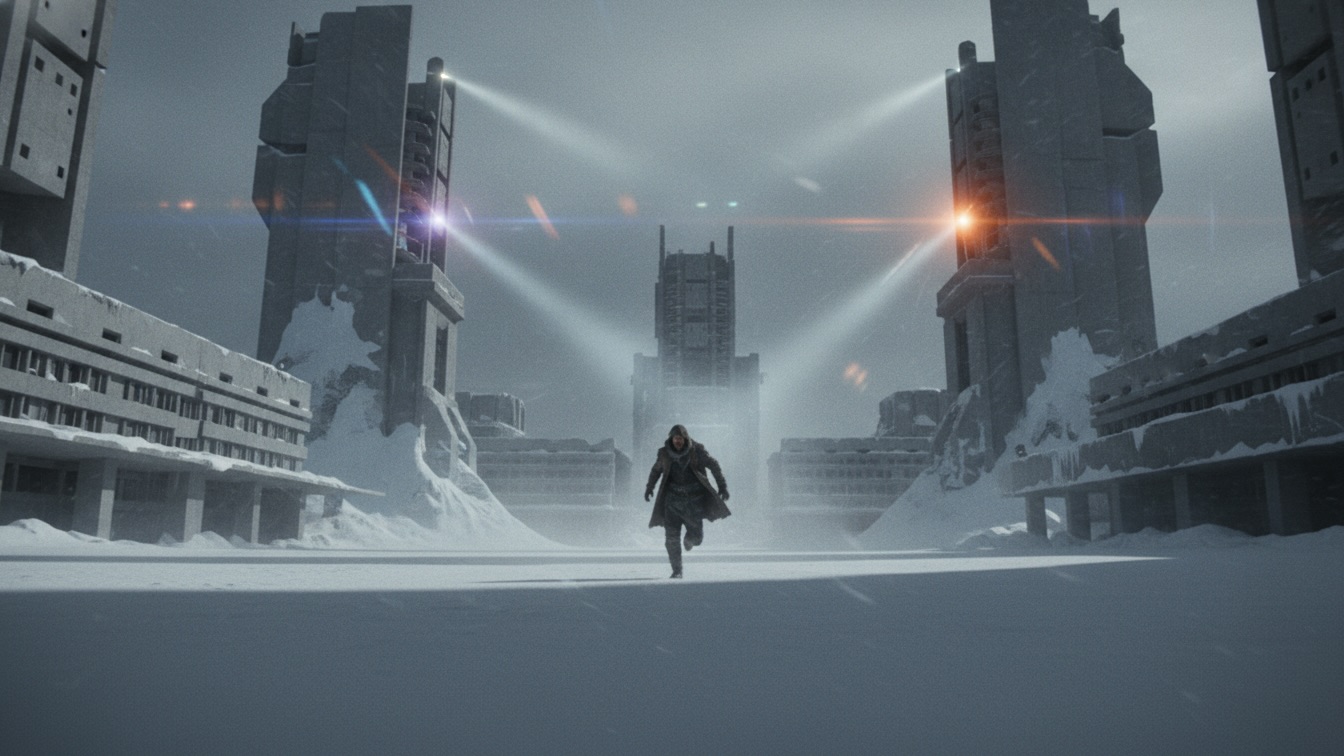
The frozen streets of a post-apocalyptic Winnipeg are a maze of grey, brutalist concrete and militarized checkpoints. The air is thin and burns the lungs, filled with the scent of ozone from Authority patrol drones and the constant, biting wind that whips snow into stinging clouds.
The bolt on the maintenance hatch was frozen solid. Karl slammed his shoulder into it, once, twice, a third time. A spray of rust and ice crystals flaked off, dusting his thin gloves. Behind him, the rhythmic thud of Authority boots grew louder, an iron heartbeat against the concrete of the overpass. They weren't supposed to be here. The handoff was timed for a patrol gap. A five-minute window. It had been less than one.
He fumbled at his belt, fingers numb, and pulled out a pry bar. The steel was so cold it felt like it was burning his skin through the worn fabric. He jammed the tip into the seam of the hatch and threw his entire weight onto it. A groan of tortured metal, a shriek that scraped his nerves raw, and the hatch popped open with a suddenness that sent him sprawling onto his back. Snow and grit skittered across his face.
No time. The boots were closer now, the sound sharp and distinct. He scrambled backward into the dark, coffin-sized space, dragging the heavy metal door shut just as the first beam from a patrol light sliced across the wall where he'd been standing. The darkness was absolute, smelling of stale water and decay. He held his breath, listening to the muffled shouts, the crunch of boots on ice just inches from his head. They were searching. Panning their lights. He pressed himself against the cold, damp wall, the tiny data chip in his palm feeling like a hot coal.
Simple star, stellar dendrite, hollow column. The words were a silent mantra, a fragment from the forbidden text he’d memorized. The page was a ghost in his mind: a grainy, pre-Collapse encyclopedia entry on snowflakes. Each one different. Each one a perfect, fleeting rebellion against sameness. The Authority had burned the books first, then the art, then anything that suggested a person could be unique. But they couldn't burn a memory. The chip felt impossibly complex against his skin, its surface etched with the pattern they'd given him, the recognition code. A fernlike stellar dendrite. A key to crash their whole damn system.
He waited until the sounds faded, until his own ragged breathing was the only thing in the cramped space. He counted to one hundred, twice, then slowly pushed the hatch open a crack. The coast was clear. The patrol had moved on, their lights painting sterile cones of white on the opposite block. He slid out, body aching, and broke into a low run, keeping to the shadows of the massive support pillars that held up the decaying skyways.
Winnipeg was a skeleton picked clean by the cold and the Authority. Concrete towers, stained grey and black, clawed at a perpetually overcast sky. The only color came from the Authority's ubiquitous crimson banners and the searing blue of the energy fences that cordoned off the citizen sectors. Karl navigated the labyrinth by instinct, a rat in a maze he was born into. He was a courier, a ghost. His job was to carry whispers through a city built to enforce silence.
He cut through the skeletal remains of a market, the stalls all collapsed into drifts of dirty snow. A drone whined high overhead, its optical sensor a malevolent blue dot sweeping the ground. He froze behind a rusted-out van, tucking his chin to his chest, making himself small. The blue light washed over his position and moved on. He let out a breath he hadn't realized he was holding, the vapor pluming white in the frigid air.
His contact was waiting at the rendezvous, the old pumping station by the frozen river. The place was a husk of pre-Collapse industry, all rust and broken windows. He approached with caution, circling the perimeter twice before slipping through a gash in the chain-link fence. The contact, a grim-faced woman named Lena, was huddled behind a massive, inert turbine. She didn't look up when he approached, her eyes scanning the grey expanse of the river ice.
"You're late," she rasped, her voice thin in the wind.
"Patrol," Karl said, his own voice cracking. "They were early. Or we were late."
"Doesn't matter. Did you get it?"
He nodded, opening his palm. The chip gleamed dully. The intricate snowflake pattern was barely visible in the gloom. Lena took it, her fingers brushing his. Her hand was as cold as the pry bar.
"The code matches," she said, her shoulders slumping with a fraction of relief. "Get this back to the hideout. This is it, Karl. This is everything. The virus will cascade through their network. Black out every camera, every sensor, from here to the perimeter."
Suddenly, the world exploded in light. A dozen searchlights blazed to life, pinning them against the turbine, turning the falling snow into a blinding, swirling vortex. Shouts echoed across the ice. "On the ground! Hands where I can see them!"
Authority troops. They were pouring in from all sides, clad in black thermal armor, their rifles leveled. They had been waiting. The whole thing was a trap.
Lena moved first. She shoved the chip back into Karl's hand. "Go!" she screamed, pulling a small, crude pistol from her coat. "Run!"
He didn't need to be told twice. He scrambled away as Lena fired a single, defiant shot that was immediately answered by a deafening volley of automatic fire. He didn't look back. He couldn't. He ran, slipping and sliding on the icy ground, his lungs on fire. The searchlights tracked him, turning the world into a nightmare of stark white and dancing black shadows.
He was a target. The chip was the target. They wanted it back. They couldn't have it. He thought of the snowflake—unique, fragile, perfect. A pattern that could bring down an empire. He ran toward the edge of the pumping station, a sheer drop to the frozen river below. There was nowhere to go. They were closing in, their boots crunching, their commands sharp and devoid of humanity.
He looked down at the chip in his hand. If they caught him, it was over. The revolution, the hope, everything would die right here on this miserable, frozen slab of concrete. He couldn't let that happen. Without a second thought, he brought the chip to his lips. It was small, metallic, and tasted of oil and the cold. He put it on his tongue, took a deep, ragged breath, and swallowed.
It went down hard, a sharp-edged lump scraping his throat. He gagged, his eyes watering, but forced it down. It was inside him now. A part of him. They couldn't take it without cutting him open.
With a wild yell, he launched himself over the edge. The fall wasn't long, maybe twenty feet. He hit the ice-covered river with a force that knocked the wind out of him and sent spiderwebs of cracks racing out from the point of impact. His shoulder screamed in protest. For a moment, he lay there, stunned, the black sky and the swirling snow filling his vision. The lights and shouts from above spurred him to move. He crawled, then staggered to his feet, ignoring the fire in his shoulder. He ran out onto the vast, white emptiness of the river, a lone figure fleeing into the heart of the storm.
The chase was a blur of pain and cold. He ran until his legs were numb, until his lungs felt like they were full of broken glass. He used every shortcut, every sewer grate, every collapsed building he knew. The chip was a cold knot in his gut. He could feel it. A secret, a weapon, a victory he carried inside his own body. He was the courier and the message, both at once.
It took him hours to make it back to the hideout, a hidden warren of tunnels beneath a derelict boiler plant. He practically fell through the reinforced door, collapsing into the arms of his comrades. They hauled him in, their faces a mixture of fear and awe.
"They got Lena," he gasped, his body shaking uncontrollably. "It was a setup. But I saved it. I saved the chip."
He was brought before Elias, the old man who led their small cell of resistance. Elias had the weary eyes of someone who had seen too many friends die. He helped Karl to a chair, gave him a tin cup of lukewarm water.
"Where is it, son?" Elias asked, his voice gentle but laced with an unbearable tension.
Karl looked up, a grim, triumphant smile touching his lips. "They couldn't get it. I swallowed it."
A wave of murmurs went through the small crowd gathered in the damp, low-ceilinged room. Someone clapped him on the good shoulder, a cheer starting to rise.
But Elias didn't smile. His face went pale, a mask of sheer, unadulterated horror. He grabbed Karl's tunic, his knuckles white. "You did what?"
"I swallowed it," Karl repeated, confused. "The virus. It's safe. They can't get it now."
Elias stared at him, his eyes wide with a terror so profound it silenced the entire room. The hope, the brief flicker of victory, died in an instant. The old man's voice was a choked whisper, a death rattle.
"Karl," he said, and the name sounded like a curse. "That wasn't a virus. We don't have the tech for that. We never did."
Karl's blood ran cold. The knot in his stomach tightened, a feeling of icy dread spreading through him. "What... what was it? The snowflake... the key..."
"It wasn't a key to their network," Elias said, his voice breaking. He finally let go, stumbling back as if Karl were suddenly radioactive. "It was the key to ours. It was a list, you damn fool. Unencrypted. The name, location, and family connections of every single operative in this city."
The room was utterly silent. The weight of the words crushed the air from Karl's lungs. The thing inside him wasn't a weapon against the Authority. It was a map. A directory. A death warrant for everyone he had ever known, everyone who was fighting for a world where a snowflake could be considered beautiful.
He felt a sharp, cramping pain in his gut. A wave of nausea washed over him. He looked at the horrified faces around him—the people he had just condemned.
"The casing," Elias continued, his voice hollow and distant, "it's a military-grade alloy. It's designed to break down in stomach acid. To poison whoever swallows it. There's no getting it out, son. It's already started to dissolve."
Karl doubled over, a strangled cry escaping his lips as the pain intensified, sharp and corrosive. It wasn't just a list. It was poison. The hero of the hour had just become their executioner.
“The hero of the hour had just become their executioner.”