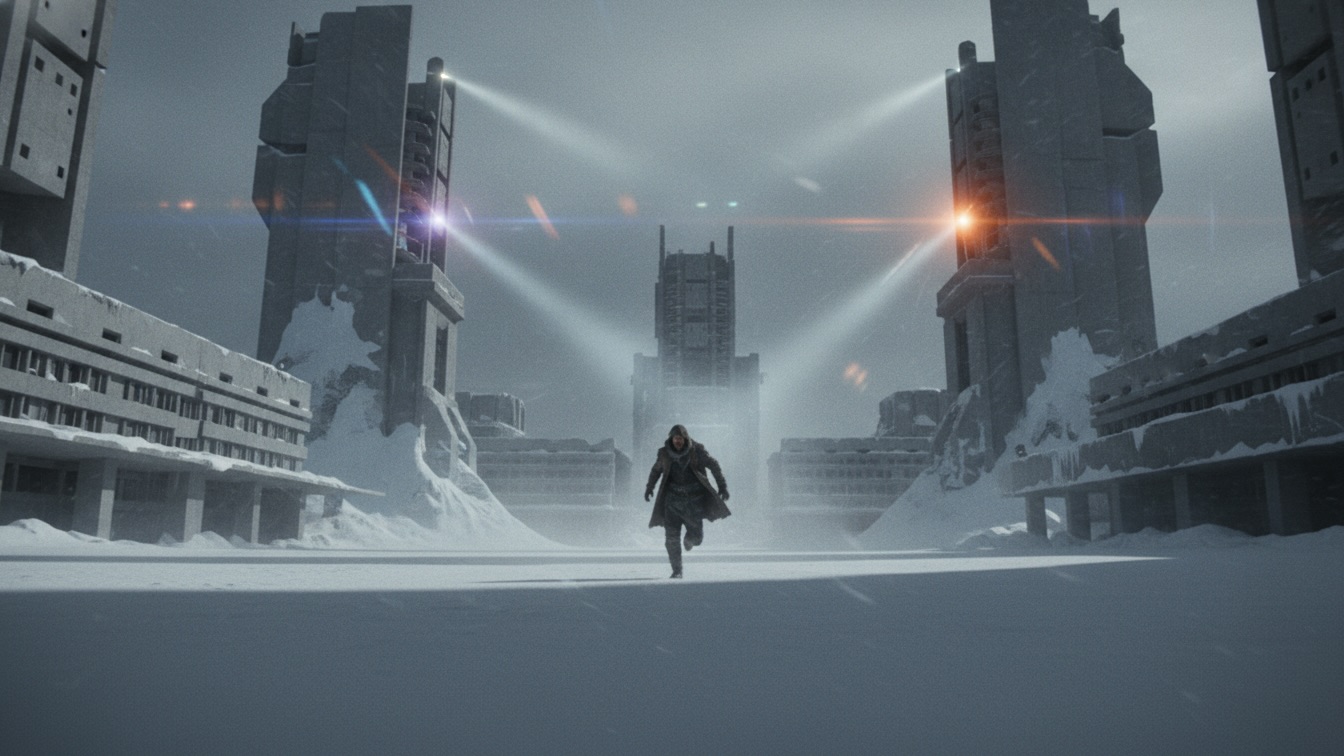
The narrative follows Karl, a courier for a resistance movement in a dystopian, frozen Winnipeg, as he executes a high-stakes retrieval mission. After narrowly evading an Authority patrol and retrieving a data chip from a maintenance hatch, Karl navigates the ruined city to meet his contact, Lena. The rendezvous turns into an ambush, resulting in Lena's death and a desperate chase across the ice. Believing the chip contains a virus capable of destroying the Authority's surveillance network, Karl makes the impulsive decision to swallow the device to prevent its capture. Upon returning to his resistance cell, however, the triumph turns to horror. The leader, Elias, reveals that the chip was not a virus but an unencrypted list of every operative in the city. furthermore, the casing is designed to dissolve and poison the carrier. Karl realizes too late that his act of self-sacrifice has doomed both himself and the entire rebellion.
The central theme of the text revolves around the fragility of individuality within a totalitarian system, symbolized poignantly by the snowflake. The protagonist clings to the memory of a pre-Collapse encyclopedia entry describing stellar dendrites, viewing the unique geometry of a snowflake as a "perfect, fleeting rebellion against sameness." This metaphor underpins the resistance's ideological struggle against the Authority, a regime that enforces uniformity through the destruction of art and history. The snowflake represents the beauty of the unique, standing in stark contrast to the "sterile cones of white" projected by the patrol lights and the grey, concrete skeleton of the city.
However, the story subverts this theme through a crushing dramatic irony. The narrative constructs a classic hero's journey where the protagonist protects the "holy grail" at all costs, only to reveal that the object of salvation is actually an instrument of destruction. This thematic twist explores the danger of blind faith and the fog of war. Karl’s belief in the "virus" is absolute, a narrative he tells himself to survive the terror of the chase. The tragedy lies in the fact that his commitment to the cause is exactly what destroys it. The "snowflake" he swallows is not a symbol of unique rebellion, but a literal list of names—a catalog of individuals who will now be extinguished because of his action.
Furthermore, the environment acts as a thematic mirror to the hopelessness of the characters' situation. The setting is relentlessly hostile; the cold burns like fire, the metal screams, and the city is a "skeleton picked clean." This atmospheric oppression reinforces the theme of inevitable decay. Just as the city is freezing and crumbling, the resistance is shown to be fragile and easily broken. The physical poisoning of Karl at the end serves as a somatic manifestation of the toxic reality of their insurgency: there is no glorious victory, only a slow, painful dissolution from the inside out.
Karl functions as an archetype of the desperate survivor, a man whose identity is entirely subsumed by his function as a "courier" and a "ghost." Psychologically, he exhibits signs of high-functioning anxiety and hyper-vigilance, traits necessary for survival in his environment. He perceives the world through a lens of threat assessment, viewing the city as a maze he was born into. His internal monologue reveals a deep-seated need for meaning; he clings to the "forbidden text" about snowflakes not just as a code, but as a psychological anchor. This fixation suggests that he is driven less by a strategic understanding of the war and more by a romanticized ideal of rebellion. He fights because he needs to believe that uniqueness is possible in a world of enforced uniformity.
His decision-making process during the climax highlights a fatal flaw: his heroism is reactive rather than cerebral. When cornered, he does not analyze the tactical situation but instead relies on a visceral, emotional response. Swallowing the chip is an act of supreme defiance, a way to assert control over his own body and the mission when all other avenues are closed. He views himself as the vessel of the revolution, telling himself, "I was the courier and the message." This conflation of self and mission blinds him to the possibility of error. He seeks validation and the role of the savior, which makes the final revelation psychologically devastating.
The transition from triumph to horror in the final scene marks a total psychological collapse. When Elias reveals the truth, Karl is stripped of his identity as a hero and recast as the villain of his own story. The physical pain of the dissolving chip mirrors his psychological disintegration. He is forced to confront the reality that his endurance, his pain, and his sacrifice were not only meaningless but actively harmful. This realization induces a state of cognitive dissonance so severe it leaves him paralyzed. He is no longer the "ghost" navigating the maze; he is the trap itself, the mechanism by which the Authority achieves its ultimate victory.
The narrative employs a gritty, sensory-heavy style that immerses the reader in the visceral experience of the protagonist. The author utilizes tactile and auditory imagery to create a pervasive sense of discomfort. The cold is not merely a weather condition but an active antagonist; it "burns," the metal "screams," and the air tastes of "rust and ice crystals." This sensory overload effectively conveys the physical toll of the environment on Karl. The prose is often jagged and sharp, mimicking the "broken glass" in Karl's lungs and the "tortured metal" of the hatch. This stylistic choice mirrors the harsh, unyielding nature of the dystopian world.
Pacing is used effectively to manipulate tension and mirror Karl’s physiological state. During the infiltration and the subsequent chase, the sentences are shorter and more fragmented, simulating the rapid heartbeat and shallow breathing of a man running for his life. The action is frantic, characterized by verbs like "slammed," "scrambled," and "launched." This accelerates the narrative momentum, carrying the reader along on Karl's adrenaline high. The pacing abruptly shifts when Karl enters the hideout. The sentences become longer and more expository as the adrenaline fades, slowing the reader down just in time for the crushing weight of the twist to settle in.
The tone of the piece is relentlessly noir, characterized by high contrast between light and dark. The "absolute" darkness of the hiding spot is pierced by "sterile cones of white" and "malevolent blue" sensors. This chiaroscuro effect emphasizes Karl's isolation and the binary nature of his existence—hidden or exposed, alive or dead. The narrative voice remains close to Karl's perspective, limiting the reader's knowledge to what he knows. This limited third-person perspective is crucial for the final twist; the reader is tricked alongside Karl, sharing his false sense of victory so that the final revelation lands with maximum emotional impact.