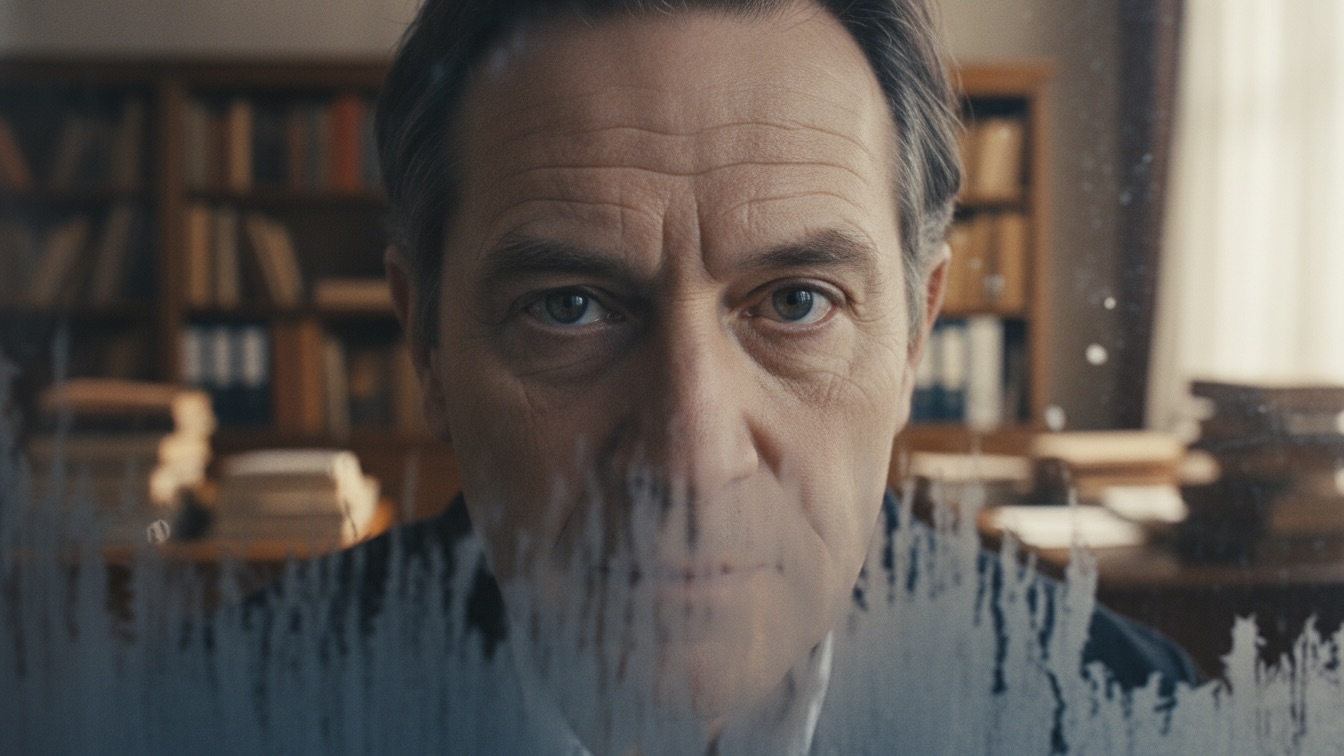
The air in David’s office was thick with the scent of old paper and dust, a testament to decades of accumulated stories. Outside, the Winnipeg winter clawed at the windowpanes, promising a fresh layer of frost, but inside, a stifling warmth clung, demanding relief.
"You know," David grunted, his knuckles white against the grimy sash, "you'd think after fifty years in this building, they'd at least oil the damn windows." The frame juddered under his insistent pressure, a faint squeal of metal echoing in the small room, but it held firm. Outside, the world was a dull, steel grey, hinting at more snow. He wiped a bead of sweat from his brow, his breath fogging the glass for a moment before dissipating. The room, crammed with stacks of books, teetering files, and a formidable ancient computer humming softly, felt oppressive. He glanced at his watch. Ten minutes. Jamie would be here soon. He needed air, needed to clear his head before diving into whatever AI-fueled fantasy this young man was peddling.
He tried again, bracing a foot against the worn carpet, putting his whole weight into it. The window rattled, protesting, but didn’t budge an inch. David sighed, a long, exasperated sound that seemed to chase away the last vestiges of his patience. This was going to be one of those days. He could feel it in his aching shoulder, a familiar throb that usually presaged a deadline, or, worse, a particularly obtuse interview subject.
Just then, a light rap on the door. He straightened, tugging at the collar of his slightly rumpled shirt. “Come in,” he called, trying to sound less like he’d been wrestling with inanimate objects. The door opened slowly, revealing Jamie, a young man with an energetic, almost boyish face framed by dark, wind-swept hair. He wore a thick, practical winter coat that still held the chill of outside, a stark contrast to the stuffy office. A worn leather satchel was slung across his chest.
“David?” he said, extending a hand, his grip firm and warm. “Thanks for having me.”
“Jamie. Come in, come in,” David gestured vaguely at the overflowing armchair opposite his desk, its springs likely as tired as David felt. “Excuse the… ambiance. And the heat. Trying to get this infernal window open, but it seems to be unionizing.” He gave the window one last, futile glare. The lack of fresh air already made his temples throb slightly. He didn't want Jamie to think he was unprepared, but the office always felt like this, a cluttered monument to past stories, unwilling to let new ones in without a fight.
Jamie smiled, a genuine, unforced smile that softened his features. He shrugged off his heavy coat, revealing a simple, well-worn sweater underneath. He seemed utterly unfazed by the chaos of the room, or David’s slightly disheveled state. “No worries at all. Happens. Always a battle with the elements here, right?” He perched on the edge of the armchair, not sinking into its depths, as if ready to spring up at a moment’s notice. His eyes, bright and attentive, scanned the stacks of books, pausing on a particularly thick volume about arctic ecosystems. David found himself disarmed by the casual confidence, the lack of pretension.
“Indeed,” David said, settling behind his desk, the old wood groaning under his elbows. He pulled a yellow legal pad and a pen towards him, the familiar tools a comfort in this strange new world of AI he was trying to understand. “Well, let’s talk about these elements, then. Or rather, the new kind of elements. AI. And your ‘Winter City Stories’ project.” He leaned back, pen poised, a skeptical glint in his eye. “I’ll be blunt, Jamie. My career has been built on human stories. The messy, unpredictable, flawed human experience. When I hear about AI writing, my immediate reaction is… well, it’s not exactly excitement.” He paused, letting the implication hang in the air. He wanted to see how Jamie would react, if he’d get defensive, or try to sell him some shiny new tech brochure.
Jamie nodded, his smile not faltering, though a flicker of something, understanding perhaps, crossed his face. “I appreciate the honesty, David. And I get it. Believe me. I’ve seen enough of the hype, the fear, the grand pronouncements. It’s a lot.” He leaned forward slightly, his posture open, earnest. “But that’s actually a huge part of why we started ‘Winter City Stories’ at the Arts Incubator. Not to replace human stories, but to amplify them. To make it possible for stories that otherwise would never be written, to actually exist. To find their voice.” He spoke with a quiet intensity, his gaze steady. There was no sales pitch, just conviction.
David tapped his pen against the pad. “I read about your work in Arviat. The Film Society. Helping northern youth. That’s tangible. That’s hands-on. Creating something with your own two hands. How does that translate to an AI doing the writing? Isn't there a fundamental disconnect there? A loss of… authorship?” He remembered the article he wrote years ago about Narrative Science. Quill. The automated baseball reports, the corporate summaries.
“It’s a fair question,” Jamie conceded, running a hand through his hair. “And it’s a question we ask ourselves, constantly. Every day. What is authorship in this new space? What is creativity? For us, it’s always started with people. Always. The technology, AI, whatever you want to call it, it’s just a hammer. Or a printing press, even.” He paused, letting the comparison settle. “Think about it. Before the printing press, how many people could truly share their stories widely? How many voices were lost because the means of production were so… limited?”
David considered this, his brow furrowed. The analogy wasn’t entirely new, but Jamie presented it with a fresh, almost naive optimism that David found surprisingly compelling. He’d braced for tech-speak, for jargon, not for historical parallels.
“Our goals at the Arts Incubator, when we first approached OpenAI for their Researcher Access Program, were really simple: curiosity. Explore what AI can do. And, crucially, remove barriers to storytelling. Especially in small, northern communities. Places that don’t have a lot of resources. No publishing houses. No big budgets. Just people with lives, with histories, with imaginations.” Jamie’s voice took on a softer, more reflective tone, as if picturing those communities. “We didn’t go into this with a grand plan for millions of stories. We just wanted to see if it could help someone, anyone, tell their story when they couldn’t before.”
“And now you’re at seven million words,” David stated, a hint of skepticism returning. “Fourteen times the Harry Potter series. That’s… a lot. How exactly does that happen? What’s the process? Do you just feed it a prompt, and it spits out a novel?” He tried to imagine the sheer volume. It was staggering. It made his own decades of writing feel like a handful of pebbles against a mountain.
Jamie chuckled, a genuine, warm sound. “Not quite that simple. Or, actually, it could be. But we don’t let it be. Our approach is… playful. Experimental. And always rooted in human creativity. We don’t treat AI as a replacement for imagination. Never. For us, it’s about automating the hard work. The stuff that gets in the way of telling the story. Not just generating text or images, but handling things like formatting, typesetting, conversion, metadata.” He spread his hands, illustrating the sheer volume of administrative tasks. “Think of it like this: if you’re trying to build a house, the AI isn’t the architect, it’s the guy who mixes the cement, cuts the wood, hauls the bricks. All the grunt work that frees up the architect to design, to innovate, to dream.”
“So, the human input,” David probed, “where does that come in? Is it just a rough outline?” He remembered his own battles with word processors, the early struggles with desktop publishing. Now, it was all automated, seamless. Yet, the story still had to come from somewhere.
“Every project starts with people, David,” Jamie affirmed, his gaze unwavering. “Not software. We built our system so that we have to develop the plot, the characters, the setting, the emotional core ourselves. That initial human input is key. Absolutely key. The AI doesn’t invent the world; it helps us explore it faster. From more angles. It’s like having a hundred research assistants, but they don’t have opinions, they just do what you tell them, tirelessly, without complaint.” He leaned back, a thoughtful expression on his face. “Technically, yes, we could automate much more. But we choose not to. Full automation would remove the curiosity. The surprise. The learning. That’s what makes the work meaningful. For us, for the creators.”
David scribbled a note: 'Human input: plot, characters, setting, emotional core.' This was different from Narrative Science. That was about transforming existing data. This sounded like… collaboration. He looked at Jamie, really looked at him. The young man’s enthusiasm was infectious, but David was a journalist. He’d seen too many starry-eyed optimists burned by the cold realities of technology.
“And the output?” David asked, his pen tapping. “Is it pristine? Perfect? Or is it still… raw?” He thought of the often-clunky prose produced by early AI systems, the awkward phrasing, the uncanny valley of language that sounded almost human, but not quite.
“Oh, it’s raw,” Jamie admitted with a laugh. “Definitely raw. Nothing is published without human editing. Nothing. We revise for voice. For cultural relevance. For intent. The AI accelerates drafts, expands possibility, gives us a mountain of text to work with. But the final responsibility, the final shaping, always rests with us. With the human. In that sense, the process mirrors traditional creative work. You’ve got a team, an editor, a proofreader. It’s just that one of your team members happens to be an incredibly fast, tireless machine.”
“So it’s not just ‘here’s your story, folks, courtesy of the robots’,” David clarified, a faint smile touching his lips. He liked the analogy of the team. It made sense, grounded it in a world he understood.
“Exactly,” Jamie said, relief evident in his posture. “It’s very much a collaboration. A partnership. The AI is a tool, a very powerful one, but it’s still our story. Always.”
David paused, considering his next question. He’d anticipated a defensive posture, a sales pitch. Instead, he was getting… an invitation. An explanation. “You mentioned the initial goal wasn’t about publishing or audiences. But you’ve seen a tremendous amount of traffic. What was that like? The feedback?” He remembered the numbers Jamie had shared: millions of visits, page views. It defied the notion of niche art projects.
“Oh, that was the biggest surprise of all,” Jamie said, his eyes widening slightly as if reliving the moment. “Honestly, we started this project mostly for fun. For ourselves. To learn. We figured, maybe a few hundred people would poke around. We definitely weren’t expecting anything beyond tinkering and testing. We’d planned for maybe twenty, thirty stories, and then we’d move on.” He chuckled, shaking his head. “Then, suddenly, the server started getting absolutely hammered. We thought we’d broken something, coded it wrong, maybe a leak in the system. But it turned out… people were actually reading them. They were hungry for them.”
He leaned forward again, radiating an almost palpable excitement. “The feedback, David, it’s been overwhelmingly positive. People started writing to us. Asking for more. Telling us what they loved. How a particular story resonated with them. That was completely unexpected. And it was just… exciting. So, we just kept going. Now there’s more than a thousand stories. And this month alone, we’ll probably hit a million visits.” He paused, a look of genuine wonder on his face. “We must be doing something right.”
David felt a prickle of something akin to admiration. Not for the technology, but for the human response to it. For the unexpected community that had blossomed around these AI-assisted narratives. “And the stories themselves? Any surprises in the content?” He thought of the AI’s occasional absurdities, the nonsensical outputs he’d read in other contexts.
“Oh, definitely,” Jamie confirmed, a wry smile playing on his lips. “Sometimes the AI will take a character or a scene in directions we didn’t plan. It can be delightful, genuinely surprising. And sometimes… it’s off-tone. Absurd. Nonsensical. But even those moments, David, they’re not failures. They’re sparks. They prompt us to rethink, to adapt. To lean into the unexpected. It’s part of the exploration. The unpredictable adventure where humans and machines work together.” He paused, thoughtfully. “It’s about learning. How can communities engage with AI in ways that are meaningful for them?”
“Meaningful,” David echoed, scribbling the word down. “And authorship? Creativity? Especially compared to the Arviat Film Society, where the hands-on creation was so central. Do people feel that same sense of ownership when AI is involved?” This was the core of his journalistic skepticism. Could a machine truly facilitate art, or merely imitation?
“It’s a different kind of ownership,” Jamie explained, his voice becoming more earnest. “But no less valid. Many of the artists we work with come from film, oral history, music. And many don’t speak English as a first language. Think of the barriers there. AI helps break down some of those. It helps translate ideas, helps structure narratives. It allows creators to focus on their voice, their ideas, their narrative without getting bogged down in the mechanics of language or publishing.”
He continued, “We’ve also evolved our approach. We realized that just using off-the-shelf tools like ChatGPT wasn’t enough for what we wanted. Last year, we made a rule: if we’re going to use AI tools, we have to build our own tools. Our own agents. We experiment with model training, dynamic prompt engineering, building our own image generators. We’re exploring agentic systems across a spectrum of creative and practical applications. The stories are just one outcome. What we learn informs other projects too. Right now, we’re using those same storytelling tools to help with knowledge translation and science communication for a massive nuclear waste program. It’s about empowering communities with the skills to tell their own stories, on their own terms.”
David put his pen down, a long pause stretching between them. This wasn’t just about generating fiction. This was about agency, about access, about solving real-world problems. He thought about his own struggles with complex scientific topics, trying to make them accessible, trying to find the human story within the data. Perhaps this wasn't so far removed from his own work after all. He looked at the stacks of scientific journals on his shelves, the dense, jargon-filled reports. A storytelling AI could transform that, make it sing.
“So, no fences around memoir?” David asked, a wry smile on his face, referring to his own earlier, half-joking thought about ‘certifying’ human-only narratives. “No ‘organic potato’ labels for non-AI stories?”
Jamie laughed, a clear, ringing sound. “Not for us. We always say AI is a collaborator, not a creator. Ethical guidance, transparency, intentional use are incredibly important. It’s about showing that AI can expand creative possibilities without replacing lived experience. We actually don’t use it for telling traditional stories, beyond editing or getting advice. We like to do those ourselves. It’s really about having fun and learning, for us.”
He stood, picking up his coat. “I think we’ll see AI become normalized in the coming years. There’s a lot of drama now, but it’s no different than when the printing press was invented. Or the first cameras. Technologies and times change. It’s how we embrace and explore those boundaries, how we push them, that will be most important. For storytelling. For communities. For everything.” He zipped up his coat, a slight frown creasing his brow as he looked at the stubbornly shut window. “Still stuck, huh? Maybe it just needs a good story to convince it.”
David watched Jamie leave, the heavy office door clicking shut behind him, plunging the room back into its stale quiet. He picked up his pen again, but instead of writing, he found himself looking at the window. The grey light outside seemed different now, less oppressive, more… promising. He thought of seven million words. Of voices finding their way out of isolation. He leaned forward, rested his forehead against the cool glass, feeling the faint vibrations of the city outside. The window hadn't opened, but something in his own tightly shut perspective felt a little less stuck.
A small, almost imperceptible shift, like a distant glacier groaning into motion. He could feel a story beginning to form, not on the page, but in the quiet hum of the room, in the lingering hope Jamie had left behind.
“He could feel a story beginning to form, not on the page, but in the quiet hum of the room, in the lingering hope Jamie had left behind.”