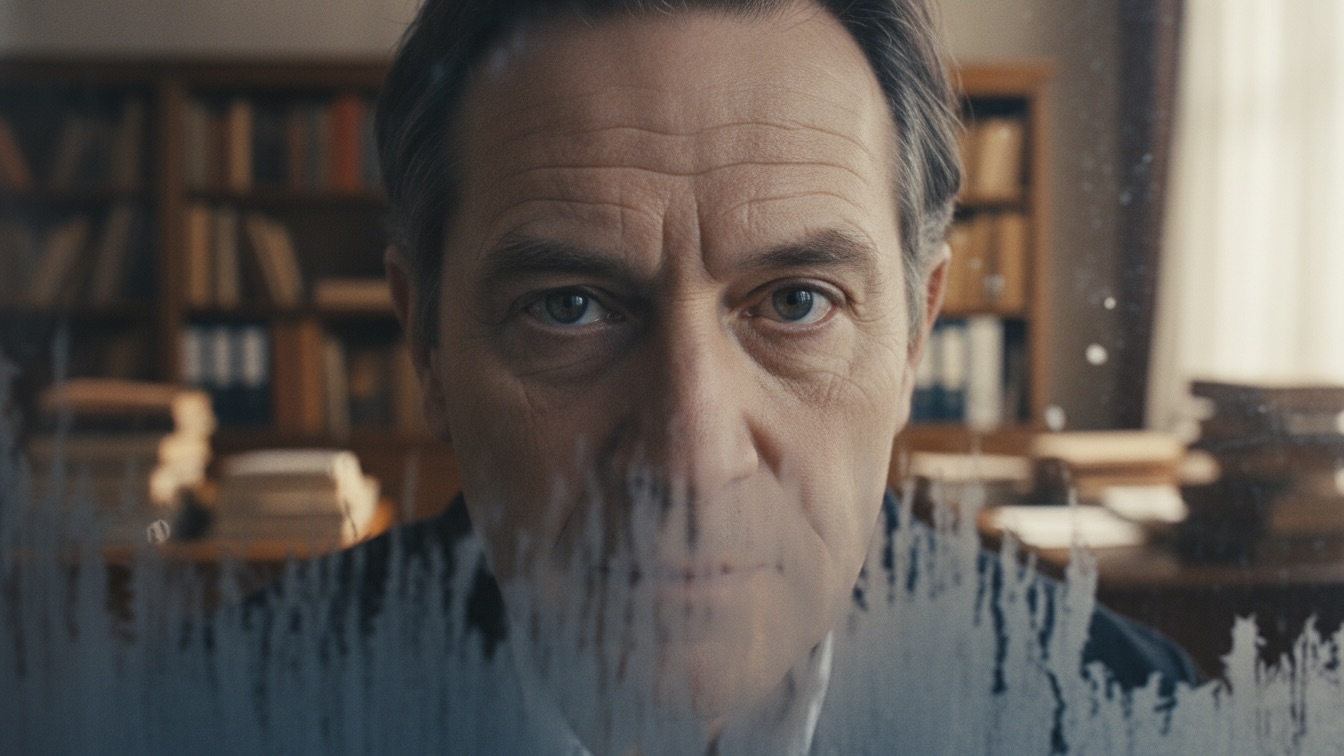
The narrative opens in the claustrophobic, overheated office of David, an aging journalist who is physically and metaphorically wrestling with a stuck window. His frustration with the unyielding frame mirrors his internal resistance to the changing landscape of his profession. This tension is interrupted by the arrival of Jamie, a young representative from the Arts Incubator, who has come to discuss "Winter City Stories," a project utilizing Artificial Intelligence to generate narrative content. David initially approaches the meeting with deep skepticism, viewing AI as an antithesis to the messy, soulful human experience he has spent his career chronicling.
As the dialogue unfolds, Jamie dismantles David’s preconceptions not with technological jargon, but with human-centric analogies. He frames AI as a tool akin to a printing press or a carpenter aiding an architect, emphasizing that the creative core—the plot, emotion, and intent—remains strictly human. Through Jamie’s explanation of how the project empowers marginalized voices in northern communities and removes technical barriers to storytelling, David’s defensive posture begins to crumble. The story concludes with the window remaining physically shut, but David experiences a significant internal shift. He recognizes the potential for this new technology to act as a collaborator rather than a replacement, finding a sense of "fresh air" in the concept even as the room remains stifling.
The central theme of the text is the negotiation between tradition and innovation, specifically regarding the definition of authorship in the digital age. The story posits a conflict between the romanticized struggle of the solitary human creator and the efficiency of algorithmic assistance. David represents the traditionalist view that suffering and manual effort are intrinsic to value, evidenced by his attachment to the "messy, unpredictable, flawed human experience." Conversely, the narrative challenges the notion that ease negates art. By comparing AI to a hammer or a printing press, the text suggests that technology does not replace the creator but rather changes the nature of the labor required to create.
intertwined with this is the theme of accessibility and the democratization of voice. The text moves beyond the philosophical debate of "what is art" to the practical reality of who gets to participate in it. Jamie highlights how technical barriers—such as language fluency, typing mechanics, and publishing logistics—often silence marginalized communities. The AI is presented not as a generator of ideas, but as an equity tool that handles the "grunt work," allowing those without traditional resources to act as architects of their own narratives. This shifts the focus from the purity of the process to the impact of the outcome.
Finally, the story explores the psychological concept of stagnation versus adaptation. The physical environment serves as a potent metaphor for this theme. The "stuck window" symbolizes a fixed mindset and an inability to let in new perspectives. David’s initial futility in opening the window mirrors his futility in stopping the tide of technological progress. However, the resolution suggests that adaptation is an internal process. While the external circumstances (the window) remain unchanged, the internal perspective can shift, turning an oppressive atmosphere into one of promise and "lingering hope."
David functions as the protagonist whose internal state is intimately projected onto his external environment. As a psychologist might observe, his physical struggle with the window is a manifestation of his cognitive dissonance regarding his relevance in a changing world. He is a man who values the tactile and the tangible, evidenced by his reliance on a yellow legal pad and his disdain for the "AI-fueled fantasy." His initial irritability and the physical symptoms of stress—the throbbing temple, the sweating—indicate a man operating under a threat response. He feels his identity as a "human storyteller" is under siege by cold automation.
However, David demonstrates a capacity for intellectual flexibility that redeems him from being a mere caricature of a luddite. His motivation shifts from a desire to expose a fraud to a genuine curiosity about the human element within the machine. He is disarmed not by the technology, but by the "human response" to it—the community engagement and the emotional resonance Jamie describes. By the end of the chapter, David’s conflict resolves not through a victory over the window, but through an acceptance of his inability to control the mechanism, choosing instead to change his relationship to the "view." He moves from a state of defensive isolation to one of tentative connection.
Jamie serves as the foil to David, representing the synthesis of human creativity and technological pragmatism. He is characterized by an "energetic, almost boyish face" and a lack of pretension, which immediately counters David’s expectation of a sterile, corporate technocrat. Psychologically, Jamie displays high emotional intelligence; he reads the room—both the physical disorder and David’s emotional skepticism—and responds with empathy rather than defensiveness. He does not try to sell a product but rather shares a philosophy, using validation ("It’s a fair question") to lower David’s guard.
His motivation appears rooted in genuine altruism and curiosity rather than commercial ambition. Jamie views himself and his team as explorers or collaborators, distinct from the machine they utilize. He maintains a clear boundary between the tool and the artist, insisting that the "emotional core" must remain human. His confidence stems from a secure attachment to his own creativity; he does not fear the AI because he understands his role as the "architect." By remaining unfazed by the "chaos of the room," Jamie demonstrates that he is comfortable with the messiness of reality, bridging the gap between David’s gritty world and the polished potential of the future.
The narrative employs a third-person limited perspective, closely adhering to David’s consciousness to emphasize the claustrophobia of his worldview. The pacing mirrors David’s psychological state: it begins with a sense of stagnation and physical resistance, marked by words like "grunted," "juddered," and "oppressive." As the dialogue with Jamie progresses, the prose becomes more fluid and conversational, reflecting the loosening of David’s mental rigidity. The exchange of ideas creates a rhythm of thesis and antithesis, moving from skepticism to understanding, which accelerates the narrative flow toward the final epiphany.
Sensory details are used extensively to ground the abstract discussion of AI in physical reality. The "dull, steel grey" of the outside world and the "faint squeal of metal" establish a tone of bleakness and friction. The heat of the office is palpable, symbolizing the pressure David feels. In contrast, Jamie brings a metaphorical coolness; he sheds his heavy coat and speaks with "fresh" optimism. The final image of David resting his forehead against the "cool glass" provides a sensory resolution that parallels his psychological cooling, offering tactile relief even without the window physically opening.
The narrative voice balances cynicism with earnestness. David’s internal monologue is colored by a weary, noir-like grit—he sees the office as a "cluttered monument to past stories." This contrasts sharply with Jamie’s dialogue, which is open, metaphorical, and forward-looking. The author utilizes the "stuck window" as a central, recurring motif throughout the text. It acts as a structural anchor, appearing at the beginning to establish the problem and at the end to recontextualize the solution. This literary device reinforces the idea that while we cannot always change the "mechanics" of the world around us, we can alter our perception of the view.