Melgund Township Winter Story Library
Incident on the Garry Street Rooftop - Analysis
by Jamie F. Bell | Analysis
by Jamie F. Bell | Analysis
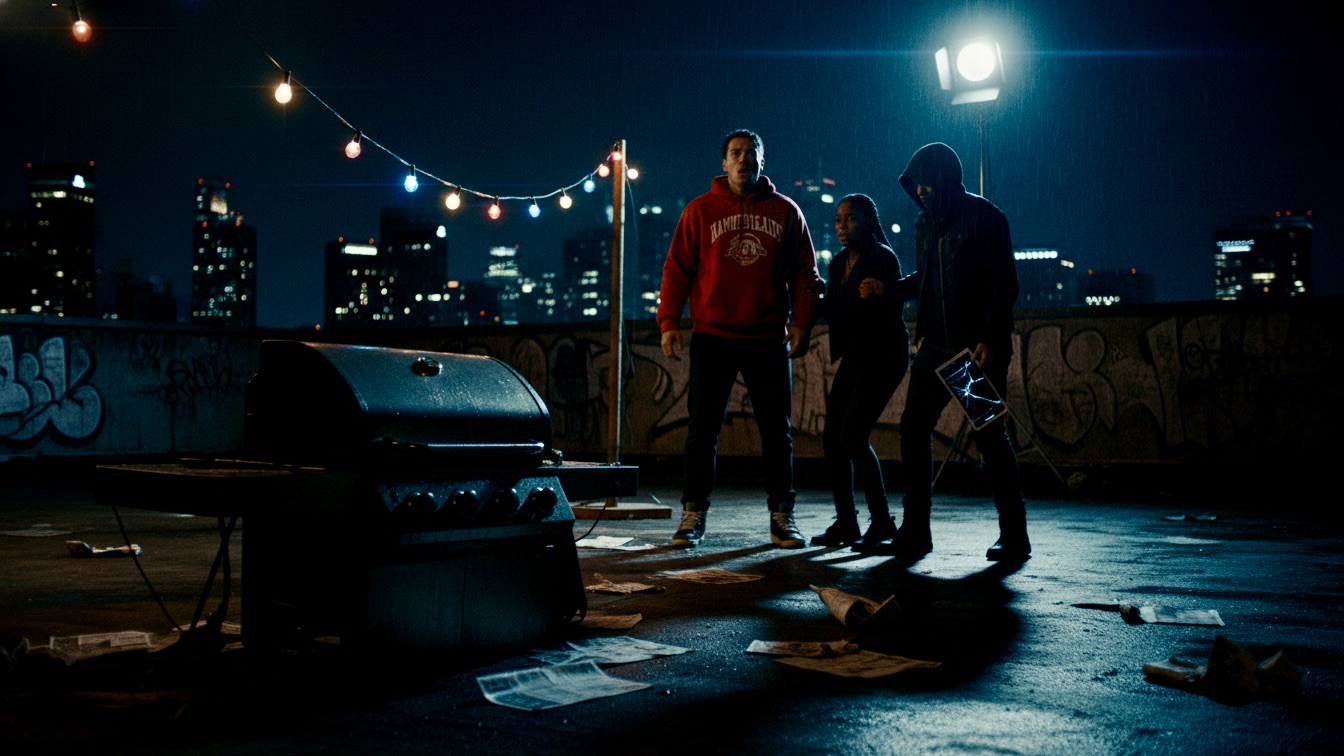
The chapter follows Sasha, a young, aspiring photojournalist, as she infiltrates a rooftop party on Garry Street to capture images for her zine, ‘Urban Etudes.’ Initially a detached observer, she identifies a point of conflict between Mark, an aggressive partygoer, and Thandi, an earnest activist distributing pamphlets. Compelled by what she perceives as a powerful story, Sasha begins to record their confrontation with her phone. Her act of recording escalates the tension, causing Mark to become performatively hostile. He shoves Thandi, who stumbles backward into a massive BBQ grill, knocking it over with a deafening crash. The party host emerges and, seeing the chaos, furiously evicts Mark, Thandi, and Sasha, whom he holds especially responsible. Sasha is left with her footage, but the potential journalistic triumph is overshadowed by a profound sense of complicity in the event she documented.
The central theme of this chapter is the Heisenberg Uncertainty Principle of human interaction, or the observer effect, applied to journalism and social dynamics. Sasha begins as a self-styled neutral observer, believing her camera grants her a privileged and protected status outside the events she witnesses. However, the story masterfully dismantles this illusion. The moment she raises her phone to record, she ceases to be a passive documentarian and becomes an active participant. The tiny red light of the recording device acts as a catalyst, transforming a private argument into a public performance and fundamentally altering the outcome. The narrative powerfully argues that there is no such thing as pure observation; the act of watching, and especially of recording, invariably changes the nature of the event being watched.
Flowing from this is a sharp examination of journalistic ethics versus personal responsibility. Sasha’s internal conflict crystallizes in the moment before the shove. The thought that "a journalist records" is presented as a "cold, clear, and absolute" imperative, a professional dogma that overrides the human impulse to de-escalate or intervene. This highlights a critical tension within the field of documentary work: the pursuit of an unfiltered "story" can necessitate a moral abdication. The chapter does not offer an easy answer but leaves Sasha, and the reader, to grapple with the consequences. Her final feeling of complicity suggests that the professional code she clung to was insufficient to absolve her of her role in the harm that occurred.
Finally, the story presents a microcosm of the clash between apathy and activism. The rooftop party, with its "standard" and "unusable" conversations, represents a deliberate escape from the world's problems. Thandi’s earnest attempt to introduce a real-world political issue is met not with debate but with aggression. Mark’s hostility is rooted in the violation of this unspoken contract of escapism; he resents being reminded of a world beyond the party. Sasha initially views this conflict with a documentarian’s eye, seeing it as "texture" and "text." By the end, however, she is forced to confront that this is not an abstract story but a real, physical confrontation with tangible consequences, a collision she helped bring about.
Sasha is a character defined by a powerful, yet ultimately fragile, sense of identity built around her role as an artist and journalist. She enters the scene armed with the "reassuring weight" of her camera and the "armor" of her neutrality. This persona as "the girl with the camera" is a carefully constructed defense mechanism, allowing her to engage with her peers from a position of detached superiority while masking her own potential insecurities. Her zine’s pretentious title, ‘Urban Etudes,’ is a self-aware admission of this performance; she is trying to elevate the mundane lives around her, and by extension her own, into something that sounds important.
Her primary psychological conflict is the collision between her idealized professional self and her underlying human morality. Initially, she clinically catalogs the scene, her "journalistic brain" identifying Mark’s behavior as a "classic intimidation tactic." This intellectual distance allows her to feel in control. However, the decision to record with her phone marks a critical turning point. The phone, a more intimate and ubiquitous device than her professional camera, blurs the line between observer and participant. Her realization that the lens can be a "magnifying glass" reveals a dawning awareness of her own power to influence events, a power she has not yet learned to wield responsibly.
In the aftermath of the incident, Sasha’s carefully constructed identity shatters. The phone in her hand no longer feels like a tool of her trade but a "cheap and greasy" piece of evidence from a crime scene. The host’s accusation, "Especially you," confirms her worst fear: she was not an innocent bystander but a key instigator. Her final thought, questioning whether she is a "reporter" or "just another piece of the evidence," signifies a profound crisis. She got the story she was looking for, but in doing so, she lost the moral high ground and the illusion of objectivity that formed the very foundation of her identity. The cold, heavy stone of complicity in her stomach is the psychological price of her "perfect, unfiltered" footage.
The author employs a tightly controlled third-person limited perspective, immersing the reader entirely within Sasha's consciousness. This narrative choice is crucial, as the story's primary drama is not the external conflict between Mark and Thandi, but Sasha’s internal moral journey. We experience the party through her cynical, observational filter, and we feel her pulse quicken as the detached observer becomes an anxious participant. This close psychic distance allows the author to explore the complex rationalizations and sudden moral reckonings that define her character arc, making her final feeling of complicity deeply resonant.
The chapter is built on a foundation of rich sensory detail that creates a palpable and immersive atmosphere. From the "slick with condensation" door handle to the "chemical soup" of smells on the roof, the world is rendered with a gritty verisimilitude. The visual descriptions, particularly the "dim, festive glow of string lights" casting "long, dancing shadows," contribute to a sense of unsteadiness and provisional reality that mirrors Sasha's own precarious moral standing. The cacophony of the party—the bass, the chatter, the laughter—serves as a constant backdrop that is violently silenced by the "deafening" crash of the BBQ, a stylistic choice that uses sound to signal a permanent shift in the narrative's tone from social observation to personal crisis.
The pacing of the chapter is expertly managed, beginning with a slow, deliberate observational rhythm as Sasha cases the party. It builds tension methodically as she focuses on Mark and Thandi, and then accelerates dramatically once she begins recording. The description of the final confrontation, where "everything seemed to slow down," is a classic technique to heighten a moment of intense action and decision-making, emphasizing the weight of Sasha’s choice to keep filming. The oversized, suburban BBQ grill serves as a brilliant central symbol. Initially an absurdly solid object representing misplaced domesticity, its violent toppling becomes a metaphor for the collapse of the party's social order and, more importantly, the shattering of Sasha's own ethical framework.