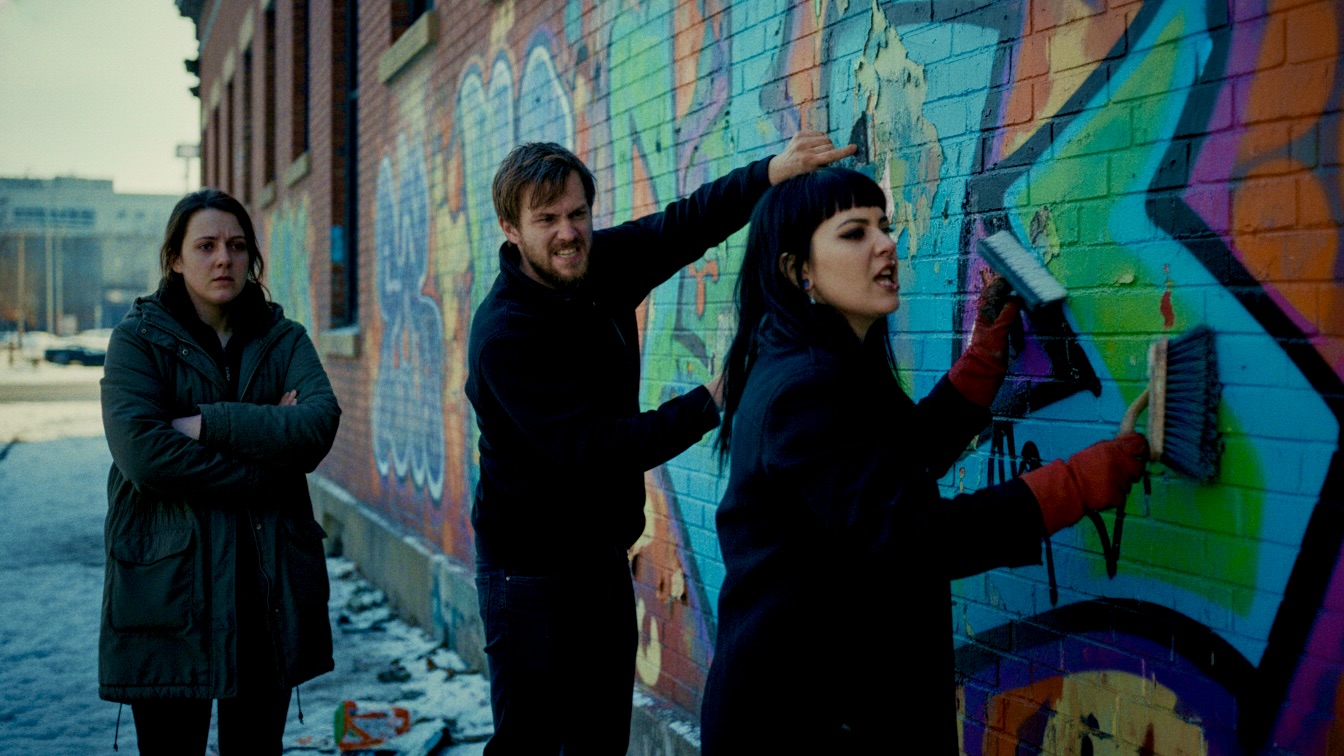
The chapter "Vandalism" opens with Debbie, the struggling owner of Canvas & Rust gallery, arriving to a brutally cold Winnipeg morning. She discovers the entire east-facing wall of her historic building has been covered by a massive, intricate mural—a stunning act of vandalism. Her initial awe as an artist quickly turns to dread as a gallery owner, realizing the financial catastrophe it represents. Shortly after, a city official delivers a remediation order and a hefty fine, giving her seventy-two hours to remove the mural or face further penalties and forced cleanup. Debbie's brother, Evan, arrives, using the crisis to pressure her into selling the gallery, a legacy from their father, to an interested buyer, Helena. Despite the overwhelming logic of his arguments, Debbie refuses, driven by a desperate, irrational resolve. She then embarks on a quest to find the artist, Lena, with help from a street musician named Ahmed. Debbie confronts Lena at a coffee shop and, in an audacious gamble, offers Lena a solo show in her gallery in exchange for helping to clean the mural. Lena, intrigued by the paradoxical offer, agrees. Finally, Debbie recruits her resentful brother, Jack, appealing to his need to channel his own anger. The chapter concludes with the unlikely trio—Debbie, Lena, and Jack—miserably and ineffectually attempting to scrub the frozen paint off the wall, their individual frustrations boiling over into conflict, united only by their shared misery and the daunting task ahead.
The chapter deeply explores the pervasive theme of art versus commerce and survival. Debbie embodies this conflict, torn between her artistic admiration for the mural's "furious energy" and the crushing financial reality it imposes. The gallery, a passion project and her father's legacy, is a constant drain, highlighting the precariousness of artistic ventures in a world driven by profit. Evan, her brother, serves as the pragmatic counterpoint, advocating for the abandonment of artistic ideals in favor of financial solvency, portraying the gallery as a "lousy business" rather than a creative haven.
Defiance and resilience emerge as central human responses to overwhelming adversity. Despite being cornered and facing bankruptcy, Debbie chooses not to sell, clinging to a "wild, desperate, terrifying resolve." Her decision is irrational from a business perspective but deeply rational from the standpoint of her identity and commitment. Lena, the artist, also embodies defiance through her powerful, unsanctioned artistic expression, a "raw, angry scream" against decay. Even Jack, initially unwilling, finds a grudging outlet for his own frustrations in the "destructive act of cleaning," transforming his resentment into a form of active, albeit reluctant, participation.
The narrative also delves into the theme of injustice and the burden of responsibility. Debbie is presented as a victim of vandalism, yet she is paradoxically punished by the city for the actions of another. The by-law, impersonal and unyielding, places the full weight of the "catastrophe" squarely on her shoulders, illustrating how systemic rules can exacerbate individual suffering. This external injustice fuels Debbie's internal "bitter pill," making her desperate fight not just about survival, but about asserting her fundamental right to fairness.
Finally, the chapter touches upon connection and disconnection within familial and societal bonds. Debbie's relationships with her brothers, Evan and Jack, are fraught with tension, misunderstanding, and resentment. Evan's "practiced concern" masks his self-interest, while Jack's anger is a raw wound between them. Yet, Debbie's desperate gamble to unite Lena and Jack in a common, miserable cause, however tenuous, suggests a nascent, if uncomfortable, form of human connection forged in shared hardship, even if they remain "three islands of misery."
Debbie's internal state is a complex tapestry of weariness, passion, despair, and ultimately, fierce resolve. She is introduced as a woman burdened by the "Winnipeg cold" and the constant financial strain of her failing gallery, Canvas & Rust. Her initial reaction to the mural—a dual emotion of "awe" as an artist and "cold dread" as an owner—perfectly encapsulates her central conflict: the battle between her artistic soul and her pragmatic responsibilities. She has poured "every penny she had" into the gallery, seeing it as both her passion and her father's legacy, making its potential loss a profound threat to her identity.
Her motivations are deeply rooted in this dual identity. She dreams of showing "the kind of art" Lena created, yet she is simultaneously terrified of the consequences. Her refusal to sell to Helena, despite Evan's compelling, logical arguments, stems from a stubborn loyalty to her vision and a defiant rejection of giving up. This decision, described as "irrational" and "stupid," is psychologically driven by a need to fight, fueled by a recent confrontation with her brother Jack, where she had demanded he face his own battles. Her hypocrisy in considering surrender becomes a powerful catalyst for her resolve.
Debbie's psychological journey in this chapter moves from passive victimhood to active, desperate agency. She doesn't call the police immediately, delaying the "official" start of her doom. Her subsequent actions—seeking Ahmed, confronting Lena, and recruiting Jack—are not well-planned strategies but rather impulsive, instinctual gambles born of a profound need to find a way out, however unconventional. She exhibits a deep, albeit sometimes painful, understanding of others, particularly Jack's anger, which she shrewdly leverages to gain his help. Her final feeling of "a wild, desperate, terrifying resolve" signifies a shift from despair to a determined, if precarious, sense of purpose.
Evan serves as the voice of cold, calculated pragmatism, contrasting sharply with Debbie's artistic idealism. His initial reaction to the mural, "impressive. For a felony," immediately establishes his transactional view of the world. He is not genuinely moved by the art but by its implications for property value and legal standing. His concern for Debbie, though "practiced," is undeniably linked to his desire for her to sell the gallery, which would allow him to be repaid what she owes him.
Evan's primary motivation is to convince Debbie to abandon her failing venture and embrace a financially secure path. He frames her attachment to the gallery as "martyrdom" and dismisses their father's legacy as a "lousy businessman," stripping away the emotional and historical value Debbie places on the building. His arguments are logical, persuasive, and relentless, designed to exploit Debbie's vulnerabilities and financial desperation. He represents the external pressures of the commercial world that threaten to extinguish Debbie's artistic spirit.
Psychologically, Evan appears to be a man driven by financial sensibility and a certain degree of self-interest, perhaps masked by a belief that he is acting in Debbie's best interest. His "smooth patter" and "calculated blows" reveal a skilled manipulator, adept at identifying and targeting emotional weaknesses. He lacks empathy for Debbie's deeper artistic and sentimental attachments, viewing them as obstacles to a rational solution. His frustration when Debbie refuses his offer exposes the underlying impatience and self-serving nature beneath his seemingly helpful exterior.
Lena is introduced as the enigmatic, defiant artist behind the colossal mural, a "creature of chaos, a disruptor." Her art is described as a "chaotic masterpiece," a "riot of color and form that seemed to thrum with a furious energy." This description immediately establishes her as a powerful creative force, driven by a desire to make a statement, an "angry scream about technology, decay, and fragile humanity." She is not a casual vandal but a "professional," with staggering detail and potent messaging in her work.
Her motivations are purely artistic and rebellious. She "doesn't like to be found" and expresses a confrontational attitude, challenging Debbie to "call the cops" or "sue me." This suggests a history of operating outside conventional norms and a deep distrust of authority and establishment figures. Her "shaved on one side" dyed-black hair and "paint-splattered army jacket" are visual markers of her counter-culture identity. Yet, her casual comment about the gallery's "nice pre-war detailing on the cornices" reveals an unexpected depth of architectural appreciation, hinting at a more nuanced artistic sensibility beyond pure rebellion.
Psychologically, Lena is guarded, suspicious, and fiercely independent. Her initial reaction to Debbie's offer—a burst of "loud, sharp bark of a laugh"—shows her disbelief and cynicism. However, the prospect of a "solo show" in a gallery, a legitimate platform for her art, clearly disarms her. This audacious offer presents a paradox she struggles to compute, challenging her established identity as a street artist. Her eventual acceptance, marked by a "slow, calculating smile" and the demand for "that in writing," reveals a shrewd intelligence and a willingness to engage with the system, albeit on her own terms, when a truly compelling opportunity arises.
Jack is presented as Debbie's resentful brother, a man burdened by weariness and deep-seated anger. His slumped shoulders and "blankly" staring at the security monitor paint a picture of stagnation and quiet despair. The "open wound" of his previous conversation with Debbie suggests a strained and unresolved familial conflict, with him feeling "trapped" by her actions. He perceives himself as having "helped" her enough, implying a history of sacrifices or burdens placed upon him.
His motivation for joining the cleanup effort is complex. Initially, he is unwilling, scoffing at the idea of "scrubbing your wall for you? For free?" He resents Debbie's imposition and his perceived role as her reluctant helper. However, Debbie shrewdly appeals to his psychological need for an outlet, recognizing his anger and suggesting that "physical work" could be "cheaper than therapy." This insight taps into his core emotional state, offering a "target for the furious, helpless energy buzzing under his skin."
Psychologically, Jack is a man simmering with frustration and a sense of being cornered. His "bitter laugh" and "snapped" responses indicate a low emotional threshold and a feeling of powerlessness. He hates that Debbie knows him so well and that her assessment of his need for an outlet is accurate. The physical act of scrubbing the wall becomes a cathartic, if destructive, channel for his rage, resentment, and "years of stagnation." He finds a perverse satisfaction in chipping away at the paint, translating his internal chaos into external, exhausting action, even as he remains deeply resentful of the circumstances.
The narrative immediately establishes a bleak and challenging tone through powerful sensory details of the Winnipeg cold. Phrases like "solid wall of it," "predator that stole the breath," and "tiny, sharp needles of ice" immerse the reader in Debbie's physical discomfort and foreshadow the emotional and financial chill she is about to experience. This pervasive cold acts as an external antagonist, magnifying the difficulty of every task and intensifying the characters' misery.
The pacing of the chapter is carefully controlled, starting with a slow, almost resigned opening that quickly accelerates with the discovery of the mural. The description of the artwork is vivid and detailed, building a moment of awe before the narrative swiftly shifts to the "cold dread" of Debbie's realization. The subsequent encounters—with the city official, Evan, Ahmed, and Lena—propel the plot forward with increasing urgency, emphasizing the seventy-two-hour deadline. The final section, depicting the arduous cleanup, deliberately slows the pacing, highlighting the brutal, repetitive nature of the work and the characters' mounting despair.
The narrative voice is a close third-person limited perspective, primarily focused on Debbie's internal experience. This allows for deep insight into her "frantic hummingbird of panic," her complex motivations, and the "universe of impossible calculations running through her head." This empathetic yet unflinching voice effectively conveys her emotional turmoil, her moments of despair, and her flashes of desperate resolve. The voice occasionally dips into the perspectives of other characters, such as Evan's "practiced concern" or Jack's "crushing weariness," to deepen the psychological landscape without fully shifting the point of view.
Imagery is used effectively to convey both the beauty of the art and the crushing weight of Debbie's situation. The mural itself is described with rich detail, from the "colossal, stylized raven with wings made of tangled electrical wires" to the "glowing red heart, dripping what looked like binary code." This vivid description allows the reader to appreciate the artwork's power, making Debbie's internal conflict more resonant. Metaphorical language, such as Evan's offer as a "lifeboat" and the final image of the trio as "three islands of misery," further enriches the text, emphasizing their isolation and the seductive nature of surrender. The "scraping" sound at the chapter's close becomes a powerful, almost primal, symbol of their desperate, arduous struggle.