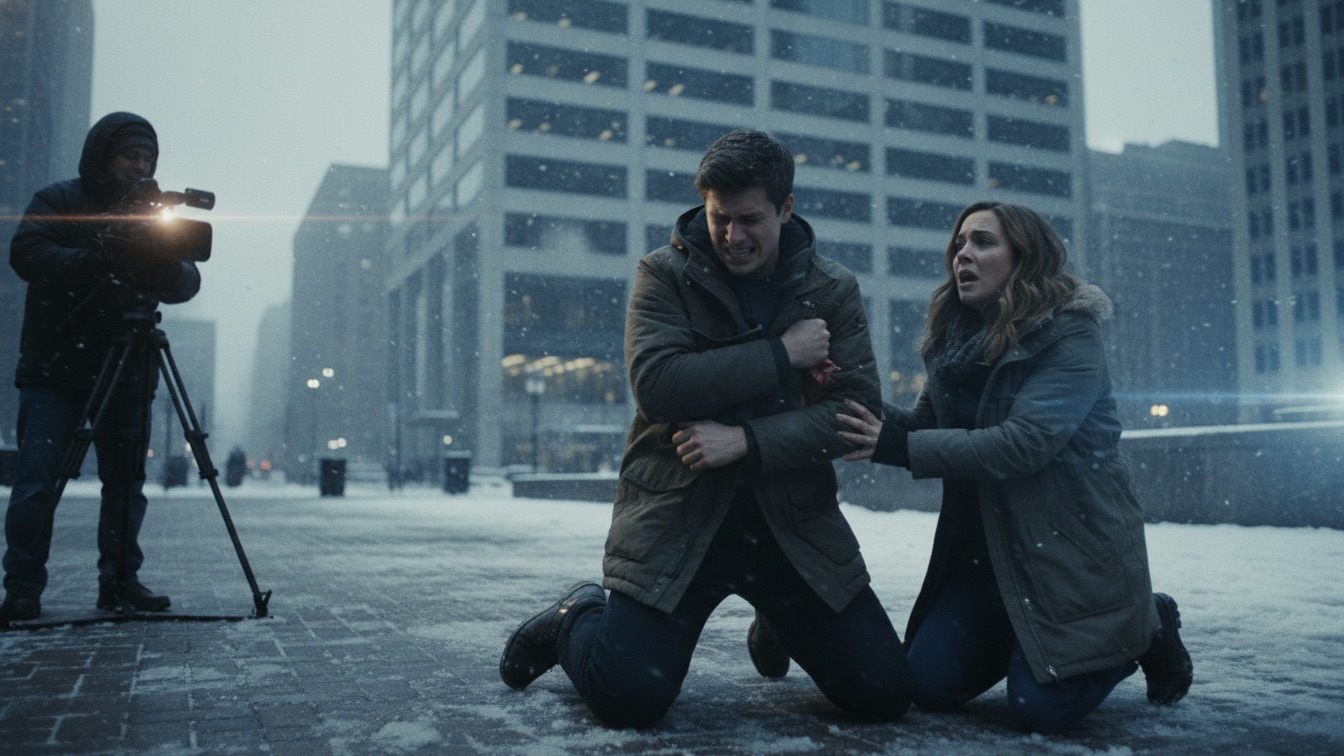
The hollow silence of a failed public meeting gives way to the biting cold of a desperate street protest outside a sterile corporate building. Snow falls, muffling sound until the sharp crack of violence shatters the quiet, followed by the tense, awkward intimacy of a stranger's apartment.
The silence in the gallery was louder than the shouting had been. It was a physical weight, pressing down on the rafters, settling in the dust motes dancing in the weak light from the street. The chairs stood in disarray, a chaotic graveyard of good intentions. Discarded flyers, printed with so much frantic hope, were crumpled on the floor or left on seats like forgotten programs at a funeral. The dripping from the ceiling in the back corner was the only percussion, a steady, maddening metronome counting out the seconds of their failure. Drip. Drip. Drip.
Debbie stood motionless, staring at the empty space where the crowd had been. Her posture was unnaturally rigid, as if the slightest movement would cause her to shatter. Her face, usually a storm of kinetic energy and sharp expressions, was a blank, pale mask. She had poured every last ounce of her formidable will into that meeting, had organized and planned and fought, and for what? To be dismissed. To be called hysterical. To watch her neighbors, the very people she was fighting for, shuffle out with embarrassed apologies in their eyes.
Jack wanted to say something. Anything. Sorry. We tried. It’s not your fault. But the words were useless, hollow little pebbles against an avalanche. His own voice was a ghost in his throat. The flash of rage that had propelled him forward, that had momentarily silenced his stutter and his fear, was gone. In its place was the familiar, gut-sinking shame. He’d made it worse. He’d stood up, pointed, and cracked like a cheap piece of glass, drawing their ridicule, confirming their assessment of the opposition as weak and pathetic. Nice try, champ. Evan’s voice was an oily residue in his mind.
He started moving, the simple act of doing something, anything, a defense against the crushing inertia. He picked up a chair, its metal legs scraping a protest against the warped floorboards. He began arranging it back into a neat row against the wall. It was a pointless, absurd gesture. Tidying up the scene of the crime. He worked methodically, his movements stiff. Each chair he lifted and placed was an admission of defeat. He could feel Debbie’s eyes on his back, but she didn’t speak.
He had worked his way through half the room when her voice finally cut through the silence, thin and brittle. “Stop.”
Jack froze, a chair held halfway in the air. He turned slowly. She hadn’t moved.
“Just… leave it,” she said, her gaze drifting over the mess. “Let it be what it is. A wreck.”
He set the chair down gently, the sound echoing in the cavernous space. He shoved his hands in his pockets, the worn fabric a familiar comfort. “Debbie…”
“Don’t,” she whispered. “Don’t say you’re sorry. Don’t say we’ll get them next time. There isn’t a next time. This was it. This was the one shot we had to get everyone on the same page.” Her voice was devoid of its usual fire. It was just tired. Ash and embers.
She finally moved, walking over to the small table where the half-empty coffee urn sat. She poured the cold, sludgy remains into a paper cup and stared into it. “Logic doesn’t work. Facts don’t work. Appealing to a sense of community… that was a joke.” She laughed, a short, harsh sound with no humor in it. “They don’t care about community. They care about their property values and not getting sued. And he knew that. He played them perfectly.”
“He called you hysterical,” Jack mumbled, the words tasting like poison. He couldn’t get the moment out of his head. The collective intake of breath, the smirks, the way her face had crumpled for just a second before the mask went up.
“Of course he did,” she said, swirling the black liquid in her cup. “It’s the oldest trick in the book. A woman gets passionate, she’s emotional. She gets angry, she’s hysterical. She presents evidence, she’s over-invested. A man does the same thing, and he’s a leader.” She finally looked at him, her eyes dark and deep. “You stood up for me. Thank you for that.”
Jack flinched, looking away. “It didn’t help. I just… made a fool of myself.”
“No,” she said, her voice a little firmer now. “You didn’t. For about five seconds there… they were scared. I saw it in his eyes. Before you… faltered. You had him.”
He just shook his head, unable to accept it. The memory of his own weakness was too strong. He could still feel the laughter of the men in expensive coats, could see the pity on the faces of the bakery brothers.
Debbie took a sip of the cold coffee and grimaced, setting the cup down. She ran a hand through her already messy hair, leaving it sticking up in odd directions. She began to pace, a caged energy returning to her movements. The stillness was broken. The shock was wearing off, being replaced by the familiar hum of her restless intelligence.
“Okay,” she said, mostly to herself. “Okay. So that didn’t work. The direct approach. The reasonable, adult, town-hall approach. We tried to speak their language. We used logic, data, community impact statements.” She gestured around the ruined room. “And they responded with playground insults and veiled threats. So… we stop speaking their language. We speak ours.”
Jack watched her, a spark of morbid curiosity lighting in his chest. “What’s our language?”
She stopped pacing and turned to face him, a dangerous glint in her eye. “Art,” she said. “Image. A symbol. Something they can’t dismiss with a condescending pat on the head. Something the news can’t ignore. We tried to tell them a story. Now we have to show them one.”
She grabbed a discarded flyer from a chair and flipped it over, snatching a pen from the sign-in table. She started sketching, her movements fast and decisive. Jack walked over, peering over her shoulder. It was a rough drawing of a stick figure standing in the snow, holding up an empty rectangle.
“What is it?” he asked.
“It’s a protest,” she said, not looking up. “It’s performance art. It’s a visual punch in the face. We can’t get into their boardroom, but their office has that big glass front. Right on the street. We can’t beat them with money or lawyers, but we can make them look like what they are. Bullies.” She scribbled more words on the paper. “‘Frozen Out.’ That’s what we’ll call it.”
Her energy was infectious, or maybe it was just the sheer insanity of it. An hour ago, they were utterly defeated. Now, she was planning a counter-attack. A desperate, probably foolish one.
“We get old picture frames,” she explained, her voice gaining speed and volume. “Big, ornate ones if we can find them. We take them down to the sidewalk in front of the Sterling Development building. And we just… stand there. In the cold. Holding them up.”
Jack stared at the crude drawing. “Holding them up… at what?”
“At nothing,” she said, a triumphant, slightly mad smile spreading across her face. “That’s the point. We hold them up and frame the empty space where our shops are going to be. We frame the air. We frame the future they’re building—a big, fat, expensive nothing. We become a living installation. People walking by will have to look. They’ll have to wonder what we’re doing. And we won’t say a word. We’ll just stand there, freezing, being framed out of our own neighborhood.”
The audacity of it was terrifying. It was also brilliant. It was visual, simple, and deeply weird. It was exactly the kind of thing that might get noticed in a way a poorly attended town hall meeting never could.
“They’ll call the cops,” Jack said, the practical, fearful part of his brain kicking in.
“Let them,” Debbie shot back. “What are they going to arrest us for? Loitering with art? Standing on a public sidewalk? The image of police arresting peaceful artists standing in the snow… God, a news crew would kill for that shot.” She tapped the pen against the paper. “We need more people. Not a crowd. Just a few. The bakery brothers, maybe. Mrs. Gable, if she’s not too scared. The more normal we look, the better. Just regular people being frozen out by a big corporation.”
She looked up at him, her eyes searching his. The question was unasked but hung heavy in the air between them. Are you in? After his public failure, after the humiliation, she was still looking at him like he was a part of this. Like he hadn’t just proven himself to be completely unreliable.
A cold draft snaked its way in from under the gallery door, a reminder of the winter waiting outside. The idea of standing out there for hours, a silent, frozen statue, was miserable. The idea of putting himself back in the line of fire, of being seen and judged and laughed at again, was worse. His instincts screamed at him to retreat, to go back to the quiet, anonymous hum of the Stop-N-Go, to disappear back into the background where he belonged.
But then he saw the flicker of hope in her eyes, a hope he had helped extinguish an hour ago. And he remembered the sharp, cruel sound of the developers laughing. He remembered the word hysterical. And the small, quiet part of him that had found its voice for five furious seconds stirred again.
“When?” he asked.
Debbie’s smile was grim, but it was real. “Tomorrow,” she said. “Lunchtime. Maximum exposure.”
***
The next morning was a study in gray. A low, heavy sky pressed down on the city, promising more snow but not yet delivering. The air had a damp, penetrating chill that seeped through the layers of Jack’s clothing and settled deep in his bones. They’d spent half the night cleaning up the gallery and the other half driving around in Debbie’s rattling hatchback to thrift stores, buying up every dusty, chipped, forgotten picture frame they could find. They had a dozen of them piled in the back of her car, a jumble of fake gold leaf, dark-stained wood, and tarnished silver.
Now they were parked a block away from the Sterling Development tower. The building was an insult of steel and glass, soaring above the historic brick and stone of the surrounding blocks. It was sleek, sterile, and utterly devoid of character. It looked like it had been dropped into the city from another, wealthier planet. Pedestrians hurried past its entrance, heads bowed against the wind, their breath pluming in the frigid air.
Debbie was behind the wheel, drumming her fingers nervously on the steering wheel. The car’s heater was fighting a losing battle against the cold. Jack could see his own breath fogging the passenger-side window. The bakery brothers, Sam and Pete, were supposed to meet them here. Jack wasn’t sure they’d show.
“You think this is going to work?” he asked, his voice low. He was wearing two sweaters under his parka, but he still felt cold.
“I think it’s a better idea than sitting in the gallery waiting for the eviction notice,” Debbie replied without looking at him. Her own nervous energy was palpable, a low-frequency hum that filled the small car. She had dark circles under her eyes, but her expression was fiercely determined. “It’s about control. We can’t control the city council, we can’t control their lawyers. But we can control the narrative, even for an hour. We can stand on a patch of sidewalk and create a different picture.”
He watched a woman in a business suit struggle against the wind, her briefcase acting like a sail. “Or we can get pneumonia and be arrested for trespassing.”
Debbie finally turned to him, her gaze sharp. “Scared, Jack?”
He met her eyes. “Yeah. A little.”
She held his gaze for a moment longer, then nodded, a flicker of something softer in her expression. “Me too.”
The admission hung in the air, a small, shared truth. It was a relief to hear it. He was so used to her projecting an armor of absolute confidence that her moment of vulnerability felt like a gift.
A sharp rap on the driver’s side window made them both jump. It was Sam, his round face red from the cold, his brother Pete hovering behind him like a larger, quieter shadow. Debbie rolled down the window, letting in a blast of icy air.
“You guys are really doing this?” Sam asked, his voice full of a kind of awed disbelief.
“We are,” Debbie said, her confidence snapping back into place. “You in?”
Sam looked at Pete, who gave a slow, deliberate nod. Sam turned back to Debbie. “Yeah,” he said. “Yeah, we’re in. What they did at that meeting… it wasn’t right.”
“Good,” Debbie said. “Grab a frame.”
Getting out of the car felt like stepping into a freezer. The wind was a physical force, pushing against him, finding every tiny gap in his clothing. They opened the hatchback and the four of them stood there for a moment, looking at the pathetic pile of empty frames. In the gray light of day, the idea felt flimsier, more foolish. They were going to fight a multi-million dollar corporation with garage sale junk.
Jack picked up a large, heavy frame made of dark, carved wood. The glass was gone, leaving only the empty space. It felt ridiculous in his gloved hands. Pete took a gaudy gold one, Sam a simple black one. Debbie chose a delicate, oval-shaped silver frame, tarnished with age.
“Okay,” she said, her voice tight. “No talking. No chanting. No signs. We just walk over there, find a spot, and hold them. Let the frames do the talking. If anyone asks what you’re doing, you don’t answer. You just look through your frame at the building. Got it?”
They all nodded, a grim little troop preparing for a very strange battle.
They walked the block in silence, four solitary figures carrying empty rectangles. People gave them strange looks, skirting around them on the sidewalk. Jack felt a hundred pairs of eyes on him, the old, familiar feeling of being exposed and judged. His heart was hammering against his ribs, a frantic, trapped bird. He wanted to drop the frame and run.
But he looked over at Debbie, walking with her head held high, her jaw set. He saw Sam and Pete, their faces grim but resolved. He tightened his grip on the wooden frame and kept walking.
They found their spots on the wide, windswept plaza in front of the building’s main entrance. A security guard inside the heated lobby watched them through the plate glass, his expression a mixture of boredom and suspicion. He picked up a phone.
Debbie gave a sharp nod. Now.
Jack took a deep breath that burned his lungs and lifted the frame. He held it up, his arms straight out, and framed a section of the gleaming glass and steel facade. The building looked cold and impersonal through the empty rectangle. He stood there, a living statue, the wind tearing at him. Beside him, Debbie, Sam, and Pete did the same. Four silent figures, framing the void.
For the first five minutes, nothing happened. People hurried past, casting confused glances, but no one stopped. The cold was beginning to work its way into Jack’s fingers, making the heavy frame harder to hold. His arms were already starting to ache. This was a stupid idea. They just looked like lunatics.
Then, a man in a delivery uniform paused. He stopped and stared, tilting his head. He looked from Jack’s frame to Debbie’s, then back at the building. A flicker of understanding crossed his face. He didn’t say anything, but he watched for a full minute before moving on.
A few minutes later, a young woman with a messenger bag and a professional-looking camera stopped. She didn’t ask questions. She just started taking pictures. The sound of the shutter clicking was sharp and loud in the cold air. It was the first sign that this might actually be working. The camera made them legitimate. It transformed them from four weirdos into an event.
Jack’s arms were on fire now. The heavy wood frame felt like it was made of lead. He shifted his weight, trying to find a more comfortable stance, but there was none. There was only the wind, the cold, and the burn in his muscles. He focused on his breathing, trying to block it out. He looked through the frame and saw his own faint reflection in the building’s dark glass, a ghost haunting the edges of the corporate world.
Then a van pulled up to the curb, a local news station logo emblazoned on its side. A reporter and a cameraman got out. They approached the woman with the messenger bag, who Jack now realized was probably a freelance journalist or a blogger. They spoke for a moment, then the news crew turned their camera on the four of them.
This was it. Maximum exposure. A small, wild thrill shot through Jack, momentarily overriding the pain in his arms. They were being seen. Their silent protest was being recorded. They weren’t invisible.
The reporter, a woman bundled in a stylish red coat, approached Debbie. “Can you tell us what this is all about? What’s the message here?”
Debbie, true to her own rules, said nothing. She just continued to stare intently through her silver frame at the building. The reporter tried again, then moved to Sam, who also remained silent. She finally came to Jack. He could feel the camera lens on him like a physical touch. His heart pounded.
“Sir? Are you part of a group? What are you protesting here today?”
He wanted to speak. He wanted to explain everything—the gallery, the arsons, the rigged town hall, the feeling of being erased from his own city. But he remembered Debbie’s instructions. He stayed quiet, his jaw clenched, his gaze fixed on the sterile glass tower. The reporter sighed in frustration and moved back to her cameraman, speaking to the camera directly now, speculating about the meaning of the “silent, almost surreal protest.”
It was working. It was actually, impossibly working. A small crowd had started to gather now, a mix of curious office workers on their lunch break and passersby drawn in by the camera crew. Phones were out, recording. The plaza was no longer empty. There was a buzz, a murmur of conversation.
And then Jack saw them. Three men, threading their way through the small crowd. They weren't dressed for the weather, wearing just work jackets and jeans. They had the same smirking, arrogant confidence as the plants from the town hall meeting. Jack’s blood ran cold. He recognized one of them—the one with the jagged scar on his eyebrow who had laughed the loudest when Jack’s voice had cracked.
They weren’t here to watch. They were here to do a job.
The men started heckling, their voices loud and abrasive, cutting through the quiet murmur of the crowd.
“Get a job, you bums!” one of them yelled.
“What’s this supposed to be? Stupid hipster garbage!” shouted another.
The mood of the crowd shifted instantly. The curiosity curdled into tension. People took a step back, creating a circle around the protesters and the hecklers. The news camera swung around to capture the new development.
Jack’s arms trembled violently now, not just from the weight of the frame, but from a fresh surge of adrenaline and fear. He tried to keep his face impassive, to stare through the frame as if the men weren’t there. But he could feel their malice, a palpable, ugly heat in the cold air.
Scar-brow stepped forward, getting right in Sam’s face. “What’s the matter, big guy? Cat got your tongue?” He shoved Sam’s frame, hard. Sam stumbled back, catching his balance, but he didn’t drop the frame. His face was pale, but he held his ground. Pete took a half-step forward, his massive frame a silent threat, but Sam gave a slight shake of his head.
The men laughed. They were enjoying this. They were performers, too, and now they had an audience. One of them walked over to Debbie, leering at her. “Hey sweetheart, why the long face? Smile a little. It’s not the end of the world.”
Debbie didn’t flinch. Her gaze remained fixed on the building, but Jack could see the muscles in her jaw tighten. He wanted to drop the frame, to step between them, but he was frozen, trapped by the rules of their own protest. No talking. No reacting.
The third man, who had been lingering at the edge, bent down. Jack’s eyes followed the movement. He was next to a section of landscaping that had been torn up for winter, a pile of loose bricks and frozen dirt. The man picked up a brick. It was dark red, heavy-looking, with a chip missing from one corner.
Time seemed to slow down. The wind died. The sounds of the city faded into a low hum. Jack saw the man’s arm draw back. He saw the man’s eyes, cold and empty, fix on Debbie. She was the leader. She was the target.
Everything happened at once. The man’s arm swung forward. The brick left his hand, a dark, spinning missile. The reporter gasped. The crowd flinched back.
Jack didn't think. There was no internal debate, no weighing of options, no flash of heroic resolve. There was only a single, absolute, animal instinct. Protect.
He dropped his frame. It hit the frozen ground with a loud crack of splintering wood. In two quick steps, he was in front of Debbie, turning his body to shield her. He raised his arm, a pathetic, reflexive defense. He didn’t even have time to brace himself.
The brick hit him high on the left shoulder with a sickening, wet thud. It wasn’t a sharp crack, like in the movies. It was a dense, deep, pulverizing impact. The force of it was staggering. It felt like a sledgehammer had slammed into him, driving all the air from his lungs in a silent gasp. A shockwave of pure, white-hot agony exploded from the point of impact, radiating down his arm, up his neck, and across his back. For a split second, the world went white, a silent, searing blankness.
He was on his knees without remembering how he got there. His left arm was completely numb, a dead weight hanging at his side, yet at the same time, it was the source of a pain so immense it felt like it was swallowing him whole. He could hear shouting now, the sounds of the world rushing back in. A woman screamed. Someone was yelling, “Hey!” The news camera was pointed right at him.
Debbie was beside him, her hands hovering over his shoulder, afraid to touch him. “Jack! Oh my god, Jack, are you okay?” Her voice was thin with panic. The blank mask was gone, replaced by raw, undisguised terror.
He tried to answer, but all that came out was a strangled grunt. The pain was a living thing, a clawed beast inside his shoulder, tearing at muscle and bone. He could feel something wet soaking through his parka. Blood? Or just melting snow? He couldn’t tell. He looked up and saw the three men disappearing into the panicked crowd, their job done.
Sirens wailed in the distance, growing closer. Sam and Pete were standing over him, their frames discarded, their faces a mixture of fury and concern. Pete was pointing after the men who had run. “It was them! They did it!” he yelled to no one in particular.
The police arrived in a screech of tires. Two officers got out, their hands on their holstered weapons. They saw the crowd, the news camera, and Jack on the ground. Their faces immediately hardened into masks of professional authority.
“Alright, what’s going on here?” the older of the two officers barked, his eyes sweeping the scene. “Everyone break it up! Now!”
Debbie was on her feet, pointing frantically at the officers. “That man was just assaulted! They threw a brick at him! They went that way!”
The officer ignored her, his focus on the source of the disturbance: them. “You folks have a permit for this demonstration?” he asked, his voice flat and accusatory.
“It’s not a demonstration, it’s… we were just standing here!” Debbie protested, her voice rising with indignation. “He’s hurt! Someone needs to call an ambulance!”
“He looks fine to me,” the officer said, glancing down at Jack with an indifferent expression. “What I see is an unlawful assembly creating a public nuisance. Now, I want all of you to disperse. Clear the area, or I’m going to start making arrests. Starting with him.” He jerked a thumb toward Jack.
Disbelief warred with the waves of pain washing over Jack. They were the victims, and they were being threatened with arrest. The injustice of it was so profound, so absolute, it was almost surreal. The system wasn't just rigged; it was actively hostile.
“This is insane,” Debbie whispered, looking from the officer’s implacable face to Jack’s. The fight drained out of her, replaced by a cold, practical fear. She knew a losing battle when she saw one. She knelt back down beside Jack. “Can you stand? We have to go. Jack, can you get up?”
He gritted his teeth, the pain a bright, sharp star behind his eyes. With Sam’s help, he managed to get to his feet, swaying slightly. His left arm was useless, a monstrously painful appendage he couldn’t feel or control. The world swam in and out of focus.
“Let’s go,” Debbie said, her voice low and urgent. She put an arm around his waist, taking some of his weight. “We’re leaving, officer. No trouble.”
The officer just watched them, his hand still resting on his gun. The news crew was still filming, capturing their humiliating retreat. Jack, leaning heavily on Debbie and Sam, was half-carried, half-dragged away from the plaza, leaving the broken frame and the blood-spotted snow behind.
***
The journey to Debbie’s apartment was a blur of pain and muffled sounds. He remembered the cold vinyl of her car seat, the rhythmic thump of the windshield wipers, Sam and Pete’s worried voices fading as they drove away from the curb. Every bump and turn of the car sent a fresh, sickening jolt through his shoulder. He kept his eyes closed, focusing on the simple act of not screaming or throwing up.
He didn’t know where they were going until she was helping him up a narrow, creaking staircase. The air smelled of old wood, dust, and turpentine. It was the smell of her gallery, but more concentrated, more personal.
Her apartment was on the third floor of an old brick walk-up. It was one large room, like a smaller version of the gallery space, with a tiny kitchen partitioned off in one corner and a sleeping loft built over it. The space was chaotic but curated. Canvases in various stages of completion were stacked against the walls. Books were piled high on the floor and on every available surface. The furniture was old and mismatched, but it looked comfortable, lived-in. It was a space that was entirely, unapologetically hers.
“Here,” she said, guiding him to a worn armchair. “Sit. Don’t move.”
He collapsed into the chair, his head lolling back. The pain had subsided from a screaming crescendo to a deep, rhythmic, throbbing ache. He could feel his heartbeat in his shoulder. It was a miserable, sickening drumbeat.
Debbie disappeared into the kitchen area. He heard the freezer door open and the rustle of plastic bags. She came back with a bag of frozen peas wrapped in a thin dish towel. It was such a comically domestic remedy for such a brutal injury.
“Take your parka off,” she commanded, her voice tight with a tension that hadn’t broken yet.
He tried to move his left arm to shrug out of the coat, and a fresh bolt of agony shot through him, so intense it made him cry out, a sharp, involuntary yelp. His vision swam.
“Okay, okay, don’t,” she said quickly. “Don’t do that. Here.”
She knelt in front of him and very carefully began to unzip his parka. Her fingers brushed against his chest, and the small, incidental contact felt electric. He was intensely aware of her proximity, the smell of her hair, the focused frown on her face. Her movements were gentle, precise, a surgeon’s care applied to the clumsy task of undressing a grown man. She managed to slide the parka off his good shoulder and then, with excruciating slowness, eased it down over his injured arm. He clenched his jaw, beads of sweat popping out on his forehead as she manipulated the limb. Finally, the coat was off. His sweater beneath was dark with a patch of blood, larger than he’d thought.
Debbie’s breath hitched when she saw it. For a moment, she just stared, her face pale. Then she pressed her lips into a thin, determined line.
“Okay,” she whispered, more to herself than to him. She gently placed the bag of frozen peas onto his shoulder. The intense, biting cold was a shock, another layer of pain on top of the first. He hissed through his teeth. But after a moment, the cold began to numb the throbbing, dulling the sharp edges of the agony. He leaned his head back against the chair and closed his eyes, breathing shallowly.
She remained kneeling in front of him, holding the makeshift ice pack in place. The silence in the room was thick, broken only by his ragged breathing and the faint sound of traffic from the street below. The adrenaline was finally wearing off, leaving behind a shaky, raw exhaustion.
“We should have gone to the hospital,” she said, her voice barely a whisper. “It might be broken.”
“No hospitals,” he mumbled, his eyes still closed. “Can’t afford it. And they’d ask questions. Police reports.”
“Police who threatened to arrest you,” she said, her voice laced with a bitter, simmering rage. “My God. They just stood there and let it happen.”
“It’s what they do.” The words were flat, tired. He’d never had any illusions about who the police were there to protect.
He felt her shift, and he opened his eyes. She was looking at his face, her expression unreadable. The anger was there, but so was something else. Fear. And something that looked terrifyingly like guilt.
“This is my fault,” she said, the words small and hard. “I pushed you into this. The protest, the frames… it was my stupid idea.”
“No,” he said, the effort to speak making his shoulder ache. “It was a good idea. It was working.”
“Working?” Her voice cracked, rising in pitch. “Look at you, Jack! It got you a brick in the shoulder! It got us threatened by the cops! We lost! Again! Only this time, it was worse. This time, someone got hurt.”
The frozen peas were starting to melt, dripping cold water onto his shirt and her hand. She didn’t seem to notice.
“It’s not about winning,” he said, the thought forming slowly in his pain-fogged mind. “It’s about… not letting them do it in silence. Not letting them erase us without anyone seeing.”
“And what good does that do?” she shot back, her fear transmuting into anger. It was an easier emotion, a more familiar one for her. “What good is being seen if all they see is you getting beaten? It just shows them they can get away with it! It shows them we’re weak!”
“We’re not weak,” he said, and he was surprised by the conviction in his own voice. He pushed himself up straighter in the chair, wincing as the movement jarred his shoulder. “Standing there, in that cold, not saying a word… that wasn’t weak. Sam and Pete weren’t weak. You weren’t weak.”
“But this is the result!” she cried, gesturing at his shoulder with her free hand. Her eyes were bright with unshed tears of fury and frustration. “This is what happens when you fight them. They don’t play by the rules. They hire thugs, they throw bricks, they have the cops in their pocket. We can’t win this way, Jack. All we can do is get hurt.”
He looked at her, at the fierce, desperate passion in her face. She saw this as a war to be won or lost. She thought she could outmaneuver them, outsmart them. He was beginning to realize it wasn’t a war at all. It was just a slow, grinding demolition. You couldn’t win. You could only choose how you were going to fall.
“So what’s the alternative?” he asked, his voice rough. “What, we just roll over? We let them knock down the gallery, burn down the warehouses, and pretend it didn’t happen? We just… disappear?”
“I don’t know!” she said, her voice breaking. She finally looked away from him, staring at a half-finished painting on an easel. It was a dark, abstract cityscape, full of jagged lines and angry slashes of red. “I don’t know. But there has to be a way to fight without ending up bleeding in my apartment. There has to be.”
The argument hung in the air, unresolved. She was talking about safety, about survival. He was talking about duty, about bearing witness. They were two different languages, born from two different kinds of desperation. Her life’s work was on the line. He had nothing to lose but the quiet misery he already lived in.
She looked back at him, her face a mess of conflicting emotions. The ice pack had grown heavy and slick in her hand. A single drop of cold condensation slid from her finger and landed on his collarbone, as cold and sharp as a needle. The small, intimate shock of it seemed to break the spell. He could feel the chasm opening up between them, a rift carved out by violence and fear.
The pain in his shoulder was a deep, insistent throb, a physical anchor in the swirling confusion of the last few hours. It was a reminder of the cost, a heavy, unavoidable price. And looking at Debbie’s face, at the terrified anger in her eyes, he knew, with a sudden, sinking certainty, that they had only just begun to pay it.
“And looking at Debbie’s face, at the terrified anger in her eyes, he knew, with a sudden, sinking certainty, that they had only just begun to pay it.”