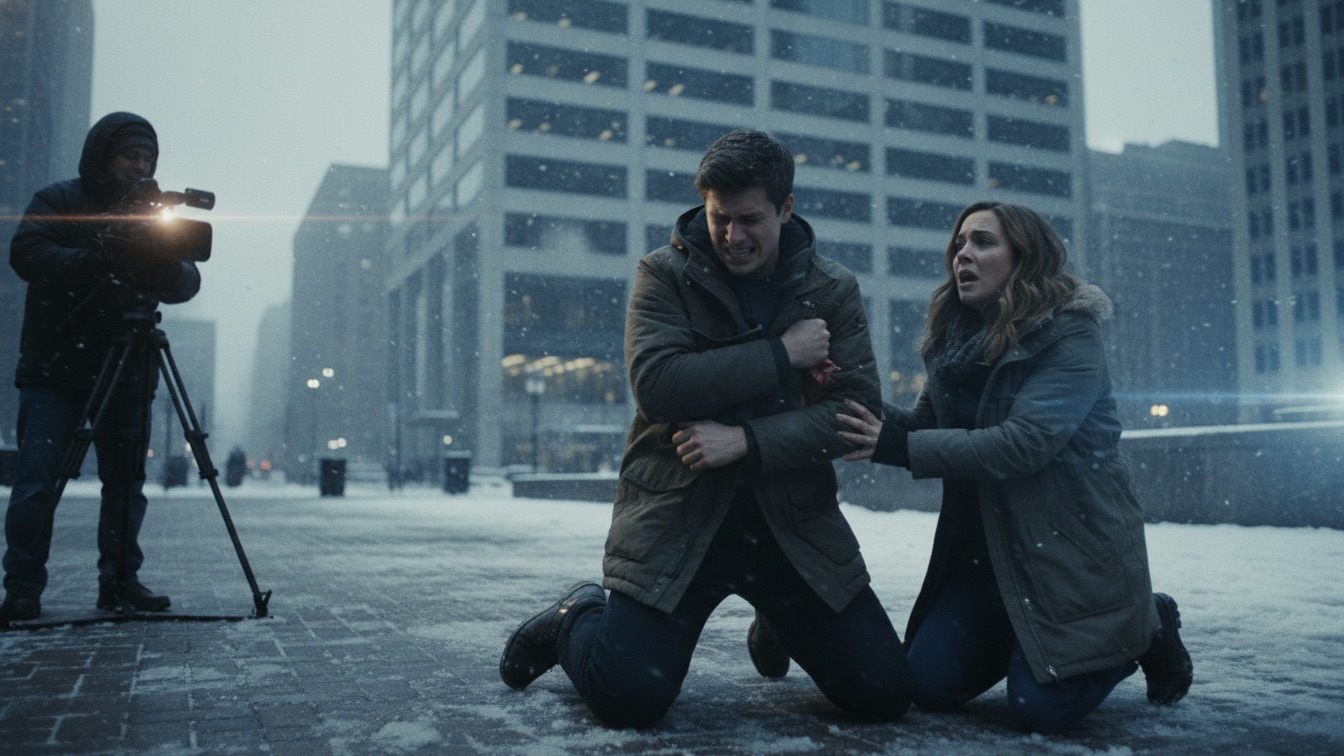
The chapter "Public Exposure" opens in the desolate aftermath of a failed town hall meeting, where protagonists Debbie and Jack confront the crushing weight of their defeat against Sterling Development. Debbie, initially rigid with despair, soon channels her anger into a radical new protest idea: "Frozen Out," a silent, performance art demonstration involving holding empty picture frames in front of the developer's building. Despite his deep-seated fear and recent public humiliation, Jack agrees to participate, motivated by Debbie's renewed hope and the memory of their adversaries' cruelty. The protest begins to gain traction, attracting media attention, but is violently interrupted by hired thugs who assault Jack with a brick as he shields Debbie. The police arrive, not to aid the victims, but to threaten the protesters with arrest, forcing Debbie and Jack to retreat, wounded and disillusioned, to her apartment where they grapple with the physical and emotional costs of their resistance.
The chapter deeply explores the theme of power dynamics and systemic injustice, vividly illustrating how a powerful corporation can manipulate public discourse, control authorities, and resort to violence to achieve its goals. The town hall meeting's failure, where logic and community appeals are dismissed, highlights the futility of conventional resistance against entrenched power. This theme is further amplified by the police's immediate accusation and threat of arrest towards the injured protesters, demonstrating their complicity or bias, and revealing a system actively hostile to the marginalized. The deployment of thugs and physical violence underscores the brutal reality that justice is often inaccessible to those without economic or political leverage.
Another significant theme is the nature and effectiveness of protest and resistance. Initially, Debbie attempts to "speak their language" through rational arguments, which proves disastrous. Her subsequent shift to "our language"—art, symbolism, and visual protest—represents an adaptive strategy to cut through the noise and capture public attention in a new way. The "Frozen Out" protest, despite its simplicity, initially succeeds in drawing media and public curiosity, suggesting the power of unconventional methods. However, the violent suppression of this peaceful demonstration raises questions about the limits of non-violent resistance when met with brute force, compelling the characters to confront the profound risks and costs involved in challenging authority.
The chapter also delves into the themes of vulnerability and resilience in the face of adversity. Debbie's rapid transition from utter defeat to renewed, albeit desperate, determination showcases her formidable resilience and adaptive intelligence. Jack, despite his chronic fear and self-doubt, displays an unexpected moment of courage, acting on instinct to protect Debbie. This act of self-sacrifice, followed by his painful injury, underscores the profound personal vulnerability inherent in activism. The shared admission of fear between Jack and Debbie creates a brief, intimate bond, highlighting the emotional toll their struggle takes and the human cost of standing up for one's beliefs.
Finally, the narrative subtly addresses gendered attacks and misogyny through Debbie's experience. Her observation that a passionate woman is deemed "hysterical" while a man exhibiting similar fervor is seen as a "leader" is a direct commentary on the double standards women face in public life. This dismissal of her arguments based on her gender is a form of disempowerment, forcing her to contend not only with the corporate opponent but also with ingrained societal biases that undermine her credibility and voice.
Debbie is portrayed as a woman of formidable will and kinetic energy, whose identity is deeply intertwined with her activism and artistic vision. Her initial state in the gallery is one of profound defeat, a "blank, pale mask" that covers the shock of having her "formidable will" utterly dismissed. This rigidity and stillness are uncharacteristic for her, signaling the depth of her despair. She struggles with the ineffectiveness of conventional, logical appeals, feeling the sting of being labeled "hysterical" and watching her community abandon their shared cause.
Psychologically, Debbie’s rapid shift from despondency to a "dangerous glint in her eye" reveals her strong coping mechanism of channeling emotional distress into strategic action. Her "restless intelligence" cannot tolerate passive defeat; she must find a new way to fight. Her concept of "Frozen Out" is not just a protest but an artistic expression of her frustration, a "visual punch in the face" that bypasses the "language" of logic that failed her. This creative adaptation showcases her resilience and her drive to control the narrative when other forms of control are denied. However, the violence against Jack shatters this controlled defiance, triggering raw "terror" and profound guilt. Her subsequent anger is a more familiar, protective emotion, but her admission of "I don’t know!" signals a critical juncture where her certainty and faith in her methods are deeply shaken, forcing her to confront the brutal realities and moral complexities of their struggle.
Jack is introduced as a character steeped in shame and self-doubt, haunted by his previous public "cracked" moment and the "gut-sinking shame" it left him with. His desire to say something, anything, is stifled by the uselessness of words and the ghost of his own voice. He seeks refuge in "the simple act of doing something, anything," a defense against "crushing inertia," tidying the chairs as an "admission of defeat." This methodical action reflects his internal struggle to find agency amidst his feelings of powerlessness and inadequacy.
Psychologically, Jack's deep-seated fear and self-perception as "weak and pathetic" are central to his character. His decision to join the "Frozen Out" protest, despite his instincts screaming for retreat, is a pivotal moment driven by the "flicker of hope" in Debbie's eyes and the memory of the developers' cruel laughter. His spontaneous act of shielding Debbie from the brick is a primal, uncalculated act of courage, transcending his usual self-consciousness and fear of public ridicule. This sacrifice is not about winning a battle but about a fundamental shift in his understanding of his own role and purpose. His subsequent realization that "It’s not about winning… It’s about… not letting them do it in silence" marks a profound internal transformation. Despite the immense pain and the physical cost, he finds a quiet, resolute conviction in bearing witness, even if it means personal suffering, challenging his lifelong narrative of weakness and insignificance.
The narrative employs a third-person limited perspective, primarily focusing on Jack and Debbie's internal states, allowing for an intimate portrayal of their despair, fear, and burgeoning resolve. The pacing of the chapter is masterfully controlled, beginning with a slow, heavy atmosphere of defeat in the gallery, where the "silence... was louder than the shouting" and the "dripping from the ceiling" marks the agonizing passage of time. This deliberate slowness emphasizes the emotional weight of their failure. The pacing then gradually accelerates as Debbie's "caged energy" returns, and the protest is conceived and executed, building tension through the preparations and the walk to the building.
The tone shifts dramatically throughout the chapter. It opens with a somber, melancholic tone of despondency, reflected in imagery like "chaotic graveyard of good intentions" and Debbie's voice being "ash and embers." This shifts to a desperate, almost manic determination as Debbie plans the art protest, imbued with "a dangerous glint in her eye" and a "triumphant, slightly mad smile." During the protest itself, the tone becomes tense and hopeful, then rapidly descends into shock, horror, and visceral pain with the brick attack. The final scenes in the apartment settle into a raw, exhausted, and bitterly analytical tone, reflecting the profound emotional and physical toll.
The chapter is rich in sensory details, immersing the reader in the characters' experiences. Auditory details like the "steady, maddening metronome" of the dripping ceiling, the "sharp and loud" click of the camera shutter, and the "sickening, wet thud" of the brick are particularly effective. Visuals such as Debbie's "blank, pale mask," the "insult of steel and glass" of the corporate building, and the eventual "patch of blood" on Jack's sweater provide stark imagery. Tactile sensations are crucial in conveying Jack's physical and emotional state, from the "physical weight, pressing down" of the silence to the "gut-sinking shame," the "damp, penetrating chill" of the morning, and the "white-hot agony" of the injury. The writer skillfully uses these details to ground the psychological drama in a tangible, often brutal, reality. The narrative voice is evocative, employing metaphors like "hollow little pebbles against an avalanche" and "a frantic, trapped bird" to deepen the emotional impact and psychological insight.