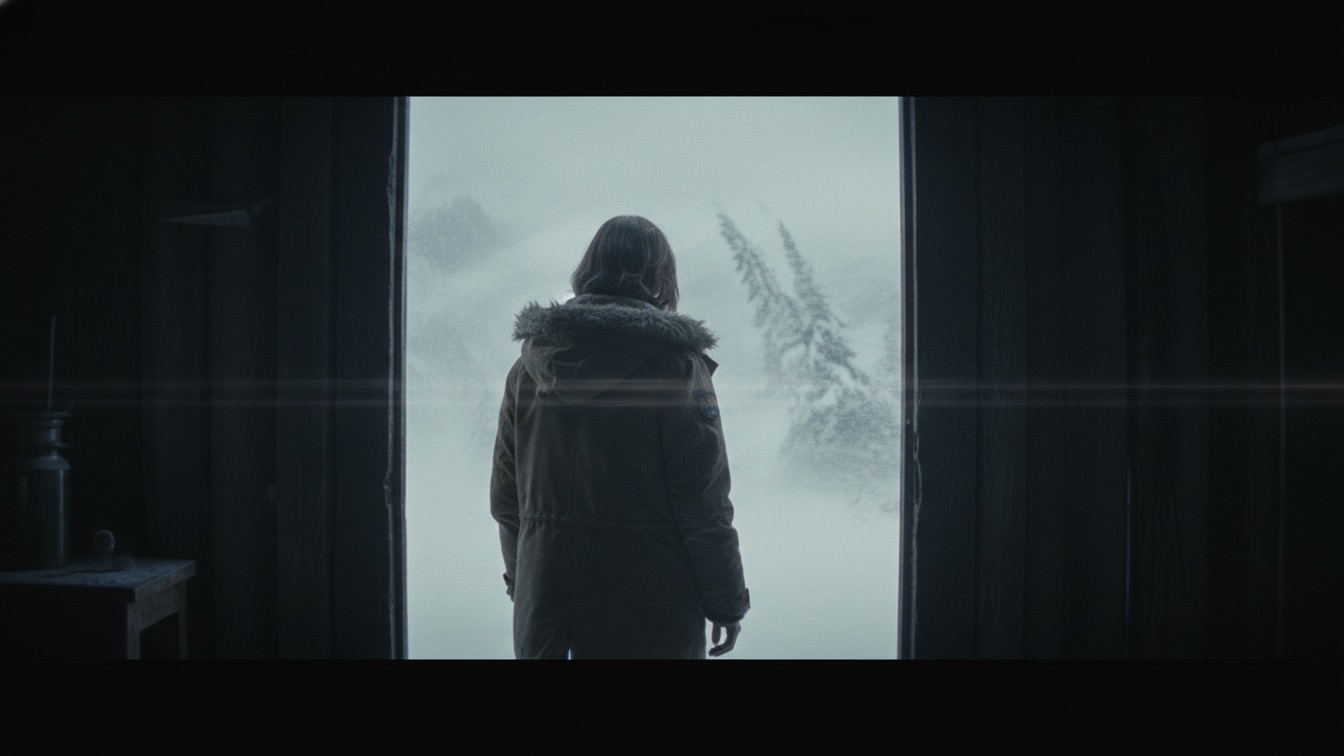
The flame is a frantic, desperate thing, consuming its fuel in a silent, shuddering dance against an encroaching void. It throws panicked shadows against the walls, distorting familiar shapes into monstrous forms while promising a safety it cannot actually provide. In its guttering light, the act of survival is revealed not as a triumph of endurance, but as a brutal transaction where the most precious internal resources are burned away to purchase a fleeting moment of existence. This illumination does not clarify the world; rather, it exposes the terrifying cost of keeping the darkness at bay.
"The Blizzard Memory" operates within the genre of supernatural survival horror, yet it subverts the traditional tropes of man-versus-nature narratives. typically, in stories of arctic survival like Jack London’s To Build a Fire, the antagonist is the indifference of the physical world, and the solution is the generation of heat. Here, the narrative twists this convention: the cold is not indifferent but predatory, and heat—specifically emotional warmth—is not a salvation but a lure. The story uses the blizzard as a metaphor for a consuming dementia or a traumatic erasure, where the physical stripping of heat parallels the metaphysical stripping of identity. The central conflict is not merely about keeping the blood liquid, but about retaining the narrative of the self against a force that seeks to turn biography into blank data.
The narrative voice, provided by Penny, is intensely immediate and sensory, yet it is defined by its limitations. Her perspective is reliable in its reportage of physical suffering—the "shards of glass" in the lungs, the "lead weights" of feet—but it becomes increasingly fragmented as the entity encroaches. The horror is amplified by what she cannot say and what she is forced to forget. The text employs a first-person perspective to trap the reader inside Penny’s eroding mind. We experience the warmth of the memory of her brother Leo, and consequently, we experience the visceral horror of its surgical removal. The gap left behind—the "ache of forgotten sunlight"—serves as a narrative void that the reader must fill with their own understanding of loss, as Penny no longer possesses the context to mourn fully.
Ethically, the story presents a harrowing variation of the trolley problem, internalized within the psyche. The existential dimension focuses on the "Ship of Theseus" paradox applied to the human soul: if one must burn their memories to survive, at what point does the survivor cease to be the person who fought to live? Penny’s choice to sacrifice her most distinct and loving memory to save Tom and herself posits that survival is a reductive process. The story suggests that to endure extreme trauma, one must sometimes amputate the parts of the self that are most capable of feeling, leaving behind a husk that is alive but fundamentally diminished. The winter setting acts as the ultimate equalizer, stripping away the complexities of personality until only the biological imperative to breathe remains.
Psychological State:
Penny operates in a state of hyper-arousal characteristic of acute survival stress, transitioning into a dissociative fugue as the supernatural threat reveals itself. Her perception of the world is highly metaphorical, transforming the wind into a "bully" and a "thief," which indicates a mind trying to humanize an inhuman threat to make it comprehensible. As the cold permeates the cabin, her psychological state shifts from panic to a grim, transactional pragmatism. She recognizes the commodification of her own psyche, viewing her memories not as abstract treasures but as fuel to be spent.
Mental Health Assessment:
While physically resilient, Penny displays signs of profound psychological fracturing. Her coping mechanism—banter—fails early, forcing her to confront the reality of her situation without defenses. The "hollowing out" she experiences is a supernatural allegory for severe trauma or dissociative amnesia. By the end of the chapter, she suffers from a specific, induced lacuna in her memory. Her mental health is stable only in the sense that she remains functional, but she has suffered a catastrophic amputation of her emotional history, leaving her with a form of survivor's guilt she cannot fully articulate because she cannot remember the source of the loss.
Motivations & Drivers:
Her primary driver is the preservation of life—specifically Tom’s life, perhaps even more than her own. This altruism is the engine of the story's climax. In the freezing cabin, her motivation shifts from seeking physical warmth to managing the "emotional temperature" of the room. She becomes the curator of their shared consciousness, driven by the need to starve the beast while keeping their bodies from freezing. Ultimately, her motivation distills into a sacrificial protectionism, where she trades her past to secure a future for them both.
Hopes & Fears:
Penny’s deepest fear is not death, but the "static"—the erasure of meaning. She fears the silence that isn't just an absence of sound but an active negation of self. Her hope is paradoxical; she hopes for survival, but the realization of that hope requires the destruction of the very things that make survival worthwhile. She fears becoming a "collection of facts" without emotional resonance, a fear that is tragically realized in the final paragraphs.
Psychological State:
Tom presents a classic façade of deflection. His humor is a "flimsy wooden shield," a frantic attempt to impose normalcy on a situation that defies it. Internally, he is terrified, a state betrayed by his physical trembling and the immediate cessation of his jokes when the entity manifests. The cold strips away his bravado, revealing a vulnerability that he usually hides. His psychological state is reactive; he follows Penny’s lead, paralyzed by the incomprehensible nature of the threat until she directs him.
Mental Health Assessment:
Tom utilizes humor as a defense mechanism, likely a long-standing trait used to navigate stress. However, this mechanism is shown to be brittle. When he recounts the memory of his grandmother’s cookies, we see the cracks in his psyche—he is already suffering from the effects of the entity, experiencing the decoupling of fact from emotion. He is less resilient than Penny in the face of the supernatural; without her intervention, he likely would have succumbed to the "freezing" of his will. His mental health is precarious, dependent on external validation and shared reality, which the entity threatens to dismantle.
Motivations & Drivers:
Tom is driven by a need to maintain morale and connection. He tries to keep Penny engaged through banter, acting as the anchor to their shared social reality. He wants to be useful—digging at the door, building the fire—but feels helpless against the metaphysical threat. His motivation is to be a partner in survival, but he lacks the intuitive understanding of the entity that Penny develops.
Hopes & Fears:
Tom hopes for a return to "normal," symbolized by his references to "TPS reports" and "traffic jams." He fears the loss of sensory pleasure and comfort, as seen in his lament over the taste of the cookies. Beneath the sarcasm, he fears being alone in the dark. He relies on Penny not just for survival strategies, but for emotional continuity. His fear is realized when he witnesses Penny’s sacrifice, understanding that while they survived, the dynamic between them has been irrevocably altered by her loss.
The story constructs its emotional arc through a subversion of the standard relief-tension cycle. Typically, finding shelter in a storm provides a release of tension. Here, the entry into the cabin creates a momentary spike of hope ("The bird fluttered"), which is immediately suffocated by the "deep, profound stillness" inside. The emotional trajectory moves from physical desperation to a brief, deceptive comfort, and then plunges into a psychic horror that is far colder than the blizzard outside. The architecture is built on the realization that the characters’ primary source of comfort—their shared humanity and memories—is actually the source of their danger.
Tension is maintained by the "listening silence." The emotional atmosphere in the cabin is claustrophobic, turning the intimacy of two survivors into a liability. The author weaponizes nostalgia. The memory of the camping trip, initially a source of warmth, transforms into a terrifying diagnostic tool when they realize the emotion has been eaten. This creates a pervasive sense of violation. The reader is made to feel the intrusion of the entity not as a physical attack, but as an emotional rape, where the most private sanctuaries of the mind are breached and looted.
The climax achieves a profound emotional resonance through the transmutation of joy into a weapon. Penny does not fight with anger or fear; she fights with love. She intentionally amplifies her love for her brother to lethal levels to overfeed the entity. This creates a complex emotional layering: the scene is simultaneously beautiful (the vividness of the sunset memory) and horrific (the knowledge of its impending destruction). The aftermath leaves the reader with a lingering sense of "coldness"—not the physical cold of the snow, but the emotional numbness of the protagonist, effectively transferring the character's hollowness to the audience.
The environment in "The Blizzard Memory" is not a setting but a character—an active, malevolent participant. The "whiteout" conditions outside mirror the "blank slate" of the mind that the entity seeks to create. The lack of visual distinction in the blizzard parallels the loss of distinct emotional memories. The cabin, described as having "wood the color of old bones" and a "vacant eye," serves as the belly of the beast. It is a digestive tract disguised as a shelter. The spatial confinement forces the characters inward, both physically into the room and psychologically into their own minds, which is exactly where the predator wants them.
The transition from the "howling gray" outside to the "stifling silence" inside marks a shift from physical assault to psychological siege. The fire, traditionally the hearth and heart of a home, becomes a treacherous focal point. It draws the characters together and warms them, but in doing so, it makes them visible to the entity. The environment enforces a cruel irony: the conditions required for biological survival (warmth, shelter, rest) are the exact conditions that facilitate spiritual destruction. The frost blooming on the inside of the window pane signifies that the danger is no longer trying to get in; it is already in the room, radiating outward from the void that consumes their memories.
The prose relies heavily on sensory metaphors that blend physical sensation with abstract concepts. Phrases like "words... torn to static" and "silence... rode on its back" give the intangible elements of the storm a physical weight. The author frequently uses the imagery of consumption and erosion. The wind is a "thief," the snow is "sugar" (sweet but deadly), and the memory is a "meal." This consistent linguistic threading reinforces the central theme of predation. The rhythm of the sentences mirrors the characters' physical state: short, jagged, and breathless during the struggle in the snow; longer, more fluid, and descriptive during the recollection of memories; and finally, stark and hollow in the concluding paragraphs.
Symbolism is anchored in the elemental conflict between Fire and Ice, but with twisted associations. Fire represents memory, life, and vulnerability. Ice represents oblivion, safety (from the entity), and death. The Zippo lighter is a potent symbol of human ingenuity and resistance—a small, mechanical spark against a cosmic winter. However, the most powerful symbol is the "hollow ache." The story treats the absence of emotion as a tangible object, a "gap" that occupies space. The "gray" of the storm bleeds into the "gray" of the memories, creating a visual palette that reflects the draining of vitality.
The use of the "static" motif is particularly effective. It bridges the gap between the auditory (the wind) and the cognitive (the memory loss). When Penny loses the memory of Leo, his laughter turns to "static," suggesting a loss of signal, a disconnection from the broadcast of her own life. This technological metaphor grounds the supernatural horror in a modern anxiety about connectivity and the preservation of data, suggesting that without the "signal" of emotion, humans are merely empty hardware.
The story resonates deeply with the Algonquin legend of the Wendigo, a spirit of winter associated with famine and greed. While the Wendigo traditionally consumes flesh, this entity consumes the "meat" of the soul—memories and happiness. This places the story within a lineage of "psychic vampire" narratives, echoing the Dementors of J.K. Rowling’s work, who drain peace and hope, leaving only despair. However, "The Blizzard Memory" strips away the personification found in those examples; the monster here is elemental, a force of nature rather than a distinct creature, which aligns it more closely with the indifferent cosmic horror of H.P. Lovecraft or Algernon Blackwood’s The Willows.
The narrative also dialogues with the cultural archetype of the "sacrificial woman." Penny fits the mold of the protector who gives of herself to save the male counterpart, a trope common in gothic literature. Yet, the specific nature of the sacrifice—her memory of a male relative (her brother)—adds a layer of tragedy regarding the erasure of lineage and family history. It touches on the modern fear of Alzheimer’s and dementia, where the horror is not the death of the body, but the death of the personality while the body remains.
Furthermore, the story evokes the atmosphere of "Polar Gothic," a subgenre that utilizes the extreme isolation of ice and snow to explore the fragility of the human mind. It shares DNA with John Carpenter’s The Thing, where the cold and isolation breed paranoia and a loss of identity, though here the assimilation is internal rather than external. The cabin functions as a liminal space, a threshold between the world of the living and the domain of the dead, a common motif in folklore where travelers must pay a toll to pass safely.
The lasting impact of "The Blizzard Memory" lies in the terrifying permanence of the loss. In most horror stories, survival is the ultimate victory. Here, survival is merely the state of remaining biologically functional after the essence of life has been excised. The reader is left to grapple with the disturbing question of what constitutes identity. If we are the sum of our memories, and those memories can be subtracted, is the person who walked out of the cabin the same one who walked in? The story forces a confrontation with the fragility of our own internal narratives, suggesting that our most cherished moments are merely data that can be corrupted or deleted.
The winter imagery lingers as a sensory afterimage. The description of the cold as a "listening silence" transforms the way the reader perceives a quiet winter landscape. It imbues the blank whiteness of snow with a sense of hungry anticipation. The story effectively recodes the sensation of warmth; the comfort of a fire or a happy memory is tainted by the suspicion that it is a beacon for something predatory. This inversion of comfort is the story’s most insidious psychological trick.
Finally, the tragedy of the ending is amplified by the asymmetry of knowledge. The reader knows what Penny lost—the vibrant, sunlit memory of Leo on the beach—but Penny herself does not. We are forced to hold the memory for her, becoming the custodians of the ghost she created. This creates a profound sense of melancholy, as the audience mourns a relationship that the protagonist can no longer even recall missing. The "ache" she feels is transferred to the reader, who is left bearing the weight of the forgotten sun.
The wind outside has ceased its howling, but the silence that remains is not peaceful; it is the heavy, suffocating quiet of a library where the books have been stripped of their text. The snow that settles on the survivors' shoulders is no longer an enemy to be fought, but a shroud acknowledging the partial death that has occurred. Survival, in this frozen world, is revealed to be a process of subtraction, a whittling down of the soul until it is small enough and cold enough to slip unnoticed through the fingers of the dark.
As Penny stands trembling in the aftermath, the melting ice on her cheek creates a sensory confusion that mirrors her internal state. The water is cold, indistinguishable from the tears of a grief she cannot name. She is a vessel scrubbed clean, a house with the lights turned off, standing in a landscape that is terrifyingly vast and indifferent. The horror is not that the storm broke her, but that it took the pieces of her that mattered most, leaving her to walk forward into a future that has been severed from its roots.