Melgund Township Winter Story Library
Coordinates of Isolation - Analysis
by Jamie F. Bell | Analysis
by Jamie F. Bell | Analysis
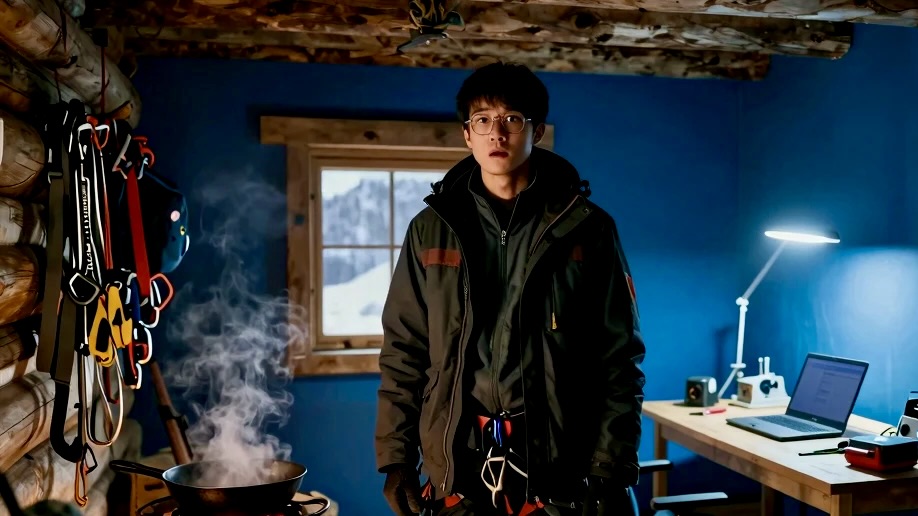
The fogging of the lenses is not merely a reaction to temperature differentials; it is the manifestation of a desperate, failing barrier between the intellect and the visceral world. This blindness, induced by the collision of a sterile internal desire with a humid, chaotic reality, represents the collapse of the illusion of control. Yuki seeks to view the world through a pristine, transparent medium, yet the very act of entering the living space obscures his vision, rendering his intellectual instruments useless against the sensory assault of heat, grease, and sound. The moisture clinging to the glass is the weeping of order in the face of entropy, a tangible sign that the carefully calibrated parameters of isolation have been breached by the messy, undeniable humidity of human existence.
The narrative situates itself within the psychological realism genre, utilizing the classic "odd couple" trope but elevating it through the high-stakes lens of Arctic survival literature. The overarching theme is the conflict between the Apollonian desire for order, logic, and distance, and the Dionysian reality of chaos, sensation, and proximity. Yuki represents the former, viewing the world as a dataset to be cataloged, while Kaito embodies the latter, engaging with the environment through tactile and gustatory indulgence. The setting of the Arctic taiga acts not merely as a backdrop but as a crucible that forces these opposing philosophies into a violent synthesis. The "indifferent geometry" of the landscape serves to highlight the futility of Yuki’s attempt to impose a binary code upon a world that is fundamentally organic and unpredictable.
The narrative voice is anchored firmly in Yuki’s third-person limited perspective, a choice that creates a deliberate perceptual gap for the reader. We experience the world through Yuki’s anxieties and prejudices, leading to an inherently unreliable assessment of Kaito. Where Yuki sees "entropy" and a "disaster zone," the text hints at a functional, albeit messy, system of survival that Yuki is too rigid to comprehend. The winter imagery reinforces this perceptual limitation; just as the snow reduces the world to "binary code," Yuki’s mind reduces Kaito to an obstacle. The cold acts as a narrative device that strips away social niceties, leaving only the raw, shivering core of the characters' personalities. Yuki’s internal monologue, filled with counting prime numbers and scientific terminology, reveals a mind frantically trying to intellectualize fear, while the external reality of the cabin—loud, hot, and smelly—refuses to be intellectualized.
Morally and existentially, the chapter interrogates the concept of isolation as a virtue. Yuki seeks the "coordinates of isolation" to escape the judgment of his family and the noise of society, viewing the research station as a "monastery of science." However, the text suggests that true isolation is impossible as long as one carries the self. The existential horror arises not from the lethal landscape, but from the realization that even at the edge of the world, one is trapped with the "human element." The snoring that keeps Yuki awake becomes a profound symbol of this inescapability; it is the persistent, biological rhythm of another life that refuses to be silenced by the vast quiet of the northern hemisphere. The chapter posits that the greatest challenge of the Arctic is not the temperature, but the forced intimacy with the chaotic, breathing, frying reality of another person.
Psychological State:
Yuki operates in a state of high-functioning anxiety, characterized by a rigid adherence to structure and a desperate need for environmental control. The cold of the Arctic appeals to him because it represents a sterile baseline, a variable he can manage through equipment and preparation. His psychological equilibrium is fragile, maintained only by the imposition of order upon his surroundings. The "schizophrenia of design" in the cabin threatens this equilibrium, triggering a defensive withdrawal. His counting of prime numbers is a clear compulsion used to self-soothe when the physical world becomes overwhelming, indicating a mind that retreats into abstraction to escape visceral threats.
Mental Health Assessment:
Yuki displays traits consistent with Obsessive-Compulsive Personality Disorder (OCPD), distinct from OCD in his belief that his rigid methodology is the only correct way to exist. His mental health is brittle; he relies on external validation (the dissertation, the approval of Vane) and environmental sterility to function. The shift from the "numbing tremor" of the plane to the chaotic heat of the cabin destabilizes him immediately. His resilience is low because it is predicated on everything going exactly to plan. He lacks adaptability, viewing deviation not as a challenge to be navigated but as an error to be corrected.
Motivations & Drivers:
His primary motivation is the collection of "raw data," which serves as a proxy for personal worth and a shield against his family's "polite but suffocating disappointment." He is driven by a desire to prove his competence through the most rigorous, ascetic means possible. He seeks to become a "ghost in the machine," erasing his own humanity to become a pure instrument of science. The winter environment is the stage upon which he intends to perform this act of self-erasure, proving that he is tougher and more capable than his "compact" stature suggests.
Hopes & Fears:
Yuki hopes for a "monastery," a place of silence where he can be defined solely by his intellect. He fears the messiness of human interaction and the loss of control. The fogging of his glasses and the snoring from the next room realize his deepest fear: that he cannot filter out the world. He is terrified of being perceived as weak or inefficient, which is why he clings so tightly to his expensive gear and formal titles. The cold represents a purity he aspires to, while the heat and grease of Kaito’s kitchen represent the chaotic humanity he is running from.
Psychological State:
Kaito exhibits a grounded, sensory-seeking psychology that stands in stark contrast to Yuki’s cerebral detachment. He is comfortable in his skin and in his environment, evidenced by his lack of clothing in a drafty cabin. His psyche appears integrated and unbothered by external judgment; he laughs from his chest and engages with the world through touch and taste. The winter does not seem to be an adversary to him but a backdrop for his own vitality. He creates his own micro-climate of rock music and frying fat, imposing his life force onto the sterile landscape rather than shrinking from it.
Mental Health Assessment:
Kaito appears robust and highly resilient. His "tactical" mess suggests a mind that prioritizes function and accessibility over aesthetics, a critical adaptation for survival situations where seconds count. His humor and loud music are likely adaptive coping mechanisms to combat the sensory deprivation of the Arctic winter. He combats the silence not with fear, but with a deliberate injection of noise and life. He shows no signs of the social anxiety or rigid perfectionism that plagues Yuki, suggesting a secure attachment to his own identity.
Motivations & Drivers:
Kaito is driven by the practicalities of survival and the maintenance of the outpost. His motivation in this chapter is to welcome the new arrival, albeit in his own idiosyncratic way, and to continue his routine. He seeks to maintain a habitable space that includes creature comforts like heat and food. He is driven by the immediate reality—the blizzard coming, the food cooking—rather than abstract long-term goals. He seems motivated to break Yuki’s stiffness, testing the newcomer’s boundaries with humor and provocation.
Hopes & Fears:
Kaito likely hopes for a partner who can pull their weight, or at least one who won't be a liability. His comment about "trying not to kill each other" masks a genuine concern about social friction in isolation. While he appears fearless, his "tactical" preparation indicates a healthy respect for the lethal potential of the environment. He may fear boredom or the oppressive silence of the taiga, which he actively combats with his boombox. He values the human connection, however rough, over the sterile silence Yuki craves.
The emotional trajectory of the chapter follows a curve of rising tension, sharp dislocation, and simmering, unresolved frustration. It begins with physical discomfort—the vibration of the plane—which establishes a baseline of endurance. Yuki’s anxiety is tightly coiled, managed through the counting of numbers and the checking of latches. The landing provides a momentary release of physical danger, only to replace it with the existential shock of the cold. This transition creates a sense of vulnerability; the environment is actively hostile, stripping away the comfort of the modern world and leaving Yuki exposed on the "frozen tarmac."
The tension spikes dramatically upon entry into the cabin. The anticipation of a "quiet hum" is violently subverted by the assault of sensory data—heat, noise, smell. This moment serves as an emotional collision, shattering Yuki’s expectations and replacing his anxiety with indignation and sensory overload. The interaction with Kaito is a dance of rejection; Yuki attempts to maintain a wall of formality, while Kaito casually dismantles it with grease and informality. The emotional temperature in the room is discordant, vibrating between Yuki’s cold rigidity and Kaito’s warm, chaotic energy.
The chapter concludes not with resolution, but with a lingering, invasive annoyance. The retreat to the bedroom offers no sanctuary. The emotional architecture shifts from the macro-conflict of the environment to the micro-conflict of the shared space. The snoring acts as a sonic intruder, penetrating the physical barriers Yuki has erected. The feeling shifts from superiority to entrapment. The silence Yuki craved is replaced by a "guttural rumble," transforming the cabin from a sanctuary of science into a prison of intimacy. The prevailing emotion is a claustrophobic realization that the physical cold is manageable, but the human presence is a variable that cannot be controlled.
The spatial arrangement of the Blackwood Research Outpost serves as a direct externalization of the psychological conflict between the two men. The taiga outside is described in terms of "indifferent geometry" and "binary code," reflecting Yuki’s desired mental state: clean, sharp, and devoid of emotion. It is a landscape of absolutes, which Yuki finds comforting because it is predictable. However, the cabin itself is a "schizophrenia of design," physically manifesting the clash of worldviews. The split between the sleek, orderly lab and the chaotic, messy living quarters creates a spatial dissonance that forces Yuki to constantly cross the threshold between his idealized self and the gritty reality of survival.
The cabin acts as a permeable membrane rather than a fortress. The cold seeps in, the noise travels through walls, and the smell of pork fat permeates the air. This permeability undermines Yuki’s psychological need for compartmentalization. He attempts to create an "island of sanity" on his desk, arranging his pens and laptop in precise alignment, but this small territory is besieged by the surrounding chaos. The "thump, thump, thump" of the bass and the vibration of the snoring travel through the floorboards, proving that in such a confined space, there is no true separation. The environment demonstrates that isolation is a physical myth; the space is too small to contain two such divergent energies without friction.
Winter functions here not just as a setting, but as an amplifier of internal states. For Yuki, the sub-zero temperature is a shield and a validator of his seriousness. He wears his layers like armor. For Kaito, the winter is a force to be pushed back against with artificial heat and calories. The "aggressive, moisture-sucking vacuum" outside forces them inward, compressing their psychological distance. The weather dictates the terms of their engagement; the approaching blizzard justifies Kaito’s messy porch and enforces their confinement. The environment effectively traps Yuki in the very situation he sought to avoid, turning the vast openness of the Arctic into a claustrophobic domestic struggle.
The prose utilizes a stark, clinical diction when filtering through Yuki’s perspective, contrasting sharply with the visceral imagery of Kaito’s domain. Words like "telemetry," "baseline," "variables," and "entropy" characterize Yuki’s attempt to impose scientific order on his experience. This is juxtaposed against the "frying pork fat," "sweatpants," and "bird's nest" hair of Kaito. The sentence rhythm mirrors Yuki’s state of mind; during moments of control, the sentences are measured and precise ("Click. Snap. Lock. Order."). When chaos intrudes, the rhythm becomes disjointed and overwhelmed by sensory details.
Symbolism is woven tightly into the narrative fabric. The eyeglasses are a recurring motif of perception and blindness; Yuki’s inability to keep them clear symbolizes his inability to see the situation—or Kaito—clearly. The "pelican case" represents Yuki’s emotional baggage and his need to protect his fragile inner self with a hard, waterproof shell. The "Spam" serves as a potent symbol of Kaito’s philosophy: it is processed, ugly, and low-brow, yet it provides the essential warmth and calories needed to survive. Yuki’s rejection of the Spam is a rejection of the messy necessities of life in favor of a sterile ideal.
The binary opposition of temperature—the -30 degree exterior versus the humid, overheated interior—serves as the central aesthetic mechanic. The story moves from the "white and black" of the snow to the "blue smoke" and "grey sweatpants" of the interior, muddling the clarity Yuki craves. The "indifferent geometry" of the trees contrasts with the "chaotic heap" of the logs on the porch. These visual contrasts heighten the thematic conflict, rendering the abstract clash of personalities into concrete, sensory terms. The recurring sound of the "bass beat" and the "snoring" acts as an auditory symbol of the uncontrollable human pulse that disrupts Yuki’s sterile silence.
The narrative draws heavily on the tradition of "Arctic Gothic" and isolationist literature, echoing the atmospheric tension found in works like The Thing or Frankenstein. The setting of the remote outpost is a literary archetype representing the edge of civilization, where social contracts break down and humanity is tested against the primal forces of nature. However, instead of a supernatural monster, the "horror" here is the banality of an annoying roommate, subverting the genre expectations. It places the story in conversation with existentialist dramas like Sartre’s No Exit, reinforcing the idea that "hell is other people," even—or especially—in the vast emptiness of the North.
Culturally, the story plays with the "Odd Couple" dynamic, a staple of comedic and dramatic storytelling, but strips it of its usual urban context. By placing it in the taiga, the stakes are raised from social discomfort to survival. There is also a subtle interplay of archetypes: the Scholar vs. the Warrior/Survivor. Yuki represents the modern reliance on technology and data, a figure of the Information Age who believes understanding comes from measurement. Kaito represents an older, more primal archetype of the frontiersman, who understands the land through engagement and instinct. This clash reflects a broader cultural tension between theoretical knowledge and practical application.
The text also invokes the mythology of the ascetic. Yuki views the outpost as a "monastery," aligning himself with the tradition of hermits and monks seeking enlightenment through deprivation. He seeks a purification of the self through the "coordinates of isolation." Kaito, conversely, represents the intrusion of the profane world—food, flesh, noise—into this sacred space. This tension between the sacred (science/silence) and the profane (body/noise) gives the narrative a mythic resonance, suggesting that Yuki’s quest for purity is doomed to fail because he cannot discard his own physical needs or the presence of others.
What lingers after the final sentence is not the grandeur of the Arctic landscape, but the claustrophobic, rhythmic intrusion of the snoring. The reader is left with a profound sense of entrapment. The vastness of the exterior world shrinks down to the thinness of a pine door and the vibration of floorboards. The story successfully transfers Yuki’s irritation to the reader; we feel the injustice of the noise, the frustration of the unyielding environment, and the crushing weight of a four-month sentence with a stranger. The intellectual anticipation of scientific discovery is completely subsumed by the visceral reality of annoyance.
The cold, initially presented as a lethal threat, transforms in the reader's mind into a longed-for escape. We begin to understand Yuki’s desire for the "indifferent geometry" because the alternative—the messy, loud, hot humanity of Kaito—is so overwhelmingly intrusive. The story leaves us questioning the romanticization of isolation. We are forced to confront the reality that escaping society does not mean escaping the friction of human interaction; it merely concentrates it. The "zero-point of social interaction" that Yuki sought is revealed to be a fallacy; there is no zero-point, only the intense, magnified one-on-one.
Ultimately, the narrative leaves an afterimage of the fogged glasses. It is a lingering reminder of our own limitations in perceiving others. We are left wondering if Yuki’s judgment of Kaito is fair, or if it is merely the product of his own rigidity. The story provokes a reflection on tolerance and adaptability. It asks us to consider whether we, too, would crumble if our carefully curated environments were invaded by the smell of frying fat and the sound of bad rock music. The silence of the snow is haunting, but the noise of the human is inescapable.
The taiga does not care about the dissertation. It does not care about the prime numbers, the pristine North Face nylon, or the chaotic stack of firewood. Outside the thin aluminum skin of the outpost, the wind continues its abrasive work against the spruce trees, a force of erosion that will eventually wear down both the structural liability of the porch and the rigid psychological architecture of the man inside. The cold is a patient observer, waiting for the heat of their animosity to burn itself out, knowing that eventually, the silence will reclaim the space between the bass beats.
In the dark, the rhythm of the snoring becomes a grotesque parody of a metronome, marking time in a way that mathematics cannot account for. It is the sound of life persisting without permission, a biological vibration that travels through the floorboards and into the marrow, deeper than the cold ever could. Yuki lies in the dark, counting backward, but the numbers have lost their power. He is no longer a ghost in the machine; he is merely a body in a box, vibrating in dissonance with another, trapped in the inescapable friction of being alive.