Melgund Township Winter Story Library
Coordinates of Isolation - Treatment
by Jamie F. Bell | Treatment
by Jamie F. Bell | Treatment
Format: Short Film / Anthology Episode | Est. Length: 10-12 minutes
Imagine an anthology series, Zero Point, where each episode drops a new character into an environment of extreme isolation. From deep-sea labs to Martian colonies to remote Arctic outposts, the series explores a single, terrifying question: when you strip away society, what part of yourself is left, and what happens when you are not as alone as you hoped to be? "Coordinates of Isolation" serves as a signature episode, establishing the series' core theme that the greatest unknown is not the hostile environment, but the person you're trapped with.
A small ski-plane cuts through a vast, indifferent landscape of snow and black spruce, its engine a lone, angry buzz in an ocean of silence. Inside, a meticulously dressed academic, YUKI SATO, grips a case of delicate scientific equipment, his knuckles white as the plane makes a terrifyingly rough landing on a frozen creek bed.
A rigid, anxiety-ridden atmospheric scientist, seeking pristine isolation for his doctoral research, arrives at a remote Arctic outpost. He discovers he must share his hermetically sealed existence with a chaotic, undisciplined survivalist whose very presence threatens to contaminate his data and shatter his sanity.
The primary theme is the clash between Order and Chaos. Yuki represents a desperate need for control, structure, and predictable data, believing that a sterile environment is necessary for success. Kaito embodies a pragmatic, adaptive chaos, a methodology born from instinct and survival rather than theory. The episode explores the idea that true isolation isn't geographical but psychological; Yuki seeks to escape the "noise" of humanity, only to find it amplified and concentrated in a single, unavoidable individual.
A secondary theme is the conflict between Intellectualism and Instinct. Yuki approaches the Arctic as a set of variables to be measured and managed, armed with top-of-the-line gear and academic protocols. Kaito lives within the environment as a physical reality, his "messiness" a form of tactical readiness. The story questions which approach is more valuable when the theoretical dangers of a climate model are replaced by the immediate threat of a blizzard or a broken stove.
The professional stakes for Yuki are immense: the data he collects will either make or break his entire doctoral dissertation and, by extension, his academic career. Failure means returning home to the suffocating disappointment of his family and mentor. The personal stakes are a test of his own self-sufficiency and mental fortitude, his attempt to prove he is more than just a fragile intellectual. Underlying everything are the physical stakes of survival in an environment where a simple mistake—like unsecured fuel or unstacked wood—can have lethal consequences.
The central conflict is Man vs. Man, a direct personality clash between Yuki's rigid intellectualism and Kaito's chaotic pragmatism. Kaito is the primary antagonistic force, not through malice, but by his very nature; his noise, his mess, and his disregard for protocol are a direct assault on the sterile environment Yuki requires to function. The external conflict is Man vs. Nature, with the oppressive cold, the vast silence, and the threat of blizzards acting as a constant pressure cooker for their relationship. Internally, Yuki battles his own anxiety, his condescension, and his crippling need for control in a situation where control is impossible.
Dr. Yuki Sato, a brilliant but anxious PhD candidate, arrives at the remote Blackwood Research Outpost to collect climate data, believing the extreme isolation will provide the perfect, sterile environment for his work. His hopes are immediately shattered upon meeting his station partner, Kaito Hayashi, a brash, slovenly field specialist who treats the high-tech research station like a backwoods hunting cabin. Yuki is appalled by Kaito's disregard for protocol, from the chaotic state of the supplies to his loud music and greasy cooking.
Yuki’s attempts to impose order—proposing a "chore chart" and demanding a structured environment—are met with amused contempt by Kaito, who argues his seemingly messy methods are a tactical response to the harsh realities of the Arctic. Retreating to his small room, Yuki creates a personal sanctuary of perfect order, determined to insulate himself from Kaito's influence. However, as night falls and a storm brews outside, he lies awake, tormented by the inescapable sound of Kaito's snoring, realizing with dawning horror that the greatest threat to his research and sanity isn't the sub-zero temperature, but the unpredictable human element he cannot control.
YUKI SATO: A highly intelligent atmospheric biologist whose brilliance is matched only by his severe anxiety and obsessive need for control. He views the world as a set of data points to be ordered and analyzed, and he uses rigid protocols as a shield against the unpredictable messiness of life.
* Psychological Arc: Yuki begins the story believing he can master any environment through intellectual rigor and discipline. By the end, he is stripped of this illusion, realizing that his carefully constructed systems are useless against the chaotic force of another human being. His journey is from a state of arrogant control to one of powerless frustration, setting the stage for a necessary, if painful, adaptation.
KAITO HAYASHI: A seasoned field operations specialist and survival expert who is completely at home in the wild. He is pragmatic, instinctual, and lives entirely in the moment, finding Yuki's rigid formality and obsession with rules to be a source of endless amusement. His chaos has a hidden logic, prioritizing immediate survival and comfort over long-term tidiness.
* Psychological Arc: Kaito is a static character within this introductory episode, serving as the immovable object to Yuki's unstoppable force. He is confident, self-assured, and unbothered by Yuki's judgment. His role is to be the catalyst that forces Yuki to confront his own inflexibility.
BEAT 1: THE ARRIVAL. The story opens with the jarring, visceral experience of Yuki’s flight, establishing the brutal indifference of the landscape and Yuki’s internal anxiety. The rough landing on the ice is a physical manifestation of his loss of control, immediately putting him on edge before he even steps out of the plane. The pilot's parting words foreshadow the conflict to come, leaving Yuki alone in a vast, oppressive silence.
BEAT 2: THE DISCOVERY. Yuki’s short trek to the outpost reveals the first signs of chaos: the haphazardly piled wood, scattered fuel cans, and frozen snowshoes on the porch. This visual evidence of entropy offends his sensibilities and builds a sense of dread about the state of the station's interior. He steels himself, believing he can rectify the situation with logic and protocol.
BEAT 3: THE CONFRONTATION. Pushing open the door, Yuki is assaulted by a wall of heat, loud rock music, and the smell of frying Spam, his glasses fogging over to render him blind and helpless. When his vision clears, he is confronted by the shirtless, chaotic presence of Kaito, the polar opposite of everything he represents. Yuki’s attempt to establish dominance and order with a formal introduction and a proposed "chore chart" is immediately and laughingly dismissed, establishing Kaito as an uncontrollable force.
BEAT 4: THE RETREAT. Defeated in his initial confrontation, Yuki retreats to his assigned bunk room, a cold, spartan space that he can control. He methodically unpacks, arranging his laptop, notebooks, and pens with geometric precision, creating a small island of sanity in the sea of Kaito's chaos. This act of ordering his space is a desperate attempt to reassert control over his environment and his own spiraling anxiety.
BEAT 5: THE INCESSANT HEARTBEAT (CLIMAX). As night falls and a storm rages outside, Yuki lies in his sleeping bag, unable to sleep. The true horror of his situation dawns on him: it is not the cold or the wind that will break him, but the relentless, guttural, and unpredictable sound of Kaito's snoring vibrating through the cabin walls. He realizes with sinking dread that there is no protocol, no data point, and no sanctuary that can save him from this intimate, inescapable human contamination.
The episode's mood begins with palpable Anxiety and Tension during the turbulent flight. This transitions to Dread and Disgust as Yuki discovers the messy state of the outpost and confronts Kaito. A brief moment of False Hope and Righteous Control occurs as Yuki organizes his room, creating a temporary sense of order. The final mood is one of Powerless Despair and Claustrophobia, as the inescapable sound of Kaito's snoring traps Yuki in a psychological prison far more confining than the physical cabin.
If expanded into a season, "Coordinates of Isolation" serves as the inciting incident for a tense, four-month character study. The initial conflict over lifestyle habits would escalate into life-or-death scenarios. An early episode might see Yuki's meticulous adherence to protocol save a critical piece of equipment Kaito nearly destroyed, while a mid-season crisis—a generator failure during a whiteout blizzard—would force Yuki to rely entirely on Kaito's "tactical" survival instincts, which he previously dismissed as messiness.
The season's arc would be their forced evolution from antagonists to a grudging, co-dependent team. They would slowly learn to synthesize their opposing worldviews: Yuki’s data analysis could predict a catastrophic ice shift, while Kaito’s practical skills would be needed to implement a solution. The overarching story would be about two fundamentally different men finding a middle ground, not through friendship, but through the shared necessity of survival, ultimately questioning whether true strength lies in rigid order or adaptive chaos.
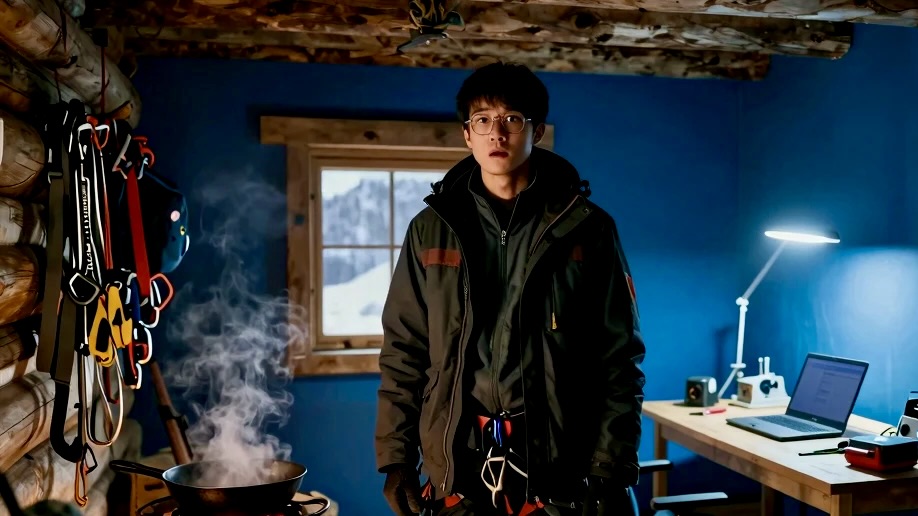
The visual style will be built on a stark contrast between exteriors and interiors. Exteriors will be shot with wide, static frames, emphasizing the immense, empty scale of the Arctic. The color palette will be desaturated and cool—dominated by whites, blues, and greys—to convey the crushing indifference of nature. These shots will be quiet, punctuated only by the sound of wind and crunching snow.
Interiors, by contrast, will be claustrophobic and warm, shot with handheld or tight lenses that heighten the sense of confinement. The lighting will be dominated by the golden, flickering light of the wood stove and harsh practicals, creating deep shadows. The frame will be cluttered with Kaito’s gear, emphasizing the chaos that Yuki cannot escape. The tone is a slow-burn psychological drama with undercurrents of dark, situational humor, comparable to the two-hander tension of The Lighthouse set against the bleak, unforgiving landscapes of Wind River or The Thing.
The target audience is adults aged 25-55 who gravitate towards character-driven psychological thrillers and survival dramas. This includes fans of high-concept anthology series like Black Mirror and Love, Death & Robots, as well as viewers who appreciate the slow-burn tension and atmospheric storytelling of films by directors like Denis Villeneuve or Taylor Sheridan. It is for an audience that prefers suspense and character conflict over action, and enjoys stories that explore the complexities of the human condition under pressure.
For a 10-12 minute runtime, the pacing must be deliberate yet efficient. The first act (Arrival and Confrontation) should be swift, establishing the setting, characters, and core conflict within the first 3-4 minutes. The second act will slow down, focusing on Yuki's attempts to cope and the rising tension, allowing the claustrophobia to build. The final act is the short, sharp realization in the bunk room, ending on a note of quiet horror rather than a dramatic event, leaving the audience trapped in Yuki's psychological state.
The primary production challenge is creating an authentic and hostile Arctic environment. This can be achieved through a combination of on-location shooting for wide exterior shots and a controlled soundstage for all interior scenes. The set design for the cabin's interior is critical; it must feel both functional as a research station and believably lived-in and chaotic, reflecting the personalities of its inhabitants.
Special attention must be paid to the props and costumes to visually tell the story of the characters' opposing philosophies. Yuki's gear should be brand-new, expensive, and pristine (e.g., Arc'teryx, North Face), while Kaito's should be worn, patched, and utilitarian (e.g., Carhartt, military surplus). Sound design will be a key storytelling tool, contrasting the overwhelming exterior silence with the cacophony of the interior—the loud music, the sizzling skillet, and, most importantly, the inescapable, oppressive sound of snoring.