Format: Short Film / Anthology Episode | Est. Length: 10-12 minutes
Imagine an anthology series titled The Grid, where each episode explores a different failure of the technocratic dystopia of Melgund Creek. This episode serves as a standalone descent into the psychological warfare used to maintain civic order through biometric-monitored simulations, illustrating how the state weaponizes individual trauma to ensure total compliance.
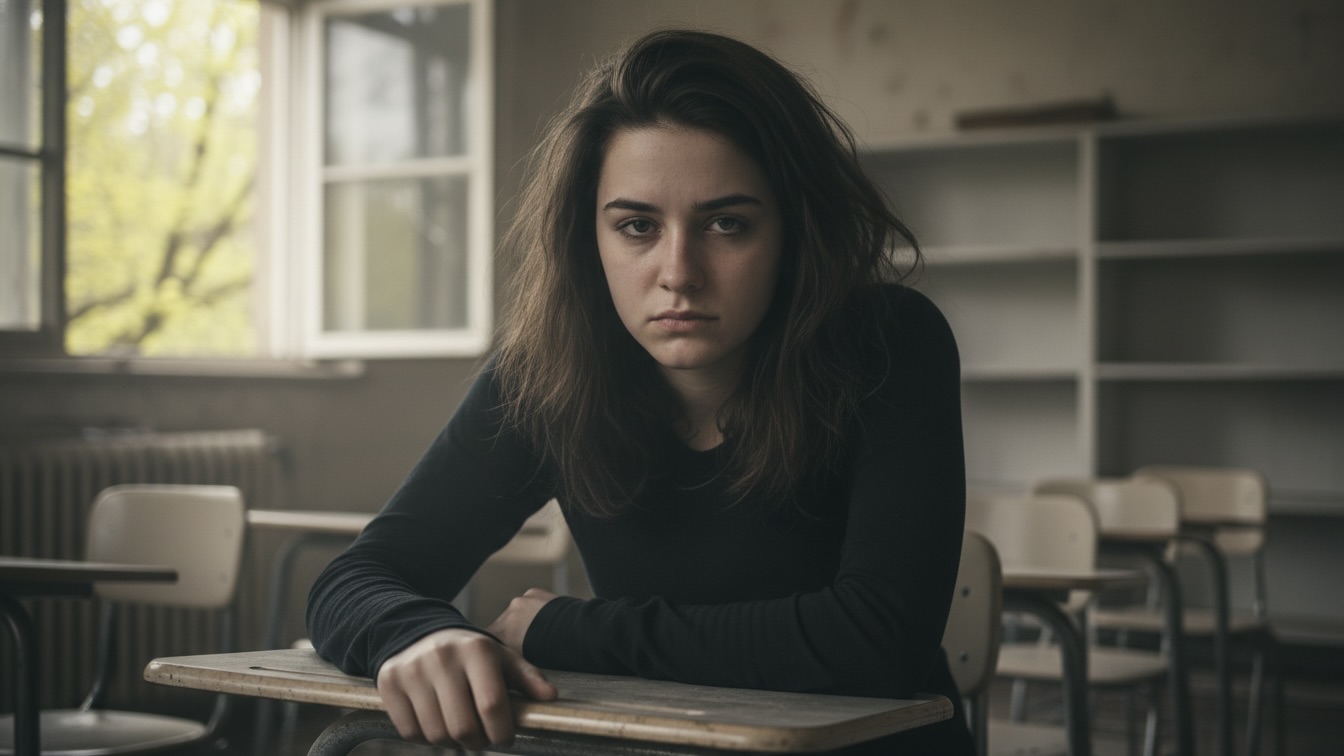
In a decaying classroom coated in thick yellow pollen, a cynical teenager decides to intentionally sabotage her mandatory biometric loyalty test to spite the government, unaware that the system is designed to break those who refuse to bend.
A rebellious student attempts to "speedrun" a mandatory VR civic evaluation by choosing the most penalized answers possible. Instead of a standard test, she is plunged into a personalized psychological nightmare that threatens to dissolve her perception of reality.
The primary theme is the erosion of the self under constant surveillance and the futility of performative rebellion in a digital age. It explores how modern dystopias don't just control behavior through physical force, but by weaponizing an individual's own insecurities and isolation against them.
The secondary theme focuses on apathy as a failed defense mechanism. Cleo’s journey suggests that cynicism is not a weapon of change, but a shell that the system can easily crack to reveal the terrified, lonely individual underneath.
If Cleo fails the test, she loses her universal credits, resulting in immediate homelessness for herself and her mother. However, the deeper risk is the permanent fracturing of her psyche as the simulation begins to bleed into her physical perception of the world, leaving her unable to distinguish between the "psyop" and reality.
The external conflict is Cleo versus the Melgund Creek administration and their invasive "Spring Renewal" algorithm, which uses pupil dilation and heart rate to detect dissent. Internally, Cleo struggles with her own profound fear of social isolation, a vulnerability the system exploits to prove that her rebellion is merely a mask for her loneliness.
Cleo and her friend Mateo sit for the annual Civic Loyalty Evaluation in a bleak, pollen-choked classroom. Determined to "speedrun" the test with failing marks as an act of defiance against the town’s crumbling infrastructure and corrupt leadership, Cleo enters the VR pod expecting a series of multiple-choice scenarios. She ignores Mateo’s warnings that the algorithm has changed to track genuine belief rather than just answers.
Once inside the simulation, the standard "town square" environment fails to load, replaced by a gravity-defying gray void. Cleo is confronted by faceless, melting manifestations of the town's leadership who beg for her compliance, revealing that the system isn't looking for loyalty, but is mining her deepest psychological vulnerabilities. When she finally rips the headset off to escape the nightmare, she finds that the real world has begun to "glitch," leaving her trapped in a reality where her senses are no longer in sync with the environment.
Cleo: A cynical, exhausted teenager whose psychological arc moves from aggressive apathy to total sensory disorientation. Initially using rebellion as a defense mechanism against a failing world, she ends the story trapped in a perceived glitch where she can no longer trust the timing of her own reality.
Mateo: Cleo’s pragmatic and anxious friend who serves as the voice of survivalist logic. He represents the "compliant" citizen who passes the test by choosing middle-of-the-road answers, highlighting the contrast between his safe, stable reality and Cleo's fractured one.
The Waiting Room: Cleo and Mateo sit in the oppressive, pollen-stained Room 204, discussing the rumors of a new, biometric-tracking algorithm that can sense insincerity. Cleo dismisses the stakes and vows to tank the exam as a political statement, despite Mateo’s warnings about the loss of universal credits and their subsequent eviction.
The Descent: Cleo enters Pod 12 and initiates the sequence, but instead of the expected town square simulation, she experiences a violent inversion of gravity within a textured gray fog. She is confronted by faceless, melting figures in suits who beg for her compliance rather than demanding it, turning her rebellion into a pathetic, hollow spectacle that mocks her desire for conflict.
The Mirror and the Break: The simulation forces Cleo to face a hyper-realistic reflection of herself that voices her secret fears of isolation and the realization that her cynicism is just a way to avoid being "invisible." Overwhelmed by the somatic feedback and the psychological assault, she physically rips the headset off, only to find that the "real" world now exhibits the same digital glitches and audio delays as the simulation.
The episode begins with a sense of gritty, grounded frustration and teenage angst, transitioning into high-concept surrealist horror during the simulation. The audience experiences a shift from social commentary to psychological dread, ending on a note of lingering paranoia as the boundary between reality and simulation vanishes for the protagonist.
In a full season, Cleo’s experience would be revealed as a "Type-2" failure, where the system intentionally breaks the subject's perception of reality to ensure they can never effectively organize or rebel again. This "glitch" becomes a recurring motif, suggesting that those who dissent are not imprisoned, but are instead "desynced" from the rest of society.
Other episodes would follow different citizens—teachers, security forces, and the Mayor himself—revealing that everyone in Melgund Creek is trapped in a unique layer of the same psychological prison. The season finale would see Cleo attempting to find others who are "desynced," questioning if the glitches are a side effect of the test or the true nature of their world.
The visual style should contrast the "Real World" (high-contrast, sickly yellows, grimy textures, and handheld camera work) with the "Simulation" (liminal spaces, desaturated grays, and uncanny valley character designs). The simulation scenes should utilize "impossible" geometry and inverted gravity to keep the audience as disoriented as Cleo.
The tone is inspired by the "lo-fi sci-fi" aesthetic of Children of Men mixed with the surreal, psychological horror of Black Mirror. It is a cold, clinical look at how technology can be used to strip away the human ego, leaving behind nothing but a compliant, broken shell.
The target audience is young adults and fans of speculative fiction (ages 16-35) who enjoy dark, thought-provoking narratives about technology and social control. It appeals to viewers who appreciate "elevated horror" and stories that prioritize psychological depth and atmospheric tension over traditional jump scares.
The pacing is slow and atmospheric in the first act to establish the weight of the setting, followed by a rapid, disorienting acceleration during the VR sequence. The final three minutes should feel breathless and "off-beat," using subtle editing tricks to simulate the protagonist’s sensory lag and the feeling that reality is failing to render correctly.
The melting figures in the simulation should be achieved through a mix of practical "slime" effects and digital liquid simulations to create a truly repulsive, non-human texture that feels "wet" and heavy. This creates a visceral reaction that contrasts with the sterile, white plastic of the VR pods.
The "audio lag" in the final scene requires precise ADR (Automated Dialogue Replacement) work to ensure the sound is just slightly out of sync with the actor's lip movements. This should be subtle enough to make the audience question their own senses before the final realization that Cleo is still—or perhaps permanently—trapped in a psychological loop.


