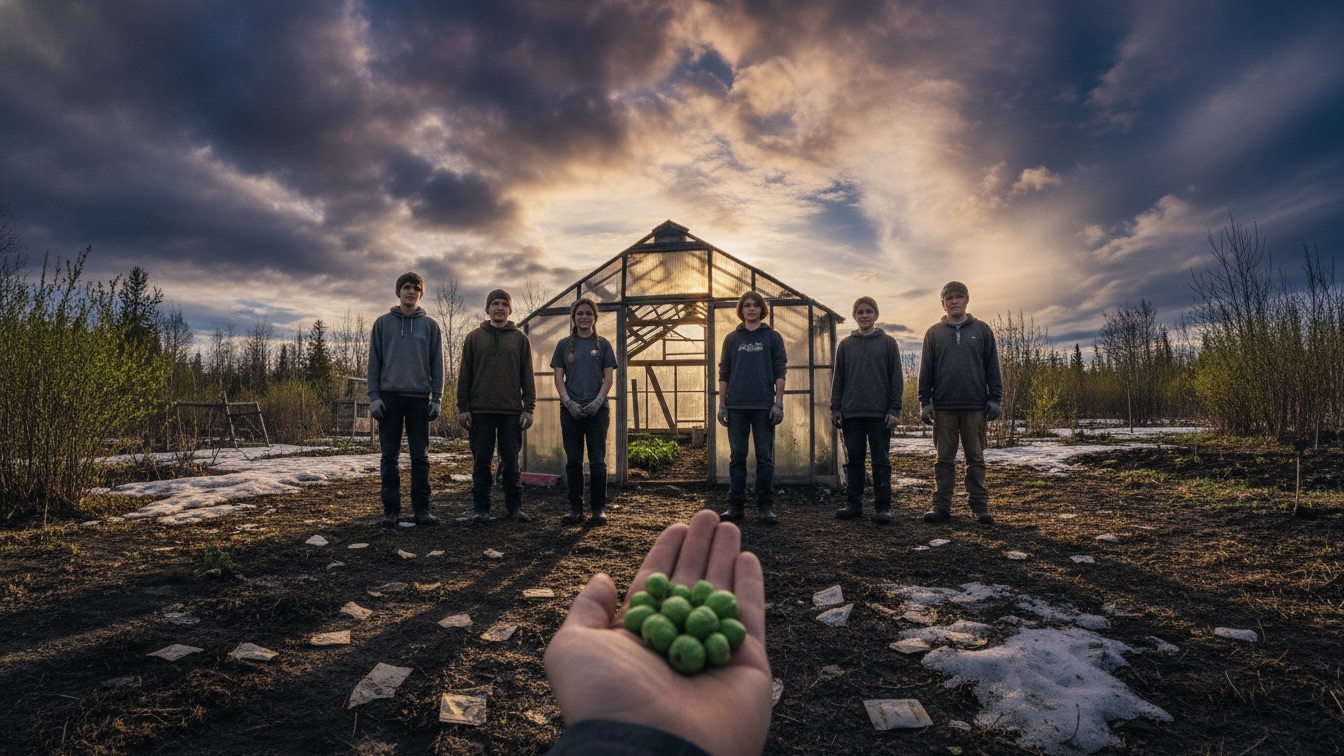
Leo stood in the melting snow of Melgund, staring at a handful of seeds that promised a different future.
The air in Melgund did not smell like flowers. It smelled like wet wood, old exhaust, and the heavy, metallic scent of melting ice. Leo adjusted his grip on the rusted garden gate. His boots were caked in a grey sludge that felt like a permanent part of his weight. He was twenty-two, and for the last three years, his life had felt like a video game stuck on a loading screen. The town was small, the opportunities were smaller, and the sky always seemed to be the color of a concrete floor. He looked down at his phone. No notifications. Just the cracked screen reflecting the flat light of a Northwestern Ontario spring.
He stepped into the community garden. It wasn't much to look at yet. The raised beds were skeletons of grey cedar, holding frozen clumps of soil. But in the center, near the small greenhouse that leaned precariously to the left, a group had already gathered. They looked like a strange collection of survivors. There was Sarah, who was twenty and spoke as if she were delivering a TED Talk to an empty room, and Chloe, who spent most of her time filming the world through a lens because the real thing was too high-definition to handle. Then there were the elders—Mr. Henderson, a man who seemed to be made of corduroy and tobacco smoke, and Ms. Gable, who painted landscapes that looked more like maps of a nervous breakdown.
"The timing of your arrival is most fortuitous, Leo," Mr. Henderson said. He did not look up from the wooden table. He was sorting through small, translucent packets. His voice was deep and resonant, a theatrical boom that felt out of place in a muddy field. "We are currently debating the structural integrity of our ecological ambition."
Leo wiped his hands on his jeans. "I thought we were just planting some weeds."
Sarah turned to him, her eyes bright with a sharp, analytical fire. "To categorize Asclepias syriaca as a mere weed is to ignore the fundamental logistics of the monarch migration. We are not merely planting; we are constructing a refueling station for a transcontinental odyssey. The optics of this project require a more sophisticated vocabulary, Leo. We are the architects of a biological corridor."
"It’s about the aesthetic of survival," Chloe added. She had her camera out, snapping a photo of a dried, burst milkweed pod from the previous year. "If we don't document the rebirth, the digital record of this town remains purely industrial. We need to pivot the narrative. We need to brand the restoration."
Ms. Gable nodded, her long silver hair caught in the wind. "Behold the pod," she said, holding up a curved, husk-like shell. "It is a vessel. A cradle. And eventually, it will be the source of our creative commerce. Do you see the fibers, Leo? The silk? It is the ghost of the summer, waiting to be pressed into something permanent."
Leo moved closer. He looked at the pod. It was ugly, really. Brown, rough, and split open like a wound. But inside, the white silk was clean and bright. "You really think people will buy paper made out of this?" he asked. "In a world where everything is a PDF?"
"The market craves the tactile," Sarah said, her hands moving in precise, rhythmic gestures. "The more our lives are digitized, the more the value of the physical object appreciates. We are not just selling paper. We are selling the story of the milkweed. We are selling the survival of the monarch. We are selling a tangible piece of Melgund that isn't a piece of scrap metal."
Mr. Henderson stood tall, brushing dirt from his vest. "Indeed. We shall distribute the seeds to the citizenry. We shall invite them to become stakeholders in this fragile green empire. And when the season turns, when the butterflies have departed for the southern kingdoms and the stalks have grown brittle in the frost, we shall harvest the remains. We shall boil, beat, and press the fibers until we have created a canvas worthy of our highest thoughts."
Leo felt a strange flicker in his chest. It wasn't quite hope—hope felt too heavy, too dangerous. It was more like a low-voltage current. "So, we give them the seeds for free?" he asked. "And then we buy back the dead plants?"
"The logistical framework is simple yet elegant," Sarah explained. "We provide the biological capital. The community provides the labor and the land. In the autumn, we collect the raw materials. It’s a closed-loop system of creative entrepreneurship. It’s a hedge against the stagnation of our current economic reality."
Chloe lowered her camera. "I’ve already mapped out the social media rollout. We start with the dirt. People love the dirt. It’s authentic. Then the sprouts. Then the first wing. By the time we get to the paper-making phase, we’ll have an audience that is emotionally invested in the product. We aren't just making a commodity; we are building a movement."
Leo looked around the garden. The mud was still there. The cold wind was still biting through his thin jacket. But the space felt different. It didn't feel like a graveyard for last year’s vegetables anymore. It felt like a laboratory. "What do you need me to do?" he asked.
Ms. Gable smiled, and for a moment, she looked decades younger. "You have the strongest back, Leo. And the most skeptical mind. We need you to prepare the beds. We need you to ensure that the foundation is solid. For if the roots do not take, the theatre of our imagination will have no stage."
"I can dig," Leo said. He reached for a shovel leaning against the greenhouse. The handle was cold and splintered, but he gripped it tight.
"The soil is currently in a state of transition," Mr. Henderson observed, gesturing toward the dark earth. "It is neither frozen nor fully awake. It is the perfect moment for intervention. We must act before the spring becomes a flood."
Sarah opened one of the packets. The seeds were flat and brown, shaped like tiny shields. "Each of these contains the blueprint for a thousand miles of flight," she said. "It is a heavy responsibility to hold in one’s palm."
Leo pushed the shovel into the ground. The earth resisted at first, a stubborn crust of frost and dead grass, but then it gave way. The sound of the blade slicing through the wet soil was the first real thing he had heard in weeks. It wasn't a digital ping or a recorded voice. It was the sound of the world opening up.
"We shall plant the perimeter first," Ms. Gable directed. "A protective ring. We must create a sanctuary where the chaos of the outside world cannot intrude. The monarchs require stillness. They require a specific kind of devotion."
As Leo worked, the rhythm of the labor began to clear the static from his head. He thought about the butterflies. He had seen them before, of course—orange flashes in the tall grass—but he had never thought of them as a business plan. He had never thought of them as a way out.
"Do you think they’ll actually come?" Chloe asked, her voice uncharacteristically quiet. "What if we build all this and the migration route shifts?"
Sarah stopped, a seed held between her thumb and forefinger. "The risk is inherent in any venture of significance. But the data suggests that they are searching for us as much as we are searching for them. They are looking for the milkweed. It is their only home. If we provide the habitat, the biological imperative will do the rest."
"It is a grand drama," Mr. Henderson added. "A play with no script, only instinct. And we are the stagehands, ensuring the lights are bright and the curtains are drawn."
Leo stopped digging for a moment, leaning on the shovel. He looked at the others. Sarah with her data, Chloe with her lens, the artists with their grand visions. They were all a little bit broken, he realized. They were all trying to find a way to make the grey weight of the world feel lighter.
"The paper," Leo said. "Tell me about the paper again. How do you get from a plant to a sheet of paper?"
Ms. Gable stepped closer. "It is a process of refinement, Leo. We harvest the stalks after the first frost. We strip the outer skin to reveal the bast fibers. We boil them with wood ash to break down the lignin. Then, we beat the fibers into a pulp—a thick, wet soup of potential. We lift that pulp onto a screen, let the water drain away, and what remains is a woven skin. It is strong. It is beautiful. It carries the memory of the summer in its texture."
"And we can print on it?" Chloe asked. "Like, high-end art prints?"
"The ink will bleed into the fibers in a way that no synthetic paper can replicate," Ms. Gable said. "It creates a depth of field that is almost three-dimensional."
"The scalability is what excites me," Sarah said. "If we can prove the concept here in Melgund, we can expand to other communities along the corridor. We could create a regional brand. 'The Monarch Press.' It has a certain gravitas, don't you think?"
Leo looked at the mud on his boots. It didn't look like sludge anymore. It looked like the raw material of a future he hadn't planned for. He felt the weight of the shovel, the cold of the wind, and the strange, formal heat of the conversation. For the first time in a long time, he didn't feel like he was waiting for something to happen. He felt like he was happening.
"Let's get the seeds in the ground," Leo said.
Mr. Henderson nodded, his eyes gleaming with a theatrical spark. "The first act begins. Let us hope the audience is ready for a masterpiece."
They worked in silence for a while, the only sounds the scrape of metal on stone and the distant cry of a crow. The sun began to dip toward the horizon, casting long, dramatic shadows across the garden. The light turned a deep, bruised purple, reflecting off the patches of snow that still clung to the edges of the beds. It was a somber beauty, a Northwestern Ontario spring in all its raw, unpolished glory.
Leo felt a blister starting to form on his palm. It hurt, but the pain was grounding. It was a reminder that he was here, that he was doing something that mattered, even if it was just moving dirt. He thought about the paper they would make in the fall. He imagined holding a sheet of it, feeling the rough texture under his fingers, knowing that it had once been a home for a butterfly.
"The interface between the human and the natural world is often fraught with friction," Sarah remarked as she knelt to place a seed. "But here, in this specific coordinates of time and space, I believe we are achieving a rare state of synchronicity."
"It’s going to look amazing on the feed," Chloe whispered, more to herself than anyone else.
Leo didn't care about the feed. He didn't care about the optics or the scalability, not really. He just wanted to see the first green shoot break through the crust. He wanted to see if the world could actually grow something new in a place as tired as Melgund.
As the darkness began to settle, they gathered their tools. The greenhouse looked like a ghost in the twilight, its plastic walls humming in the wind. They stood together for a moment, a small circle of people in a very large, very cold landscape.
"We meet again at dawn," Mr. Henderson declared. "The labor is long, but the vision is clear."
"I’ll bring the coffee," Leo said. "And a better shovel."
They walked back toward the town, their shadows stretching out before them like giants. The town of Melgund sat waiting, its lights flickering on one by one, a constellation of small lives tucked into the edge of the wilderness. Leo felt a strange sense of ownership as he looked at the quiet streets. It wasn't just a place he was stuck in anymore. It was a place he was building.
He reached into his pocket and felt the single seed he had tucked away. It was small and hard, a tiny secret. He squeezed it, feeling its edges against his skin.
"Tomorrow," he whispered.
The wind picked up, carrying the scent of the forest and the promise of a thaw that would finally stick. The grey weight was still there, but it felt different now. It felt like something that could be lifted, one shovelful at a time.
Leo walked faster, his boots crunching on the gravel road. He didn't look at his phone. He didn't look at the cracked screen. He looked at the sky, where the first stars were beginning to appear, cold and bright and ancient. He felt a sudden, sharp urge to run, to move, to do everything all at once. But he slowed himself down. He breathed in the cold air. He waited.
The project was just a beginning. A small, green seed in a very large, very brown field. But as he reached his front door, Leo realized that for the first time in his life, he knew exactly what he was supposed to do next. He wasn't a character in a game anymore. He was the author of the next chapter.
“He reached into his pocket, his fingers brushing the small, hard shield of the seed, and realized the true scale of the metamorphosis he had just invited into his life.”


