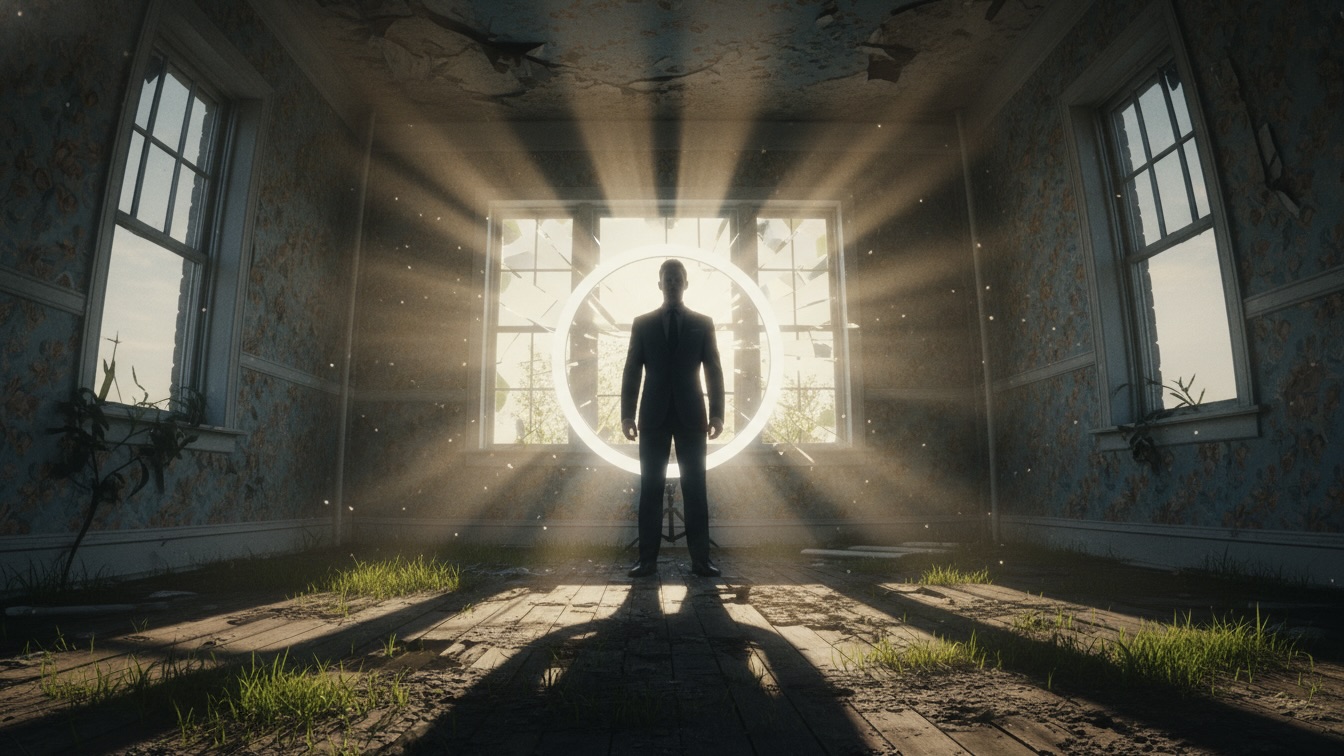
Format: Short Film / Anthology Episode | Est. Length: 10-12 minutes
Imagine this as a standout entry in The Market Price, a high-concept anthology series exploring the intersection of hyper-capitalism and cosmic horror. Each episode serves as a cautionary tale where modern obsessions—from crypto-mining to influencer culture—manifest as physical distortions in reality, eventually consuming the protagonist. In this world, the "market" is a sentient, indifferent force that treats human ambition as a biological resource to be harvested and optimized.
A high-energy real estate influencer breaks into a condemned "bando" to film a live-streamed renovation tutorial, only to realize the house is literally digesting his ego and warping its geometry to match his hollow rhetoric.
An arrogant "alpha" influencer attempts to live-stream the renovation of a cursed property in a derelict town. As he tries to "pivot" the house's structural decay, the geometry of reality collapses to match his predatory mindset.
The primary theme is the hollow nature of "grind culture" and the linguistic gymnastics used to mask economic failure and human suffering. It critiques the predatory nature of modern real estate speculation and the way digital personas detach individuals from physical reality, turning genuine tragedy into "content."
The secondary theme explores cosmic indifference, where the "void" represents the ultimate efficiency—a place where human ego and "hustle" are rendered mathematically irrelevant. It suggests that the language of optimization is not a tool for success, but a symptom of a reality that has already decided to erase the individual.
For Chad, the stakes begin as his professional reputation and viewer count but rapidly escalate to his physical survival and the integrity of his soul. Sierra represents the community's survival, acting as a grim witness for those who refuse to respect the "sickness" of the land. Ultimately, the stake is the total erasure of the individual into a state of "pure potential" that is indistinguishable from non-existence.
The external conflict is the house itself, a sentient architectural anomaly that reacts to Chad’s aggressive "alpha" energy by warping its own geometry and mimicking his voice. Internally, Chad struggles against his own narcissism; his refusal to acknowledge weakness or failure prevents him from escaping before the "void" takes hold. Sierra serves as a secondary, passive antagonist, representing the cold reality of the town that Chad refuses to see until it is too late.
Chad, an insufferable real-estate influencer, breaks into a rotting house in Melgund Creek to film a live-streamed "bando flip" for his thousands of followers. He is interrupted by Sierra, a local woman who warns him that the ground is "sick" and the house is condemned, but Chad dismisses her as a "poverty-minded" hater. After she leaves, Chad attempts to demolish a wall with a tactical sledgehammer, only for the house to absorb the tool and begin physically manifesting his motivational buzzwords into a nightmare of shifting hallways and fleshy drywall.
As the house's geometry breaks—turning hallways into infinite shafts and rooms into rotating traps—Chad continues to stream, desperately trying to rebrand the horror as "paranormal hustle." He eventually finds himself at the threshold of the front door, looking out into a gray, featureless static where Melgund Creek used to be. Sierra watches from the void as the house collapses into a single point of "total optimization," leaving Chad to "hustle" in a vacuum of non-existence.
Chad: A hyper-performative "alpha" influencer driven by a pathological need for status and a deep-seated fear of being "average." He views the world through the lens of ROI and "pivoting," a mindset that initially serves as his armor but eventually becomes the very thing the house uses to dismantle his reality. By the end, his ego is so absolute that he perceives his own erasure as the ultimate form of "streamlining."
Sierra: A weary, grounded representative of the "generational failure" Chad mocks, she acts as a modern-day Cassandra who has seen the town's rot firsthand. She is not a hero, but a witness, bound by a grim duty to warn the "scavengers" who come to exploit the ruins of her home. Her lack of inflection and emotional distance serves as the perfect foil to Chad’s manic, high-BPM energy.
The Setup: Chad sets up his high-end streaming rig in a derelict, foul-smelling house, performing a manic "alpha" monologue for his four thousand viewers while dismissing the town's decay as a "skylight opportunity." He claps his hands to test the acoustics, but the sound is swallowed by the peeling wallpaper, establishing an immediate sense of atmospheric dread. Sierra enters to deliver a flat, chilling warning about the "sick dirt" and shifting geometry, but Chad mocks her "victim mentality" for the camera before she disappears into the spring heat.
The First Impact: Alone again, Chad attempts to "open up the concept" by swinging a tactical sledgehammer into a kitchen wall, only for the impact to feel like hitting wet flesh rather than plaster. The wall ripples like water and slowly swallows the hammer whole, leaving Chad empty-handed and his Apple Watch screaming about his elevated heart rate. He tries to play it off as a visual effect for his growing audience, but the house begins to echo his own voice back to him through the vents, distorting his "grind" rhetoric into a low-frequency growl.
The Collapse: The hallway to the kitchen stretches to an impossible length, and the floor tilts into a thirty-degree incline that Chad’s brain refuses to process as he crawls toward the "void." Inside the kitchen, the wallpapered flowers begin to breathe and the floor turns into a black mirror where Chad’s reflection mocks him in a tailored suit, speaking his own buzzwords with chilling authority. As the room rotates and the walls close in with every shouted "Hustle," Chad is forced to crawl through a shrinking, triangular aperture that cracks his ribs, finally reaching the front door only to find that the world outside has been replaced by a silent, gray static.
The episode begins with a high-energy, irritatingly bright tone that mirrors Chad’s influencer persona, creating a sense of "cringe" and annoyance in the audience. As the house begins to warp, the mood shifts into surrealist body horror and claustrophobia, replacing the annoyance with a visceral sense of "wrongness." The finale offers a cold, intellectual dread as the audience realizes Chad is not being killed, but "optimized" out of existence, leaving them with a hollow, unsettling feeling of cosmic indifference.
In a broader season, "Grinding Into the Void" serves as the midpoint escalation where the series transitions from grounded social satire to full-blown cosmic horror. Earlier episodes would establish Melgund Creek as a recurring location—a "thin place" where the failures of the American Dream have allowed a predatory, mathematical void to seep into the physical world.
The season-long narrative would follow Sierra as she navigates different "scavengers" arriving in town, slowly revealing that she is part of a silent collective trying to manage the "void's" hunger. The finale would see the entire town finally "optimized," leaving behind a pristine, gray map that serves as a warning for the next zip code targeted by the "alpha" mindset.
The visual style should utilize a "Prosumer" aesthetic, blending high-quality iPhone 17 Pro footage with traditional cinematic wide shots that emphasize the house's impossible geometry. The lighting should transition from the harsh, artificial "halo" of the ring light to a sickly, organic glow emanating from the walls, using deep shadows and "glitch" effects to represent the breaking of reality.
The tone is "Corporate Gothic"—a blend of the sterile, high-energy language of LinkedIn influencers with the decaying, visceral horror of The House of Leaves. The sound design is crucial, utilizing compressed, "bit-crushed" versions of Chad’s own voice to create a cacophony of motivational noise that eventually drowns out all natural sound.
The target audience is adults aged 18-35 who are fluent in internet culture, "grindset" memes, and the aesthetics of livestreaming. It appeals to fans of psychological horror and social commentary who enjoy seeing modern archetypes dismantled in surreal, high-concept environments.
The pacing is relentless, mimicking the "no days off" energy of the protagonist. It follows a three-act structure: Act I (The Pitch) is fast-paced and dialogue-heavy; Act II (The Pivot) slows down into a tense, atmospheric crawl; and Act III (The Optimization) accelerates into a chaotic, sensory-overload climax that ends abruptly in total silence.
The "shifting geometry" effects should be achieved through a mix of practical rotating sets and seamless digital "stretching" of the background plates to maintain a sense of physical weight. The "fleshy drywall" and "breathing wallpaper" require high-quality animatronics or tactile VFX to ensure the horror feels grounded and "wet" rather than purely digital.
The "gray void" outside the door should be a featureless, high-contrast static that avoids looking like a simple green screen, perhaps utilizing LED volume walls to provide the correct ambient light on the actors. The sound design must be layered with binaural frequencies to create a physical sense of pressure in the viewer's ears during the "Grind" and "Hustle" chants.


