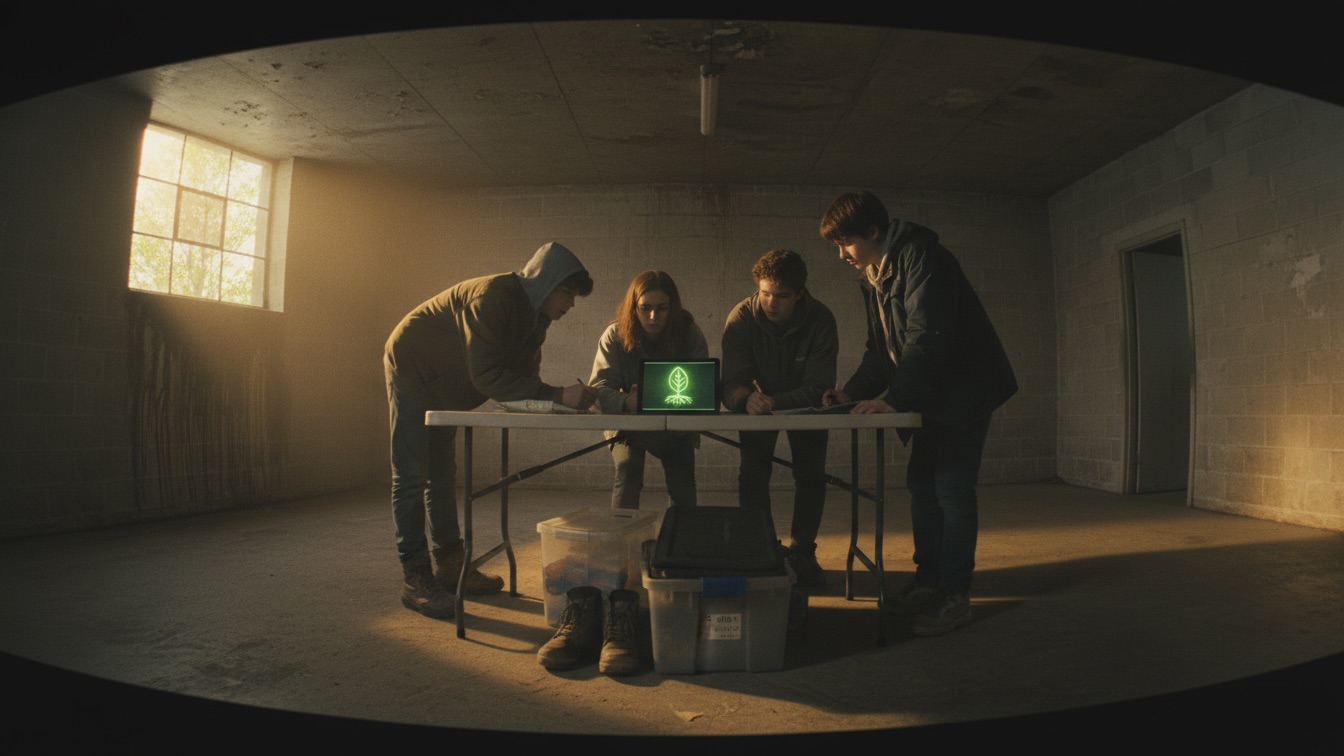
A group of teenagers in a damp basement plan a seed bank to save their dying rural community.
The air in the Melgund United Church basement tasted like wet drywall and the ghost of a thousand potluck dinners. It was that specific Northwestern Ontario spring—the kind where the snow doesn't so much melt as it does surrender into a gray, treacherous slush that ruins your boots and your mood simultaneously. Leo sat at a folding plastic table that wobbled every time he shifted his weight. His boots, a pair of beat-up hikers with salt-stained seams, were currently forming a small, pathetic lake on the linoleum floor. He stared at his tablet screen. A crack ran diagonally across the glass, refracting the overhead fluorescent light into a tiny, annoying rainbow.
"We can’t just use a spreadsheet, Leo," Maya said. She was leaning back in a chair that looked like it hadn't been cleaned since the 1990s. She was busy peeling a label off a water bottle with surgical precision. "Nobody in this town under the age of seventy knows how to open an Excel file, and everyone over seventy thinks Google is a spy agency."
"It’s not for them to open," Leo muttered. He tapped a cell on the screen. "It’s for us. We need to know who has what. If Mrs. Gable gives us her heirloom beans and we lose track of them, that’s like, a generational crime. Those beans have been in her family longer than this church has had indoor plumbing."
"It’s just beans," Toby said. He was sitting on a stack of hymnals in the corner, staring at his phone. He didn't look up. "They grow in dirt. You eat them. You poop them out. The circle of life. Why are we making this a whole thing?"
Sam, who had been staring out the high, narrow window at the mud-caked street, finally turned around. He looked exhausted in the way only a seventeen-year-old with three part-time jobs and a failing chemistry grade can look. "Because there’s nothing else to do here, Toby. It’s either this or we go stand in the Canadian Tire parking lot and throw rocks at crows. At least the seed bank sounds like we’re doing something for the 'community.'"
Leo sighed, the sound catching in his throat. "It’s not just about doing something. It’s about not letting everything just... stop. If the grocery store in Dryden shuts down its delivery route again, we’re back to eating canned corn and disappointment. If we have a seed bank, we have options."
"Options for what?" Maya asked, finally stripping the label clean. "To become 19th-century peasants? I’m not wearing a bonnet, Leo. I’m just not."
"No bonnets," Leo agreed. "Just seeds. Look, the plan is simple. We get the little paper envelopes. The ones from the dollar store. We give them to the regulars at the seniors' center. They put in the seeds they saved from last fall. We catalog them—type, year, location, success rate. Then, when the ground actually thaws in June—"
"If it thaws," Toby interrupted.
"—when it thaws, we distribute them to anyone who wants to start a plot at the community garden. It’s a closed loop. It’s efficient. It’s... it’s actually kind of cool if you stop trying to be ironic for five seconds."
Sam walked over and looked at the tablet. "How are you going to track the 'success rate'? People lie about their gardens. It’s like fishing. My dad says his tomatoes were the size of softballs last year. I saw them. They were more like golf balls. Sad, lumpy golf balls."
"We'll have a rating system," Leo said, his voice gaining a bit of speed. "Like Yelp, but for squash. We need to focus on the 'Blue Potatoes.' Have you guys heard the stories about the potatoes Mr. Henderson grows up on the ridge?"
Maya looked up, her interest finally piqued. "The ones that are actually purple inside?"
"Yeah. They’re supposed to be blight-resistant. In a place like Melgund, where the soil is basically just rocks and spite, that’s gold. If we can get those seeds—well, tubers—into the bank, we’re actually contributing something."
"Henderson won't give them up," Toby said, still not looking from his screen. "He’s a hoarder. He’s got three rusted-out trucks in his yard and a dog that looks like it’s made of wire and anger. He’s not sharing his secret stash with a bunch of kids."
"He might if we explain what it's for," Leo said. He felt a familiar tightness in his chest, a mix of anxiety and a weird, stubborn hope. "It’s not just about the food. It’s about the fact that everyone in this town is siloed. Everyone’s in their own little house, complaining about the price of gas and the lack of jobs. If we share the seeds, we’re sharing the knowledge. We’re forcing people to talk to each other."
"That sounds like a nightmare," Maya said, though she was smiling slightly. "Do you know how long Mrs. Gable talks when you get her started? You ask for beans, and four hours later you’re learning about her third cousin’s hip replacement in Thunder Bay."
"That’s the price of the beans, Maya," Leo said. "Social labor."
"Social labor," Sam repeated, testing the words. "Sounds like a fancy way of saying we’re the town’s new errand boys."
"And girls," Maya added.
"And girls," Sam corrected. "But seriously, Leo. How do we store them? This basement is damp. If we put seeds in here, they’ll just turn into a giant pile of mold by May."
Leo reached into his backpack and pulled out a stack of plastic bins. They were mismatched, some with cracked lids taped shut with duct tape. "Air-tight containers. Silica packets. I’ve been saving them from my shoeboxes and beef jerky bags for months."
Toby finally looked up. "You’ve been saving silica packets? That’s the most Melgund thing I’ve ever heard. We’re officially a post-apocalyptic settlement."
"We live in a town with one blinking yellow light and a gas station that doubles as a pizza place," Leo said, his voice flat. "We’ve been post-apocalyptic since the mill closed in '08. We’re just finally catching up to the aesthetic."
They sat in silence for a moment. The furnace in the corner kicked on with a heavy, metallic thud, followed by a wheezing sound that suggested it was on its last legs. The smell of burning dust filled the room. It was a comfortable kind of bleakness. This was their reality—a world of repurposed plastic and salvaged hope. Outside, a truck rumbled by, its tires splashing through a deep puddle. The sound echoed up the stairs.
"Okay," Maya said, standing up. She grabbed a Sharpie from the table. "If we’re doing this, we’re doing it right. I’ll handle the labels. I have better handwriting than all of you combined. Leo, you handle the 'database' on your cracked iPad. Sam, you’re the muscle—you go talk to Henderson. He likes your dad."
"He likes my dad’s chainsaw," Sam muttered. "He doesn't like me."
"Close enough," Maya said. "Toby, you’re on social media duty. Make it look like we’re a legitimate organization and not just four bored teenagers in a church basement. Use some of those aesthetic filters. Make the mud look like... I don't know, 'heritage earth' or something."
"On it," Toby said, his thumbs already flying across the screen. "'The Melgund Seed Project.' No, 'The Melgund Germination Initiative.' Sounds more official. More like we have a grant."
"Do we have a grant?" Sam asked.
"We have twelve dollars and a bag of silica packets," Leo said. "But we have the plan. And we have the envelopes."
He pulled out a box of small, brown paper envelopes. They were cheap and flimsy, but they were clean. In this room, they were the brightest things present. Leo felt a small, sharp spark of something that wasn't irony. It was the feeling of a gear finally catching.
"We start with the easy stuff," Leo said, laying out the envelopes on the wobbly table. "Peas, carrots, lettuce. The stuff that grows even if you ignore it. We build trust. Then we go for the Blue Potatoes."
"The Blue Potatoes," Maya whispered, her voice mock-theatrical. "The Holy Grail of Melgund."
"It’s a start," Leo said. He picked up the Sharpie and wrote MELGUND SEED BANK: 001 on the first envelope. The ink bled slightly into the paper, but the letters were bold. They were real.
Outside, the sun began to set, casting a long, muddy light across the street. The spring air was still cold, still heavy with the scent of melting ice and old pine needles. But inside the basement, the four of them were leaning over the table, their heads close together, arguing over the best way to categorize a snapdragon. It wasn't much, but it was a beginning. It was a way to stay rooted in a place that seemed determined to blow away.
"Wait," Toby said, looking up from his phone. "Does anyone actually know how to grow a potato?"
Leo looked at the others. Sam shrugged. Maya bit her lip.
"We’ll Google it," Leo said. "While we still have a signal."
They worked for hours, the rhythmic scratching of pens and the tapping of screens the only sounds against the hum of the dying furnace. They talked about the neighbors—the ones who would support them and the ones who would think they were crazy. They talked about the future, not as a vague, terrifying void, but as a series of planting seasons. One year for the soil to recover. Two years for the perennials to take hold. Five years for the town to look different.
It was a small dream, contained in paper envelopes and plastic bins. But as the clock on the wall ticked toward nine, none of them wanted to leave. The mud outside was still there, the slush was still freezing into ice, and the town was still struggling. But for the first time in a long time, the basement felt like something more than a shelter from the wind. It felt like a laboratory.
"Check this out," Toby said, turning his phone around. He’d created a logo: a simple, hand-drawn sprout pushing through a crack in a paved road. It was minimalist, slightly edgy, and perfectly captured the vibe of Melgund.
"I don't hate it," Maya said.
"I almost like it," Sam added.
Leo looked at the small green sprout on the screen. "It’ll do. It’ll definitely do."
They packed up their things as the church's automatic lights flickered, a warning that the building was locking down. Leo grabbed the bins, cradling them like they were made of glass. They walked up the stairs, their boots clumping loudly on the wood, and emerged into the crisp, biting night air. The stars were out, sharp and cold over the dark silhouette of the boreal forest.
"See you guys tomorrow?" Leo asked, his breath misting in the air.
"Yeah," Maya said, pulling her hood up. "I'll bring more Sharpies. We’re gonna need them."
"I'll check the signal at Henderson's," Sam said. "Maybe I can scout the perimeter without the dog eating me."
"I'm posting the first update now," Toby called out as he started walking toward his bike. "The Melgund Germination Initiative is officially live."
Leo watched them go, his hands tight around the plastic bins. He looked down at the muddy ground, then back at the dark church. He felt a weird, buzzing energy in his fingertips. It wasn't the kind of world-changing power you saw in movies. It was smaller. It was the power of a few dried-up seeds and a plan that might actually work.
He started the long walk home, his boots splashing in the dark, thinking about the Blue Potatoes and the way the earth would feel when it finally, truly warmed up.
“As Leo turned the corner toward his house, he saw a single, weathered envelope tucked into his mailbox with no return address.”


