Format: Short Film / Anthology Episode | Est. Length: 10-12 minutes
Imagine this as an entry in an anthology series titled Late Bloomers, which explores the messy, unglamorous reality of reinvention in one's fifties and sixties. Each episode follows a different individual navigating the "third act" of life, stripping away the polished veneers of retirement brochures to reveal the grit, humor, and unexpected connections found in community college courses and local volunteer work. The series serves as a grounded, darkly comedic look at the psychological hurdles of aging, proving that growth is often a byproduct of the very things we try to discard.
Renee, a stiff 56-year-old former accountant, stands in a sweltering dirt lot staring in disgust at a bin of rotting cantaloupe, realizing her "Applied Psychology" course is less about feelings and more about filth.
A clinical, twice-divorced retiree is forced to confront her emotional isolation while working a compost heap with an infuriatingly optimistic partner. When a verbal confrontation turns into a literal explosion of fertilizer, they must choose between their intellectual shields and the messy reality of human connection.
The primary theme is the tension between intellectualization and lived experience, specifically how people use academic labels to avoid genuine vulnerability. It explores the concept of "Black Gold"—the idea that beauty and growth can only emerge from the processing of rot, whether that rot is organic garbage or the failures of one's past.
The story also examines the "beginner’s mind" in late adulthood, highlighting the ego-bruising transition from being a career expert to a novice in life’s most basic social functions. It suggests that true psychological health is found not in the diagnosis of others, but in the willingness to get one's hands dirty in the "mess" of interpersonal relationships.
For Renee, the stakes are her emotional survival; if she cannot break her habit of "diagnosing" others to keep them at a distance, she faces a permanent, lonely exile behind a wall of textbooks and failed marriages. For Toby, the stakes involve the validation of his life’s purpose, as Renee’s sharp-tongued critique threatens to expose his optimism as a fragile coping mechanism for his own past losses, potentially shattering his hard-won peace.
The primary conflict is interpersonal and ideological, pitting Renee’s dismissive-avoidant defense mechanisms against Toby’s relentless, "savior-complex" optimism. External pressures include the oppressive valley heat, the sensory assault of the decomposing compost, and the physical limitations of their aging bodies, all of which exacerbate the internal friction. The antagonistic force is essentially "the mask"—the false personas both characters wear to protect themselves from the reality of their loneliness.
Renee, a retired accountant seeking clinical answers for her failed relationships, finds herself assigned to a compost-building project for a psychology credit. She meets Toby, an energetic older man whose cheerful metaphors about "potential" and "future soil" grate against her cynical, detached worldview. As they sort through fermenting kitchen scraps in the sweltering heat, Renee uses her psychological training to brutally deconstruct Toby’s character, accusing him of using the garden to hide from his own life’s failures and a "savior complex."
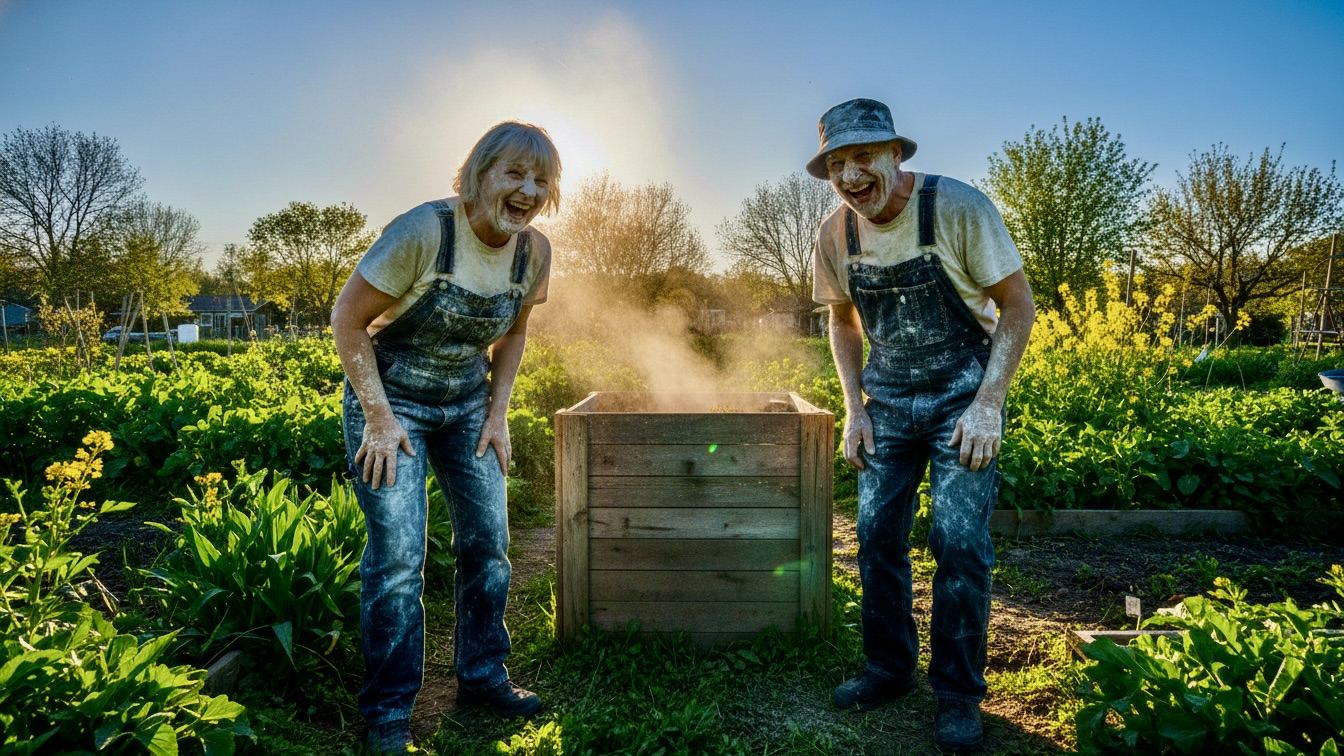
Toby retaliates by accurately diagnosing Renee’s own emotional cowardice and her tendency to use intellect as a shield against connection. The tension reaches a breaking point when they attempt to move a heavy bag of bone meal, which snags and explodes, coating them both in white powder. In the absurdity of the moment, their defenses shatter, leading to a shared moment of genuine laughter and a silent agreement to stop analyzing and start working together in the dirt.
Renee: A 56-year-old retired accountant who is clinical, sharp-tongued, and emotionally guarded. At the start, she is "dismissive-avoidant," using psychology as a weapon to maintain distance from her own failures; by the end, she sheds her gloves to accept a moment of raw, unmediated human connection.
Toby: A 60-65-year-old volunteer with "golden retriever energy" and a penchant for heavy-handed metaphors. He begins as a seemingly simple-minded optimist but is revealed to be a man consciously choosing engagement over despair; he ends the story having earned Renee's respect by forcing her to see the person behind the "savior" mask.
Beat 1: Renee arrives at the sweltering municipal lot, expressing her disdain for the gap between the "smiling adults" in the course brochure and the reality of sifting through rotting garbage. She meets the whistling, hyper-energetic Toby, whose relentless positivity immediately triggers her defensive cynicism. Their initial interaction establishes a sharp power struggle over how to handle the "lasagna method" of building the compost pile.
Beat 2: As they sort through fermenting kitchen scraps in the oppressive heat, Renee’s physical disgust drives her to lash out at Toby’s heavy-handed metaphors about "potential." Toby attempts to bridge the gap by showing her the "black gold" of worm castings, but Renee recoils, refusing to touch the "messy" reality of the process. This rejection leads to a tense standoff where Renee begins to use her psychological training to dismantle Toby's optimistic facade, marking the midpoint of their conflict.
Beat 3: Toby fires back with a devastatingly accurate assessment of Renee's fear of connection, leading to a moment of raw, mutual vulnerability. The argument culminates in the accidental explosion of a bone meal bag, which leaves them both physically ridiculous and emotionally exposed. In the absurdity of the aftermath, their defenses shatter, leading to a shared moment of genuine laughter and a silent agreement to finally work together.
The episode begins with a tone of dry, observational irritation, moving into a claustrophobic and heated psychological confrontation as the characters strip away each other's masks. The climax provides a sudden, cathartic release of tension through absurdity, ending on a grounded, quiet note of shared humanity. The audience experience should shift from amusement at Renee's cynicism to discomfort during the verbal sparring, finally landing on a sense of relief and warmth.
If expanded, the season would follow Renee as she navigates her degree, with each episode focusing on a different "practical" assignment that forces her to interact with the community she previously ignored. Toby would remain a recurring presence, serving as a foil to Renee’s academic rigidity and eventually becoming her first genuine friend in decades. Their relationship would evolve from reluctant partners to a platonic anchor for one another as they face the realities of aging.
The overarching narrative would track Renee’s slow transition from an "accountant of the mind," who merely tallies up people's flaws, to a participant in the "messy" world of community psychology. The season finale would see her finally responding to a text from her children not with a clinical update, but with a vulnerable admission of her own struggles. This evolution would be mirrored in the growth of the community garden, which transforms from a pile of rot into a thriving space.
The visual style is "Sun-Drenched Realism," utilizing high-contrast lighting to emphasize the harshness of the valley sun and the textures of the compost—wet coffee grounds, writhing worms, and the fine white dust of bone meal. The camera work should be handheld and intimate, staying close to the characters' faces to capture the micro-expressions of Renee’s disdain and Toby’s fading smile. The color palette will shift from the sulfurous yellow of the pollen-heavy air to the deep, rich browns of the worm castings.
Tonal influences include the grounded, character-driven humor of Better Things and the bittersweet exploration of aging found in The Kominsky Method. The sound design will emphasize the "wet" sounds of the compost and the distant, indifferent hum of city traffic to highlight the isolation of the two characters in their dirt lot. The overall mood is one of "uncomfortable growth," where the humor is derived from the characters' resistance to the very things they need.
The target audience is adults aged 40-70 who appreciate sophisticated, dialogue-driven drama that explores the complexities of aging, retirement, and emotional intelligence. It appeals to viewers who enjoy "slice of life" storytelling with a cynical edge that eventually gives way to earned sentiment. This demographic typically seeks content that validates their own experiences of reinvention and the difficulty of forming new bonds later in life.
The 10-12 minute runtime requires a brisk, three-act structure where the first three minutes establish the setting and conflict, the middle five minutes escalate the psychological warfare, and the final minutes handle the bone-meal "detonation" and resolution. The pacing should feel increasingly frantic and breathless as the heat and tempers rise, creating a sense of pressure-cooker tension. The tempo slows down significantly for the final, quiet handshake, allowing the emotional weight of the breakthrough to land with the audience.
The "bone meal explosion" is a critical practical effect that must be carefully choreographed to ensure the actors are safely but convincingly coated in white powder in a single take. The production will also require a realistic, tiered compost bin and various stages of "organic waste" that look appropriately revolting on camera without creating an actual biohazard for the cast and crew.
Filming should ideally take place during the "golden hour" or midday to maximize the visual impact of the aggressive sunlight described in the text. Special attention must be paid to the "worm castings" bin, using macro photography to capture the movement of the worms as a visual metaphor for the "shifting" psychological state of the characters. Practical makeup will be needed to transition the characters from "sweaty and clean" to "covered in bone dust" while maintaining the visibility of their facial expressions.


