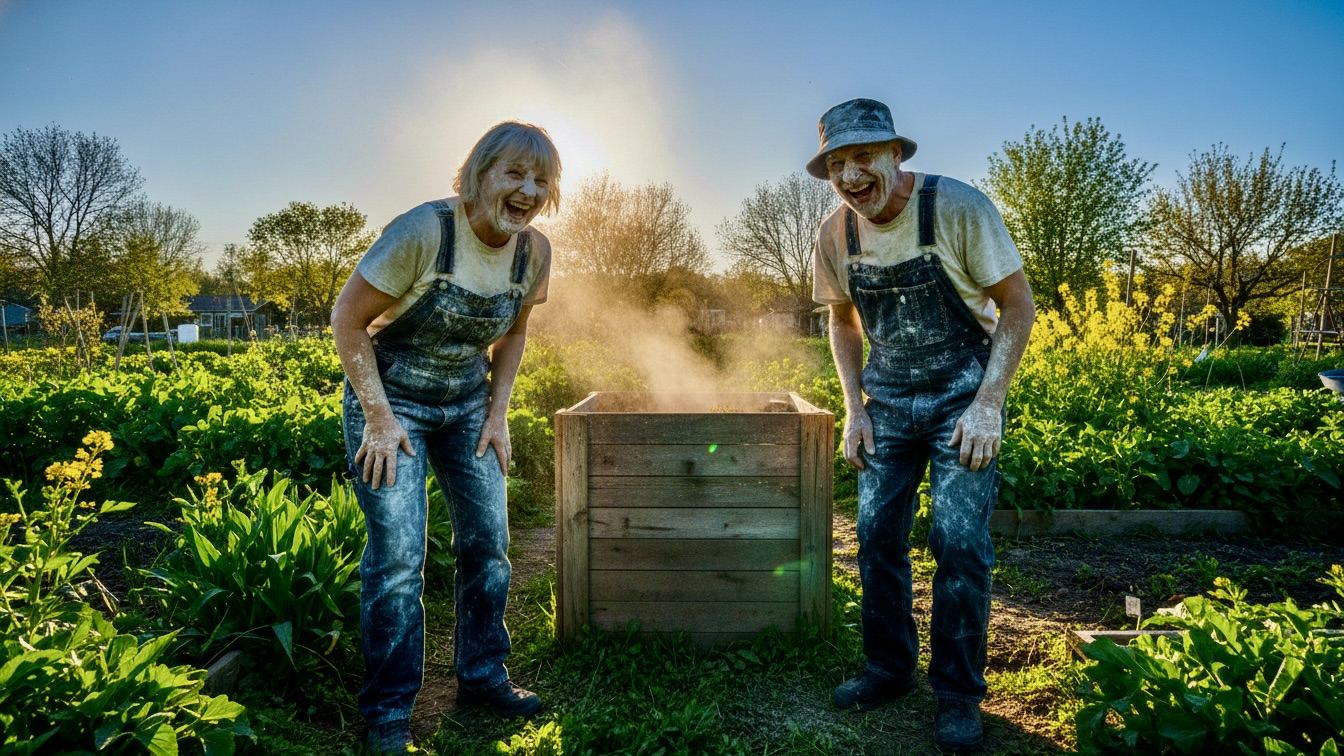
Renee, a fifty-six-year-old retired accountant turned psychology student, finds herself performing manual labor in a sweltering municipal lot. She is there to fulfill a requirement for her Applied Community Psychology course, which involves managing a compost heap. Her partner for the project is Toby, an energetic older man whose enthusiastic approach to garbage and life deeply irritates Renee’s cynical sensibilities.
The morning heat and the stench of rotting vegetables exacerbate Renee's internal frustration with her life and her perceived failures in her family relationships. When Toby attempts to offer metaphorical wisdom about the "potential" within the rot, Renee reacts with biting intellectual aggression. She uses her psychological training to diagnose Toby with a savior complex, attempting to dismantle his optimism by labeling it a compensatory mechanism for his own personal failures.
Toby does not crumble under her critique; instead, he retaliates with a devastatingly accurate assessment of Renee’s own dismissive-avoidant attachment style. He accuses her of using intellectualism as a shield to avoid the messy reality of human connection. The verbal warfare is suddenly interrupted by a physical accident when a bag of bone meal tears open, dousing both of them in white powder. This absurd moment breaks the tension, leading to a shared laugh and a genuine, vulnerable introduction that marks the beginning of a real partnership.
The central theme of the story is the transformative power of "the mess," both in nature and in human psychology. The compost pile serves as a visceral metaphor for the process of taking the "rot" of one’s life—failed marriages, career changes, and personal disappointments—and turning it into something fertile. Renee initially views the garbage with disgust, mirroring her own reluctance to face the unpolished aspects of her internal world. Toby, conversely, embraces the decay, suggesting that growth is impossible without first engaging with the unpleasant realities of decomposition.
Another significant theme is the conflict between intellectualization and lived experience. Renee represents the clinical, detached observer who uses academic terminology to keep the world at a distance. She believes that by labeling a problem, she has solved it or, at the very least, protected herself from it. The narrative suggests that true psychological insight does not come from a textbook but from "getting one's hands dirty" in the unpredictable, often repulsive reality of human interaction.
Aging and the search for identity in the third act of life also permeate the text. Both characters are navigating the transition from established careers into a space where they are once again beginners. Renee’s struggle with her "lumbar spine" and her "linen blouse" highlights the physical and social friction of this transition. The story posits that aging requires a difficult shedding of the ego, moving from the role of the "expert" back to the role of the "student" who must learn to handle the "bone meal" of existence.
Renee is a woman defined by her defenses, specifically her reliance on order and intellect to manage emotional pain. Her background as an accountant suggests a lifelong preference for balance sheets and clear-cut answers, a trait she has unsuccessfully tried to transplant into the field of psychology. She views her environment through a lens of clinical judgment, which serves as a protective barrier against the vulnerability she feels regarding her failed marriages and distant children. Her internal monologue is sharp and observant, yet it reveals a deep-seated loneliness that she is unwilling to acknowledge until she is forced to do so.
Her transformation in the chapter is sparked by her failure to maintain this distance. When she attacks Toby, she is not merely being cruel; she is attempting to re-establish the power dynamic she feels slipping away in the heat of the compost lot. However, Toby’s counter-diagnosis pierces her armor because it addresses the core of her isolation. By the end of the chapter, she demonstrates a significant shift by removing her gloves and shaking Toby’s hand. This physical act symbolizes her willingness to abandon her "dismissive-avoidant" stance and engage with the world in a tactile, unshielded way.
Toby serves as the foil to Renee’s rigid intellectualism, embodying the "engaged" participant in life. He is characterized by his "golden retriever energy" and a seemingly bottomless well of optimism that Renee finds performative and irritating. While he initially appears to be a simple, perhaps even shallow, character, his reaction to Renee’s verbal assault reveals a surprising level of emotional depth and resilience. He does not retreat from her anger but meets it with a mirror, showing her that his "hands-on" approach is a conscious choice rather than a lack of sophistication.
His character challenges the idea that optimism is a form of denial. While Renee accuses him of hiding from reality in the dirt, Toby argues that he is more present than she is because he is willing to work with the "anaerobic" and "toxic" parts of life to make them healthy again. He is a "savior" in the sense that he believes in the possibility of redemption for both soil and people. His willingness to laugh at himself after the bone meal explosion shows a lack of ego that Renee desperately needs to emulate. He represents the potential for joy that exists even when one is "up to the elbows in the mess."
The narrative voice is characterized by a sharp, sardonic tone that reflects Renee’s internal state. The prose is lean and unsentimental, utilizing short, punchy sentences to convey the oppressive heat and the protagonist's irritability. This style creates a sense of immediacy, drawing the reader into the physical discomfort of the setting. The contrast between the "sulfurous yellow dust" of the pollen and the "linen blouse" Renee wears emphasizes the clash between her desire for refinement and the raw reality of her surroundings.
Sensory details are used effectively to ground the psychological conflict in a physical space. The author leans heavily into olfactory and tactile descriptions, such as the "sweet and rank" smell of fermenting strawberries and the "wet, slapping sound" of garbage hitting the bin. These details serve to make the metaphor of the compost pile feel more tangible and less like a literary trope. The "white bone meal" explosion serves as a brilliant stylistic pivot, moving the story from a tense psychological drama into a moment of slapstick absurdity that facilitates the emotional resolution.
The pacing of the chapter is deliberate, building the tension through a series of escalating verbal exchanges. The dialogue is crisp and serves as a weapon for both characters, allowing the subtext of their personalities to come to the surface. By the time the bone meal bag tears, the reader is primed for a release of pressure. The shift from the heavy, "anaerobic" atmosphere of the argument to the "genuine laugh" at the end provides a satisfying narrative arc that mirrors the very "lasagna method" of composting Toby describes—layering the brown and the green until something new begins to form.


