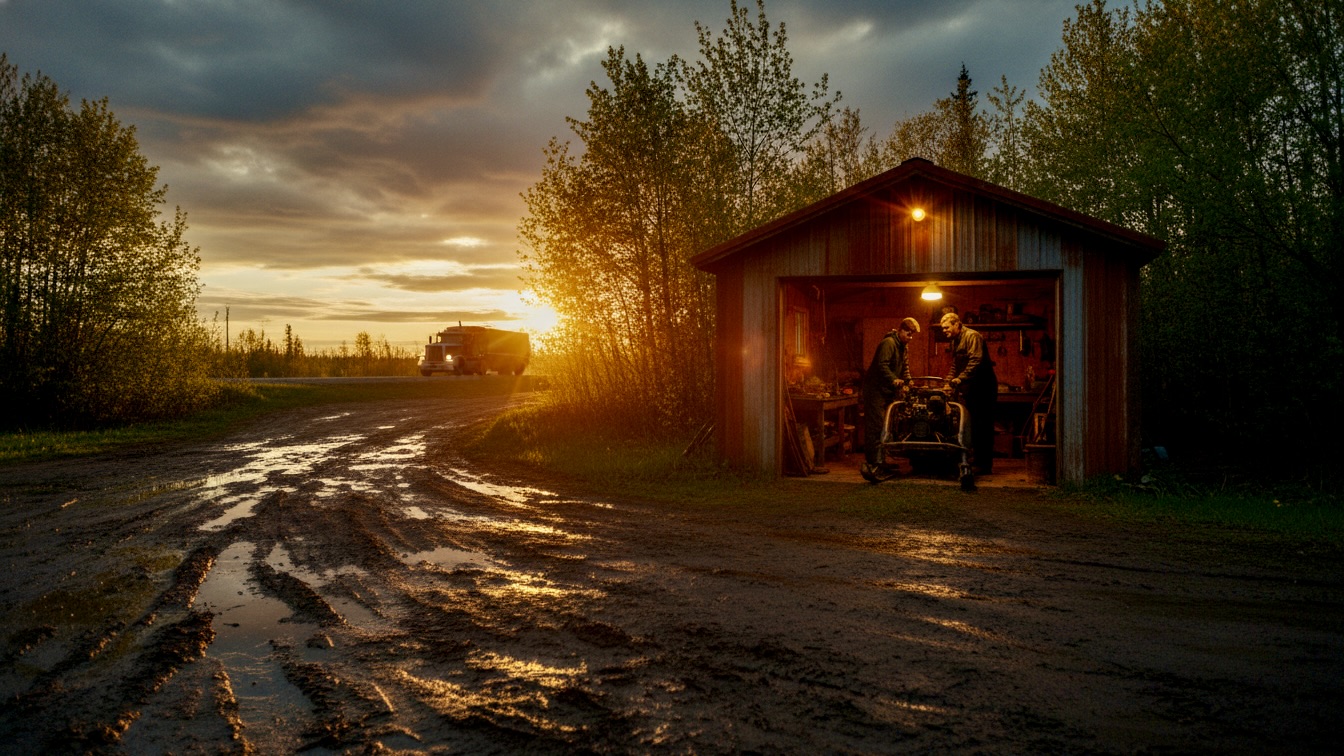
Format: Short Film / Anthology Episode | Est. Length: 10-12 minutes
Imagine this story as a cornerstone episode of The Perimeter, an anthology series that explores the friction between isolated rural communities and the encroaching machinery of global industry. Each episode focuses on a different "sacrifice zone"—towns where the landscape is being repurposed for the greater good of the metropolis—seen through the eyes of those living on the front lines. The series maintains a grounded, hyper-realistic tone, weaving a narrative arc about the loss of local agency and the slow-burn psychological toll of living in a "reasonable risk" environment.
An eleven-year-old boy sits on a milk crate in a dying garage, clutching a glossy corporate pamphlet that promises a "safe" nuclear future while his uncle stares at a missing bolt and a wall of empty tool hooks. The silence of the spring thaw is broken only by the boy’s pointed question: "So, they’re burying the glowing trash?"
A cynical mechanic deconstructs corporate jargon for his young nephew as a nuclear waste repository threatens to transform their quiet Northern town. They must decide whether to accept the "reasonable" risks dictated by outsiders or demand a standard of perfection that the industry cannot afford.
The primary theme is the Deception of Language, specifically how corporate euphemisms like "ALARA" (As Low As Reasonably Achievable) and "Best Practices" are used to mask the prioritization of profit over human safety. The story explores the gap between "corporate-speak" and "lived reality," illustrating how technical math and slick marketing fail to account for the emotional and cultural value of a landscape.
Secondary themes include the Erosion of Home and Intergenerational Responsibility. The garage, the recreation hall, and the lynx trails represent a heritage that is being quantified as "socio-economic assets" by people in skyscrapers. The dialogue between Miller and Sam highlights the burden placed on the next generation to police the "limits" and "permissions" granted to industry by the government.
For Sam, the stakes are his future and the physical safety of the environment he will inherit; a leak isn't a statistical anomaly to him, but a permanent poisoning of his morning coffee. For Miller, the stakes are the preservation of his community’s dignity and the prevention of their home becoming a mere "construction zone." If they fail to demand "zero discharge" and community-led monitoring, they risk losing the very essence of Dyment to noise, dust, and the "reasonable" leakage of radioactive waste.
The external conflict is the NWMO (Nuclear Waste Management Organization) and the distant government bodies in Toronto who have decided the Revell site is a "reasonable" risk without local consultation. This is represented physically by the glossy pamphlets and the heavy trucks that shake the garage foundations. Internally, the conflict lies in Miller’s weary cynicism versus Sam’s burgeoning need for agency; Miller must overcome his sense of defeat to teach Sam how to fight back against a "done deal."
Sam visits his Uncle Miller in a grease-stained garage during a muddy spring thaw, bringing a pamphlet about a proposed nuclear waste repository at the nearby Revell site. Miller, a weary mechanic, uses the state of his garage and tools to explain that the industry's "best practices" are merely legal shields designed to prevent personal liability. He breaks down the "ALARA" principle, revealing it as a loophole that allows companies to balance the cost of safety against the health of the local creek.
As the light fades, the conversation shifts to the cultural impact on their town, from the loss of snowmobile trails to the industrialization of the local recreation hall. Miller explains that the government’s "Safety Case" is a lecture rather than a dialogue, ignoring the local knowledge of how the land actually functions. Inspired, Sam suggests a community-led monitoring station to keep the "fox from guarding the henhouse." The episode ends with the physical intrusion of a massive truck climbing the hill toward the site, its vibration rattling the garage and signaling that the "reasonable" risks have already begun to arrive.
Miller (50s): A mechanic with permanently stained knuckles and a back that pops like a dry branch. He is the voice of lived experience and healthy skepticism, having seen the world transition from a place of "spotless" standards to one of "reasonable" compromises. His psychological arc moves from a state of quiet, cynical observation to a role of active mentorship, empowering Sam to find his voice.
Sam (11): An observant and firm young boy who is still small enough to sit on a milk crate but old enough to see the cracks in a corporate "Safety Case." He represents the future of Dyment, moving from a state of being overwhelmed by the "big world" to a position of moral clarity. His arc concludes with the realization that "perfect" is the only acceptable standard when the stakes are permanent.
* The Mud and the Gloss: Sam sits in the dim garage watching Miller struggle with a Ski-Doo engine, the physical decay of the room contrasting with the bright, "friendly" pamphlet Sam holds. Sam asks about the "glowing trash," prompting Miller to explain that the danger isn't a movie effect, but a heavy, hot reality that outlasts trees and buildings. Miller dismisses the "best practices" in the pamphlet as corporate fluff used to avoid lawsuits rather than ensure actual safety.
* The ALARA Loophole: Miller explains the "As Low As Reasonably Achievable" (ALARA) principle by comparing it to cleaning the garage; "reasonable" means doing the bare minimum to save money, while "spotless" is what the community actually needs. Sam realizes that "limits" are just permissions to leak, and he demands "zero discharge" because zero is easy to count and impossible to hide. They discuss the Dyment Recreation Hall, reframing it from a "socio-economic asset" to a sacred place for birthdays and funerals that is now threatened by industrial noise.
* The Rumble of Reality: Miller tells Sam about the government's "Summary of Issues," explaining that their "noise" is finally being heard and that the project isn't a "done deal" yet. Suddenly, a massive truck rumbles past, vibrating the garage floor and rattling a jar of nails, providing a physical manifestation of the encroaching industry. The episode closes as Miller shuts the garage door against the grey light, while a single red light on a battery charger pulses like a warning heart, symbolizing the vigil they must now keep.
The episode begins with a mood of Stagnation and Gloom, mirrored by the "bruised grey" light and the "soup of brown mud." As the dialogue progresses, the mood shifts into Intellectual Frustration, as the characters deconstruct the language used to colonize their home. By the climax, the emotion transitions into Dread and Resolve; the physical vibration of the truck creates a sensory tension that leaves the audience feeling the weight of the "reasonable risk" while Sam’s firm stance provides a small, defiant spark of hope.
In a full season, this episode would serve as the "Inciting Incident" for the Dyment community's resistance. Subsequent episodes would follow the escalation of the "Summary of Issues" into a full-scale environmental assessment battle, with Miller and Sam organizing the "community-led monitoring station" they discussed in the garage. The narrative would explore the internal fractures in the town as some residents are lured by "economic benefits" while others, led by Miller’s philosophy, hold out for "perfect" safety.
The season-long thematic escalation would move from the Deception of Language to the Physicality of Resistance. We would see the "lynx trails" become sites of protest and the "recreation hall" become a war room for legal challenges. The finale would circle back to the garage, but instead of Miller and Sam being alone in the dark, the community would be gathered, using their own "eyes on the ground" to challenge the first official radiation readings from the site.
The visual style is Northern Noir, characterized by a desaturated color palette of greys, browns, and oily blacks, emphasizing the "spring thaw" aesthetic. The camera work should be intimate and tactile, focusing on macro shots of Miller’s stained knuckles, the texture of the mud-caked boots, and the slick, artificial sheen of the corporate pamphlet. The lighting should transition from the "weak yellow" of the garage to a heavy, oppressive shadow as the trucks pass by outside.
The tone is Grounded and Ominous, comparable to films like Winter’s Bone or Dark Waters. It avoids the melodrama of typical "disaster" movies, focusing instead on the quiet, low-frequency anxiety of a community being told their safety is a math problem. The sound design is crucial, utilizing a persistent, low-frequency hum and the rhythmic "tick" of melting snow to create a sense of a ticking clock that the characters cannot stop.
The target audience includes viewers of prestige drama and environmental thrillers (ages 25-55) who appreciate slow-burn narratives and social commentary. It appeals to those interested in the "David vs. Goliath" trope, specifically within the context of rural sustainability and the modern tension between green energy solutions (like nuclear) and the local communities that host their waste.
The pacing is deliberate and conversational, allowing the weight of the dialogue to land before the sensory intrusion of the truck. The 10-12 minute runtime is structured as a single-act "chamber piece" that builds tension through verbal deconstruction. The first 7 minutes are dedicated to the philosophical debate in the garage, while the final 3-5 minutes introduce the physical threat (the truck vibration) and the characters' emotional response to the changing world outside.
The most critical production element is the Sound Design. The "rumble" of the truck must be felt by the audience, requiring a mix that emphasizes low-end frequencies to vibrate the viewing environment. The contrast between the quiet "drip" of the snow and the "growl" of the engine is the episode's primary sensory hook.
Practical effects should be used for the garage interior to ensure a lived-in, authentic feel. The "Summary of Issues" and the corporate pamphlet should be professionally designed props that look indistinguishable from real government documents to ground the fiction in reality. The pulsing red light in the final shot should be the only vibrant color in the scene, serving as a visual metaphor for the "glowing" threat that Miller insists isn't just for the movies.


