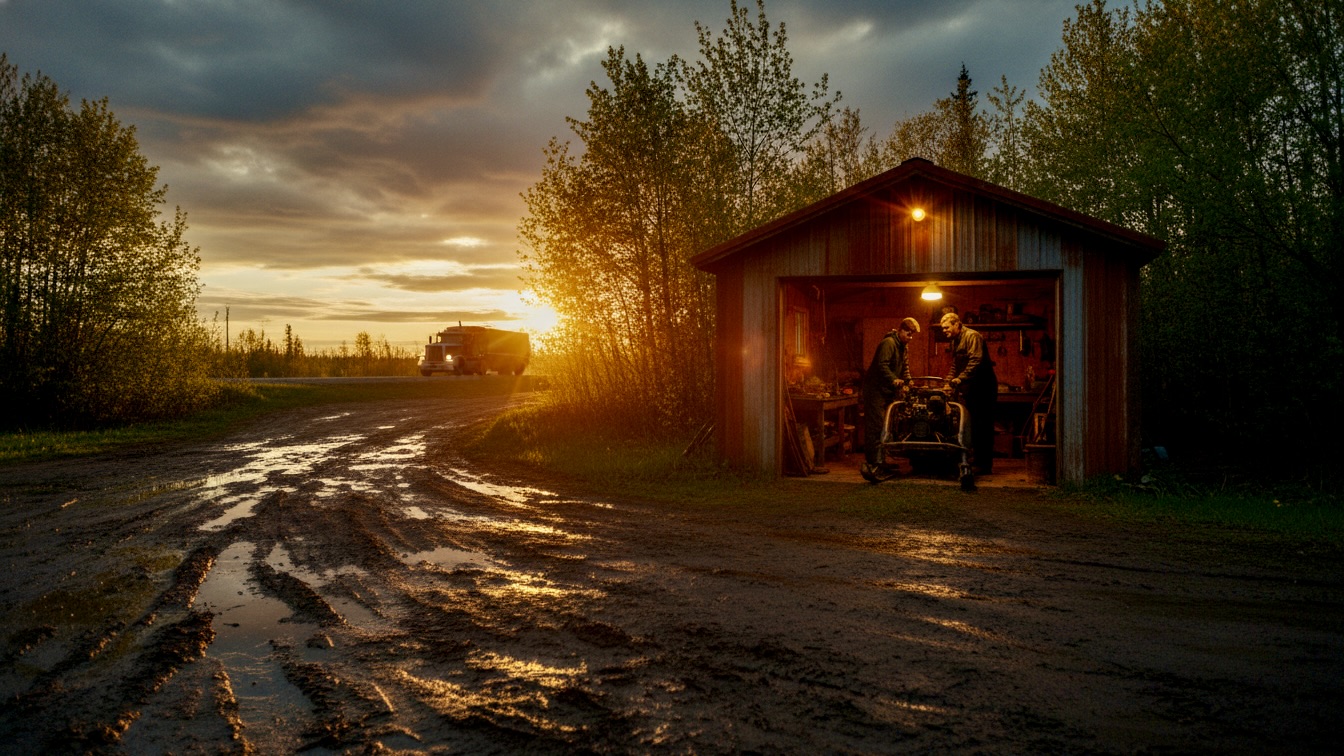
The narrative unfolds within the dim, oil-scented confines of Uncle Miller’s garage during a bleak spring thaw. Eleven-year-old Sam approaches his uncle with a glossy corporate pamphlet detailing a proposed nuclear waste repository at the nearby Revell site. As the light fades into a bruised grey, Sam seeks clarity on the technical jargon and promises of safety contained within the document. Miller, a weary and cynical mechanic, deconstructs the euphemisms of the nuclear industry, explaining how terms like "reasonable risk" and "best practices" serve as corporate safeguards rather than community protections.
Their conversation shifts from the abstract mechanics of radiation to the tangible impacts on their rural life, such as the fate of local recreation halls and snowmobile trails. Miller emphasizes the necessity of community-led monitoring and the refusal to accept anything less than perfection when the stakes involve the environment. The chapter concludes with the physical intrusion of a heavy truck rumbling toward the site, vibrating the very foundation of the garage. This sensory shift signals that the theoretical debate has transitioned into a looming, unstoppable reality for the town of Dyment.
A central theme of the story is the linguistic chasm between corporate entities and the communities they affect. The author highlights how professional jargon like "ALARA" and "safety case" functions as a tool of obfuscation rather than communication. To the people in the skyscrapers of Toronto, these terms represent manageable variables and economic balances. To Sam and Miller, however, this language feels like a deliberate "escape hatch" designed to prioritize profit over the long-term health of the land and its inhabitants.
The narrative also explores the profound sense of loss associated with industrial encroachment on a "home" space. Miller views the local geography not as a "socio-economic asset," but as a repository of personal and communal history. The mention of the air hockey table and the specific movement of deer suggests that the value of the land is found in its utility for living, not its capacity for storage. The story suggests that when a community is transformed into a construction zone, the intangible sense of belonging is the first thing to erode.
Finally, the text grapples with the concept of temporal responsibility and the arrogance of human planning. Miller points out the absurdity of trying to predict the behavior of rocks and waste over thousands of years using "natural analogues." He posits that the "reasonable" risks of the present become the permanent burdens of the future. By contrasting the "slick" paper of the pamphlet with the "oily water" of the garage floor, the story underscores the messiness of reality that corporate models fail to capture.
Sam is an eleven-year-old boy standing on the precipice of a loss of innocence regarding the safety of his world. He displays a keen, observant nature, noticing the "small holes" left by missing tools in the garage, which reflects his internal anxiety about things disappearing. His desire for "zero discharge" and a "scoreboard" in the middle of town reveals a psychological need for binary certainty in a world suddenly filled with grey areas. He is not merely a passive listener; he actively seeks to translate complex adult concepts into a moral framework he can understand.
His interaction with the pamphlet serves as a metaphor for his growing skepticism toward authority. By crumpling the paper and watching it soak up oily water, he symbolically rejects the sanitized version of the future offered by the government. Sam’s motivation is rooted in the preservation of his immediate joys, such as the recreation hall and the lynx trails. He represents the generation that will actually inherit the consequences of the "reasonable" decisions made by the adults of the present.
Miller functions as the cynical but protective mentor, whose physical state mirrors the rugged, neglected environment of the garage. His "permanently black" knuckles and popping joints suggest a life defined by hard, manual labor and a deep familiarity with how things break. Psychologically, Miller is characterized by a profound distrust of institutional power, likely born from years of watching local interests be sidelined by distant decision-makers. He does not offer Sam false comfort, choosing instead to arm the boy with the "noise" of dissent and a critical eye for corporate "fluff."
Despite his outward hardness, Miller’s "softened" expression when discussing the community hall reveals a deep-seated love for his home. He is a man who values the "perfect" over the "reasonable," seeing the latter as a compromise that leads to slow decay. His role is to bridge the gap between Sam’s childhood idealism and the harsh realities of political and environmental struggle. He views the act of being "loud" as a necessary survival strategy for a community that is being told to stay quiet and accept its fate.
The narrative voice is grounded in a gritty realism that utilizes sensory details to create an atmosphere of encroaching dread. The description of the light as "bruised grey" and the driveway as a "soup of brown mud" sets a somber, heavy tone that matches the weight of the subject matter. The author uses the physical environment of the garage—the missing tools, the rusted cans, and the dying light—to mirror the precarious state of the town. These details ground the high-level debate about nuclear waste in a tangible, decaying reality.
Pacing in the chapter is deliberate, starting with a slow, contemplative dialogue that builds toward the sudden, jarring arrival of the truck. This shift in pace effectively mirrors the transition from theoretical concern to physical threat. The use of the truck’s vibration, which Sam feels in his "teeth," serves as a powerful sensory metaphor for how industrial projects penetrate the private lives and bodies of the local population. It transforms the abstract "Summary of Issues" into a literal, bone-shaking presence.
The symbolism of the "red light" at the end of the chapter provides a haunting closing image. While Miller and Sam discuss the need for a community monitor with "big red letters," the battery charger’s rhythmic pulsing suggests that a warning system is already active, even if the characters are not yet ready for it. The contrast between the "glossy" pamphlet and the "soggy, brown mess" it becomes on the floor serves as a final stylistic flourish. It reinforces the story’s critique of polished corporate messaging when it finally meets the muddy, uncompromising truth of the earth.


