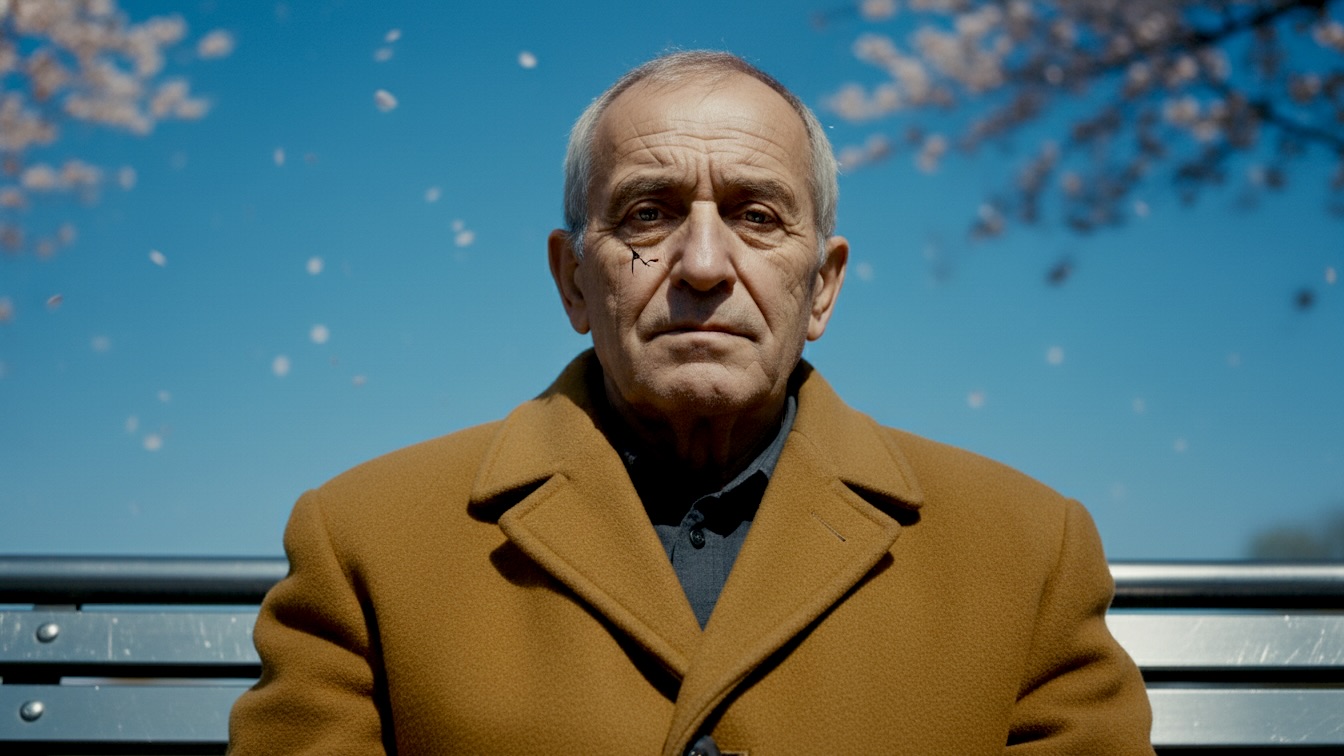
Format: Short Film / Anthology Episode | Est. Length: 10-12 minutes
Asphalt Mirror serves as a standalone entry in a speculative anthology series titled The Glitch Horizon, which explores a world where the fundamental laws of physics have begun to degrade due to an unknown, systemic decay. Each episode focuses on different characters navigating localized anomalies, suggesting a global phenomenon where reality is becoming increasingly dependent on human perception and intent. The series arc investigates whether this "Bright Glitch" is a natural entropy, a technological failure, or a transition into a new state of existence.
Leo and Elena sit on a park bench as the asphalt beneath them ripples like a disturbed pond, signaling a world that is literally losing its structural integrity. As Leo observes a pigeon sliding across the unstable surface, he realizes that the environment is no longer fixed, but responsive to the presence of observers.
In a world where reality is fraying and physics responds to human movement, an elderly couple must decide whether to cling to the memories of a stable past or embrace the unpredictable nature of a shifting present. Their journey across a glitching city becomes a final test of their bond and their willingness to define their own reality.
The primary theme is the intersection of aging and entropy, drawing a parallel between the physical decline of the human body and the degradation of the world’s "rendering." It explores the philosophical concept of solipsism—the idea that the world only exists as we perceive it—and how shared experience, like a long-term marriage, provides a necessary anchor in an increasingly chaotic environment.
The secondary theme is the power of narrative and belief. By treating the world as a system that "favors the traveler," the protagonists reclaim agency in a landscape that has become indifferent or broken. It is a meditation on how we choose to interpret our surroundings when the objective truth of the world is no longer reliable.
The stakes are both existential and intimate: if Leo and Elena stop moving or lose their shared focus, they risk being "reclaimed" by the environment, effectively fading into the background of a world that no longer maintains their existence. On a deeper level, the risk is the loss of their shared history; if the world stops remembering the way things were, the couple’s memories may become the only proof that a stable, logical reality ever existed.
The external conflict is the "Bright Glitch," a hostile or indifferent environmental instability that threatens to dissolve the characters’ surroundings into nonsensical geometry. The internal conflict centers on Leo’s paralyzing nostalgia and his fear of the "unrendered" future, which clashes with Elena’s pragmatic, forward-moving acceptance of their new, fluid reality.
Leo and Elena navigate a park where gravity and physics are failing, manifesting as upward-falling cherry blossoms and stationary joggers. While Leo fixates on the "glitch" as a sign of a dying, tired world, Elena insists on maintaining their daily routine, using their shared confidence to stabilize the path ahead of them.
As they walk toward a bakery, the city rearranges itself into impossible configurations, forcing them to confront the instability of their environment. The episode culminates in a quiet moment of reflection in a plaza that shifts based on their stillness, leading them to accept that while the world is broken, their connection remains the only constant worth preserving.
Leo is a man defined by his memories and his resistance to change, struggling with the physical limitations of his age and the existential dread of a world that no longer follows the rules he once understood. His arc moves from a state of melancholic observation and fear to a tentative acceptance of the "glitch" as a new, albeit strange, frontier.
Elena is the pragmatic anchor of the relationship, possessing a grounded resilience that allows her to manipulate the shifting reality through sheer force of will and habit. Her arc is one of steady endurance; she begins the episode as a protector of their routine and ends it as a guide, leading Leo toward a future that she refuses to fear.
The opening scene establishes the atmospheric tension as Leo and Elena sit on a bench, contrasting their physical frailty with the bizarre, rippling asphalt of the park. The tension peaks when they observe a jogger frozen in place, highlighting the danger of failing to "travel" through the glitching landscape.
The midpoint occurs as they walk toward the bakery, with the environment reacting to their movement by stabilizing, proving that their presence dictates the world's structure. This transition shifts the mood from apprehension to a sense of empowered discovery, as they realize they are not victims of the glitch, but participants in it.
The climax takes place in the plaza, where the couple stops to eat, causing the world to settle into a quiet, temporary normalcy. The final scene features the couple watching the sky as the stars appear as glowing triangles, marking their final acceptance of the new, alien reality and their decision to keep moving together.
The episode begins with a mood of cold, melancholic detachment, mirroring the "metal-cold" bench and the fractured, pixelated sun. As the couple begins to move, the mood shifts into a surreal, dreamlike wonder, characterized by the bioluminescent fountains and impossible architecture. The final act settles into a warm, poignant intimacy, leaving the audience with a sense of quiet hope despite the underlying existential uncertainty.
If expanded, the season would follow Leo and Elena’s journey toward the "coast," a destination that may no longer exist, serving as a metaphor for the search for a permanent, stable reality. Each episode would introduce new, increasingly complex anomalies, forcing the characters to adapt their understanding of what it means to be "real" in a world that is constantly rewriting its own source code.
The season-long arc would explore the mystery of the Glitch—whether it is a natural evolution, a simulation reaching its end-of-life, or a collective hallucination. As the characters travel, they would encounter others who have found ways to "exploit" the glitch, leading to a climax where the protagonists must decide whether to save the old world or fully embrace the chaotic potential of the new one.
The visual style is "High-Definition Surrealism," utilizing sharp, vibrant colors and crisp, clean lines to make the world look like a high-end, yet slightly incorrect, digital rendering. The tone is akin to a blend of The Leftovers and Eternal Sunshine of the Spotless Mind, balancing grounded, intimate human drama with unsettling, high-concept science fiction elements.
Cinematically, the film will employ subtle, unnatural camera movements and lighting shifts to emphasize the "glitch" without relying heavily on overt CGI. The goal is to make the audience feel the same unease as the characters, where the beauty of the impossible—like the upward-falling blossoms—is always tempered by the underlying sense of structural decay.
The target audience consists of adults aged 30-65 who enjoy thoughtful, character-driven science fiction and existential dramas. It is designed for viewers who appreciate slow-burn narratives and philosophical inquiries into the nature of reality, memory, and the endurance of love in the face of overwhelming change.
The pacing is deliberate and rhythmic, mimicking the slow, measured walk of an elderly couple, which accelerates only when the world shifts around them. The 10-12 minute runtime utilizes a three-act structure where the first act establishes the rules of the world, the second act tests those rules through movement, and the third act provides a moment of stillness and thematic resolution.
The production should prioritize practical effects where possible, using forced perspective and lighting tricks to create the "glitch" effects, such as the rippling asphalt or the square sun. The use of color grading is essential to differentiate between the "stable" moments and the "glitched" environments, with the latter utilizing a slightly oversaturated, hyper-vivid palette to emphasize the "high-definition lie" of the world.
Sound design is a critical component, requiring a distinct contrast between the "old noise" of the city—a warm, nostalgic hum—and the sharp, metallic, or digital sounds that accompany the anomalies. The silence of the world when the characters are stationary should be palpable, creating a tension that forces the audience to crave the movement of the protagonists.


