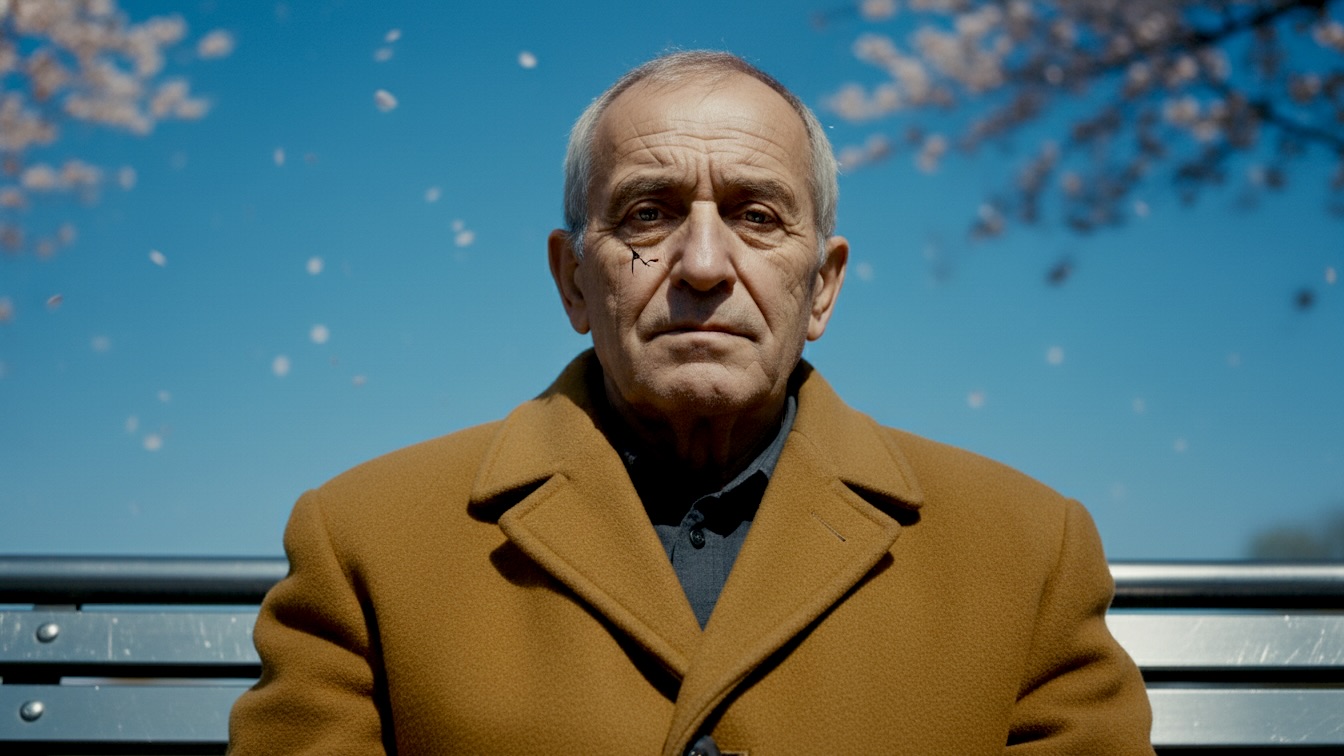
In a world undergoing a surreal structural degradation known as the Bright Glitch, an elderly couple named Leo and Elena navigate their surroundings with a mixture of weary acceptance and quiet defiance. The physical laws of their environment have become fluid, dependent on the movement and intent of the observer, turning the mundane act of walking into a negotiation with reality itself. After a brief period of stagnation on a park bench, the pair decides to travel to a local bakery, an action that forces the environment to stabilize and manifest around them. Their journey highlights the tension between the loss of objective reality and the persistence of human connection, concluding with a moment of shared wonder as they observe the celestial geometry of a transformed night sky.
The central theme of the narrative is the erosion of objective truth in the face of aging and existential decay. By framing the world’s instability as a resource management issue or a glitch, the author suggests that reality is a shared construct that requires active human participation to maintain its coherence. The road, which favors the traveler, serves as a powerful metaphor for agency; existence only solidifies when one moves forward with purpose. This reflects a poignant commentary on the human condition, where the elderly often feel as though the world is losing its grip on the details because their own internal sense of order is being challenged by the passage of time.
Furthermore, the story explores the dichotomy between poetic interpretation and pragmatic survival. Leo views the world through a lens of existential dread and metaphorical significance, searching for meaning in the glitches, while Elena represents a grounding, pragmatic force that insists on the continuity of daily life. Their relationship demonstrates that while the world may be "breaking" or losing its fundamental structure, the rituals of intimacy—sharing bread, holding hands, and walking together—act as an anchor. The transition from a chaotic, pixelated world to a stable one when they commit to a destination suggests that love and companionship are the ultimate tools for rendering a coherent reality.
Leo functions as the philosophical witness of the narrative, a man deeply burdened by the weight of memory and the awareness of his own physical decline. He views the world’s transition into a glitchy, unpredictable landscape as a mirror of his own aging process, perceiving a shared exhaustion between the universe and his own body. His preoccupation with the "road" and the laws of physics indicates a desire to impose logic upon a world that has become fundamentally irrational. Throughout the story, he struggles with a sense of alienation, constantly analyzing the "errors" in his environment while simultaneously craving the stability of the past.
His internal conflict stems from the realization that he is merely a spectator in a world that is losing its substance. While he possesses a poetic sensibility, he is prone to melancholy, often feeling that the background noise of existence has faded into a haunting silence. However, his reliance on Elena reveals a deep-seated need for connection to stave off this existential isolation. By the end of the chapter, Leo begins to accept the beauty of the broken world, finding a tentative peace in the idea that he and Elena are "exploiters" who define their own path through a dissolving reality.
Elena is a character defined by her resilient pragmatism and her refusal to be cowed by the dissolution of her environment. She serves as the primary catalyst for movement, effectively dragging Leo out of his paralysis and forcing the world to acknowledge their presence. Her focus on the mundane—the orange, the price of milk, the sourdough bread—is not an act of ignorance, but a deliberate strategy to maintain a sense of normalcy. She understands that if she stops moving or stops caring about the small details of life, the world will cease to support her.
Her relationship with Leo is one of protective affection, as she balances his tendency toward existential spiraling with firm, grounding commands. She does not deny the reality of the glitches; rather, she chooses to integrate them into her life without letting them dictate her emotional state. Elena possesses a quiet confidence that acts as a beacon for the environment, causing the world to flatten and stabilize beneath her feet. She is the anchor in the relationship, proving that even as the world changes its mind, she remains steadfast in her commitment to the journey.
The author utilizes a tone that is both melancholic and strangely whimsical, capturing the surreal atmosphere of a world that is literally coming apart at the seams. The prose is rich with sensory details, such as the sharpness of the orange, the metallic scent in the air, and the tactile reality of the rough bread. These visceral descriptions contrast sharply with the pixelated, square sun and the upward-falling petals, heightening the reader's sense of disorientation. The narrative voice is intimate and conversational, allowing the reader to feel the rhythm of Leo and Elena’s partnership as they traverse their shifting landscape.
Pacing is expertly managed, moving from the static, contemplative moments on the bench to the more active, transformative sequences on the street. The author uses the physical environment as a narrative device; when the characters are still, the world becomes strange or absent, but when they are in motion, the narrative gains momentum and clarity. This structural choice reinforces the theme that existence is an active, ongoing process. The dialogue is snappy and grounded, providing a necessary counterweight to the more abstract descriptions of the "Bright Glitch," ensuring that the human element remains at the forefront of the story.


