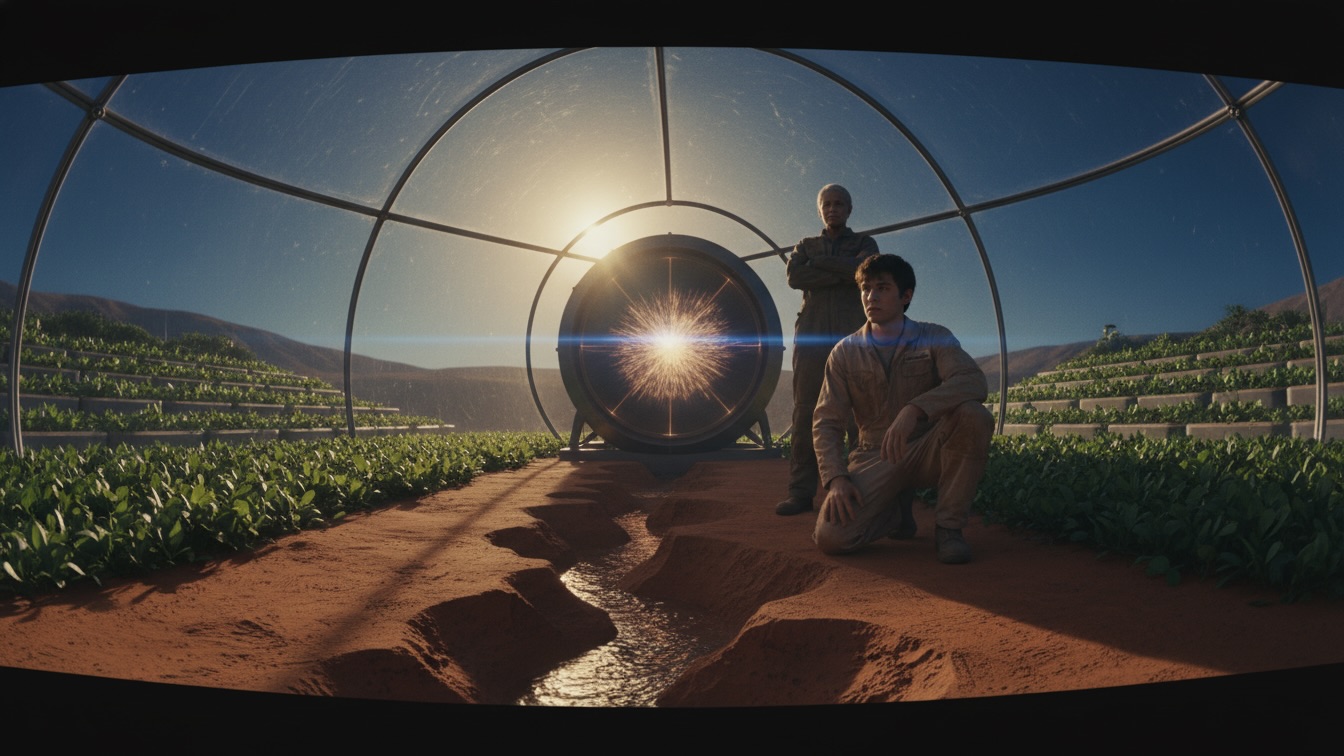
A trickle of waste water carves a path through Martian dust, sparking a fight over the planet's actual future.
The air in Dome 4 always smelled like burnt wires and recycled sweat. Hank knelt in the orange grit, his knees clicking. The synthetic dust wasn't like Earth dirt. It didn't have that damp, organic weight. It was jagged, volcanic, and thirsty. It got into the seams of his suit and stayed there, grinding against his skin until he felt like he was being sanded down from the inside out. He didn't mind today. Today, there was a sound that didn't belong in a pressurized bubble on a dead rock. It was a rhythmic, wet patter.
He traced the sound to the base of Heat Exchanger 7. A seal had failed. It wasn't a catastrophic blowout, just a steady drip. A bead of coolant-saturated water hit the dust, sat there for a second like a silver marble, and then soaked in. Hank watched it. His pulse was a dull thud in his ears. He reached out with a gloved finger and poked the damp spot. It felt cold even through the reinforced fabric.
"Don't touch that. You'll get a rash or a fine. Probably both," a voice said.
Hank didn't look up. He knew the heavy, metallic stomp of Tara’s boots. She was the lead thermal tech, a woman who looked like she’d been carved out of a canyon wall and then left in the sun to dry. She was thirty-two, but on Mars, that was ancient. Her face was a map of stress lines and bad coffee. She stood over him, her shadow blocking the pale, filtered light of the Martian spring. Outside the polymer skin of the dome, the sun was a weak, white dot, but inside, the heaters were cranking to simulate a growing season that didn't exist yet.
"It’s just water, Tara," Hank said. He used a small plastic trowel to dig a shallow trench. "Well, mostly water. It’s the seasonal melt-off from the external collectors. The seals are sweating."
"The seals are failing because the pressure fluctuates every time the sun hits the panels," Tara snapped. She pulled a handheld diagnostic tool from her belt. The screen was cracked in the corner, a jagged spiderweb over the scrolling green data. "I’ve been telling Maintenance for three cycles. They don't care. They’re too busy fixing the air scrubbers in the VIP sectors. Leave it alone. I’ll patch it when the pressure drops."
Hank ignored her. He was busy. He carved a tiny, winding path through the dust, leading away from the exchanger. He built a small mound, a miniature dam, to pool the liquid before letting it spill into his makeshift canal. "Look at it. It’s actually flowing."
"It’s a leak, Hank. Not a river. You’re wasting oxygen standing here playing in the mud," Tara said. She leaned against the vibrating metal casing of the exchanger. Her eyes were tired. "You think this is some kind of sign? It’s physics. High pressure to low pressure. Gravity pulls liquid down. There’s no poetry in a broken gasket."
"I’m not looking for poetry," Hank muttered. He smoothed the edges of his canal. The water started to follow the groove, a dark, wet thread against the rust-colored ground. "I’m looking for a hard-launch. If we can’t get the water to move where we want it here, in a controlled environment, how are we ever going to do it out there?"
He pointed toward the transparent section of the dome. Beyond the thick layers of lead-glass and polymer, the Martian landscape stretched out—a violent, beautiful mess of red craters and frozen carbon dioxide. The Valles Marineris was out there, miles away, a scar on the planet's face.
"Out there is a vacuum that will boil your blood if you so much as sneeze wrong," Tara said. She tapped her tool against her thigh. "We aren't terraforming. We’re gardening in a graveyard. This whole 'spring' project is just for the shareholders back on Earth. They want to see green on the livestreams so they keep sending the checks. It’s a marketing campaign, not an ecosystem."
Hank felt a familiar heat rise in his chest. It wasn't anger, exactly. It was more like a stubborn vibration. "Then why are you still here? If it’s all a lie, why do you spend twelve hours a day keeping the heat at sixty-eight degrees?"
Tara went quiet. The only sound was the hum of the turbines and the soft, wet gurgle of Hank’s tiny river. "Because I like the paycheck. And I like not being dead."
"Liar," Hank said. He watched the water reach a fork in his trench. He’d built a small delta. The liquid slowed, spreading out, soaking into the dust in a way that looked strangely familiar. He leaned in closer, his nose almost touching the grit. "Tara. Look."
"I’m looking at a mess I have to clean up."
"No, look at the pattern. I didn't carve it this way. The water... it’s choosing this path."
Tara groaned but knelt beside him. Her joints popped. She peered at the damp tracks in the dust. The water had bypassed his main canal and carved a sharp, narrow gorge through a patch of packed sediment. It branched out into three distinct channels, then merged again before hitting a small rock.
She went still. Her breathing changed. "That’s... that shouldn't happen. The slope is too shallow for that kind of velocity."
"It’s a replica," Hank whispered. He pulled up a map on his wrist-link. He projected a hologram of the Valles Marineris over the dust. The blue light of the map hovered over the wet orange grit. The lines matched perfectly. The tiny leak had carved a geological mirror of the largest canyon system in the solar system. "It’s doing it again. The planet remembers how to be a planet."
"It’s a coincidence," Tara said, but her voice lacked its usual bite. She reached out, her gloved thumb tracing the tiny canyon. "Fluids follow the path of least resistance. The dust has a specific grain. It’s just math, Hank."
"It’s a hard-launch," Hank insisted. "The water knows where to go because the ground is already shaped for it. We don't have to build a new world. We just have to wake up the old one."
Tara looked at him. Really looked at him. Her eyes were bloodshot from the lack of real sleep, but there was a spark there, something small and sharp. "You’re twenty-one. You’ve never even seen a real river. You grew up in a hab-unit in sector seven. Why do you care so much?"
Hank stood up, wiping his hands on his thighs. "Because I’m tired of everything being 'simulated.' I want something that happens because it wants to happen, not because a computer told a valve to open. Even if it’s just a leak. Even if it only lasts an hour."
The sun began to dip below the horizon, the light shifting from a pale yellow to a bruised, dusty purple. On Mars, the sunset was blue—a weird, inverted ghost of an Earth evening. As the temperature outside plummeted, the heaters in the dome groaned, struggling to keep up. The drip from the heat exchanger slowed. The rhythmic patter became a hesitant tick.
"The pressure is dropping," Tara said. She stood up and adjusted her belt. "The ice is refreezing in the lines. The show’s over."
Hank watched his tiny river. The edges were already turning white with frost. The dark, wet earth was hardening, the flow stopping mid-track. In a few minutes, it would be nothing but a stain in the dust.
"It’ll be gone by morning," Tara said. She started to walk away, her boots clanging on the metal floor. She stopped after a few paces and looked back. Hank was still staring at the frozen delta. "Hey. Apprentice."
Hank looked up. "Yeah?"
"Don't forget to log your hours. Maintenance will be here at 0600 to swap that seal. If they see your 'river,' they’ll report you for tampering with the infrastructure."
"I know," Hank said.
Tara disappeared into the shadows of the turbine hall. Hank stayed for a long time, watching the blue light of the sunset fade into the black of the Martian night. He felt the cold seeping through his boots. He reached down one last time and touched the frozen stream. It was solid. Unmoving.
He didn't see Tara come back. She moved quietly when she wanted to. She didn't approach him. Instead, she stood by the control console fifty feet away. She pulled out her private tablet, the one not linked to the colony’s main server. She opened a mapping application and dropped a high-precision GPS pin on the exact coordinates of Heat Exchanger 7.
She typed a short note into the metadata: Sub-surface flow pattern detected. Potential site for biological seeding, Phase 2. Do not clear dust. Move the planting cycle up to April.
Hank stood up and began to walk toward the barracks, his head down, shoulders slumped. He thought he had lost the argument. He thought the spark was gone. He didn't see Tara watching him, her face illuminated by the soft glow of the tablet. She waited until he was gone, then she walked over to the tiny, frozen river.
She looked at the miniature Valles Marineris, carved by a mistake. She took a small, clear canister from her pocket—a sample of experimental moss spores she wasn't supposed to have. She didn't plant them. Not yet. The ground was too cold. But she knelt down and placed the canister right at the head of the stream, burying it just deep enough that the morning maintenance crew wouldn't see it.
"Physics," she whispered to the empty dome. "But maybe a little bit of luck."
The wind howled against the polymer skin of the dome, a high, lonely whistle that sounded like someone trying to breathe through a closed throat. Hank lay in his bunk, staring at the ceiling, thinking about the water. He didn't know about the spores. He didn't know about the pin on the map. He just knew that for a second, the dust had been wet, and it had moved like it was alive.
He closed his eyes, the image of the blue sunset burned into his retinas. Tomorrow, he would wake up, eat his synthetic protein, and fix another broken machine. But he would keep his trowel in his pocket. Just in case.
Deep in the pipes of Heat Exchanger 7, a final, stubborn drop of water trembled against the metal, caught between the warmth of the machine and the killing cold of the night, waiting for the sun to rise and turn the ice back into a choice.
“As the morning light hit the sensors, the heat exchanger didn't just drip; the entire base plate began to buckle under a pressure that shouldn't exist.”


