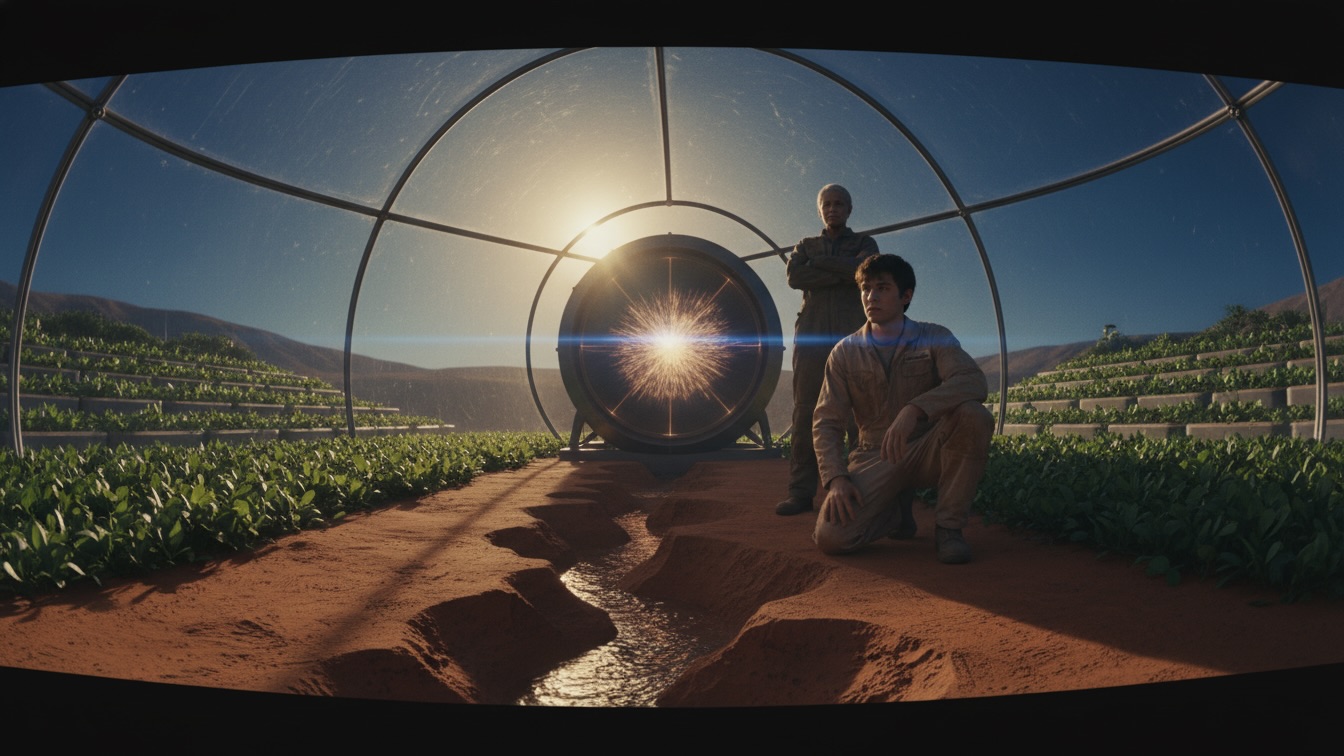
The narrative unfolds within the claustrophobic and abrasive environment of Dome 4 on Mars, where Hank, a young apprentice, discovers a minor leak in a heat exchanger. Rather than reporting the malfunction immediately, he becomes captivated by the way the coolant-saturated water interacts with the synthetic Martian dust. He begins to manipulate the flow, carving a miniature river system that eventually mirrors the gargantuan Valles Marineris canyon system. This act of "playing in the mud" serves as a catalyst for a philosophical confrontation with his superior, Tara, the lead thermal tech.
Tara initially dismisses Hank’s fascination as youthful naivety, framing their work as a cynical marketing ploy designed to appease Earth-bound shareholders rather than a genuine effort to revive the planet. She argues that the environment is a graveyard and their efforts are merely decorative gardening. However, Hank remains steadfast in his belief that the planet possesses a latent memory of its former self, arguing that the water is "choosing" its path rather than simply following the laws of physics. His insistence on finding something "real" amidst the simulations of their daily lives creates a palpable tension between the two characters.
As the Martian sun sets in its characteristic blue hue and the temperature drops, the leak freezes, and the brief moment of "life" in the dust appears to end. Tara orders Hank to return to his quarters and warns him that maintenance will soon erase his work. However, the story concludes with a psychological reversal. Once alone, Tara privately validates Hank’s discovery by marking the site for future biological seeding and planting experimental moss spores. The chapter ends on a note of quiet, clandestine hope, suggesting that both characters are driven by a desire to see the planet wake up, despite their differing outward expressions of that hope.
The central theme of the story revolves around the tension between artificiality and authenticity. In the controlled environment of the dome, every sensory experience is recycled or simulated, from the "burnt wires and recycled sweat" smell to the heaters mimicking a non-existent spring. Hank’s obsession with the leak represents a psychological hunger for a "hard-launch"—a term he uses to describe an event that occurs because it "wants to happen" rather than because a computer commanded it. This reflects a deeper human need to connect with an autonomous, living world that exists outside of human engineering.
Another prominent theme is the persistence of nature and planetary memory. Hank suggests that the planet "remembers how to be a planet," implying that the geological structures of Mars are not just dead rock but blueprints waiting for the right catalyst. The fact that the water carves a perfect replica of the Valles Marineris suggests that the laws of nature are inherently creative and self-organizing. This theme challenges the cynical view of Mars as a "graveyard," proposing instead that it is in a state of suspended animation, capable of reclaiming its identity if given the opportunity.
The narrative also explores the conflict between corporate pragmatism and individual idealism. Tara’s perspective highlights the grim reality of space colonization, where survival is a commodity and "green" is a marketing term used to secure funding. This creates a psychological barrier for the workers, who must reconcile their daily drudgery with the grand, often hollow, promises of terraforming. However, the ending suggests that even the most hardened pragmatists harbor a secret idealism. Tara’s clandestine planting of the moss spores indicates that the human spirit cannot entirely abandon the hope of creation, even when faced with the crushing weight of corporate bureaucracy and a hostile vacuum.
Hank represents the archetype of the idealistic youth who refuses to be desensitized by a harsh, mechanical environment. Psychologically, he is driven by a profound sense of alienation from the "simulated" world he was born into. Having grown up in a habitat unit, his sensory palette is limited to the synthetic, which makes the "wet patter" of the leak an almost spiritual experience for him. He is not merely an apprentice technician; he is a seeker of truth who uses his trowel to uncover the hidden potential of the world around him.
His stubbornness is not a sign of immaturity but a defense mechanism against the soul-crushing cynicism of his surroundings. When he feels the "vibration" in his chest during his argument with Tara, it signifies a visceral rejection of the idea that his life is merely a part of a marketing campaign. He requires the planet to be alive so that his own existence can feel meaningful. By carving the canal, he is attempting to co-create with the planet, seeking a partnership with the land rather than total dominance over it.
Tara serves as the psychological foil to Hank, embodying the weariness and defensive cynicism of the older generation. Her physical description—carved like a canyon wall and weathered by stress—suggests that she has been assimilated by the harsh Martian environment. She uses her technical knowledge and sharp tongue to distance herself from the emotional pain of failure. To her, a leak is just physics because admitting it could be something more would make the daily struggle for survival even more difficult to bear.
However, her internal state is far more complex than her outward persona suggests. Her silence when Hank calls her a "liar" reveals a crack in her armor, indicating that she still cares deeply about the mission’s success. Her secret actions at the end of the chapter demonstrate a sophisticated psychological compartmentalization. She maintains her authority and professional standing by dismissing Hank, yet she acts on his discovery in private. This suggests that she sees herself as a protector of the "spark" of life, performing the necessary but unglamorous work of ensuring that Hank’s idealism has a place to take root.
The author utilizes a gritty, tactile prose style that emphasizes the physical discomfort of the Martian environment. Sensory details such as the "jagged, volcanic, and thirsty" dust and the "metallic stomp" of boots create a sense of immersion in a world that is fundamentally hostile to human life. This focus on the "sanding down" of the protagonist’s skin serves as a metaphor for the psychological erosion experienced by the colonists. The contrast between the "silver marble" of the water and the "orange grit" highlights the preciousness and fragility of liquid in this setting.
Pacing in the chapter is deliberate and localized, mirroring the slow and methodical nature of terraforming itself. The narrative stays tightly focused on the small patch of dust and the heat exchanger, creating a sense of intimacy within the vast, cold dome. This micro-focus allows the dialogue between Hank and Tara to carry more weight, as every word spoken is framed by the rhythmic hum of the machinery. The shift from the technical jargon of "pressure fluctuations" to the poetic imagery of the "blue sunset" signals a transition from the mundane to the profound.
The tone of the story is one of restrained melancholy undercut by a hidden current of hope. The description of the sunset as a "weird, inverted ghost of an Earth evening" evokes a sense of loss and longing for a home that most characters have never known. However, the final image of the "stubborn drop of water" waiting for the sun to rise provides a powerful symbolic resolution. The use of the word "choice" in the final sentence elevates the physical process of melting into a moral or existential act, suggesting that even in a world governed by harsh physics, there is still room for agency and transformation.


