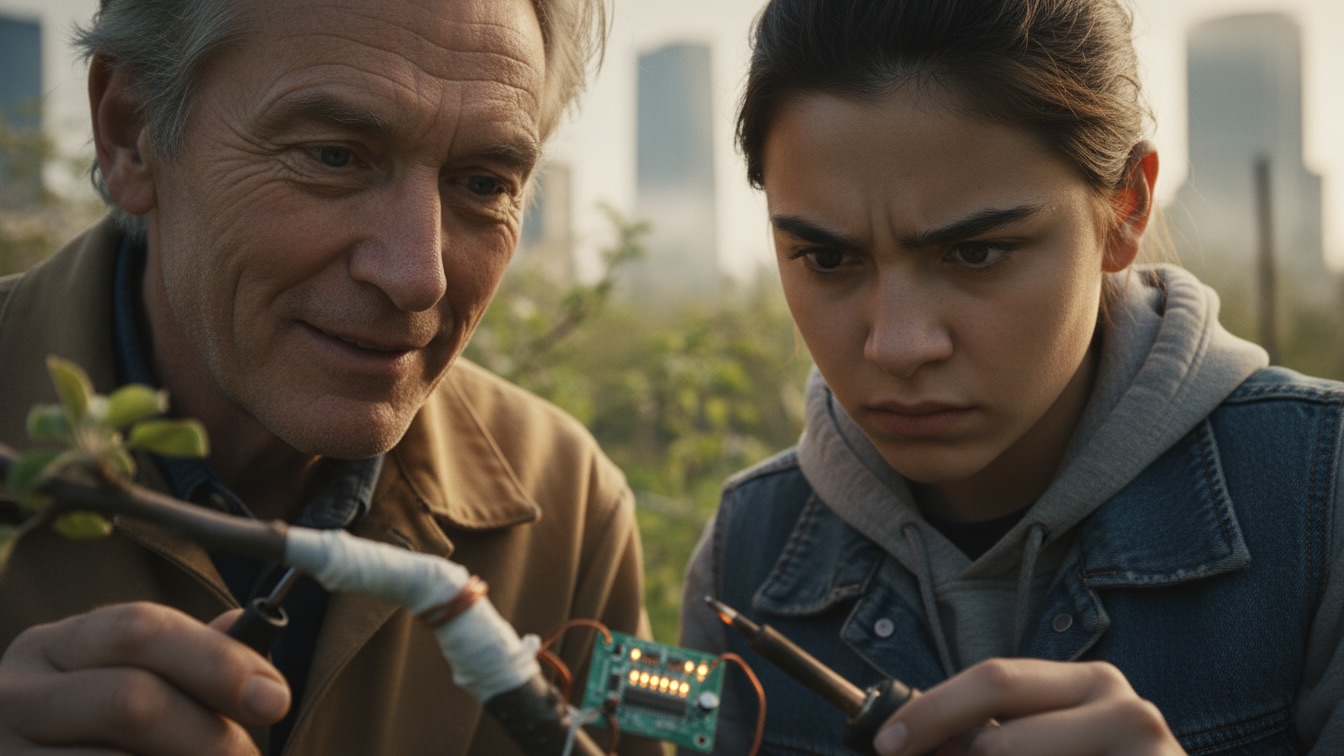
A retired coder and a glitching teen use scrap metal and grafting tape to fight a killing frost.
The silence in my apartment has a frequency. It is a high-pitched hum that eats at the corners of my vision. I used to think retirement would be a clean compile—no bugs, no crashes, just a smooth run until the end of the program. I was wrong. It is just empty space. My calendar is a desert. No Slack notifications. No emergency deployments. Just the ticking of a clock that sounds like a hammer hitting a nail. I am sixty-five and I am obsolete. My hands, once capable of weaving complex logic into the fabric of the internet, now just hold lukewarm coffee. I am a legacy system running in a world that has moved to a new architecture. I need a reason to boot up in the morning. I need to be more than a ghost in my own living room.
The Sky-Root Collective is a patch of dirt and hope wedged between two glass towers. It is Spring, but the air still has a bite that reminds you the world doesn't care if you're cold. I walked in today with a bag of rusted tools and a sense of profound displacement. The dirt is dark, smelling of rot and potential. It’s the only place in the city where time doesn't feel like it’s being streamed at 2x speed. Here, things take as long as they take. You cannot optimize a carrot. You cannot patch a dying sapling with a hotfix. It is stubbornly, beautifully slow.
Linda met me at the gate. She is the kind of person who looks like she’s made of sun-dried leather and iron wire. She pointed to a corner near the north wall. "That's your sector, Pete. The apple trees are struggling. They need someone with patience. Most people here just want to plant radishes and see a result in twenty days. These trees? They require a long-term investment."
"I have nothing but time, Linda," I said. My voice sounded rusty to my own ears. "Time is the only currency I haven't spent yet."
"Then you shall be their guardian," she replied, her tone shifting into that theatrical gravity everyone in the collective seems to adopt. "Protect them from the lingering ghost of winter."
That’s when I saw the kid. He was sitting on a plastic crate, his face illuminated by the harsh blue glare of a handheld terminal. He looked like he was vibrating. His fingers moved with a frantic, twitchy energy that I recognized—the muscle memory of a digital native drowning in a sea of data. He wore a heavy hoodie despite the rising sun, hiding himself in the shadows of the fabric.
"That’s Jae," Linda whispered. "High-performance brain, low-bandwidth nervous system. He’s here on a wellness mandate. Too much screen, not enough soul."
I approached him. The ground crunched under my boots. He didn't look up until I was two feet away. His eyes were bloodshot, darting across the screen. "The latency is unbearable," he muttered. "The local mesh is dragging. It’s like trying to breathe through a straw."
"Perhaps the air out here is more efficient," I said. I tried to make it sound like a joke, but it came out flat.
Jae looked at me then. Truly looked at me. "You’re Pete. The one who worked on the old backbone protocols. My father mentioned you. He said you were a god of the monolithic era."
"A god of a forgotten religion," I replied. "Now, I just move dirt. What are you doing with that terminal?"
"I am attempting to secure a node on the new decentralized web," Jae said, his voice rising in a theatrical cadence. "But the architecture is a riddle, and my mind is a shattered mirror. I cannot focus. The anxiety is a DDoS attack on my frontal lobe."
"I can help you with the protocol," I said, sitting on a nearby stump. "I know the logic of the old ways. The new ones aren't so different; they just have more layers of abstraction. But in exchange, you have to help me with these trees. I need a pair of steady hands for the grafting. My fingers... they don't do the fine work anymore."
Jae looked at the trees, then back at his screen. "A trade of ancient wisdom for modern navigation. A pact is formed. Teach me the art of the branch, and I shall grant you entry into the hidden layers of the mesh."
We spent the next three days in a strange rhythm. I showed him how to cut the scion wood—sharp, clean angles that exposed the green life underneath. I taught him about the cambium layer, the thin ribbon of cells that carries the tree's soul. "Match the green to the green," I told him. "If they don't touch, the connection fails. It’s just like a handshake protocol. If the timing is off, the data drops."
Jae was a natural. His anxiety seemed to bleed out into the soil. When he held the grafting knife, his hands stopped shaking. He treated the trees like delicate hardware. "Behold," he would say, holding up a perfectly joined branch. "The union of two separate entities. A biological bridge. It is... satisfying."
In the afternoons, he opened his terminal. He showed me the decentralized web. It was a mess of peer-to-peer nodes and encrypted shards. It was beautiful. We sat there, a retired engineer and a hyper-connected teen, debugging a world that felt increasingly broken. We were building something. Not just trees, and not just code.
Then the weather report changed.
A cold front was screaming down from the north. A late frost. In Spring, a frost is an executioner. The trees had just started to bud. If the temperature dropped below freezing, the grafts would die. The sap would freeze and shatter the delicate cell walls we had just spent days aligning.
"The forecast is grim," Jae said, his voice trembling. "A literal blue screen of death for our orchard. We cannot let the frost claim them. I have invested too much of my remaining sanity into these branches."
"We need heat," I said. The old engineer in me started spinning up. I looked at the pile of e-waste in the collective’s shed—old servers, discarded tablets, lithium batteries that no longer held a full charge. "And we need control. We can't just light fires; we'll scorch the roots."
"We shall build a sanctuary!" Jae shouted, his theatricality returning with a desperate edge. "We will weave a web of warmth from the corpses of the old world!"
We worked through the night. The urgency was a physical weight in my chest. We stripped the heating elements from old coffee makers and the thermal pads from dead laptops. We used the decentralized mesh Jae had been working on to create a sensor network. Every tree got a small heater and a temperature probe, all controlled by a central hub made from a salvaged tablet.
"The code is live!" Jae yelled over the wind. The temperature was plummeting. The ground was hardening. We were out there with soldering irons and electrical tape, fighting the atmosphere. My back ached. My eyes stung. But I felt more alive than I had in a decade.
"Monitor the draw!" I commanded. "If the batteries fail, we lose the sector!"
"I am rerouting power from the secondary cells!" Jae replied, his fingers flying across the terminal. "The mesh is holding! The trees are at a stable five degrees Celsius! We are defying the heavens, Pete!"
We stood in the middle of the garden as the frost settled on everything else. The glass towers around us turned white. The grass became brittle. But our little patch was steaming. The heaters hummed—a low, mechanical purr that countered the silence of the city. We stayed up until the sun broke the horizon.
As the light hit the trees, the frost began to melt. The buds were intact. The grafts were holding. The trees were alive.
Jae collapsed onto his crate, his terminal finally dark. He looked exhausted, but the frantic vibration in his limbs was gone. He looked at peace.
"We did it," I said. I sat down next to him. My body felt like it was made of lead, but my mind was clear.
"You taught me how to connect," Jae said softly. He wasn't being theatrical now. He was just a kid. "Not to a server. To something real. To the dirt. To you."
"And you taught me that my skills aren't obsolete," I said. "They just needed a new application. Spring isn't a season, Jae. It’s a choice. It’s when you decide to put your time into something that will grow after you're gone."
We sat there for a long time, watching the sun warm the apple trees. The blossoms were starting to peek through. Small, stubborn sparks of white and pink against the gray city.
I looked at my hands. They were covered in dirt and solder. They were steady.
But as I looked past the garden gate, I saw a black sedan idling by the curb. A man in a sharp suit was watching us, a tablet in his hand that glowed with a familiar, cold light. The city doesn't like it when you build your own grid. The world doesn't like it when you find a way to step out of the stream.
“The man in the sedan closed his tablet, and for the first time since the frost, I felt a chill that no heater could touch.”


