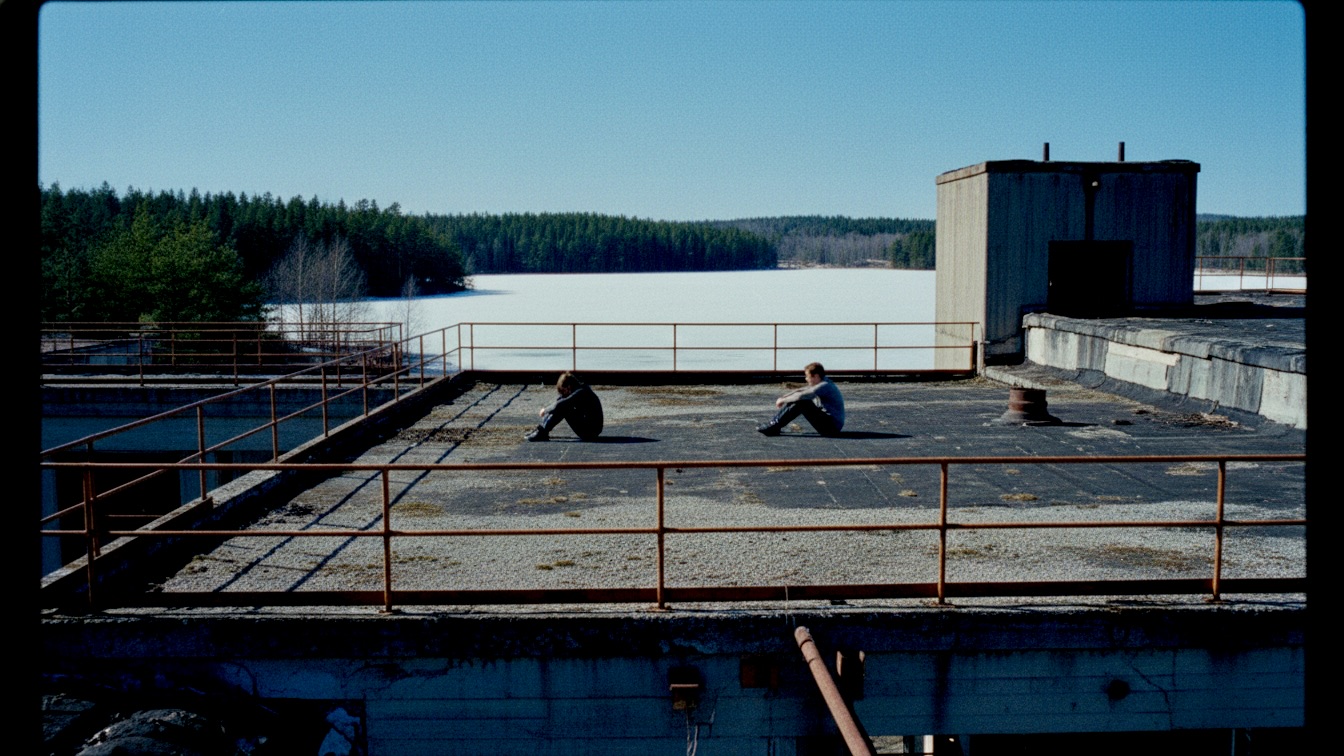
The lake looked like dirty glass, full of rotting ice and the heavy silence of a dead town.
The chainlink fence was missing its padlock. It had been missing for three years, ever since the liquidation company came through and decided the scrap metal wasn't even worth the fuel to haul it south. I pushed the gate open. The hinges screamed. It was a sharp, ugly sound that cut through the damp spring air, but nobody was around to hear it. The parking lot was a massive expanse of cracked asphalt, pushing up tufts of dead, yellow grass. It used to be full of Ford F-150s and Dodge Rams, hundreds of them, parked shoulder to shoulder across three different shifts. Now, it was just empty space. You could feel the absence of the cars. You could feel the absence of the low, vibrating hum of the digester that used to rattle the windows of every house in a five-mile radius. The mill was dead. The town was just waiting for the obituary to clear the papers.
Will walked ahead of me, his boots crunching on the broken glass that littered the loading bay. He was wearing the same Carhartt jacket he had worn since tenth grade. The canvas was frayed at the cuffs, stained with motor oil and God knows what else. He didn't look back to see if I was following. He just kicked a crushed beer can out of his way and headed for the exterior fire escape. The metal stairs clung to the side of the main boiler building like a rusted spine.
"Watch the fourth step," Will said, his voice flat. "The grate is rusted through. You'll snap your ankle."
"I know," I said. "We've been up here a hundred times, Will."
"Just saying," he muttered.
I grabbed the handrail. The iron was freezing. It was late April, but spring up here in Northwestern Ontario was just a technicality. It didn't mean flowers and sunshine. It meant mud. It meant the snow turned gray and granular, melting into slush that soaked through your socks and ruined the floorboards of your car. The air smelled like wet pine needles, thawing dirt, and the faint, lingering chemical ghost of sulfur. The mill hadn't bleached paper in four years, but the smell was baked into the concrete. It was baked into our clothes, into the drywall of our houses.
We climbed. The wind picked up the higher we got, whipping off the lake and biting at my exposed cheeks. My lungs burned. The cognitive static in my brain was deafening. Every step up the rusted metal stairs felt like a countdown. I had my phone in my right pocket. The battery was at fourteen percent. The screen was cracked in the top left corner, a spiderweb of shattered glass that obscured the time. But I didn't need to check the time. I needed to check the email. I had read it thirty times since I woke up. Congratulations. The Faculty of Arts and Science is pleased to offer you admission to the University of Toronto for the upcoming fall semester.
It was a digital ghost haunting my pocket. A ticket out. A betrayal.
We reached the roof of the digester building. It was flat, covered in a thick layer of black tar and coarse gravel. To the west, the sun was dropping behind the dense line of spruce trees. The light was harsh, casting long, warped shadows across the roof. It illuminated the things that were gone. The heavy steel exhaust vents had been sawed off by scavengers looking for copper wire. The massive water tower that used to sit on the adjacent roof was just a circular stain of rust now. The absence of the machinery made the roof feel too big. It made us look small.
Will walked to the eastern edge and sat down, his legs dangling over the precipice. It was a straight sixty-foot drop to the concrete loading dock below. Beyond the dock was the lake.
I walked over and sat about three feet away from him. The gravel dug into through my jeans. The cold from the tar seeped into my thighs immediately. I looked out at the water.
The lake was half-frozen. It wasn't the solid, white ice of January. It was spring ice. Candle ice. It was rotting from the inside out, turning black and porous as the water beneath it warmed. Giant, jagged plates of it were shifting against each other, pushed by the underwater currents. It looked like dirty glass. It looked like something that would swallow you whole if you stepped on it.
Will pulled a crushed pack of Belmonts from his jacket pocket. He didn't offer me one. He just put it between his lips, cupped his hands against the wind, and struck a cheap plastic lighter. The flame flared, illuminating the deep, exhausted bags under his eyes. He was nineteen, same as me, but he looked older. The mill closing had aged everyone in town by a decade. His dad had lost his pension. His mom had started working double shifts at the Tim Hortons on the highway. Will just worked under the table at the local garage, replacing tires and doing oil changes for people who couldn't afford to pay him in cash, so they paid him in favors or cheap weed.
He exhaled a thick cloud of smoke. The wind ripped it away instantly.
"The ice is breaking up early this year," Will said. He didn't look at me. He looked down at the dark water.
"Yeah," I said. My voice sounded thin. My heart was hammering against my ribs. The physical sensation of anxiety was a cold rock sitting at the bottom of my stomach. Just say it. Just open your mouth and say the words.
"Supposed to hit ten degrees by Tuesday," he continued, flicking a piece of ash over the edge. "Maybe drag the tin boat out. See if the walleye are biting near the narrows."
"Will," I said.
He stopped. He didn't turn his head, but his posture stiffened. He knew that tone. We had known each other since we were six years old, sitting on the faded carpet of Mrs. Gable's first-grade classroom. He knew exactly what my voice sounded like when I was hiding something.
"What?" he asked. The word was defensive.
I pulled my hand out of my pocket. I didn't take the phone out. I just left it in there, my fingers clamped around the warm plastic casing.
"I heard back," I said.
The silence that followed was heavier than the absent hum of the mill. It was the kind of silence that sucked the oxygen out of the air. The wind kept blowing, the loose chainlink fence kept rattling down below, but on the roof, time just stopped.
Will took another drag of his cigarette. He took a long time blowing it out.
"From where?" he asked. His voice was completely devoid of inflection.
"Toronto," I said. I swallowed hard. My throat felt like sandpaper. "U of T. I got the email this morning."
He slowly turned his head to look at me. His eyes were flat, expressionless. The fading sunlight hit the side of his face, highlighting the dirt smudged across his jawline.
"Toronto," he repeated.
"Yeah."
"You applied to Toronto?"
"I told you I was applying everywhere," I said, my voice rising slightly, defensive before he even attacked. "I told you I was sending out applications in January."
"Yeah, to Lakehead," Will said. "To Nipissing. Places you could actually drive to. Places where normal people go. You didn't say anything about Toronto."
"It was a reach school," I said. "I didn't think I'd get in. My grades were barely at the cutoff."
"But you got in."
"Yes."
Will let out a short, hollow laugh. It wasn't a happy sound. It was the sound of a door slamming shut. He turned his gaze back to the rotting ice on the lake.
"Well," he said. "Look at you. The bougie main character. Finally getting out of the dirt."
My chest tightened. "Don't do that, Will."
"Do what?" He threw his arms up, the cigarette still wedged between his fingers, trailing smoke. "Congratulate you? Isn't that what you want? You want me to tell you how brave you are for abandoning a dying town? Oh, wow, Sam, you're so inspiring. You're gonna go live in a shoebox apartment that costs two grand a month so you can drink oat milk lattes and talk about how traumatic it was growing up around blue-collar hicks."
"Shut up," I snapped. The anger flared hot and fast in my chest, burning away the anxiety. "You don't know anything about it. I'm taking out OSAP. I'm taking out loans that are going to ruin me for the next twenty years. It's not a vacation."
"Then why go?" Will fired back, his voice rising, overlapping mine. "Why go there? If you want a degree so bad, go to Thunder Bay. Stay close. Why do you have to go thousand miles away to a place where nobody gives a shit about you?"
"Because there is nothing left here!" I yelled.
The echo of my voice bounced off the rusted metal of the boiler building. It hung in the air, naked and brutal.
Will stared at me. His jaw was clenched so tight I could see the muscle jumping beneath his skin. He looked down at his boots, then looked back at the empty parking lot.
"Nothing left," he repeated quietly. He nodded slowly, bitterly. "Right. Because the mill closed. Because the money dried up. So the town is just useless to you now. Everyone here is just dead weight."
"I didn't say that."
"You didn't have to," Will said, his voice dropping into a low, vicious register. "You think you're better than us. You always have. Even when your dad was pulling double shifts on the debarker right next to my dad, you always acted like you were just visiting. Like this was just a waiting room for you. Now you get to run off to the city and pretend you're not from the dirt."
My hands were shaking. I pressed them flat against the cold tar of the roof to steady them. The physical reality of the roof was overwhelming—the biting wind, the smell of damp earth, the sheer drop to the concrete.
"You're so full of shit, Will," I said. My voice was completely steady now. The anger had crystallized. It was cold and sharp. "You act like staying here makes you noble. Like you're the captain going down with the ship. But it's not a ship. It's a rotting corpse. You're romanticizing a corpse."
"Fuck you, Sam."
"No, fuck you," I pushed back, sliding a few inches closer to him, leaning into the space between us. "What are you defending? What is your grand plan? You sit in Kyle's basement four nights a week smoking cheap weed out of a plastic bong, talking about how the government screwed the logging industry. You work under the table for minimum wage. You don't have a savings account. You don't have a future. You're depressed, Will. You're suffocating, and instead of trying to climb out, you're just mad at anyone who finds a ladder."
Will physically recoiled. He blinked, the armor cracking for just a second. The words hit him right in the chest. I could see it. I could see the exact moment the truth of it punctured his lungs.
He looked down at his cigarette. It had burned all the way down to the filter. He dropped it onto the tar and crushed it under the heel of his boot. He twisted his foot back and forth, grinding the tobacco into the gravel long after the spark was dead.
"You think you've got it all figured out," Will said softly. The fight had drained out of his voice. He just sounded exhausted. "You think going to Toronto is going to fix whatever is broken in your head. But it won't. You're still going to be you. Just surrounded by richer people who look right through you."
"Maybe," I said. I pulled my knees up to my chest and wrapped my arms around them, trying to stop the shivering. The wind was relentless. "But at least I'll be moving."
Will didn't reply. He just sat there, staring out at the lake.
The silence settled over us again, but it was different this time. It wasn't the pregnant, anxious silence of a secret waiting to be told. It was the heavy, suffocating silence of a grave being filled. We had drawn the lines. He had accused me of betrayal. I had called out his failure. There was no walking it back. The words were out in the open, sitting on the roof between us like physical objects.
I looked at the side of his face. I remembered when we were twelve, sneaking into the abandoned train cars behind the lumber yard, throwing rocks at the glass insulators on the telephone poles. I remembered when his dad got laid off, and Will showed up at my house at two in the morning, sitting on my porch steps and crying so hard he threw up in my mom's hydrangea bush. I remembered a thousand different versions of Will, and none of them were the guy sitting next to me right now.
The guy sitting next to me was a stranger. He was a ghost haunting a town that had already died.
Down on the lake, a massive sound shattered the quiet. It sounded like a gunshot, echoing sharply off the trees.
We both jumped slightly, looking down. A massive plate of the black, rotting candle ice had finally given way. The current beneath it surged up, dark and freezing, swallowing the broken chunks of ice. The water churned violently for a few seconds, swirling the debris, before slowly settling back into a slow, dark rhythm. The ice was gone. The water was open.
Will stared at the open water. His jaw was locked.
I pulled my phone out of my pocket. The cracked screen lit up. Fifteen percent battery. The email was still there. The admission offer. The deadline to accept was May 1st.
I looked at the phone, and then I looked at Will. I realized, with a sudden, cold clarity, that I didn't need to ask for his blessing. I didn't need him to understand. I was leaving, and he was staying, and that was just the geometry of the situation.
Will placed his hands flat on the gravel and pushed himself up. He stood on the edge of the roof, the wind whipping his unzipped jacket around his torso. He didn't look down at me.
"I'm going down," he said.
"Will, wait," I said, my voice cracking slightly. I didn't know what I wanted him to wait for. I didn't have anything left to say. I just didn't want him to walk away. Not yet.
He turned his back to the wind, stepping dangerously close to the rusted edge, and finally pulled his phone from his pocket to make the call I knew would ruin everything.
“He turned his back to the wind, stepping dangerously close to the rusted edge, and finally pulled his phone from his pocket to make the call I knew would ruin everything.”


