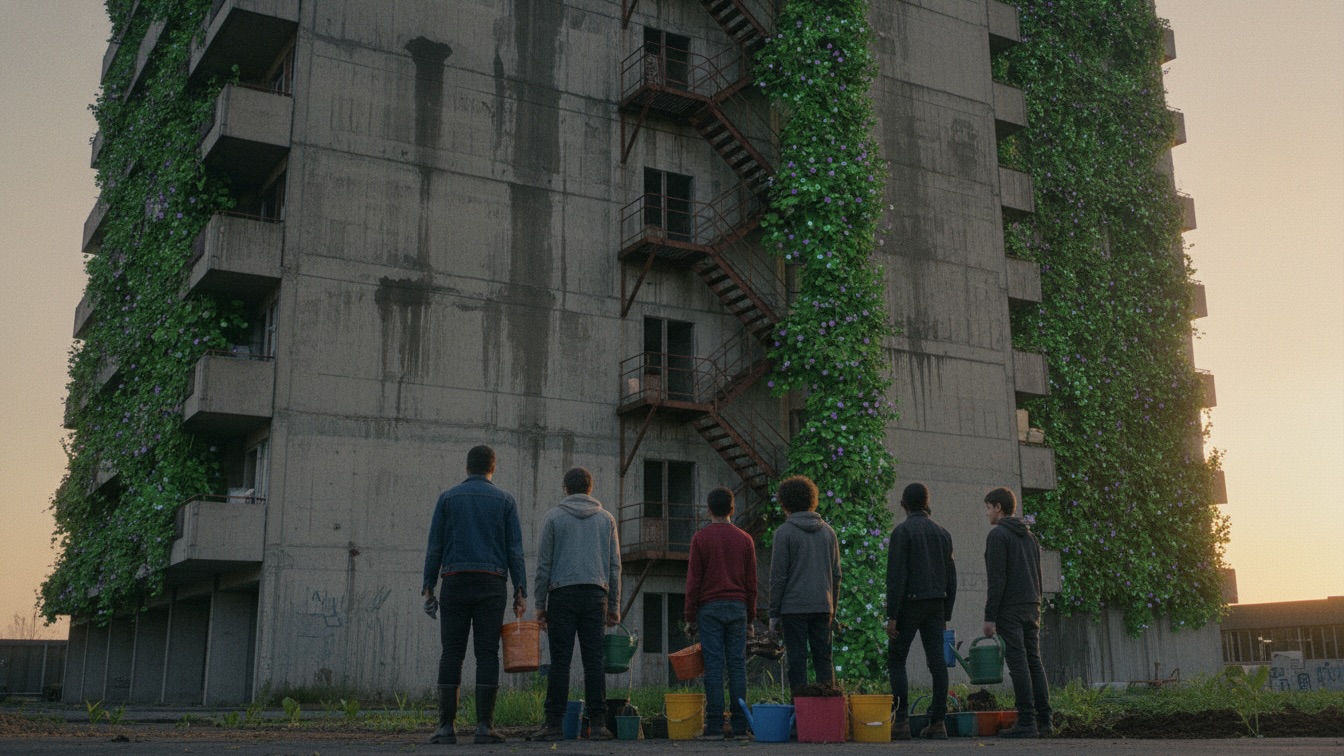
In the decaying urban environment of Sector 4, an architect named Wendy attempts a daring feat of "guerrilla gardening" by installing a living bio-scaffold onto a crumbling high-rise. Her neighbor, Matt, watches with cynical detachment from his balcony, mocking her efforts as a futile gesture in a district defined by poverty and neglect. Wendy’s mission is funded by micro-donations and relies on a legal loophole, but her goal is visceral: to lower the unbearable temperatures of the concrete jungle and provide clean air to a community forgotten by the elite North District.
The project faces a life-threatening crisis when a sudden heat spike occurs and the building’s antiquated plumbing fails to provide water to the bio-printed seedlings. As the plants begin to wither under the oppressive sun, Wendy realizes her automated systems are useless against the systemic rot of the infrastructure. In a moment of desperation, she appeals to Matt’s buried sense of humanity, urging him to mobilize the building’s residents. This leads to a surprising display of communal effort as the neighbors form a manual bucket brigade to save the greenery.
The success of the garden draws the immediate attention of Councilman Barnes, a bureaucratic figure who arrives to demand the removal of the unauthorized modification. However, Wendy uses the real-time data from her sensors and the threat of public scrutiny during an election year to force his hand. Barnes begrudgingly allows the garden to remain as a pilot program, granting the residents a rare victory. The chapter concludes on an ominous note as Wendy discovers that an unknown entity is attempting to sabotage the project’s data from within the decentralized ledger.
The narrative explores the profound tension between systemic neglect and individual agency within a dystopian urban setting. The "bio-scaffold" serves as a central metaphor for hope and resilience, representing a technological attempt to mend a social and environmental fracture. While the City Council views the housing block as a "low-priority zone" defined by "crushing poverty," Wendy views it as a living organism capable of regeneration. This conflict highlights the theme of environmental justice, where the right to breathe clean air and live in a regulated climate is a luxury reserved for the tech-elites.
The transition from automated technology to human cooperation marks a pivotal thematic shift. Initially, Wendy relies on haptic gloves, decentralized ledgers, and bio-printed seedlings, believing that superior engineering alone can solve the crisis. However, when the high-tech systems fail due to the building's physical decay, the solution becomes primitive and communal. The "bucket brigade" symbolizes the power of collective action, suggesting that true urban renewal cannot be imposed from the top down or through gadgets alone, but must be sustained by the people living within the space.
Finally, the story examines the performative nature of political power and the role of data as a weapon. Councilman Barnes does not concede because he values the well-being of the residents; he concedes because the "metrics" and the "public ledger" make it politically inconvenient to do otherwise. This underscores a world where morality is secondary to optics and efficiency. The closing discovery of data sabotage suggests that in this society, the control of information is the ultimate battlefield, and even a successful physical intervention can be erased by a digital ghost.
Wendy is characterized by a fierce, almost obsessive determination to manifest change in a world that resists it. She operates with the precision of an engineer and the passion of an activist, using her technical skills to exploit the very systems that marginalize her community. Her reliance on her "haptic gloves" and "wrist-comm" suggests a character who finds safety in data and structural integrity, perhaps as a psychological defense against the chaotic instability of her environment. She is not merely planting flowers; she is attempting to engineer a sense of dignity for a population that has been conditioned to expect failure.
Her internal conflict surfaces during the heat spike, where her composure cracks under the pressure of potential failure. She views the survival of the plants as a direct proxy for the survival of the residents' spirits. This high-stakes mindset reveals her deep-seated fear that if she cannot save the garden, she validates the Council’s belief that Sector 4 is beyond saving. Her victory over Barnes shows her growth into a shrewd political player, as she learns to speak the language of "budgets" and "metrics" to protect her vision.
Matt serves as the psychological foil to Wendy’s idealism, embodying the "learned helplessness" often found in oppressed environments. His cynicism is a protective mask, a way to insulate himself from the disappointment of the failed "urban renewal" projects he has witnessed in the past. He represents the voice of the weary observer, someone who has traded hope for a "lukewarm protein shake" and a front-row seat to the neighborhood's slow collapse. His initial mockery of Wendy’s "salad on a skyscraper" is a manifestation of his own bitterness toward a system that has consistently failed him.
However, Matt’s character arc is defined by his transition from a passive critic to an active participant. When he vaults over the railing to help, he sheds his mask of indifference. This suggests that his cynicism was never a lack of caring, but rather a response to a lack of opportunity. By leading the bucket brigade, he reclaims a sense of purpose and community leadership. His final comment about the "salad" indicates that while he remains grounded in his dry humor, he has finally allowed himself to feel a sense of ownership and pride in his surroundings.
Councilman Barnes is the personification of the detached, bureaucratic elite. He is described through his expensive suit and his amplified voice, elements that physically and metaphorically separate him from the "soot-stained" residents of Sector 4. Psychologically, he is driven by a desire for control and the maintenance of the status quo. He views the bio-scaffold not as a life-saving improvement, but as a "violation of city code" and a "weed." This reveals a mindset that prioritizes order and aesthetic uniformity over human life and ecological health.
Despite his position of power, Barnes is shown to be a slave to public perception and political utility. He is a reactionary figure, shifting his stance the moment he realizes that "three thousand people" are watching the stream. His decision to label the garden a "pilot program" is a calculated move to co-opt Wendy’s success and frame it as a government initiative. He represents the systemic obstacle that treats human progress as a PR problem to be managed rather than a goal to be achieved.
The narrative voice of the story is grounded in "cyberpunk-lite" aesthetics, blending gritty industrial imagery with flashes of organic beauty. The author uses sensory details to create a palpable sense of discomfort, such as the "lukewarm protein shake," the "soot-stained walls," and the "hazy sky" that looks like a "dull copper coin." These descriptions establish a world that feels exhausted and recycled. The contrast between the "emerald" seedlings and the "gray slab" of the building creates a visual tension that mirrors the thematic struggle between life and decay.
Pacing is expertly managed through the use of environmental pressure. The sudden jump in the "temperature readout" serves as a narrative catalyst that forces the characters out of their established roles and into a state of emergency. The rhythmic "clink" of buckets and the "shouting of the residents" provide an auditory shift from the "dull roar of distant traffic," signaling the awakening of the community. This acceleration of events builds toward the confrontation with Barnes, which provides a moment of high-stakes dialogue before the tension is released.
The tone of the chapter is one of "gritty optimism," where victory is achieved not through magic or easy fixes, but through sweat and manual labor. The author avoids overly sentimental language, choosing instead to describe the flowers as "hardy" and "waxy" rather than "majestic." This choice reinforces the idea that in Sector 4, beauty must be tough to survive. The final shift in tone during the cliffhanger introduces a sense of digital paranoia, effectively transitioning the story from a localized social drama into a broader technological conspiracy.


