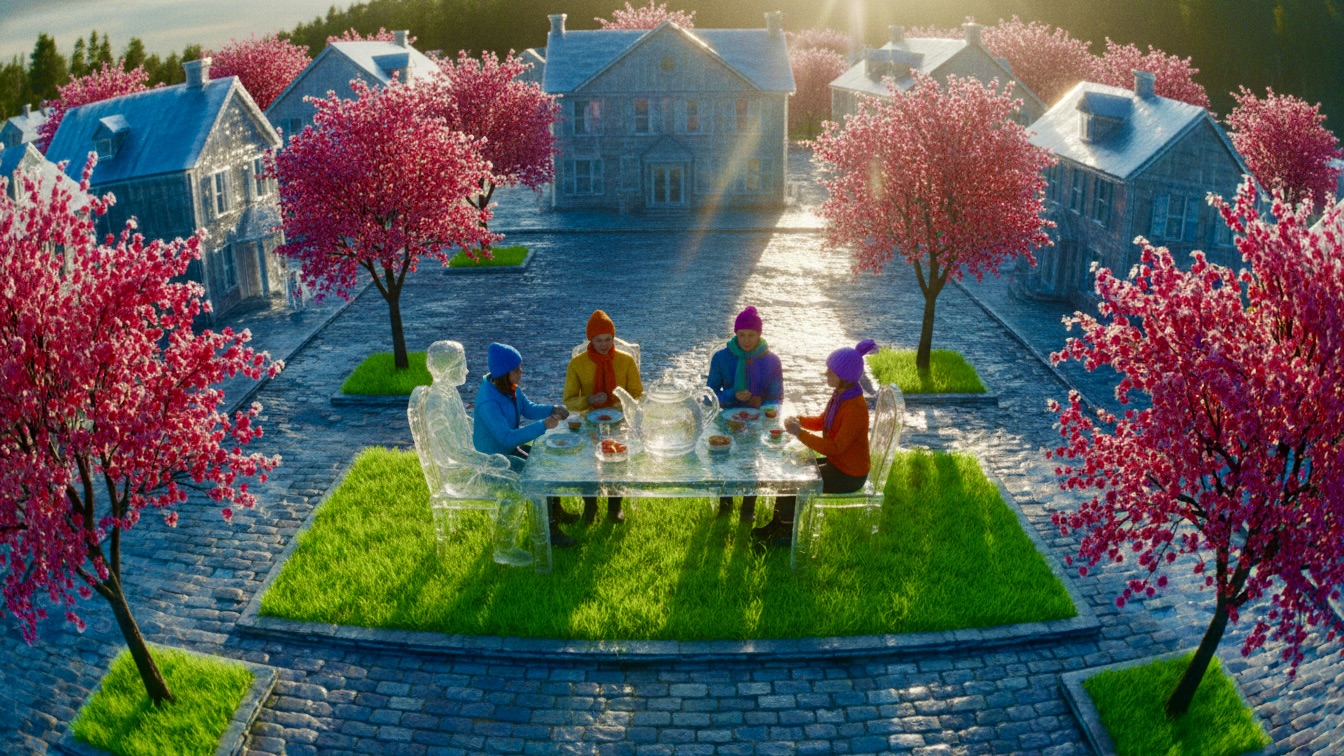
The snow fell in the shape of human teeth, white and hard, clicking against the silver frozen ground.
Anne’s brain felt like a browser with fifty tabs open, and forty of them were playing audio she couldn’t find. The world was too bright. The sun was a high-definition glare that hit the silver snow and bounced straight into her retinas. It wasn't the white of winter. It was iridescent. It was a glitch in the color grading of the world. She stood on her porch, her knuckles white as she gripped the railing.
Her stomach was a tight knot of cold wire. The porch swing was moving. It wasn't the wind. There was no wind. Just the heavy, still air of a spring that had forgotten how to bloom. Sitting on the swing was a figure made of hard, translucent ice. It was her grandmother. Not a vague shape. Not a snowman. It was a perfect, anatomical replica, down to the specific pattern of the lace on her collar and the way her left eyelid drooped when she was tired. The silver snow had gathered in the creases of the statue’s lap like spilled mercury.
"This is statistically impossible," Anne said. Her voice sounded flat in the dead air. She didn't feel sad. She felt like she was looking at a broken line of code. The statue didn't move, but the swing continued its rhythmic creak. The chains groaned. Anne walked forward, her boots crunching on the silver crust. She reached out a hand. It didn't feel like ice. It felt like a low-voltage current. When her finger touched the statue’s cheek, a spark jumped. It stung. Anne pulled back, her heart hammered against her ribs like a bird in a shoebox. The statue remained still, but the eyes—perfectly carved spheres of frozen water—seemed to track the movement.
"The morning is quite vibrant, is it not?"
Anne jumped. Mrs. Gable was standing on the sidewalk. She was wearing a neon pink tracksuit that looked like it had been through a shredder. She was holding a tray of cookies. They were frozen solid. Mrs. Gable wasn't looking at Anne. She was looking at the statue on the swing.
"I brought the peppermint delights your grandmother always favored," Mrs. Gable said. Her tone was formal, rehearsed, like she was reading from a script for a play she didn't understand.
"She’s dead, Mrs. Gable," Anne said. "She’s been dead for three years. This is a block of ice. This is a weather anomaly. We need to call someone. We need to call the state or a scientist or literally anyone with a flamethrower."
Mrs. Gable tilted her head. Her neck made a dry, clicking sound. "Your lack of hospitality is noted, Anne. It is a social failure. We are having tea at the square. You should attend. Bring your guest."
Anne watched the woman walk away. Mrs. Gable’s feet didn't sink into the snow. She drifted over the silver surface. Anne looked back at the statue. The ice was changing. Small, silver flowers were beginning to grow out of the statue’s scalp, mimicking the curls of her grandmother's hair. It was beautiful. It was the most disgusting thing Anne had ever seen.
She left the porch. She had to find Tim. Tim was the only person in this town who still used a hammer. Everyone else was too busy talking to their frozen roommates. The walk to the center of town was a fever dream. The silver snow had piled up in drifts that looked like sleeping bodies. In the park, the 'frozen tea' party was in full swing. It was a tableau of the deranged. The townspeople had brought out card tables and fine china. They sat in the freezing bright light, wearing parkas and sunglasses, chatting with the statues of their lost relatives.
"The flavor profile of this Darjeeling is exquisite," a man said to a statue of his five-year-old son. The boy-statue sat frozen in the act of reaching for a sugar cube.
Anne’s skin crawled. She felt a wave of nausea. This wasn't grief. This was a refusal to exist in the present. The town had turned into a museum of its own tragedies. The silver light made everything look expensive and fake. She pushed through the crowd, ignored the polite nods from the living, and headed for the forge at the edge of the district.
Tim’s shop was the only place that wasn't silver. It was black and orange. The heat from the furnace hit Anne like a physical blow, and for a second, she wanted to cry. It was real heat. Not the electric hum of the ice. Tim was standing over a bench, his face smeared with soot. He looked exhausted. He looked like he hadn't slept since the first silver flake fell.
"I can't get it to melt, Anne," Tim said. He didn't look up. He was holding a blowtorch to a small hand made of ice. The hand was severed at the wrist. It was perfect.
"Why do you have a hand, Tim?" Anne asked. She stayed near the door, away from the metal.
"Found it in the street. Thought I’d do a controlled test," he said. He cranked the oxygen on the torch. The blue flame hissed. He pressed the cone of fire directly against the frozen fingers. The ice didn't drip. It didn't steam. It glowed. The silver inside the ice began to pulse.
"Stop it," Anne said. Her ears began to ring.
Tim didn't stop. "It’s a physical object. It has a melting point. Everything has a melting point. If I can just find the frequency—"
The sound started then. It wasn't a scream from a throat. It was the sound of a thousand glass bells shattering at once inside a cathedral. It was high, piercing, and rhythmic. The sound waves hit the hanging tools in the shop, making the saws and hammers vibrate. Anne dropped to her knees, covering her ears. Tim dropped the torch. He fell backward, his hands pressed against his head. The ice hand on the table didn't break. It just sang. The sound was a physical weight, pressing into Anne's sinuses, making her teeth ache.
Then, as quickly as it started, it stopped. The silence that followed was worse. It was a heavy, expectant silence.
"It screamed," Tim whispered. His nose was bleeding. A thin trail of red ran down his lip. "The ice. It has a voice."
"It’s not ice," Anne said. She stood up, her legs shaking. "It’s us. It’s the town. We’re doing this."
Tim looked at her. His eyes were bloodshot. "We’re not making it snow, Anne. I’m a blacksmith, not a wizard."
"Look outside, Tim. Look at the logic of it," Anne said. She gestured to the window. "We stopped moving forward. Everyone is so obsessed with what they lost that the world literally stopped to accommodate them. It’s a glitch. We’ve broken the timeline with our own baggage."
Tim stood up, wiping his face. "That sounds like some high-level nonsense. It’s weather. It’s a chemical reaction in the atmosphere."
"Then why is the snow changing?" Anne asked.
She pointed toward the door. The sky had turned a bruised shade of purple, though the sun was still a bright, aggressive white. The clouds weren't fluffy. They were jagged. And then, the new snow began to fall. It didn't drift. It dropped.
Clack. Clack. Tink.
The sounds were hard. Metallic. Anne stepped out onto the gravel path. She looked down. At her feet lay a small, white object. It wasn't a flake. It was a tooth. A perfect, ceramic-white human molar. She looked up. Thousands of them were falling from the sky. They were coating the silver drifts in a layer of jagged enamel. The sound of the tooth-storm was like a million typewriters clicking in unison.
"It’s biting back," Anne said. She felt a sharp pain in her shoulder. A tooth had hit her through her jacket.
Tim stepped out beside her, shielding his head with a leather apron. "This is not a natural phenomenon. This is a hostile event."
"It’s a manifestation," Anne said. She felt a strange clarity. The irony of the situation was finally hitting her. The town wanted their dead back. They wanted the past to stay put. Well, now the past was falling from the sky and it had roots. "We refused to let go, Tim. So the world is making sure we can't move at all. We’re going to be buried in this."
Across the street, Mrs. Gable was still standing in the tooth-storm. She wasn't hiding. She was holding her tray out, catching the teeth like they were precious gems. She was smiling, even as the sharp white flakes cut into her cheeks.
"The bounty is significant today!" Mrs. Gable shouted over the clicking of the storm.
Anne looked at Tim. "We have to leave. Now. Before the drifts get too high."
"The truck won't start," Tim said. "The fuel line is frozen silver."
Anne looked toward her house. She could see her grandmother on the swing, now covered in a layer of white teeth, looking like a macabre queen on a throne of bone. The swing was moving faster now. The creaking was getting louder, beginning to harmonize with the sound of the falling enamel.
Anne realized then that the statues weren't just decorations. They were anchors. Every statue was a weight, holding the town in this frozen second of spring. The silver snow was the glue. The teeth were the cage.
"We walk then," Anne said.
"To where?" Tim asked. "The whole county is probably like this."
"Then we walk until the colors look normal again," Anne said. "I’d rather die in the mud than live in a jewel box."
She started moving. The teeth crunched under her boots, sharp and unforgiving. She didn't look back at the porch. She didn't look at the tea party. She kept her eyes on the horizon, where the silver met the purple sky. But as she reached the edge of the town limits, she felt a cold weight on her ankle.
She looked down. A hand, made of silver ice and coated in white teeth, had reached up from the drift. It wasn't trying to hurt her. It was just holding on.
"Don't go," a voice whispered from the snow. It sounded like her grandmother, but distorted, like a recording played at the wrong speed. "The tea is almost ready."
Anne kicked her leg free, her breath hitching in her chest. She looked at the road ahead. The silver didn't stop at the town line. It stretched as far as she could see, a shimmering, frozen wasteland of memory and sharp edges. The glitch wasn't local. It was the new version of reality.
"Tim," she whispered.
"I see it," he said.
Behind them, the sound of the thousand bells began again, louder this time, shaking the very ground beneath their feet as the statues began to stand up.
“Behind them, the sound of the thousand bells began again, louder this time, shaking the very ground beneath their feet as the statues began to stand up.”


