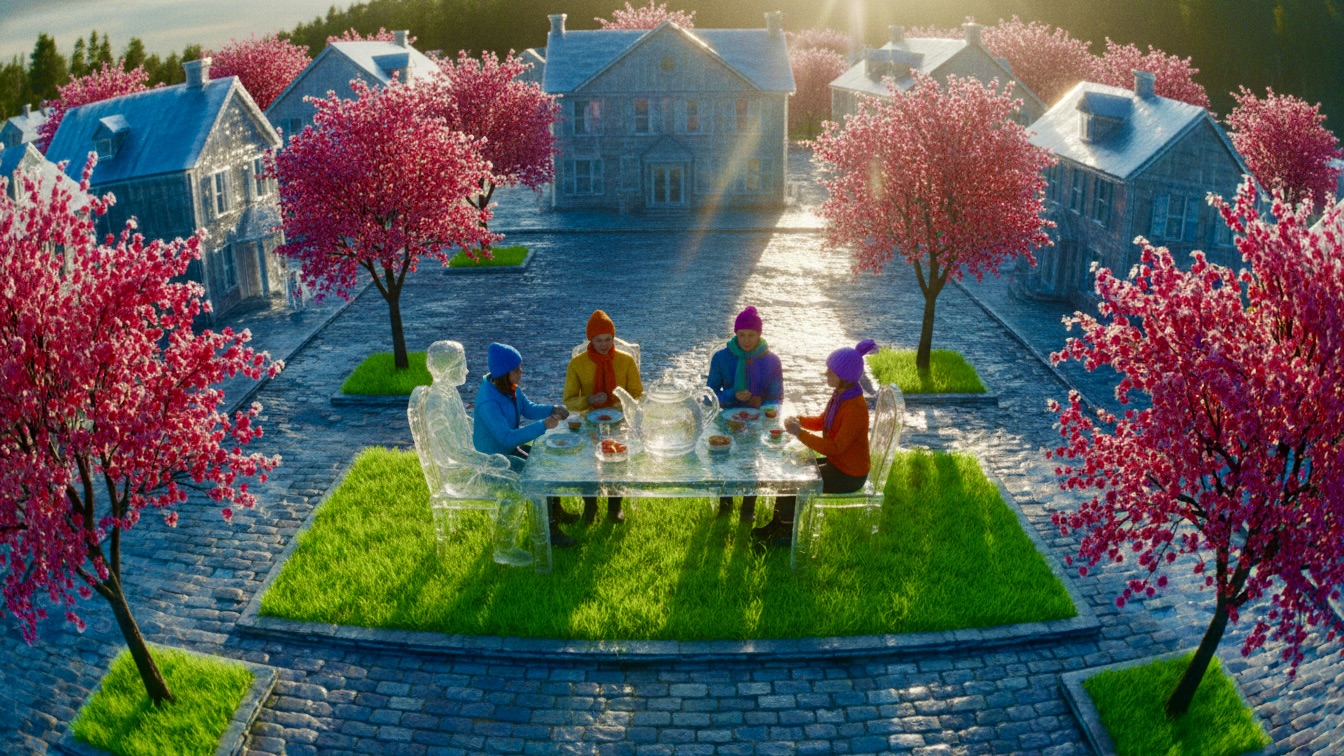
The narrative begins with Anne discovering a hauntingly accurate ice sculpture of her deceased grandmother sitting on her porch swing. This figure is part of a larger, surreal phenomenon where "silver snow" has transformed the town into a crystalline landscape. Anne observes her neighbors, including Mrs. Gable, engaging in a collective delusion where they treat these frozen statues as if they were still living. The atmosphere is thick with a sense of wrongness, characterized by the smell of rotting peaches and ozone.
Anne seeks out Tim, the town’s blacksmith, hoping to find a rational or physical solution to the encroaching ice. Tim attempts to melt a severed ice hand with a blowtorch, but the object responds not with water, but with a piercing, crystalline scream. This event marks a shift from a passive weather anomaly to an active, hostile manifestation. Anne realizes that the town’s inability to move past its grief has caused a literal "glitch" in the fabric of reality.
The situation escalates when the sky turns purple and begins raining human teeth instead of snow. This "tooth-storm" coats the silver landscape in jagged enamel, physically attacking those who remain outside. Anne and Tim attempt to flee the town to find a place where "colors look normal again." However, as they reach the outskirts, they discover the silver wasteland extends to the horizon. The story concludes with the statues beginning to animate and the realization that the past has physically anchored the living to a frozen, distorted present.
The primary theme of the story is the paralyzing and destructive power of collective grief. The townspeople have collectively refused to process their losses, leading to a physical manifestation of their psychological stagnation. The silver snow and ice statues represent a "museum of tragedies" where the past is preserved at the expense of the present. This preservation is not a comfort but a cage, turning the familiar into something alien and hostile.
Another significant theme is the breakdown of reality through the lens of psychological trauma. The story uses technological metaphors, such as "broken lines of code" and "glitches," to describe the supernatural events. This suggests that reality is a construct maintained by the forward momentum of time and human experience. When the characters fixate on what they have lost, the "software" of the world fails, resulting in a reality that is beautiful but fundamentally "disgusting" and "hostile."
The narrative also explores the conflict between physical reality and emotional projection. Tim represents the desperate attempt to use logic and industry to fix a problem that is essentially metaphysical. His failure to melt the ice with a blowtorch highlights the futility of addressing psychological trauma with purely physical tools. The ice "screams" because it is an extension of human suffering, not a mere chemical reaction. This suggests that the characters cannot simply "burn away" their past; they must find a way to move through it.
Finally, the transition from silver snow to falling teeth introduces a theme of biological betrayal and the "bite" of memory. The teeth represent the aggressive nature of a past that refuses to stay buried. While the silver ice is seductive and ornamental, the teeth are sharp, utilitarian, and painful. This evolution suggests that the longer one dwells in a frozen state of grief, the more predatory and dangerous those memories become. The world is no longer just holding the characters back; it is actively consuming them.
Anne serves as the narrative's primary consciousness, and her internal state is defined by a deep sense of cognitive dissonance. She views the world through a lens of digital metaphors, comparing her brain to a browser with too many tabs open. This suggests a state of chronic overstimulation and a desperate need for order in the face of chaos. Unlike her neighbors, she refuses to participate in the "tea party" of the dead, demonstrating a high level of psychological resilience and a commitment to objective truth.
Her motivation is driven by a desire for "normalcy," which she defines as the presence of "mud" and organic decay rather than "jewel box" perfection. She recognizes that the beauty of the ice is a mask for a deep, existential rot. Her decision to leave the town is an act of self-preservation against the seductive pull of her own history. She is a character who values the pain of moving forward over the comfort of standing still, even when the road ahead appears just as bleak.
Tim represents the grounded, practical element of the town, yet he is clearly at his breaking point. As a blacksmith, his identity is tied to the manipulation of metal and heat, making him the antithesis of the cold, silver world outside. He is exhausted, his soot-smeared face contrasting with the iridescent glare of the snow. He approaches the ice with the mindset of a scientist or an engineer, looking for a "melting point" or a "frequency" to solve the problem.
His internal conflict stems from the failure of his craft to provide a solution to the town's plight. When the ice hand screams, it shatters his reliance on physical laws, leaving him vulnerable and bloodied. He is a man who has lost his utility in a world that no longer follows the rules of cause and effect. Despite his skepticism of Anne’s "high-level nonsense," he eventually follows her, showing a pragmatic recognition that his forge can no longer protect him from the shifting reality.
Mrs. Gable is a tragic figure who exemplifies the total surrender to the "glitch" of grief. She operates on a "script," performing social rituals that have lost all meaning in the face of the apocalypse. Her neon pink tracksuit and frozen cookies create a grotesque image of suburban normalcy transposed onto a nightmare. She does not see the horror of the ice or the teeth; she sees only the "bounty" of a past that has returned to her.
Psychologically, she represents the end state of those who refuse to acknowledge death. Her neck makes a "dry, clicking sound," suggesting that she is becoming as artificial and mechanical as the statues she admires. She is no longer an individual with agency but a part of the town’s new, frozen landscape. Her character serves as a warning to Anne and Tim of what happens when the human spirit stops resisting the pull of the "silver."
The narrative voice is characterized by a blend of cold, clinical observation and vivid, surrealist imagery. The author uses a "Techno-Gothic" style, where traditional horror elements like ghosts and statues are described using the language of modern technology. Phrases like "high-definition glare," "color grading," and "low-voltage current" create a sense of modern alienation. This stylistic choice bridges the gap between the internal psychological state of the protagonist and the external supernatural events.
The pacing of the chapter is masterfully handled, moving from a quiet, eerie stillness to a chaotic, sensory assault. The initial description of the grandmother on the swing is slow and methodical, focusing on minute details like the "lace on her collar." This builds a foundation of dread that explodes into action when Tim’s blowtorch triggers the "glass bells" of the ice. The sudden shift to the "tooth-storm" accelerates the narrative, forcing the characters into a desperate flight that mirrors the frantic clicking of the falling enamel.
Sensory details are used to create a visceral sense of discomfort. The author contrasts the "sweet" smell of rotting peaches with the "ozone" of an electrical discharge, suggesting a fusion of the organic and the artificial. The auditory landscape is equally jarring, moving from the "dead air" of the porch to the "shattering" scream of the cathedral bells. These details ensure that the reader feels the cold and the "sharp pain" of the environment just as acutely as the characters do.
The tone of the story is one of profound existential dread mixed with a grim irony. Anne’s observation that the town has become a "museum of its own tragedies" provides a biting critique of the human tendency to romanticize the past. The imagery of the "frozen tea party" is both absurd and terrifying, highlighting the madness of a community that prefers a beautiful lie to a harsh truth. This tone remains consistent even in the final moments, as the "shimmering, frozen wasteland" offers no easy hope for the protagonists.


