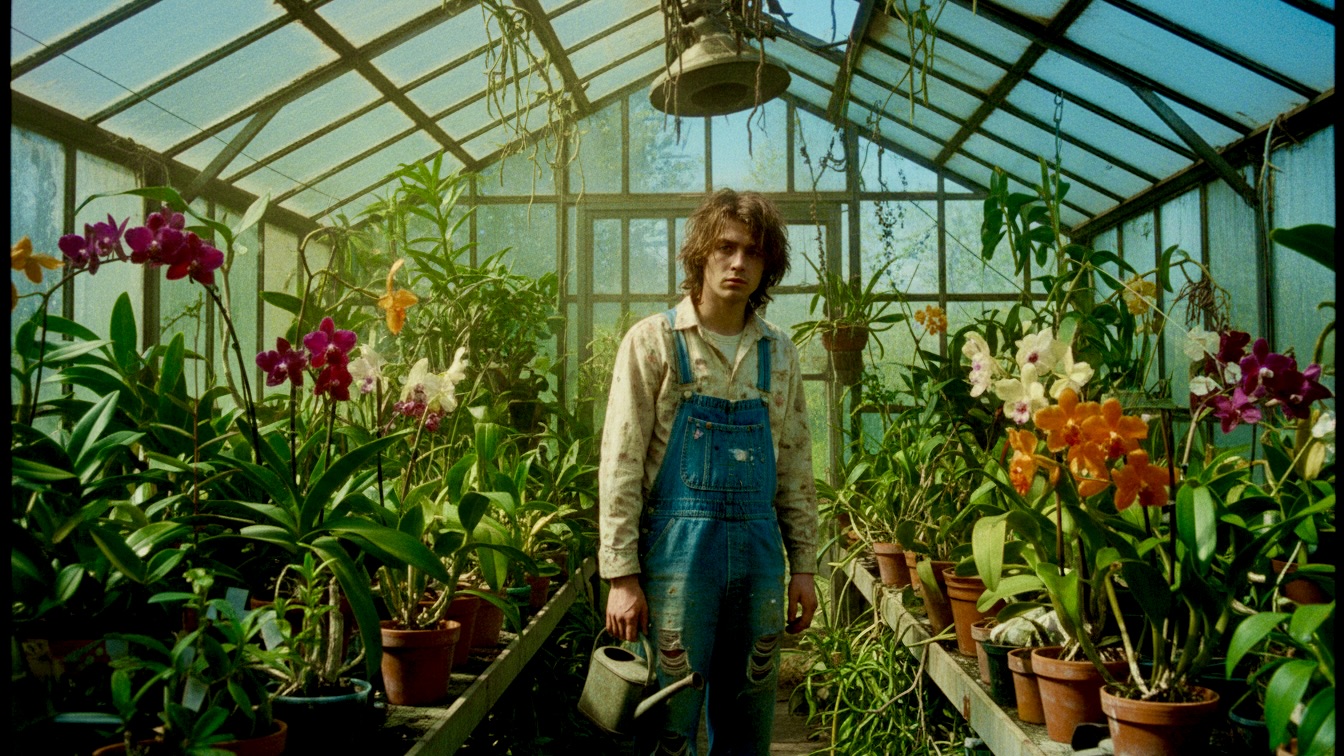
The greenhouse smelled like wet dirt and failure. Rina was already inside, smoking a crushed cigarette.
There was a smear on the glass handle of the greenhouse door.
I stopped dead on the grass. My cheap dress shoes—the ones my mother bought me at Target three years ago that now pinched my toes into a miserable cramp—were soaked with morning dew. I stared at the smear. It looked like blood. For a split second, my brain short-circuited into true crime mode, a fast-forward panic. Then I stepped closer. The light hit it. Matte red. Lipstick.
Rina.
I pushed the door open. It jammed on the rusted track, scraping like nails on a chalkboard before finally giving way.
The heat hit me instantly. It was a physical weight. A wet towel thrown over my head. My glasses fogged up in two seconds flat. I pulled them off, wiping them on the hem of my button-down shirt, blinking into the blurry green haze.
The greenhouse was my grandmother's pride and joy before she died, and now it was just a humid box of neglect that my uncle insisted on keeping. It smelled like wet dirt. Rotting roots. Fertilizer. And cheap tobacco.
"Shut the door," a voice said from the back.
I shoved the glass door closed. It rattled in its frame.
Rina was sitting on an overturned terracotta pot in the far corner, half-hidden by a massive, overgrown fern that looked like it was trying to choke the life out of the orchids next to it. She was wearing a black slip dress that was entirely inappropriate for a suburban Easter brunch. Her combat boots were covered in mud. She had a half-smoked cigarette pinched between her fingers. Her phone was in her other hand, screen cracked, the brightness turned all the way down.
"You're missing the ham," I said, navigating my way down the narrow aisle. My shoulder brushed against a hanging plant. A fat drop of condensation fell off a leaf and hit the back of my neck. I shivered.
"Fuck the ham," Rina said. She didn't look up from her phone. "Uncle Steve breathes through his mouth when he chews. I was sitting right next to him. I could hear the saliva."
"He has a deviated septum."
"He has a lack of self-awareness."
I found a relatively clean spot on the edge of a wooden potting table and hiked myself up. The wood groaned under my weight. I let my legs dangle. My stomach was a tight knot of acid and cheap prosecco. The brunch had only been going on for two hours, but it felt like three days. The noise. The fake smiles. The transaction of it all. You trade an update on your life for a plate of dry eggs, and then you wait for the judgment.
"Got another one?" I asked.
Rina sighed. She reached into her tiny, useless purse and tossed a squished pack of Camels at me. I caught it against my chest. I pulled one out. It was bent in the middle. I straightened it out, stuck it in my mouth, and waited.
She tossed me a pink plastic lighter.
I sparked it. The flint ground against my thumb. The smoke filled my lungs, harsh and chemical, cutting through the heavy smell of the orchids. It grounded me. My shoulders dropped an inch.
"How long have you been out here?" I asked.
"Twenty minutes." Rina took a drag, the cherry of her cigarette glowing bright orange in the dim, green-filtered light. "I had to tap out. Aunt Linda is off her meds again, no cap, she just cried over a deviled egg."
I snorted. Smoke came out my nose. "A deviled egg?"
"Yeah. She dropped it on the patio. It landed upside down. She just stared at it, and then her face crumpled, and she started sobbing. Said it was a metaphor for her marriage."
"To be fair, her marriage is upside down on a patio."
"Right? But like, don't do that in front of the potato salad. It ruins the vibe." Rina tapped her ash onto the dirt floor. "Mom tried to hug her. You know how Mom hugs. Like she's trying to tackle a linebacker. Linda just cried harder. It was a whole mess. I grabbed my bag and walked out. I couldn't do it. The psychic damage was too high."
"I think my mom is currently cornering Cousin Greg about his crypto investments," I said, staring at the ash forming on the end of my cigarette. "She keeps calling it 'Bit-Coin' with a hard pause in the middle."
"Greg deserves it. He wore a fleece vest to Easter."
"It's Patagonia."
"It's a crime against my eyes."
We fell quiet. The only sound was the hum of a lawnmower three houses down, muffled by the glass, and the drip, drip, drip of condensation falling from the roof onto the broad, waxy leaves of the plants around us.
This was our ritual. Every holiday. Every forced family gathering. We found the blind spot—the garage, the basement, the greenhouse—and we sat in the dark and tore our bloodline to shreds. It was a survival mechanism. If we judged them first, their judgment couldn't touch us. We were the smart ones. The aware ones. The ones who saw the matrix of suburban decay for what it was.
Or at least, that's what I told myself.
I looked at Rina. Her eyeliner was smudged in the corner of her left eye. She looked exhausted. There were dark circles under her eyes that no amount of concealer could hide. The skin around her fingernails was chewed raw.
"So," I said, letting the smoke roll out of my mouth. "How's the gap year?"
The air shifted.
It was subtle, but I felt it. The temperature in the greenhouse seemed to spike. Rina stopped scrolling. Her thumb hovered over the cracked glass of her screen. She slowly locked the phone and set it facedown on her thigh.
"It's not a gap year, Dylan. I dropped out."
"Right. Sorry. How's the dropping out?"
She looked at me. Her eyes were hard, flat. The camaraderie of the last ten minutes evaporated. "It's fine."
"Just fine?"
"What do you want me to say?" Her voice ticked up half an octave. Defensive. "Do you want me to say I'm miserable? Because I'm not. I'm actually sleeping eight hours a night. I'm not having panic attacks in the library bathroom."
"I'm just asking," I said, putting my hands up in a half-surrender. But I wasn't just asking. I wanted to poke the bruise. I don't know why. Maybe because the prosecco was sour in my stomach. Maybe because my mother had spent the entire car ride here talking about how Rina was throwing her life away, and a sick, twisted part of me wanted to confirm it so I could feel better about my own stagnant existence.
"You're not just asking," Rina snapped. "You're doing that thing."
"What thing?"
"That smug, detached thing. The thing where you act like you're above it all." She stood up. The terracotta pot scraped against the dirt. She took a step toward me. The orchids brushed against her arms. "You're just like Aunt Linda. You just hide it better."
My jaw tightened. The comparison hit like a physical slap. "I am nothing like Linda."
"Aren't you?" Rina crossed her arms. "She cries over eggs. You sit in your room and judge people on the internet because you're too scared to actually participate in society. Same difference. Just different generations."
"I participate in society."
"Dylan, you work remote doing data entry for a logistics company. You haven't left your house since January except for mandatory family guilt trips. Your screen time is probably twelve hours a day."
My stomach turned over. A cold sweat broke out at the base of my neck, completely at odds with the suffocating heat of the greenhouse. She was right. But I couldn't let her see that.
"At least I have a job," I shot back. The words tasted metallic in my mouth. Cheap. Mean. "At least I didn't waste seventy grand of my parents' money at NYU just to realize I couldn't handle the 'vibe' of reading a syllabus."
Rina flinched. The insult landed perfectly. I saw the micro-expression—the widening of her eyes, the tightening of her mouth.
I should have stopped. I should have backpedaled. Said I was joking. Said it was the heat talking.
But I didn't.
"You dropped out because you got a B-minus in a sociology seminar, Rina. Don't act like it was some grand mental health stand. You just couldn't handle not being the smartest person in the room for five minutes."
"Fuck you."
"It's the truth."
"You want the truth?" Rina's voice was shaking now. Not from sadness. From pure, unadulterated rage. She threw her half-smoked cigarette onto the dirt floor and crushed it under the heel of her boot. "You want the actual truth, Dylan?"
"Enlighten me."
"You have no friends."
The words hung in the humid air. They didn't echo. The damp dirt and the thick leaves swallowed them up instantly. But they hit my chest like a sledgehammer.
"I have friends," I said. My voice sounded thin. Weak.
"No, you don't." Rina stepped closer. She was right in my space now. I could smell her perfume—something sharp and floral that clashed with the rotting earth smell of the greenhouse. "You have Discord servers. You have people you game with. You literally pay for Discord Nitro to feel like you're in a community. But you don't have a single person in this city who would call you to get a coffee. Not one."
My throat closed up. I tried to swallow, but there was no saliva in my mouth.
"You sit up here on your little potting table," she continued, her voice dropping to a vicious whisper, "and you talk shit about Uncle Steve and Aunt Linda and Cousin Greg. But at least Greg goes outside. At least Linda feels something. You're just... dead. You're dead inside, Dylan. You're a ghost haunting your own bedroom."
I looked at her. Really looked at her.
The mascara smudge. The chewed cuticles. The defensive posture.
We were the same. We were both terrified, lonely, burned-out kids pretending that our cynicism was a shield, when really it was just a cage. We talked shit about the family because if we didn't, we'd have to look at each other. We'd have to look at ourselves.
"Are you done?" I asked. The words barely made it past my teeth.
Rina stared at me. The anger in her eyes flickered, replaced by something worse. Pity.
She looked away. She grabbed her cracked phone from the potting table. Her hands were shaking too.
"Yeah," she said, her voice flat again. "I'm done."
She turned and walked down the narrow aisle. The ferns brushed against her legs. She didn't look back.
"Rina," I said.
She pushed the glass door open. The rusted track screamed. She stepped out into the bright, blinding spring sunlight. The door slammed shut behind her, the glass rattling so hard I thought it might shatter.
I was alone.
The heat in the greenhouse felt different now. It wasn't just oppressive; it felt predatory. I looked down at the cigarette in my hand. It had burned all the way down to the filter. The ash collapsed onto my slacks, leaving a gray smear across the fabric.
I rubbed at the stain, but it only set deeper into the threads.
My chest was tight. My breathing was shallow. I looked at the orchids around me. Grandmas's prized possessions. In the dim light, the bright pink and white petals didn't look beautiful. They looked like open mouths. Gasping for air in the suffocating humidity.
I looked closer at the nearest plant. The leaves were a vibrant, glossy green on top. But underneath, near the stem, black spots were spreading. A creeping rot that was eating the plant from the inside out. You couldn't see it unless you were looking for it.
The lawnmower in the distance cut off abruptly.
The silence that followed was total.
I sat on the edge of the potting table, staring at the rot on the leaves, listening to my own uneven heartbeat. Outside, the family was laughing. Glasses were clinking. The brunch was continuing without us. Without me.
The glass door clicked shut, leaving me alone with the blooming rot, waiting for the real collapse to begin.
“The glass door clicked shut, leaving me alone with the blooming rot, waiting for the real collapse to begin.”


