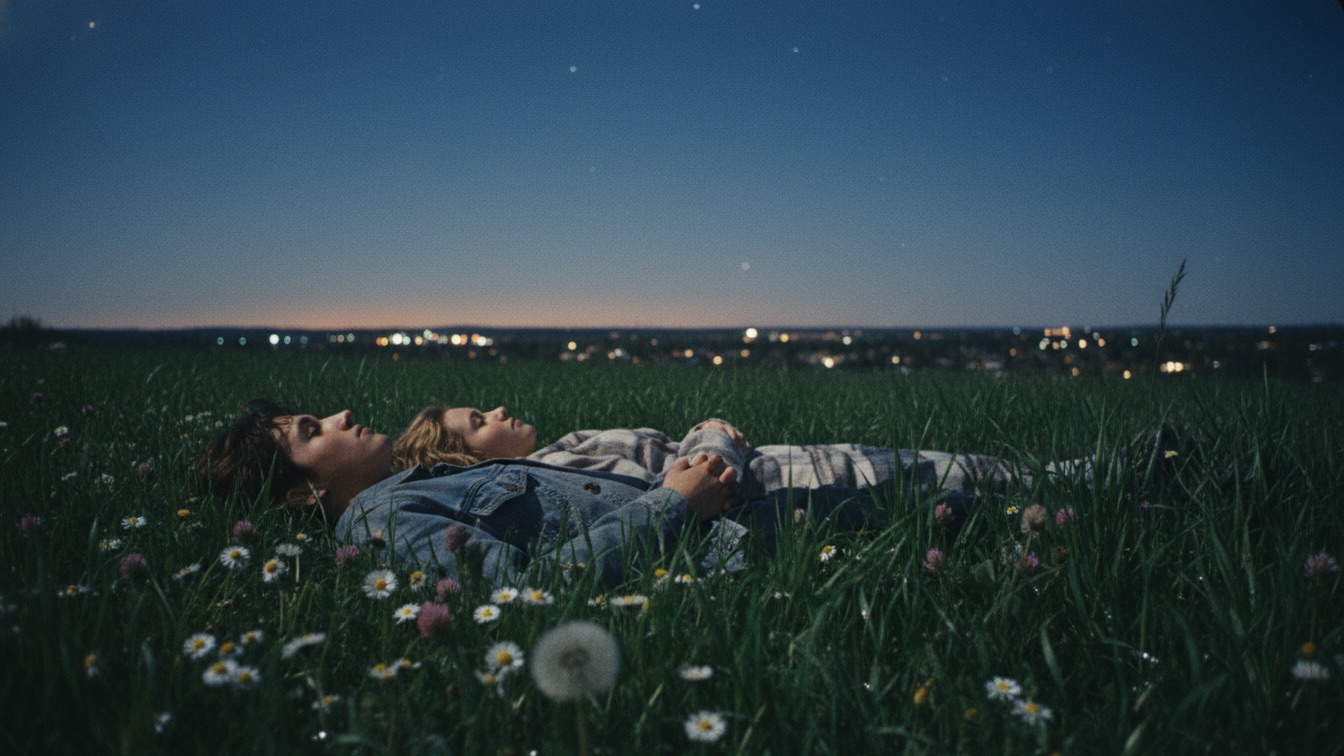
Ben's thigh twitched with a phantom vibration. The phone was gone, but the ghost was still there.
"Put it in the box, Ben."
"I'm putting it in the box."
"You're just holding it."
"I'm looking at it."
"Turn it off."
Ben stared at the screen. The glass was cracked in the top right corner. The spiderweb fractures caught the harsh, yellow light of Sam's bedroom ceiling bulb. The battery icon sat at 82%. Four notifications sat on the lock screen. One from his dad. Two from an automated job board. One from a news app telling him the global supply chain was buckling again.
He didn't want to look at them. He wanted to swipe them away. But swiping them meant engaging, and engaging meant falling back into the hole.
"Ben. Seriously. We agreed."
Sam was sitting on the edge of her mattress. Her room was a mess. Clothes piled on a chair. A half-dead pothos plant hanging from a plastic hook over the window. The window was open, letting in the sharp, aggressive smell of spring pollen and wet asphalt. The air outside was bright. Too bright. It was a Saturday afternoon, and the world was happening, and he was terrified of it.
"I know," Ben said. His voice was tight. His throat felt like it was coated in dust.
Between them on the floor was a rusted metal lockbox. Sam had bought it at a surplus store. It looked like it used to hold ammunition.
Sam’s phone was already inside. A black rectangle lying dead on the metal bottom.
Ben dragged his thumb over the power button. He pressed it. The screen flashed. Slide to power off. He swiped. The haptic motor gave one final, weak click against his palm. The screen went black.
He dropped it into the box. It clattered against Sam's phone.
Sam leaned forward, slammed the heavy metal lid shut, and snapped the latch. She grabbed the small brass padlock, fed it through the loop, and clicked it locked.
The sound was incredibly loud. A sharp, final snap.
Silence crashed into the room.
It wasn't a peaceful silence. It was a vacuum. The ambient hum of their digital lives was suddenly cut, leaving a ringing in Ben's ears. He felt a cold sweat break out on the back of his neck. His right thigh twitched. A phantom vibration. His brain firing a false signal, begging for the hit.
"Where are you putting the key?" Ben asked. His voice sounded too loud in the small room.
"In the freezer," Sam said. She stood up, grabbed the tiny silver key, and walked out of the bedroom.
Ben followed her into the narrow kitchen. The apartment smelled like old cooking oil and bleach. He watched her open the freezer, pull out an empty ice tray, drop the key into the plastic bottom, and fill it with tap water. She shoved the tray back into the freezer and slammed the door.
"There," she said. "Forty-eight hours. We can't get to it unless we melt the ice. And if we try to melt the ice, we have to sit here and watch it melt, and we'll feel like idiots."
Ben swallowed hard. "Right."
"You're shaking."
"I'm not shaking."
"Your hands are in your pockets and your shoulders are twitching."
Ben pulled his hands out of his pockets. They were sweating. He wiped them on his jeans. "I just. What if there's an emergency?"
"What emergency?" Sam leaned against the cheap laminate counter. "Your dad is going to text you about your resume. The job algorithm is going to reject you. The world is going to keep burning. None of that requires you to be instantly accessible. If someone dies, the police will come to the door."
"Dark."
"Realistic."
Ben looked at the kitchen clock. It was analog. A cheap plastic circle with a red second hand ticking loudly. 1:14 PM. The weekend stretched out in front of him like an endless, terrifying desert. No feeds. No scrolling. No distraction. Just his own brain.
His brain was a terrible place to be.
"What do we do now?" he asked.
"We go outside."
"And do what?"
"Whatever we want. We just walk."
Ben's stomach turned over. Walking without a destination. Walking without a map routing the fastest path. It felt reckless. It felt like stepping off a cliff.
They left the apartment. The hallway smelled like stale cigarette smoke. The stairs creaked. They pushed through the heavy glass lobby door and stepped out onto the sidewalk.
The spring air hit him like a physical blow.
It was sharp. It was cold in the shade and hot in the sun. The sky was an unforgiving, blinding blue. There were no clouds. Just a massive, empty expanse stretching over the city.
Cars rushed past on the street. The noise was chaotic. Unfiltered. Usually, Ben had his earbuds in. Noise cancellation turned up to the max. He curated his audio environment. A lo-fi beat. A podcast. A wall of sound to keep the city out.
Now, the city was just screaming at him.
Tires hissing on pavement. A siren wailing three blocks over. Two people arguing at a bus stop. A dog barking. The grinding roar of a garbage truck backing up. It was a massive, overlapping wave of unorganized data.
"Which way?" Sam asked.
She was wearing a faded denim jacket and her beat-up sneakers. She looked around. She actually looked. Her head was up.
Ben realized he usually stared at the sidewalk.
"I don't know," Ben said. "East? Toward the river?"
"Sure."
They started walking.
The first ten minutes were agony. Ben's right hand kept drifting toward his pocket. A nervous twitch. Every time he saw something weird—a stray cat sitting on a trash can, a poster ripped in half to make a funny face—his brain fired a command: Take a picture. Post it. Share it. Validate it.
When he reached for his pocket and found it empty, a spike of anxiety hit his chest. The moment wasn't documented. It just happened. And then it was gone. It felt like a loss.
"Stop reaching for it," Sam said. She didn't even look at him. She just saw his shoulder dip.
"I'm not."
"You've reached for your pocket six times since we crossed 4th Street."
"I'm just checking my keys."
"Liar."
Ben sighed. "It's muscle memory. I can't help it. I feel like I'm missing an organ."
"You're detoxing."
"Don't use therapy talk on me."
"I'm just saying. Look at this."
She gestured around them. They were passing a row of old brick storefronts. Most of them were empty. Paper pasted over the windows. The victims of the last economic dip. But between the cracks in the concrete, weeds were pushing up. Vicious, bright green shoots fighting through the gray.
"It's just weeds," Ben said.
"It's life," Sam shot back. "It's doing its thing. It doesn't care about the rent."
They kept walking. The blocks blurred together. Without a phone to check the time, Ben felt untethered. Was it 2:00? Was it 3:00? Time expanded. It stretched out, slow and sticky.
They crossed over the highway overpass. The cars below were a river of metal and exhaust. The smell of gasoline was heavy.
"Are we lost?" Ben asked. He looked at the street signs. They were in the industrial district now. Warehouses. Chain-link fences topped with razor wire. Potholes the size of manhole covers.
"You can't be lost if you don't have a destination," Sam said.
"That's a bumper sticker. We are physically in an unknown location."
"We're in our own city, Ben. We live three miles away."
"Yeah, and I don't know how to get back without a blue dot on a screen telling me to turn left."
His breathing was getting shallow. The claustrophobia was creeping in. The sky was huge, but the walls of the warehouses felt like they were pressing down on him. The static in his head—the lingering noise of the digital feed—was trying to fill the silence. He started listing his problems mentally. The student loans. The unanswered applications. The fact that he had twenty-three dollars in his checking account.
Panic. Tight chest. Short breath.
"Hey," Sam said. She stopped.
She grabbed his jacket sleeve. She pulled hard.
"What?"
"Listen."
Ben stopped. He forced himself to listen. Past the distant roar of the highway. Past the wind hitting the metal siding of the buildings.
Music.
Not a car stereo. Not a passing boombox. It was steady. A heavy bassline. Coming from an alley between two massive, corrugated steel buildings.
And voices. Real, overlapping, unmic'd human voices. Someone laughing. A loud, sharp bark of laughter.
"What is that?" Ben asked. "A party? Out here?"
"Let's find out."
Sam didn't wait. She turned down the alley. Ben hesitated, his stomach twisting. His instinct was to check a local app. See if there was an event registered. See if it was safe. See if it was rated. But his pocket was empty.
He had to just go.
He jogged a few steps to catch up with her. The alley was dark, the sun blocked by the high walls. It smelled like damp brick and old garbage. But at the end of the alley, it opened up into a massive, sunlit yard.
Ben stopped dead. Sam bumped into his shoulder.
It was a vacant lot. Maybe an acre of cracked concrete, boxed in by the backs of four different warehouses. But it wasn't empty.
It was entirely transformed.
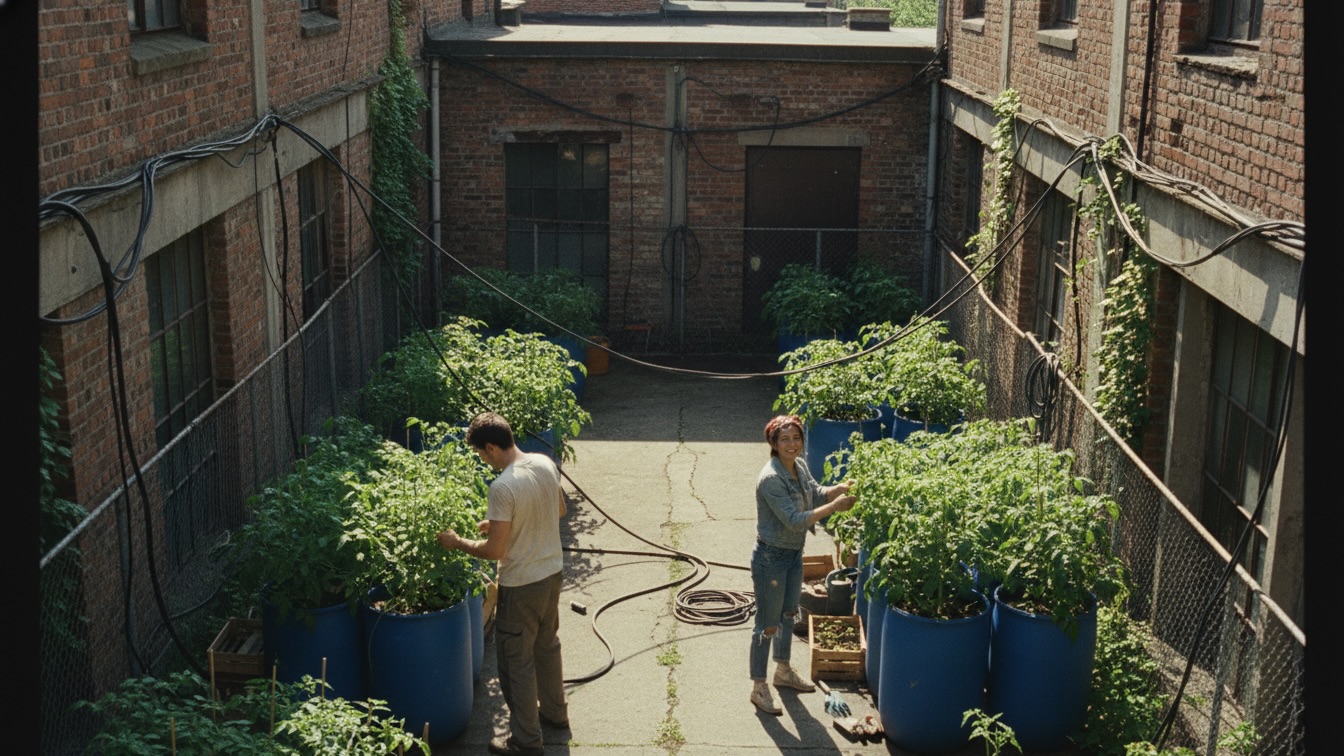
Dozens of halved blue plastic barrels were lined up in neat rows. They were filled with dark, rich soil. Green plants were exploding out of them. Tomatoes. Peppers. Things Ben couldn't identify.
People were everywhere. Maybe twenty of them. All ages. A guy with gray hair was welding a frame together out of rusted rebar. Sparks showered the concrete. Three teenagers were sitting on a battered leather couch that had been dragged outside, passing around a bag of chips.
But the weirdest part wasn't the garden. It was the cables.
Thick, black ethernet cables were strung like clotheslines between the buildings. They dropped down from the roofs, zip-tied to downspouts, running into heavy plastic storage bins on the ground. Solar panels were bolted to the warehouse walls, their wires snaking down into marine batteries.
It was a chaotic, jury-rigged mess of dirt and tech.
"What is this place?" Sam whispered.
"Can I help you two?"
A voice behind them. Ben spun around. His heart hammered against his ribs.
A woman was standing there. She looked to be in her twenties. She wore thick canvas work pants stained with grease and a faded black t-shirt. She was holding a clipboard. A real, actual clipboard with paper on it.
"Uh," Ben stammered. "No. We just. We heard the music."
The woman looked them up and down. She didn't look mean, just cautious. She noted Ben's empty hands. Sam's empty hands.
"You looking for a signal?" the woman asked. "Because we block the commercial bands here. You won't get cell service past the alley."
Ben blinked. "You block it?"
"Faraday netting on the perimeter fence," she said, pointing to a chain-link fence covered in a fine metallic mesh. "Keeps the noise out. Keeps the scrapers from pinging our devices. I'm Maya, by the way."
"I'm Sam. This is Ben."
Sam stepped forward. She was looking past Maya, staring at the blue barrels. "Is this a community garden?"
Maya smiled. The caution dropped a little. "Partly. It's a node. Garden's just how we feed the people running it."
"Running what?" Ben asked.
Maya gestured with her pen toward the cables strung over their heads. "The mesh. You guys know what a local mesh network is?"
Ben shook his head. He knew software. He knew algorithms. He knew how to get rejected by an AI HR bot. He didn't know hardware.
"Come here," Maya said.
She walked past them, deeper into the lot. Ben and Sam followed. The smell of the place was intense. Wet soil. Ozone from the welder. Sweet spring air. Sweat.
Maya led them to one of the heavy plastic storage bins. She popped the lid. Inside, it was a rat's nest of wires, but at the center was a stack of routers and a small, humming server rack.
"We don't use the main grid," Maya said. Her voice was flat, practical. "The ISPs throttle everything. They track your data. They sell your location. They feed you the algorithm. So, we stopped using them."
Ben stared at the blinking green lights on the router. "You just... built your own internet?"
"Intranet," a new voice said.
A guy slid out from under a nearby solar panel array. He had grease on his forehead and a wrench in his hand. "It doesn't connect to the outside world. It connects to the other nodes in the neighborhood. Three blocks that way, there's another setup on an apartment roof. Five blocks south, another one in a basement."
"I'm Taren," the guy said, wiping his hand on a rag and offering it to Ben.
Ben shook it. Taren's hand was rough. Calloused. Real.
"Wait," Sam said. She was frowning. "If it doesn't connect to the internet, what's on it?"
"Just us," Taren said. He tossed the rag onto a crate. "A local bulletin board. A file-sharing server. A library of PDFs. Schematics for fixing appliances. Seeds we're trading. It's just a tool. It's not a casino. It doesn't want your attention. It just sits there until you need it."
Ben looked at the plastic bin. He looked at the thick black cable running out of it, trailing across the cracked concrete, wrapping around a rusted pipe, and shooting up the brick wall.
He followed the line of the cable with his eyes.
It was physical.
It wasn't a cloud. It wasn't a server farm in Virginia running a million calculations a second to figure out how to keep him angry and scrolling. It was right here. He could touch it. He could trace it from point A to point B.
If it broke, Taren could fix it with a wrench and some tape.
If the power went out, the solar panels caught the spring sun and kept it alive.
It was a closed loop.
Suddenly, the air shifted.
Or maybe it was Ben.
The tight, crushing band that had been wrapped around his chest since he woke up—since he turned sixteen, really—snapped.
It was a physical sensation. A sudden, violent release of pressure. The invisible ceiling of the digital world, the massive, looming threat of the metrics, the scores, the ratings, the infinite doomscroll—it didn't exist here. The Faraday cage blocked it. The local node rejected it.
This space was a blank spot on the map.
Ben dragged a breath in.
It went deep. Past his tight throat, past his rigid ribs, all the way down into his stomach. The smell of the dirt and the ozone filled his lungs.
SUDDEN OXYGEN.
His vision cleared. The harsh, panicked edges of his reality softened. He wasn't floating in a digital void. He was standing on concrete. The sun was hot on his shoulders. He felt the exact weight of his own body. He was just a person, standing in a yard, talking to other people.
The static in his head died.
It didn't fade. It just cut out. Like a plug being pulled from a wall.
"You okay, man?" Taren asked. He was looking at Ben closely.
Ben let the breath out in a long, shaky exhale. He looked at his hands. They had stopped twitching. The phantom buzz in his thigh was gone.
"Yeah," Ben said. His voice was lower. Calmer. "Yeah, I'm good. This is... this is real."
Maya laughed. It was a short, sharp sound. "It has to be. The digital stuff is leased. This? We own this. Because we built it."
Sam stepped past Ben. She walked over to one of the blue barrels. She reached out and touched the dirt. She rubbed it between her fingers. It stained her skin dark brown.
"You grow tomatoes?" she asked Maya.
"Tomatoes. Zucchini. Jalapeños. Trying to get some carrots going, but the soil pH is a nightmare."
Sam looked back at Ben. Her eyes were wide. The dark circles under them looked less like bruises and more like shadows. She looked awake.
"I want to plant something," Sam said.
Maya nodded. She didn't ask for a subscription. She didn't ask for an email address. She just pointed to a stack of empty pots near the fence.
"Grab a trowel," Maya said. "Pile of compost is out back. Mix it fifty-fifty with the topsoil."
Sam didn't hesitate. She walked over, grabbed a rusted metal hand trowel, and headed for the compost pile.
Ben stood there. He looked at Taren.
"I don't know anything about plants," Ben said.
"Good," Taren said. He picked up his wrench. "Because I need to run a cat6 cable up to the roof to realign the antenna. You afraid of heights?"
Ben looked up. The warehouse roof was three stories high. A rusted iron fire escape clung to the brick wall. It looked dangerous. It looked old.
It looked completely physical.
"No," Ben said. "I'm not."
"Grab that spool of wire," Taren said, pointing to a heavy wooden spool wrapped in thick black cable.
Ben walked over to the spool. He bent down and grabbed it. It was heavy. It dug into his fingers. The rough wood scraped against his palms. The friction of the real world. He hoisted it up against his chest. His muscles strained.
It felt fantastic.
For the next three hours, Ben didn't think about his phone.
He didn't think about his dad. He didn't think about the logistics company that had rejected him. He didn't think about his credit score or his carbon footprint or the fact that the oceans were dying.
He thought about the cable.
He thought about his footing on the rusted iron stairs. He thought about the wind whipping across the flat tar roof of the warehouse. He thought about passing the wire to Taren, watching the guy strip the casing, crimp the plastic connector onto the colored wires, and plug it into a weather-beaten grey box mounted to a cinderblock.
"Done," Taren said, snapping the box shut.
Ben sat down on the edge of the roof. His legs dangled over the side. His hands were black with dirt and grease. There was a scrape on his knuckle from where he'd slipped on the ladder. It stung. A sharp, bright, physical pain. He pressed his thumb against it, feeling the blood dry.
He looked out over the city.
The sun was starting to set. The sky was turning a deep, bruised purple. The glass towers in the financial district miles away were catching the last of the light, flaring like matches before dying out.
Down below, in the yard, he could see Sam.
She was kneeling on the concrete. She had three pots lined up in front of her. She was carefully packing dirt around small green seedlings. Maya was sitting on the leather couch, drinking out of a dented aluminum water bottle. The guy with the gray hair was sweeping up metal shavings.
It was quiet.
Not silent. The city still hummed. The distant highway still roared. But the immediate space was calm. The frantic, desperate energy of the feed was gone.
Taren sat down next to him. He pulled two crushed cans of soda from his jacket pockets and handed one to Ben.
"Thanks," Ben said. He popped the tab. It was warm, flat orange soda. It tasted like heaven.
"You guys just wandering?" Taren asked.
"Yeah. Locked our phones in a box. Trying to see what happens."
Taren nodded. He didn't look surprised. "Withdrawal is rough. First day, you feel like you're missing a limb. Second day, you start noticing how loud the birds are. Third day, you never want to turn it back on."
"Will you?" Ben asked. "Turn it back on?"
"Have to," Taren said. He took a drink. "I work at a hardware store four days a week. Gotta clock in on the app. Gotta pay rent through the portal. You can't escape the machine entirely. It's too big. It owns the roads and the pipes and the money."
Ben felt a familiar cold spike in his chest. The reality checking back in.
"But," Taren added, looking down at the yard. "You don't have to live in it full time. You carve out a pocket. You build a wall. You grow some tomatoes. You run your own wire. You make a place where they can't track you. It's not about defeating the system. It's about surviving it without losing your mind."
Ben nodded slowly. He looked at his dirty hands.
He wasn't saving the world. He was just sitting on a roof. But for the first time in years, he didn't feel like he was drowning.
The sky went totally dark. The automated streetlights on the surrounding blocks flickered on, casting a sickly yellow glow over the streets. But inside the yard, someone flipped a switch, and string lights powered by the solar batteries clicked on. Warm, soft, imperfect light.
Ben stood up. His muscles ached. A real, earned ache.
"We should go down," Taren said. "Maya's probably breaking out the grill."
"Yeah," Ben said.
He climbed down the fire escape. The metal was cold under his hands. When he reached the bottom, Sam was washing her hands under a PVC pipe hooked to a rain barrel.
She looked up at him. She had dirt smeared across her cheek.
"Hey," she said.
"Hey."
"I planted jalapeños."
"Nice."
She dried her hands on her jeans. "You smell like rust."
"I helped wire an antenna."
They stood there in the middle of the yard. The smell of charcoal starting to burn. The sound of low voices. The heavy, comforting weight of physical reality surrounding them.
Ben knew the metal lockbox was waiting in Sam's apartment. He knew the ice in the freezer was slowly freezing around the key. He knew Monday was coming, and with it, the emails, the rejections, the metrics, the red bars, and the pings.
The machine was out there, circling the Faraday fence, waiting for them to step back onto the grid.
But right now, he couldn't hear it.
He reached into his empty pocket. Not to check for a phone. Just to keep his hand warm.
“He reached into his empty pocket. Not to check for a phone. Just to keep his hand warm.”