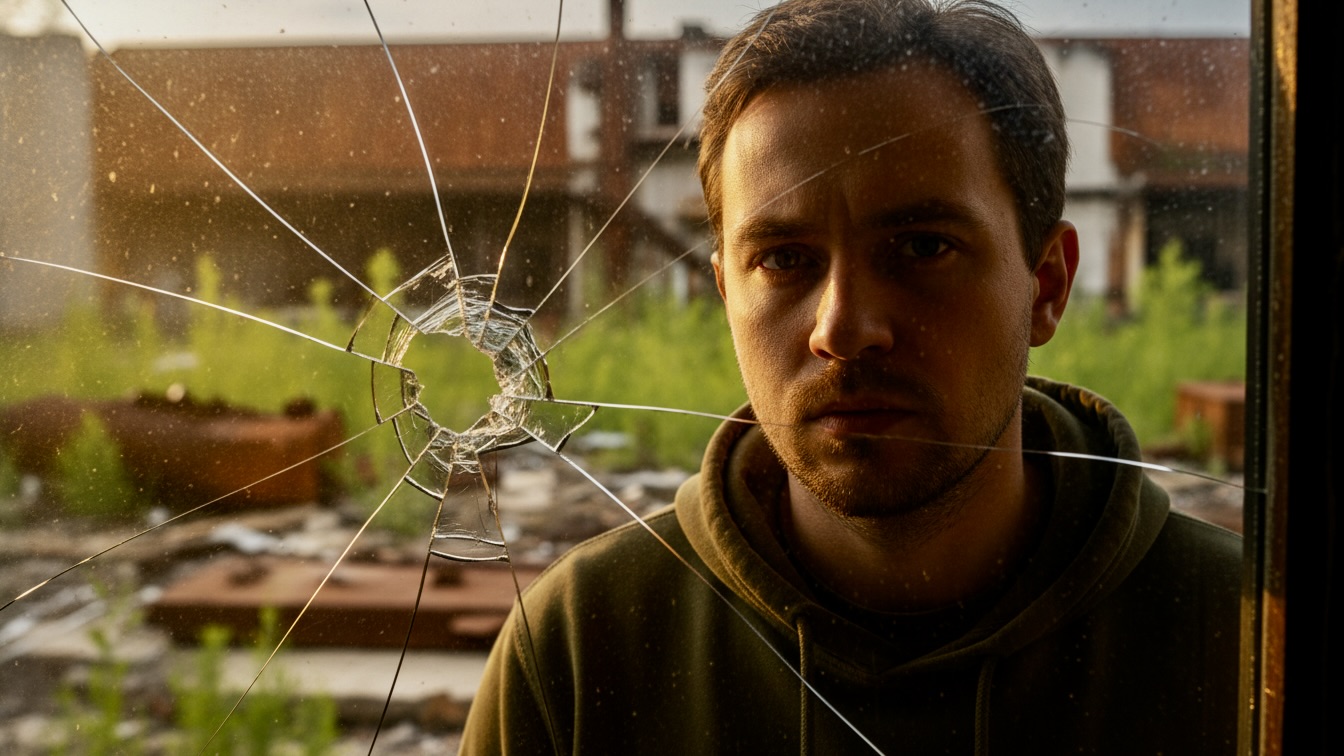
Carl watches green weeds choke a server rack while Sam jokes about the end of the world coming early.
The dandelion was winning. It had pushed through a hairline crack in the concrete floor of the logistics hub, its stem a neon green that looked almost radioactive against the grey dust. Carl watched it. He didn't have anything better to do while his lungs burned from the climb. The air in here smelled like damp drywall and something metallic, like a penny under your tongue. It was spring, apparently. Not that the calendar mattered. The only way you knew was by the way the mold started to fuzz over the remaining leather seats in the lobby and how the light felt less like a threat and more like a spotlight. Everything was too bright. It made the decay look high-definition.
"You done staring at the weed? We have a schedule, sort of," Sam said. He was leaning against a rusted sorting bin, his fingers tapping a frantic, irregular rhythm on his thigh. Sam couldn't stay still. Silence made him itch. He looked like he hadn't slept since 2024, his eyes rimmed with a permanent red puffiness that he claimed was allergies. It was probably just the stress of existing.
"It's not a weed. It's a bio-hazard," Carl muttered. He straightened up, his knees popping with a sound like dry twigs snapping. "And we don't have a schedule. We have a vague hope that the batteries in the basement haven't turned into soup yet."
"Optimism is your best quality, Carl. Truly. It's why I keep you around for the vibes," Sam said, pushing off the bin. He checked his wrist—not a watch, just a habit of looking at where a screen used to be. "If we don't get the cells, the mesh network goes down by Tuesday. And if the mesh goes down, I have to actually talk to people in person. Do you want that for me? Do you want me to have to make eye contact with the neighbors?"
"I want you to shut up for five seconds so I can hear if the ventilation fans are still spinning," Carl said. He tilted his head. The building was breathing. A low, rhythmic groan of metal settling against metal. Somewhere, three floors up, a piece of loose siding slapped against the exterior wall. Thwack. Thwack. It sounded like a heartbeat. A slow, dying one. He felt his own heart trying to match the pace, speeding up to compensate for the crushing stillness of the room. Every shadow in the corner of his eye was a drone. Every gust of wind through the broken skylight was someone's breath on his neck.
"Fans are dead, man. Everything is dead. We're just the maggots moving the corpse around," Sam whispered. He stepped over a pile of disintegrated shipping envelopes. "Look at this. Amazon Prime. Remember when you could get a literal toilet seat delivered to your house in four hours? Now it takes me four hours just to find a clean pair of socks."
"Stop talking about the old world. It's cringe," Carl said. He moved toward the stairwell, his boots crunching on glass. The sound was too loud. In his head, it sounded like a gunshot. He froze, hand hovering over the grip of the prybar tucked into his belt. He waited for the response. The counter-attack. The 'Eyes' were always supposed to be watching, even if nobody had seen a patrol in months. Paranoia was the only thing that kept the blood moving in his veins. It was better than the alternative. The alternative was the heavy, wet blanket of realization that they were just scavenging the scraps of a dinner party they weren't invited to.
They reached the basement door. It was heavy steel, painted a safety orange that had faded to the color of a bruised peach. Carl put his ear to the metal. Cold. Still. He could feel the vibration of the earth, a deep hum that felt like it was coming from the center of the planet. Or maybe it was just the tremors in his own hands. He hated the basement. The basement was where the dark felt heavy. It wasn't just the absence of light; it was a physical weight, like being underwater.
"Ready to go into the abyss?" Sam asked. He held up a flashlight. The casing was cracked and held together with blue painter's tape. "I promise not to leave you if a mutant rat tries to claim your soul."
"If a rat wants my soul, he can have it. It’s a low-value asset," Carl said. He pulled the door. It didn't groan. It shrieked. The sound echoed down the concrete throat of the stairwell, bouncing off the walls until it sounded like a choir of dying machinery. Carl winced, his teeth aching from the vibration. "Subtle. Real subtle, Sam."
"Hey, I didn't oil the hinges. Management is really slacking lately. I'll write a strongly worded review on Yelp," Sam retorted, but his voice was thinner now. He stepped into the dark, the beam of his flashlight cutting a shaky path through the dust motes. The dust was thick down here, a grey snow that never melted. It tasted like old paper and skin cells.
They descended. Step by step. The air grew colder, holding onto the winter that the surface had already started to shed. Carl’s internal clock was malfunctioning. He felt like they’d been walking for an hour, but the door was still visible above them, a square of blinding spring light that looked like a portal to another dimension. He focused on the back of Sam's jacket—a denim thing covered in patches that didn't mean anything anymore. A smiley face with a bullet hole through the forehead. A logo for a tech company that had gone bankrupt ten years ago. It was a map of a world that didn't exist.
"There," Sam whispered. He pointed the light toward a rack of lead-acid batteries. They were huge, black cubes sitting in a pool of dark liquid. The floor was stained, a Rorschach blot of chemical rot. "Please tell me those aren't leaking. Please tell me I don't have to touch acid today. My skin is already a disaster."
Carl knelt, keeping his distance from the puddle. He pulled a multimeter from his pocket. The screen was scratched, but the numbers were still legible. He touched the probes to the terminals. A spark jumped, blue and angry. He jumped back, his heart hammering against his ribs like a trapped bird.
"Life sign detected," Carl breathed. He looked at the readout. "They're holding. Barely. It’s enough to keep the signal alive for another week."
"A week. Great. We're risking our lives for seven days of shitty internet," Sam said. He sat down on an overturned crate, the wood groaning under him. "Why do we do this, Carl? Seriously. The mesh doesn't even have anything good on it anymore. It's just people trading digital pictures of their cats and complaining about the government that isn't even there anymore."
"It’s not about the content. It’s about the connection," Carl said, though it sounded hollow even to him. He began unbolting the first battery. His fingers were stiff. "If we lose the network, we're just ghosts in a graveyard. As long as the signal is up, someone is listening. Even if it's just you and me."
"I’m always listening, babe. That’s the problem," Sam said. He swung the flashlight around the room. The beam hit a pile of old office chairs, their stuffing exploding out like tumors. "This place gives me the creeps. It feels like the building is waiting for us to leave so it can finally collapse. It’s being polite. It’s got manners."
"Buildings don't have manners. They have gravity," Carl said. He lugged the first battery out. It weighed a ton. His muscles screamed, a dull, thudding ache that started in his lower back and radiated up to his jaw. He felt the sweat cooling on his forehead, turning clammy. This was the reality of the spring. Not flowers. Just heavy lifting in the dark.
They worked in a tense silence for the next hour. The only sounds were the clinking of tools and Sam’s occasional, nervous humming. He was humming an old pop song, something about a summer that never ended. It felt like an insult. The spring was a lie. It was just a fresh coat of paint on a house that was already on fire. Carl could feel the paranoia creeping back in, the localized heat of being watched. He kept looking over his shoulder, expecting to see a figure standing at the top of the stairs, silhouetted against that bright, fake light. But there was nothing. Just the dust.
"Last one," Carl panted. He wiped his hands on his jeans. They were stained black. "Let's get out of here before the floor decides it’s done holding us up."
"Music to my ears," Sam said. He grabbed the other side of the battery crate. Together, they began the slow, agonizing haul back up the stairs. Every step was a negotiation with their own exhaustion. Carl’s vision blurred. The grey concrete turned into a smear of static. He felt like he was glitching, his frame rate dropping as his body reached its limit.
When they finally broke through the basement door and back into the lobby, the light hit them like a physical blow. Carl squinted, his eyes watering. The dandelion was still there. It looked different now. Taller? Or maybe he was just lower. He slumped against the wall, his lungs heaving. The air felt too thin, too full of that sweet, cloying scent of blooming things and rot.
"We did it," Sam said, though he looked like he was about to vomit. He leaned over his knees. "We saved the world for another seven days. Someone give me a medal. Or a sandwich. I’d prefer the sandwich."
"We saved ourselves from having to talk to each other without a screen," Carl corrected. He looked at the batteries. They looked like black coffins. "That’s all we ever do. We just buy more time to be bored."
"Boredom is a luxury, Carl. Most people are busy being dead," Sam said. He straightened up, trying to regain some of his usual bravado. He adjusted his denim jacket. "Come on. Let's get these to the truck. I think I heard a drone a few minutes ago. Or maybe it was just a very loud bee. Everything sounds like a threat these days."
Carl stood up. He looked at the dandelion one last time. He had the sudden, violent urge to kick it. To crush that bright, stubborn bit of life back into the dirt where it belonged. It didn't belong here. This world wasn't for things that grew. It was for things that stayed broken. But he didn't. He just turned away.
As they loaded the truck, a beat-up thing that ran on prayers and recycled cooking oil, Carl noticed something on the horizon. A plume of smoke. Thin, white, and steady. It wasn't a wildfire. It was intentional. A signal? Or a warning?
"Sam," Carl said, nodding toward the smoke.
Sam stopped, his hand on the tailgate. The wit drained from his face, replaced by a jagged, sharp alertness. He didn't make a joke. He didn't pivot. He just stared.
"That's the north sector," Sam whispered. "The relay is over there. The one we couldn't reach last month."
"Someone’s out there," Carl said. The paranoia wasn't a buzz in his ears anymore. It was a cold weight in his stomach. The ticking clock in his head suddenly doubled its speed. The spring wasn't just bringing mold and weeds. It was bringing people. And in this world, people were the most dangerous kind of decay.
"We should go check it out," Sam said. It wasn't a suggestion. It was a realization. The banter was gone. The irony had finally failed him.
Carl climbed into the driver’s seat. The plastic of the steering wheel was cracked, biting into his palms. He looked at the smoke, then at the batteries in the back. A week of signal. A week of searching. He turned the key, and the engine coughed into a rough, sputtering life, echoing through the empty, sun-drenched ruins of the hub.
“The smoke wasn't a fire; it was a heartbeat in a dead world, and it was calling them into the north.”


