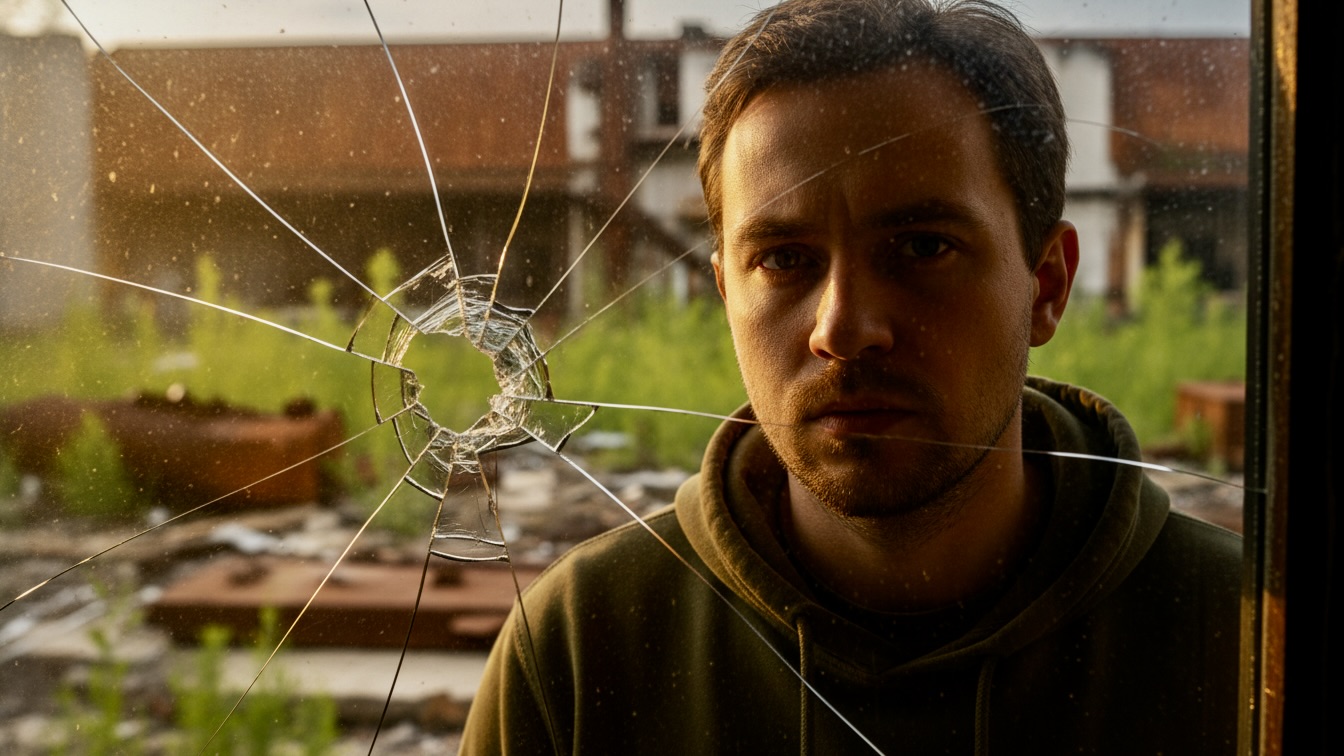
The narrative follows two men, Carl and Sam, as they scavenge a derelict logistics hub for lead-acid batteries. Their goal is to maintain a "mesh network," a localized digital connection that represents the final vestige of the old world’s connectivity. The environment is one of oppressive decay, where the arrival of spring is viewed not as a renewal, but as a "high-definition" spotlight on the rot of civilization. After a physically and psychologically grueling descent into the building's basement, they successfully retrieve the power cells. However, the triumph is short-lived as they spot a plume of smoke on the horizon. This signal of human presence shifts their focus from the struggle against entropy to the imminent threat of external conflict.
The central theme of the story is the grotesque inversion of nature and technology. In this post-apocalyptic setting, natural growth is depicted as an invasive, almost predatory force. The dandelion is described as "radioactive" and a "bio-hazard," suggesting that for the survivors, the resurgence of the organic world is a reminder of their own obsolescence. Nature does not offer hope; instead, it provides the "mold" and "fuzz" that consume the remnants of human comfort, creating a psychological landscape where the characters feel hunted by the very environment that should sustain them.
Another major theme is the desperate human dependency on technological ghosts. Carl and Sam risk their lives for "seven days of shitty internet," highlighting a psychological need for connectivity that outlives the utility of the connection itself. The mesh network serves as a digital graveyard where the living trade meaningless data to avoid the "crushing stillness" of their reality. This dependency suggests that the characters are unable to forge a new identity outside of the frameworks provided by the "old world." They are tethered to a dead civilization by a signal that offers no real future, only a temporary distraction from their status as "maggots moving the corpse around."
The narrative also explores the theme of entropy and the futility of human effort. The logistics hub, once a monument to instant gratification and global commerce, has become a "concrete throat" that swallows the characters' energy. Every action they take is a "negotiation with their own exhaustion," a metaphor for the broader human condition in this setting. They are not building a new world; they are merely buying time in a house that is "already on fire." This creates a sense of existential dread, as the characters realize that their hard-won victories only lead back to the same "boredom" and "decay."
Carl is a man defined by hyper-vigilance and a profound sense of existential exhaustion. He experiences his surroundings through a lens of physical pain and psychological trauma, where his own body seems to be betraying him. His knees pop like "dry twigs," and his lungs burn from the simple act of breathing the stagnant air of the hub. This physical deterioration mirrors his internal state, as he has surrendered to a worldview where "paranoia was the only thing that kept the blood moving." He is the pragmatic anchor of the duo, focusing on the mechanical realities of survival to avoid the "heavy, wet blanket" of his own hopelessness.
Carl’s psychological defense mechanism is a rigid, almost aggressive cynicism. He rejects the beauty of the dandelion and the nostalgia of the old world, labeling the past as "cringe" to distance himself from the pain of loss. He views the batteries as "black coffins," showing that he is acutely aware that their efforts are merely burying the present rather than birthing a future. When he sees the smoke on the horizon, his transition from exhaustion to "jagged, sharp alertness" reveals that his survival instinct is entirely predicated on the expectation of threat. He does not seek community; he seeks to avoid the "dangerous decay" that other people represent.
Sam serves as the psychological foil to Carl, utilizing constant verbalization and forced irony to mask a debilitating state of anxiety. He is a man who cannot endure silence because it forces him to confront the "itch" of his own existence. His "permanent red puffiness" and frantic tapping suggest a nervous system that is permanently stuck in a high-stress loop. By talking about Amazon Prime and Yelp reviews, he attempts to maintain a tether to a reality that no longer exists. This linguistic performance is his primary survival strategy, allowing him to navigate the "abyss" of the basement without completely succumbing to the weight of the dark.
Despite his attempts at humor, Sam is deeply fragile and reliant on the mesh network for a sense of self. He admits that he fears having to "actually talk to people in person," suggesting a profound social anxiety that has been exacerbated by the collapse of society. His humor is a "thin" facade that collapses the moment a real, external threat appears in the form of the smoke plume. When the "irony finally failed him," Sam was forced to face the reality that their isolated bubble was about to burst. This shift indicates that his bravado was never a sign of strength, but a desperate attempt to drown out the "heartbeat" of a dying world.
The tone of the narrative is characterized by a "high-definition" grimness that utilizes visceral sensory details to immerse the reader in a world of rot. The author employs metaphors that bridge the gap between the mechanical and the biological, such as the building "breathing" or the basement feeling like a "concrete throat." These descriptions create an atmosphere of claustrophobia and decay, making the setting feel like an active antagonist. The contrast between the "blinding spring light" and the "grey snow" of the dust emphasizes the characters' alienation from the natural world, reinforcing the psychological weight of their environment.
The pacing of the story mirrors the physical and mental strain of the protagonists. The narrative moves slowly through the stagnant air of the lobby and the grueling descent into the basement, creating a sense of "glitching" reality where time feels distorted. The dialogue between Carl and Sam provides a rhythmic counterpoint to the heavy, descriptive prose, offering a glimpse into their shared history and mutual dependence. This balance between internal monologue and external banter keeps the reader grounded in the characters' immediate struggle while hinting at the vast, empty world outside the hub.
The narrative voice is one of detached observation, which heightens the impact of the characters' occasional emotional outbursts. By describing the "smiley face with a bullet hole" or the "Rorschach blot of chemical rot," the author avoids sentimentality in favor of a stark, uncompromising realism. This stylistic choice aligns with the characters' own survival strategies, where any hint of genuine hope is treated with suspicion. The sudden acceleration of the plot at the end, triggered by the sight of the smoke, effectively shatters the established rhythm of scavenging, leaving the reader with a sense of impending, unavoidable change.


