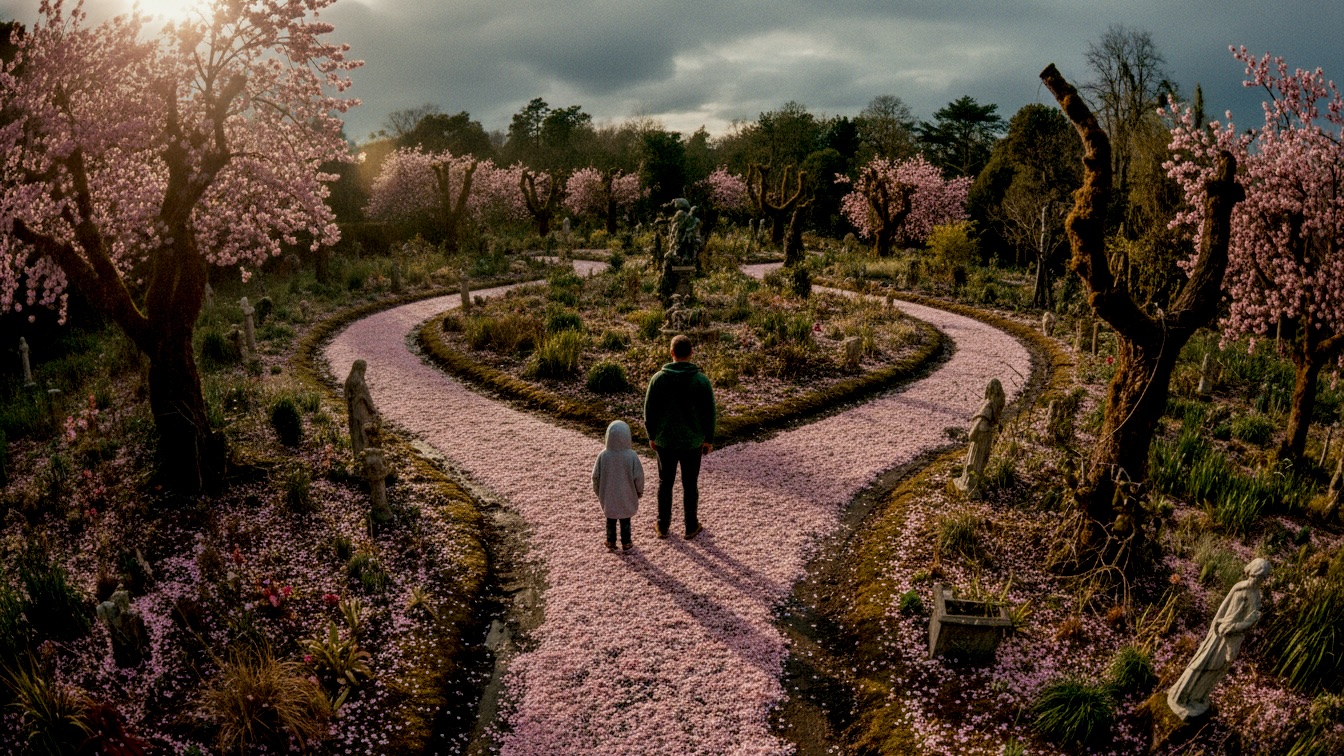
Leo stands paralyzed in his damp, muddy garden, caught between the mundane safety of his home and a mysterious, overgrown path. His ten-year-old niece, Maya, interrupts his internal stagnation, mocking his indecision and pushing him to explore the more treacherous, "secret" route. As they venture toward the lilac bushes, the environment takes on a surreal and oppressive quality, manifesting Leo's internal anxieties as a physical "Grey Weight."
The pair discovers a buried tin box containing an ancient iron key and a photograph that suggests a cyclical, perhaps supernatural, connection between Leo and the garden's history. As Leo’s hand begins to physically merge with his rusted trowel, the garden transforms into a hostile, shifting labyrinth that erases the path back to his house. They eventually reach a massive iron gate where Maya uses the key to step into a blinding white light. Leo, initially anchored by his rusted limb and the weight of his past, must literally dig himself out of the earth to follow her, ultimately finding a state of suspension between the dark garden and the transcendent light.
The central theme of the narrative is the paralyzing nature of existential stagnation and the psychological cost of indecision. Leo’s "Grey Weight" serves as a profound metaphor for clinical depression or a mid-life crisis, where the simple act of choosing a direction becomes a monumental struggle. The mud that clings to his boots represents the accumulated burdens of a life lived without intention, suggesting that when a person refuses to move, the world eventually begins to consume them.
Another significant theme is the concept of inherited trauma or cyclical destiny, evidenced by the discovery of the photograph. The image of a predecessor holding the same trowel suggests that Leo’s struggle is not unique but is part of a recurring pattern of entrapment within this metaphorical garden. The rust on the tool, which eventually spreads to Leo’s skin, symbolizes how the "tools" we use to manage our lives—our habits, our jobs, and our defenses—can eventually become inseparable from our identity, ossifying and trapping us in the process.
The story also explores the dichotomy between the innocence of youth and the cynicism of adulthood through the characters of Maya and Leo. Maya views the garden as a place of potential treasure and adventure, unburdened by the "Grey Weight" that crushes her uncle. Her ability to move with ease and her willingness to grab the key highlight the necessity of a child-like perspective to break through the psychological barriers that adults construct for themselves.
Finally, the narrative touches upon the theme of liberation through struggle. Leo’s eventual escape from the mud is not a passive event; he must use the very tool that anchors him to carve out his freedom. This suggests that salvation requires an active, often painful confrontation with one's own limitations. The ending, where he remains suspended between the light and the gate, implies that true change is a process of transition rather than a sudden arrival at a destination.
Leo is a protagonist defined by his profound psychological inertia and a sense of being overwhelmed by the mundane aspects of his existence. He perceives his life through a lens of "efficiency" and "logic," yet these very concepts have become the bars of his cage, preventing him from taking risks or seeking joy. His internal monologue reveals a man who is hyper-aware of his own dissatisfaction but lacks the initial agency to rectify it, viewing his environment as a series of heavy, wet obstacles.
As the story progresses, Leo’s conflict shifts from a mental struggle to a physical transformation, illustrating the psychosomatic nature of his distress. The rust spreading from the trowel to his hand signifies his loss of autonomy; he has become so defined by his labor and his "tools" that he can no longer distinguish himself from them. This fusion represents a total surrender to the stagnation he feared, turning him into a literal "lawn ornament" as Maya jokingly predicted earlier in the text.
However, Leo’s final moments show a crucial development in his character as he chooses to fight against the garden's grip. By using the trowel to dig himself out, he repurposes the symbol of his entrapment into an instrument of liberation. His willingness to leave the safety of his perceived reality, even if it means dragging a "broken wing" of rust behind him, marks his transition from a victim of circumstance to an active participant in his own fate.
Maya serves as the narrative’s catalyst, representing the unfiltered curiosity and resilience of childhood. She acts as a foil to Leo’s heavy, somber energy, using snark and "gen-alpha" slang to challenge his self-imposed paralysis. To her, the garden is not a psychological minefield but a physical space to be explored, showing that fear is often a learned behavior that she has not yet fully adopted.
Her role shifts from a mere observer to a guide when she takes the iron key, a task Leo is too compromised to perform. This transition highlights her bravery and her functional role as the "door-opener" for Leo’s psyche. While she experiences moments of genuine fear when the garden turns hostile, she does not allow that fear to paralyze her, demonstrating a healthy emotional flexibility that Leo lacks.
Ultimately, Maya represents the hope of the future and the possibility of transcending the "Grey Weight." Her disappearance into the white light at the end suggests a successful transition to a new state of being, unburdened by the rust of the past. She provides the necessary pull for Leo, her voice acting as a beacon that encourages him to complete his difficult journey toward the threshold.
The author utilizes a heavy, sensory-rich prose style to mirror Leo’s internal state, creating a palpable sense of atmospheric pressure. Words like "clumped," "sucking," "leaden," and "cloying" contribute to a feeling of claustrophobia, making the reader feel the "Grey Weight" alongside the protagonist. The transition from a realistic garden setting to a surreal, purple-hued landscape is handled with a slow-burn pacing that effectively heightens the sense of dread.
The narrative voice is deeply intimate, blending Leo’s internal thoughts with third-person observations to blur the line between reality and hallucination. This technique is particularly effective during the scenes where the garden begins to "eat" the house and the path. By describing these impossible events with the same grounded, sensory detail as the mud and the bills, the author forces the reader to accept the garden’s logic as an extension of Leo’s fractured psyche.
Metaphor and symbolism are the backbone of the story’s stylistic identity. The trowel, the rust, the key, and the shifting scents of the garden act as a shorthand for complex psychological states. The contrast between the dull grey of the opening and the blinding white of the ending provides a visual arc for the story, moving from the muddy complexity of a stalled life to the terrifying, yet hopeful, simplicity of a new beginning.


