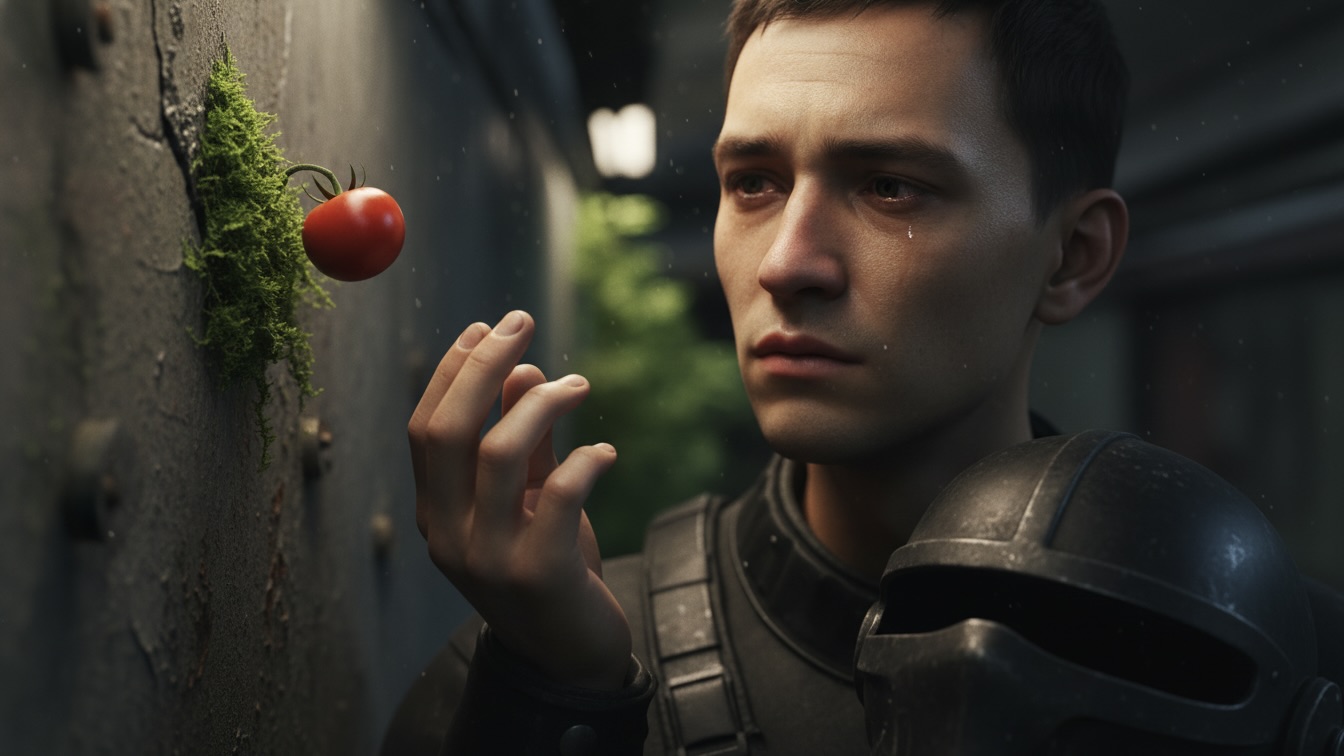
In a dying city, Will discovers a toxic moss that breathes life back into lead-poisoned soil and hope.
The air in Sector 4 tastes like a copper penny resting on your tongue. It stays there, heavy until you forget what breathing is supposed to feel like. I was elbow-deep in a pile of rusted rebar and shattered glass, my fingers searching for anything that hadn't been picked clean by the dawn-shifters. The sun was up, but it didn't do much. It just made the haze look like yellow soup.
"Will, move it," Nora hissed. She was five feet above me on a ledge of crumbling concrete, her eyes scanning the perimeter for Enforcer drones. "The sweep starts in ten minutes. If we're caught here, they'll tag our credits for a month. I'm not eating nutrient paste for thirty days because you wanted to find a spare fuse."
"It’s not a fuse," I muttered. I shoved aside a jagged piece of a cooling unit. My gloves were shredded at the fingertips. "I can feel something. It's heavy. High-density."
"Everything is heavy, Will. It's a scrap heap."
I ignored her. I dug deeper, my shoulder muscles screaming. Then I saw it. It was a Series-9 battery pack, the kind they used for the old transport rigs before the grid went dark. It was massive, the size of a microwave, and leaked a dull, milky fluid from a crack in the casing. But it wasn't the battery that stopped my heart. It was the fuzz.
Growing directly out of the acidic leak, clinging to the lead-stained soil beneath the casing, was a patch of moss. It wasn't the sickly gray mold you find in the damp corners of the hab-units. This was green. A bright, aggressive, neon green that looked like a rendering error against the drab landscape. I reached out, my pulse thumping in my throat.
"Don't touch it," Nora said, her voice dropping an octave. She scrambled down the rubble, her boots kicking up clouds of toxic dust. "That's chemical runoff. You'll lose the skin on your hand."
"It’s breathing," I said. I wasn't being poetic. I could see the tiny stalks of the moss pulsing, almost rhythmically. I cupped my hand near it. The air right there, in that tiny two-inch radius, felt different. It was cool. It was sharp. It felt like... nothing. Not lead, not exhaust, just nothing.
"We need to go," Nora said, grabbing my shoulder. "Now."
I didn't argue. I grabbed the battery pack, acid be damned. The casing burned through my glove instantly, a sharp, stinging heat that made my teeth ache, but I didn't let go. I shoved it into my reinforced pack and we ran. We didn't stop until we hit the mouth of the 4th Street subway entrance—a black hole in the ground that the Enforcers usually avoided because the structural integrity was 'low priority,' which was code for 'deadly.'
We descended into the dark. My lungs burned, but the weight in my pack felt like a heart.
***
Inside the station, the world narrowed down to the beam of my headlamp. The tracks were long gone, stripped for iron years ago, leaving only the gravel and the heavy, leaden soil that had drifted down from the surface through the vents. It was a graveyard of old tech and forgotten commuters.
I set the battery down on a rusted workbench in what used to be the station manager’s office. The moss was still there, glowing faintly in the dark.
"You're losing it," Nora said, leaning against the doorframe. She was rubbing a smudge of soot from her cheek. "You brought a toxic leak into our sleep-space. If that gas builds up, we don't wake up."
"It’s not gas, Nora. Look at the sensor." I pointed to the battered air-quality monitor I’d rigged up. Usually, the needle stayed buried in the red zone, vibrating against the 'Hazard' pin. But as I moved the monitor closer to the moss, the needle drifted. It moved into the orange. Then the yellow.
Nora walked over, her skepticism visible in the way she held her jaw tight. She looked at the needle, then at the moss. "That’s impossible. The soil here is sixty percent lead. Nothing grows in sixty percent lead."
"The moss eats the lead," I said. My mind was racing, connecting dots like a high-speed uplink. "The acid from the battery breaks down the metallic bonds, and the moss... it bio-remediates it. It filters the dirt to get to the minerals. It’s a literal filter."
I spent the next three days in a fever. I didn't sleep. I didn't eat much. I spent my remaining credits on illegal scrap sensors and plastic sheeting. I built a frame in the center of the station floor, right under one of the high vents where a sliver of spring sun managed to poke through the smog. I filled it with the worst, most poisoned dirt I could find. Then, I took a scalpel and carefully divided the moss, pinning it to the battery-waste I’d diluted with gray water.
It felt like waiting for a slow-motion explosion.
By the end of the week, the moss hadn't just survived; it had exploded. It covered the dirt in a thick, velvety carpet. The air in the station began to change. The claustrophobia that had defined my entire life—the feeling of a weight sitting on my chest—started to lift. It was sudden oxygen. It was like a veil being pulled back from my brain. I could think clearly for the first time since I was a kid.
"Will?" Nora called out from the platform. Her voice sounded different. Crisper.
"In here," I said.
She walked into the office-turned-greenhouse. She stopped dead. In the center of the moss, I had planted a single, shriveled seed I’d been carrying in a locket for three years. A tomato seed. It was a long shot. A joke, really.
But there it was. A tiny, fragile sprout, pushing its way through the green.
"Is that..." Nora started. She reached out, her fingers trembling. "Is that real?"
"It’s a plant, Nora. A real one."
She started to cry, but there was no sound. Just the tears tracking lines through the dust on her face. We stood there for a long time, just breathing the air that didn't taste like pennies.
***
Word travels in Sector 4, even when you don't want it to. People in the slums have a sixth sense for hope. It's a dangerous thing to possess, so we usually kill it on sight. But this was different.
It started with the neighbors. Old Man Elias from the block over came by first, clutching a bag of copper wiring. "I heard you got something that cleans the air," he whispered. "My girl, she can't stop coughing. The med-bay wants fifty credits just for an inhaler. I don't have fifty credits."
I didn't take his copper. I gave him a tray of the moss and a jar of the diluted battery acid. "Keep it near her bed," I said. "It needs the light, but not too much. And don't touch the liquid."
Two days later, Elias was back. He didn't say anything. He just handed me a packet of seeds he’d scavenged from a high-rise ruin. Radishes.
Within two weeks, the subway station was no longer a secret. It was a hub. People brought their scrap metal, their broken tech, their precious, hidden seeds. We traded. We worked. We turned the abandoned platform into a patchwork of illegal green. We used the old subway cars as tiered planters, lining them with the moss-filtered soil.
It was a quiet revolution. No flags, no shouting. Just the sound of trowels hitting dirt and the heavy silence of people who were finally able to take a full breath.
Then came the morning the light didn't hit the floor.
I was checking the pH levels in the third car when the shadows shifted. I didn't hear him come in. The Enforcers wear boots designed to dampen sound, a tactical advantage that makes them feel like ghosts.
I turned around, and there he was. Qin.
He was tall, wearing the matte-black tactical gear of the Sector Oversight. His face was obscured by a HUD visor, but I could see his mouth—a hard, thin line. He held a pulse-rifle at low-ready.
"Will, right?" His voice was synthesized, flat and metallic.
I stood up slowly, my hands covered in dark, rich earth. "I'm not breaking any laws, Qin. This is a public space."
"You're using unregistered tech-waste," Qin said. He stepped forward, the sensor on his wrist chirping. "And you're cultivating biological matter without a permit. That’s a Tier 2 violation. I’m supposed to clear this out with a thermal sweep."
My heart was a frantic bird in my ribs. "Then do it," I said, my voice cracking. "Burn it. But look at the air first. Check your internal sensors. Is your suit filtering right now?"
Qin paused. He looked at his wrist. I saw his head tilt slightly. He reached up and did something I had never seen an Enforcer do in the field. He unlatched his helmet.
He pulled it off, revealing a face that looked much younger than I expected. He looked tired. His skin was the same sallow gray as everyone else's in Sector 4. He took a breath. A long, slow breath.
He froze.
I saw his eyes drift to the planter in front of him. It was the original tomato plant. It had grown a foot high, its leaves broad and fuzzy. And there, hanging from a thin stem, was a single fruit. It was small, no bigger than a marble, and it was starting to turn a deep, vibrant red.
Qin stared at it. He didn't move for a full minute. The silence in the station was absolute. The other scavengers had vanished into the shadows of the tunnels, watching, waiting for the fire to start.
"I haven't seen a tomato since I was six," Qin whispered. His voice wasn't flat anymore. It was hollow. "My mother had a window box in the Upper Tiers. Before the blight."
"It’s not a blight," I said, stepping closer. "It’s just the soil. It was too heavy for them. But the moss... it lightens the load."
Qin reached out a gloved hand, then stopped, his fingers inches from the red fruit. He looked at me, and for a second, the badge on his chest didn't matter. He wasn't the law. He was just another person starving for something that wasn't gray.
"They’re coming," Qin said. He put his helmet back on, the seals hissing as they locked. "The Sector Oversight. They’ve flagged the power spike from your hydroponic rigs. You have forty-eight hours before they send a full sweep team."
"Why are you telling me this?" I asked.
Qin adjusted his rifle. "I'm not. I was never here. This station is officially marked as 'toxic-volatile.' I'll file a report saying the air is too dangerous for entry without heavy-duty containment."
He turned to leave, but stopped at the edge of the platform. "Forty-eight hours, Will. Move the plants. Find somewhere deeper."
He disappeared into the dark.
***
The festival happened thirty-six hours later. We knew we had to leave, but we couldn't just walk away. Not yet.
We gathered in the main terminal. There were fifty of us, maybe more. We didn't use any lights. We relied on the bioluminescent glow of the moss and the faint, dusty moon coming through the vents. It was a Harvest Festival held in total silence.
Nora stood next to me as we harvested the first crop of radishes and the lone tomato. We sliced the tomato into fifty tiny pieces, passing them around on bits of clean scrap metal.
When I put that sliver of red on my tongue, the world shifted. It was sweet. It was tart. It tasted like sunlight and water and things I didn't have words for. It was the most dignified I had ever felt. We weren't just scavengers anymore. We were farmers. We were the people who brought the green back.
Nobody cheered. Nobody clapped. We just stood there in the cool, clean air, sharing the taste of something real. It was a promise.
"We can't stay in the city," Nora whispered, leaning her head against my shoulder. "Qin is right. They’ll find us eventually."
"I know," I said. I looked at the maps we’d spread out on the floor. They weren't digital. They were old paper maps of the transit system, showing the lines that ran far beyond the city limits, into the 'Dead Zones' that everyone said were uninhabitable.
"The moss works on lead," I said. "It works on mercury. It works on arsenic. If it can fix a subway station, it can fix the valley."
Nora looked at the map, then back at the sea of green glowing in the dark. "That’s a long walk, Will. And there’s no grid out there. No protection."
"We don't need their protection," I said. I felt the weight of the locket in my hand, now filled with seeds we’d harvested ourselves. "We have the tech. We have the moss. We just need a head start."
I looked up at the vent. The sky was a bruised purple, the stars trying to poke through the haze. For the first time in my life, I didn't feel like I was at the end of the world. I felt like I was at the beginning.
We started packing. We dismantled the rigs, careful to keep the moss damp. We filled our packs with the filtered soil, heavy but precious. We moved like shadows, a line of ghosts carrying the future on our backs.
As we reached the edge of the sector, where the concrete gives way to the cracked, salt-white plains of the old world, I looked back. The city was a jagged silhouette of steel skeletons, cold and dead.
But in my pack, something was breathing.
"Where to?" Nora asked, her hand on the hilt of her scav-knife.
I pointed toward the horizon, where the mountains were just a faint, jagged line against the dawn. "There. Where the water used to be."
We stepped out of the shadows and into the open, the first light of a new spring hitting our faces. The air was still thin, and the dust still swirled, but I knew what to do now. I knew how to fix it.
We weren't just running. We were planting.
“We stepped out into the white salt of the Dead Zone, carrying the only green things left in the world.”


