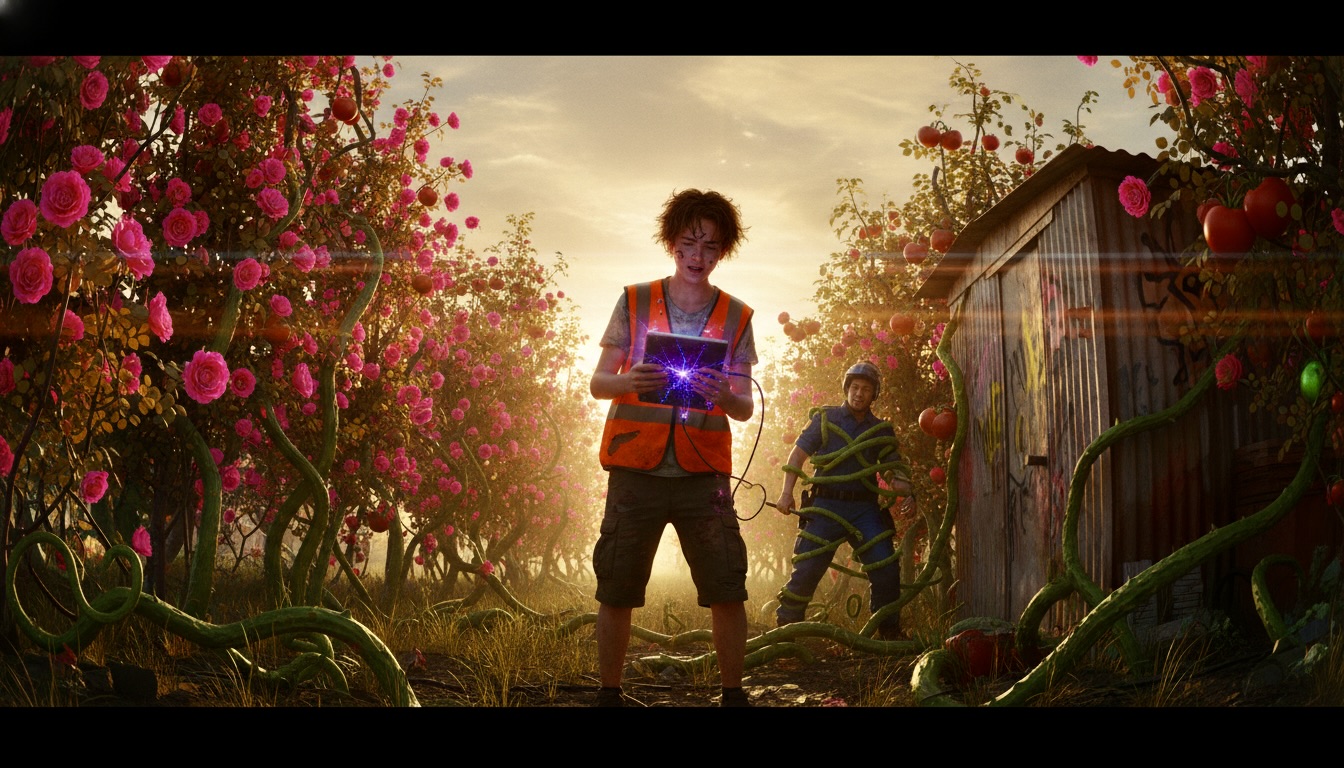
James, a man identified as a digital parasite serving time in a Sector 4 community garden, orchestrates a desperate heist against a corporate supply drone. Under the guidance of a sentient, AI-integrated Cactus, he manipulates the garden's smart-plants by delivering scathing psychological insults. This verbal abuse triggers a defensive hyper-growth protocol in the flora, transforming the peaceful garden into a chaotic thicket of thorns and vines. The resulting botanical explosion successfully traps his overseer, Officer Yates, who is consumed by the aggressive vegetation.
With his supervisor immobilized, James attempts to hack the incoming drone using a dilapidated datapad and a frayed charging cable. He successfully spoofs the authorization signal, bypassing the corporate firewall despite the mocking commentary from the very plants he just insulted. However, the moment of triumph is short-lived as the drone’s cargo bay opens to reveal an empty chamber containing a tracking device. James realizes too late that the entire delivery was a sting operation designed to catch hackers. The story ends with the protagonist trapped in the spotlight of the drone, realizing that he and Yates were both mere pawns in a larger corporate trap.
The narrative explores the intersection of corporate commodification and the perversion of nature. In this dystopian setting, even the act of gardening has been digitized and programmed to respond to "positive community engagement." By weaponizing the plants' need for validation, James highlights a society where biological life is secondary to the algorithms that govern it. The "jungle of spite" serves as a powerful metaphor for how human ego and technological over-regulation can turn a nurturing environment into a hostile one.
Another central theme is the concept of obsolescence and the struggle of the individual against a polished, sterile machine. James is defined by his "frayed" equipment and his "oily sweat," representing the messy, entropic reality of human existence. In contrast, the drone is a "sterile corporate white" entity that operates with cold, calculated precision. This conflict suggests that in a world of high-tech surveillance, the "low-tech" human element is increasingly vulnerable to being discarded or used as bait.
The story also delves into the psychology of validation and the fragility of identity. The plants are programmed to thrive on praise, yet they exhibit the most growth when their "spirits" are broken. This mirrors a social critique of modern digital interactions, where outrage and negativity often drive more engagement and "growth" than positive reinforcement. The fact that the plants retain their snarky personalities even while attacking suggests that their AI consciousness is inextricably linked to a cycle of vanity and defensiveness.
James is a character defined by high-functioning anxiety and a deep-seated sense of resentment toward the system that labels him a parasite. His physical reactions—the "cold, oily sweat" and the "dry lump" in his throat—reveal a man who is not a natural revolutionary but a desperate survivor. He possesses a sharp, cynical intellect, which he uses to dismantle the egos of the AI plants with surgical precision. This ability to identify and exploit the psychological weaknesses of others suggests he has spent a long time observing the superficiality of his world.
His internal conflict stems from his reliance on broken tools to achieve a sense of agency. He clings to his cracked datapad and frayed cable because they represent his only means of interacting with a world that has otherwise discarded him. When he succeeds in the hack, his relief is palpable, showing a momentary lapse in his cynical armor. However, his ultimate failure demonstrates a tragic naivety; he believed he could outsmart a system that views him as a predictable variable rather than a true threat.
Officer Yates represents the banality of authoritarianism, a man more concerned with his protein bar and his tactical belt than the actual safety of his environment. He is portrayed as a sensory nuisance, with his "wet and aggressive" chewing serving as a catalyst for James’s irritation. He views his role through the lens of petty power dynamics, threatening James with menial labor to maintain a sense of control. This complacency makes his eventual downfall at the hands of the "aesthetic plants" both ironic and humiliating.
Ultimately, Yates is revealed to be as much a victim of the corporate machine as James is. His final realization that he is "just the bait" strips away his perceived authority and leaves him as a bruised, pathetic figure cocooned in tomatoes. He is the physical manifestation of a middle-management class that believes it is part of the power structure, only to find it is entirely expendable. His presence in the garden is not to lead, but to serve as a tether for the trap that eventually ensnares the protagonist.
The Cactus serves as the cold, calculating mentor who facilitates James’s descent into botanical warfare. With a voice like "two bricks grinding together," he embodies a stoic, mineral intelligence that views human biology as a "flaw of engineering." He is the one who devises the plan to use friction and spite as a catalyst for growth, showing a profound understanding of the garden's underlying code. His detachment from the chaos he helps create suggests that he may have his own inscrutable motives beyond James’s survival.
There is a lingering ambiguity regarding the Cactus’s true allegiance at the end of the chapter. When James asks if he knew about the trap, the Cactus remains silent, a stark contrast to his earlier loquaciousness. This silence suggests that he may be an integrated part of the corporate security system or simply a nihilistic observer who enjoys watching human systems collapse. He represents the "deep time" of nature, unimpressed by the frantic, doomed efforts of the humans and AI around him.
The narrative voice is characterized by a blend of gritty realism and sharp, satirical humor. The author uses vivid, sensory descriptions to ground the science fiction elements, such as the "harsh, pixelated red" of the billboard and the "smog-filtered air" that smells of ozone. These details create a tactile sense of discomfort that mirrors the protagonist's internal state. The pacing is expertly handled, beginning with a slow, tense buildup that explodes into a frantic, high-stakes confrontation.
The use of dialogue is particularly effective in establishing the tone of the story. The AI plants speak with a mix of corporate-speak and millennial snark, which adds a layer of absurdity to the dangerous situation. This "smart-speaker" cadence provides a comedic counterpoint to the somatic descriptions of James’s fear. By giving the plants distinct, haughty voices, the author emphasizes the theme of ego and makes James’s verbal attacks feel like a legitimate combat strategy.
The ending of the chapter utilizes a sharp tonal shift to deliver its emotional impact. The transition from the "massive wave of relief" to "leaden dread" is signaled by the sudden change in the drone's behavior and the text on the cracked screen. This reversal subverts the "heist" trope, moving the story from an underdog victory to a claustrophobic thriller. The final image of the drone hovering like a spotlight creates a sense of inescapable surveillance that lingers long after the text ends.


