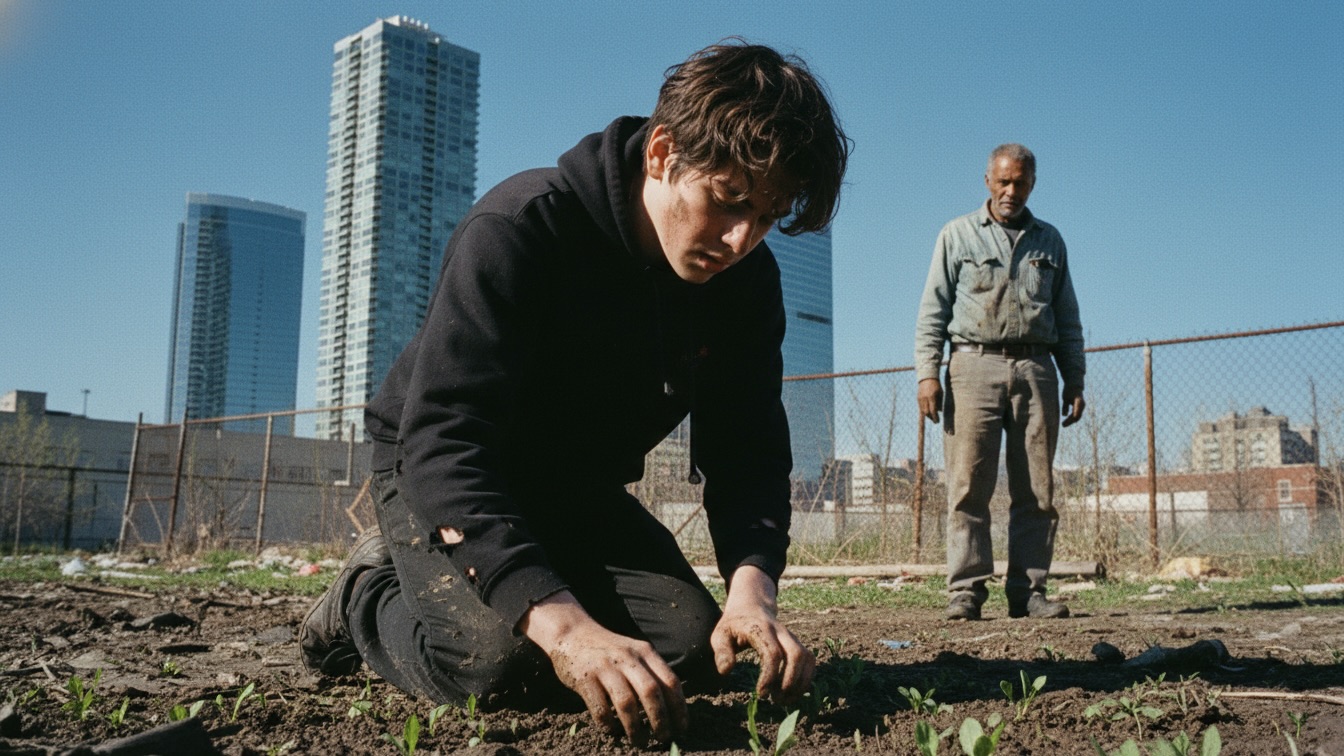
The narrative follows Dan, a young man grappling with anxiety and a sense of disconnection in a rapidly gentrifying urban neighborhood. He arrives at a derelict, chain-link-fenced lot to assist Shane, a weathered and pragmatic gardener, in planting kale. While Dan initially views the project through the lens of digital organization and institutional "programs," Shane dismisses these abstractions in favor of the raw, physical reality of manual labor.
As they work, the tension between the encroaching modern world—represented by glass towers and surveillance—and the primal act of cultivation becomes palpable. A brief, wordless interaction with a neighborhood woman provides Dan with a fleeting glimpse of authentic community connection, far removed from his digital metrics. The story concludes as Dan chooses to silence his phone and stand his ground alongside Shane when a representative of the developing city arrives to challenge their presence.
The central theme of the story is the conflict between digital abstraction and physical reality. Dan represents a generation that attempts to solve social fragmentation through "programs," "logos," and "Discord servers." These are presented as fragile and hollow when compared to the visceral, tactile experience of the garden. Shane serves as the philosophical antithesis, arguing that true community is forged through shared labor and presence rather than digital invitations.
Another prominent theme is resistance against gentrification and the sterile "order" of urban development. The glass apartments and the man in the suit represent a force that seeks to sanitize the neighborhood, turning organic spaces into "dog parks" or "bike storage." By planting kale—a hardy, stubborn crop—Dan and Shane are engaging in an act of "guerrilla gardening." This act is portrayed not as a hobby, but as a defensive war where the goal is to become as difficult to remove as a deep-rooted weed.
The narrative also explores the psychological concept of "grounding" as a remedy for modern anxiety. Dan begins the story in a state of "localized paranoia," hyper-aware of surveillance and the judgment of his neighbors. It is only through the physical act of digging, feeling the cold mud, and even bleeding into the soil that he finds a sense of stability. The "dirt under his nails" acts as a literal and metaphorical anchor, pulling him out of the digital noise and into the present moment.
Dan is a protagonist defined by his internal fragility and a desperate need for structure. He suffers from a pervasive sense of being watched, which manifests as a physical trembling and a preoccupation with his cracked phone screen. His reliance on the "Community Integration Initiative" suggests a man who wants to improve his world but is afraid to touch it directly. He uses technology as a shield to mediate his interactions with a reality that he finds threatening and unpredictable.
Throughout the chapter, Dan undergoes a significant psychological shift from an observer to a participant. Initially, he feels that his digital efforts are "stupid" when confronted with Shane's blunt reality, yet he clings to them out of habit. By the end of the text, he makes the conscious decision to bury his phone in the mud. This symbolic act represents his rejection of the "ghost" of digital organization in favor of the "root" of physical responsibility and the risks that come with it.
Shane functions as the archetypal "crusty mentor," a man whose identity is entirely fused with the environment he inhabits. He is described as being made of the same clay he digs in, suggesting a lack of ego and a total commitment to the earth. His speech is gruff and dismissive of anything that lacks utility, reflecting a worldview shaped by survival and hardship. He views the garden not as a social project, but as a "fight" for existence.
Shane’s psychological role is to strip away Dan’s pretenses and force him to face the "middle ground" of life. He rejects the binary of "hundred percent or zero," teaching Dan that growth is a slow, messy process that requires endurance. While he appears harsh, his actions reveal a deep sense of communal duty. He understands that a "contract" is formed through simple acts of giving, such as the bottle of water, rather than through digital logins or formal agreements.
The author utilizes a gritty, sensory-heavy prose style to establish a tone of "urban realism." The opening line, which contrasts the smell of exhaust with cherry blossoms, immediately sets up the duality of the setting. Sensory details like the "spiderweb of light" on the cracked screen and the "gravel in a blender" quality of Shane’s voice ground the reader in a world that feels lived-in and abrasive. These details emphasize the physical toll of the environment on the characters.
Pacing in the story mirrors the act of gardening itself, starting with a jerky, anxious energy and smoothing out into a rhythmic, meditative flow. As Dan begins to dig, the narrative slows down to focus on the repetitive actions of "reach, dig, plant, press." This shift in pacing allows the reader to experience Dan’s transition from high-frequency anxiety to a more grounded state of being. The sudden interruption by the man in the suit at the end serves as a sharp staccato note that heightens the tension.
The narrative voice is closely aligned with Dan’s internal state, utilizing a third-person limited perspective to heighten the sense of "localized paranoia." The descriptions of the glass towers as having "eyes" and the drone as a "white speck" create a feeling of constant, cold observation. This atmospheric pressure makes the small, warm interaction with the woman at the fence feel significantly more impactful. The contrast between the "thin" voice of the neighbor and the "clatter" of the fence highlights the vulnerability and strength found in human connection.


