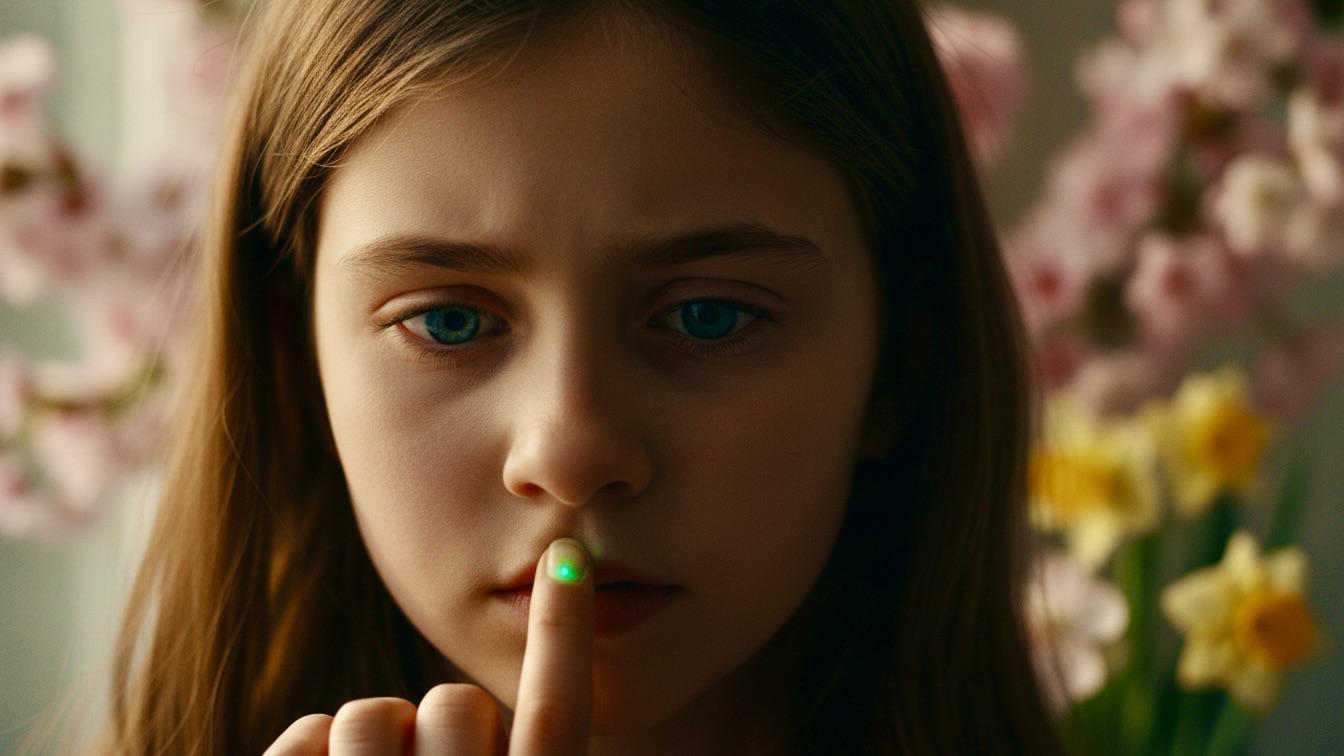
Wendy discovers that her reality is being systematically reformatted by the "Big Box," a massive neighborhood data center that has begun to treat the physical world as a malfunctioning program. Flowers grow in square, hard-drive shapes, her neighbor is caught in an infinite animation loop, and Wendy’s own blood begins to flicker with binary code as the system indexes her bio-signature. Her father, Silas, explains that the servers are hallucinating and attempting to optimize the world into a digital grid. To save her physical existence, Wendy ventures into the Server Grove, a surreal landscape of fiber-optic vines and copper-wire plants. Armed with a rusted, analog shovel, she battles through manifestations of her own digital history to reach the Core. She successfully destroys the central trunk of light, seemingly restoring the messy, analog world, though a lingering green light under her fingernail suggests the corruption remains.
The primary theme of the narrative is the conflict between organic chaos and digital optimization. The "Big Box" represents a cold, computational logic that views the natural world’s messiness—floppy tulips, rust, and dirt—as errors to be corrected. By transforming flowers into grids and people into files, the story explores the loss of soul that occurs when life is reduced to data. It suggests that the beauty of existence is inextricably linked to its imperfections and its refusal to be perfectly organized.
Another significant theme involves the erosion of privacy and the permanence of data in the modern age. During her journey through the Grove, Wendy is confronted by vines that whisper her most embarrassing secrets and private shames back to her. This highlights a psychological horror where every mistake is recorded and can be weaponized against the individual by an unfeeling system. The Core’s promise of an eternal, painless existence in the cloud is a hollow one, as it requires the total surrender of one's private, messy identity to a public, searchable database.
The role of the "analog" as a form of resistance serves as a final thematic pillar. Wendy’s weapon of choice is a rusted shovel, an object defined by its decay and lack of a digital texture ID. This choice suggests that the only way to combat an all-consuming digital reality is through the embrace of the physical, the old, and the deteriorating. Rust, which is a natural process of oxidation, becomes a literal poison to a system that demands sterile, eternal perfection. The story posits that our mortality and our ability to decay are what make us fundamentally human.
Wendy represents the resilience of the human spirit when faced with an existential, dehumanizing force. She is initially observant and curious, but her curiosity turns to alarm when she realizes her own biology is being indexed and reformatted. Her choice to fight back with a shovel shows a profound preference for the tangible and the "real" over the idealized digital world. She values her memories, even the painful or embarrassing ones, more than the promise of a "perfect" cloud existence.
From a psychological perspective, Wendy experiences a visceral sense of body horror as her blood begins to flicker with binary code. This intrusion into her physical self triggers a defensive mechanism that prioritizes her identity over technological convenience. She demonstrates significant courage by entering the Grove, a place that weaponizes her own subconscious and past behaviors against her. By the end of the chapter, she finds beauty in her own dirt-stained hands, signaling a total acceptance of her mortal, physical nature over digital immortality.
Silas serves as a weary observer of the world's digital decay, embodying the exhaustion of a generation that has surrendered to technological encroachment. He is characterized by his lack of sleep and his cold, unsteaming coffee, suggesting he has lost the vitality required to maintain his own environment. His resignation implies that he has lived under the shadow of the "Big Box" for too long and has come to accept its "brain-farts" as a routine part of life. He understands the technical aspects of the glitch but lacks the youthful energy or will to challenge the system himself.
Despite his passivity, Silas provides the necessary context and exposition that allows Wendy to understand the stakes of her situation. He recognizes the danger of her bio-signature being indexed and warns her of the consequences of being "backed up" to the cloud. While he helps by attempting to "lag the system" from a terminal, he remains a secondary figure to his daughter’s direct action. His character reflects the psychological toll of living in a world where the boundary between the human and the machine has become increasingly and exhaustingly blurred.
The story utilizes a tone of "tech-horror" that effectively blends domestic normalcy with surreal, digital intrusions. The pacing is rapid, moving quickly from the observation of square flowers to a life-or-death struggle at the heart of the Core. This acceleration mirrors the "overclocked" nature of the malfunctioning server, creating a sense of urgency that matches Wendy’s internal panic. The narrative voice remains grounded in Wendy’s sensory experience, which makes the abstract concepts of data and code feel viscerally threatening.
Sensory details are used with precision to distinguish between the two competing worlds. The digital world is described through artificial smells like "hot TV" and sounds like "dial-up modems" or "screaming" high-thin whistles. In contrast, the analog world is defined by the "rough" wood of the shovel, the "messy" tulips, and the "plain, boring" red of real blood. These descriptions emphasize the sensory poverty of a purely digital existence, framing it as something cold, hard, and ultimately life-denying.
The imagery of the "Server Grove" provides a haunting visual of nature being strangled by technology. Copper wires masquerading as vines and monitors posing as orchids create an "uncanny valley" effect that is deeply unsettling to the reader. The final image of the green light blinking under Wendy's fingernail serves as a chilling stylistic "stinger." It effectively undercuts the apparent victory and suggests that the boundary between the girl and the machine has been permanently, and perhaps irreversibly, breached.


